Locate Virginia on the Globe - and in the Galaxy

the winter sun rises less above the horizon, since Virginia is in the Northern Hemisphere
- If an online mapper/spatial data engine offers you the option of entering bounding rectangle coordinates for latitude/longitude, use the following for Virginia:
- Northernmost: 39.455826 (Virginia is in the Northern Hemisphere, so latitude is a positive number)
- Southernmost: 36.549072
- Westernmost: -83.667404 (remember the minus sign for Virginia's longitude; the state is west of the zero degree or "prime" meridian that runs through Greenwich, England)
- Easternmost: -75.225754
Also be aware that, to define less than a full degree (°) of latitude or longitude, digital systems rely upon decimals rather than minutes (') and seconds ("). 60 seconds equal one minute, 60 minutes equal one degree - but in decimals, count by tens.
If you want to change your attitude by changing your latitude, fly to 24.555734 degrees North, -81.802984 west so you can enjoy a drink with an umbrella in Margaritaville.
- How fast is Virginia moving, due to the spinning of the earth once a day around the axis?
- Virginia residents are moving a little slower around the axis that people standing on the equator. The circle around which Virginia spins is slightly smaller than the equator (by a factor of the cosine of the latitude). You can create an equation to measure the speed at a location "L," where L is the latitude: cos(L) x 1,070 miles/hr= speed of rotation..1
- Complete the math for the Fairfax campus of George Mason University (38.836348 degrees north), and students sitting quietly in classrooms are spinning at 833mph - faster than the speed of sound.
- How fast is Virginia moving around the Sun in its annual revolution?
- Assuming the average distance from the Earth to the sun is 93 million miles (in summertime, Virginia is actually further away from the sun than in winter), the formula is 2 X pi X r/t = 2 X pi X 93,000,000/365.2564/24 = 66,658 miles per hour.
- How fast is Virginia and the rest of the solar system moving within the Milky Way galaxy?
- The sun, earth, and rest of the solar system is moving towards the star Vega at about 43,000 miles/hour.
- How fast is Virginia moving within the Milky Way galaxy?
- The earth spins around the black hole located at the center of the Milky Way galaxy at roughly 450,000 miles per hour. Since a complete spin around the center (one "galactic year") requires 230 million years, the most recent revolution started when dinosaurs were first evolving and the Triassic basins were forming as Pangea began to split.
- Since the Milky Way galaxy formed 4.6 billion years ago, at the rate of one rotation per 230 million years the Earth has circled the black hole at least 20 times. However, the sun first formed approximately 16,300 light-years from the galactic core rather than the current 26,100 light-years. Since formation, the sun has been pushed along the Orion-Cygnus Arm of the galaxy, experiencing "radial migration" outwards from the black hole within that spiral arm. Because the sun first consolidated from an interstellar gas cloud at a location closer to the black hole, spinning faster around the center, it must have rotated around the galactic core more than 20 times.
- How fast is Virginia and other parts of the Milky Way galaxy moving through intergalactic space?
- Using Cosmic Background Radiation as a point of reference, the Milky Way galaxy is moving through space at 1.3 million miles per hour.2
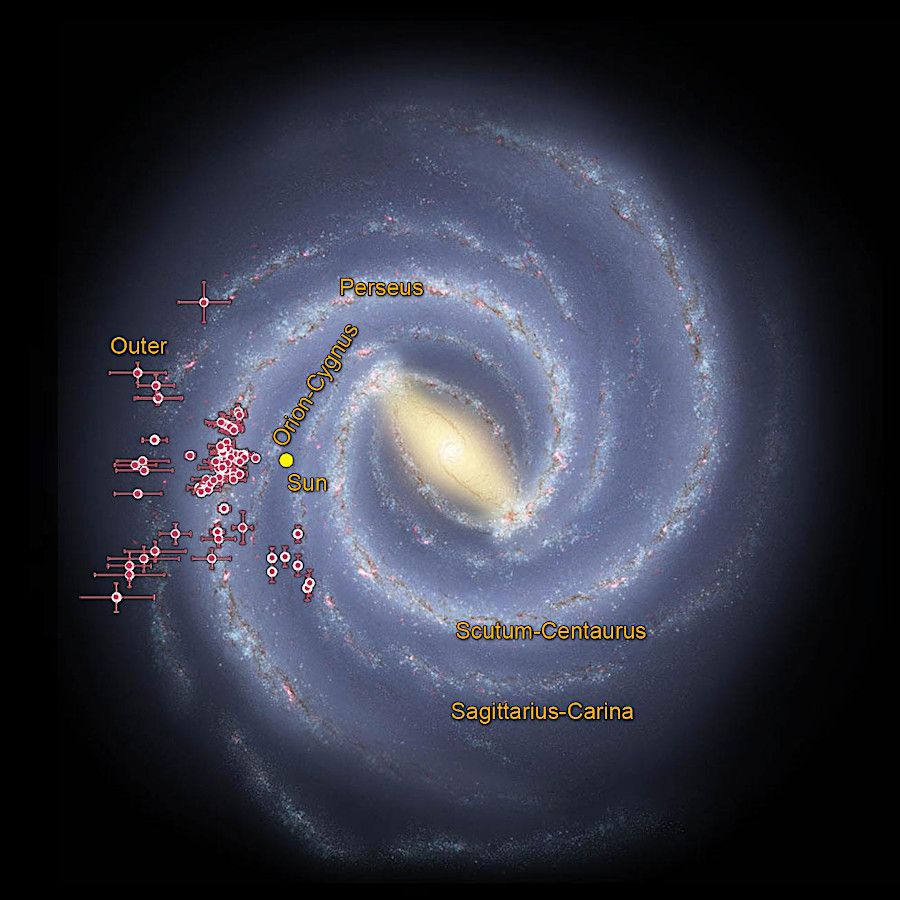
our solar system is located in the Orion-Cygnus Arm of the galaxy
Source: National Aeronautics and Space Administration (NASA), Tracing the Arms of our Milky Way Galaxy
References
1. National Aeronautics and Space Administration (NASA), "Ask the Space Scientist," http://image.gsfc.nasa.gov/poetry/ask/a10840.html (last checked September 21, 2010)
2. Scientific American, "The Milky Weigh Galaxy," http://www.scientificamerican.com/blog/post.cfm?id=the-milky-weigh-galaxy-2009-01-05; "Our Sun," National Aeronautics and Space Administration (NASA), https://solarsystem.nasa.gov/solar-system/sun/in-depth/; "How Fast Are You Moving When You Are Sitting Still?," The Univverse in the Classroom, No. 71 (Spring 2007), https://nightsky.jpl.nasa.gov/docs/HowFast.pdf; "Which spiral arm of the Milky Way holds our sun?," EarthSky, January 14, 2022, https://earthsky.org/astronomy-essentials/which-spiral-arm-of-the-milky-way-contains-our-sun/; "How many times has the sun traveled around the Milky Way?," Live Science, December 18, 2023, https://www.livescience.com/space/cosmology/how-many-times-has-the-sun-traveled-around-the-milky-way (last checked December 18, 2023)
Mapping Virginia
Virginia Places