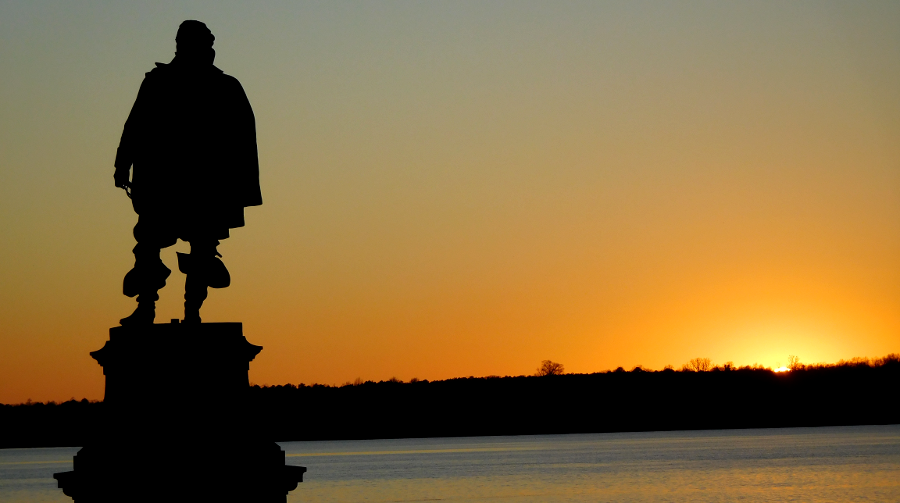
at Jamestown, the only leader of the colony honored by a statue is John Smith
at Jamestown, the only leader of the colony honored by a statue is John Smith
Colonization in Virginia started in 1606 as a speculative investment by a joint stock company. The costs to transport colonists across the Atlantic Ocean, and to build what became Jamestown, was financed by individual investors who "adventured" their capital in hopes of making a profit. From 1607-1624, Virginia was controlled not by English government officials but by the Virginia Company of London, a private for-profit organization that appointed the leaders in Virginia.
The joint stock company structure followed an English pattern started in 1551, when the Company of Merchant Adventurers (later known as the Muscovy Company) organized to explore north of Scandinavia in hopes of finding a new route to China. The East India Company had been chartered in 1600 to compete with the Dutch and trade with the spice islands now part of Indonesia.1
King James I granted a charter to the Virginia Company of London on April 10, 1606. The venture capitalists did not underwrite the colony in Virginia to create a place for religious freedom or political liberty, or to build an English empire that might compete with Spain. Starting the colony was primarily a business investment, and a risky one.
The king was not an investor, but under the terms of the initial charter he appointed the first board (royal council) of the company. Similar to the approach taken by Elizabeth I in the 1580's before the war with Spain, the venture was endorsed by James I but was not financed by the monarch.
Colonization was not an official government initiative. There was no official English Navy escort, no soldiers on official duty accompanied the expedition, and no government funds were used to finance the Virginia Company of London. James I had little at risk, and maintained the fiction of "plausible deniability" once the Spanish complained.
The effort to start an English settlement in Virginia was led by members of the English aristocracy who had family connections and the spare wealth to invest in the shares that cost £12 10s. The Treasurer (essentially the chairman of the board and chief executive officer) was Sir Thomas Smith. He and the others stayed in London while the colonists sailed across the Atlantic Ocean.2
During the journey to Virginia in 1606-1607, Christopher Newport was in charge of the three ships, the Susan Constant, the Godspeed, and the Discovery. Once in Virginia, the colonists were governed there by a 7-person council that had been chosen previously by the company's board in London. The one investor who traveled to Virginia, Edward-Maria Wingfield, was chosen by the others to be the first president of the governing council.
The colonists were essentially hired help working for the company, and they did not vote for the council. Membership of the council was not known during the original journey, when Christopher Newport was in charge. Once in sight of land, a sealed package listing the appointed members to the council was opened. The next decision reveals that the council operated with some independence from the board in London from the very beginning. John Smith was listed as a member of the council, but he was denied his seat initially. (Smith had been placed under restraint previously during the journey, due to his outspoken behavior.)
Since communications with London were slow and intermittent, operations in Jamestown could not be micromanaged from a distance. The council had a great deal of leeway in its management of the resources in Virginia. The community lacked a common goal, however, and individual rewards were not clear to the colonists either. Food was supplied by the company, and work could be rewarded as well as coerced, but there was no economic incentive for the colonists to work hard. Any wealth they developed belonged to the company, and not surprisingly the colonists who did not die of disease were hard to manage. John Smith was more capable of motivating and leading them, after he assumed the presidency of the council in 1608, but he returned to England in 1609.
That year, the king revised the charter and the governing structure of the colony. The London board appointed a governor, who was authorized to select the members of the council in Virginia. However, two ships carrying Thomas Dale, Thomas Gates, and the other leaders sailing to Virginia were shipwrecked in late 1609 on Bermuda. The other ships arrived in October, 1609, without the leaders and without sufficient food for the winter.
When the leaders finally arrived, they established a form of martial law. It brought more order to the colony, and John Rolfe's experiment with sweet-scented tobacco established an economic base for the settlers.
The Virginia Company was still not making a profit worthy of the capital that had been ventured. In 1618, Sir Edwin Sandys took control of the company and became Treasurer, replacing Thomas Smythe.
Sandys and his faction thought the company's workers in Virginia would be more productive if they had a greater voice in managing their local affairs. The company sent Sir George Yeardley to be the governor of the colony, with instructions to replace martial law and give settlers more autonomy. Yardley started the practice of granting land to individuals who paid their costs to reach Virginia, or the costs of transporting someone else (50 acres per "headright").
Sir George Yearly authorized each Virginia community to elect two representatives to a House of Burgesses, and appointed a governor's Council as part of a General Assembly. The General Assembly was able to initiate and pass local laws, but the company maintained control by retaining the right to veto those laws.
After King James I revoked the charter and made Virginia a crown colony similar to Ireland, the assembly continued to meet. The royal governors, like the company's governors, recognized that the House of Burgesses was a useful mechanism to get the Virginians to comply with government mandates.
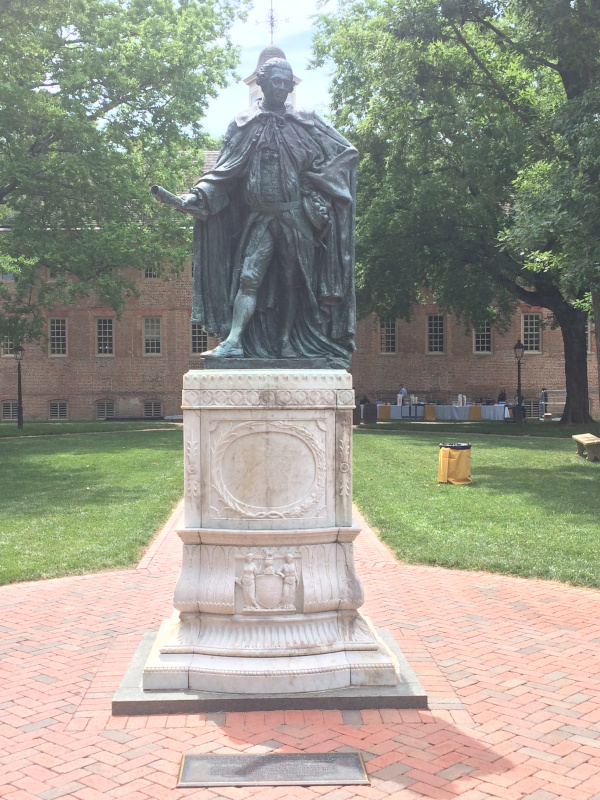
Virginia gentry funded a statue honoring Lord Botetourt
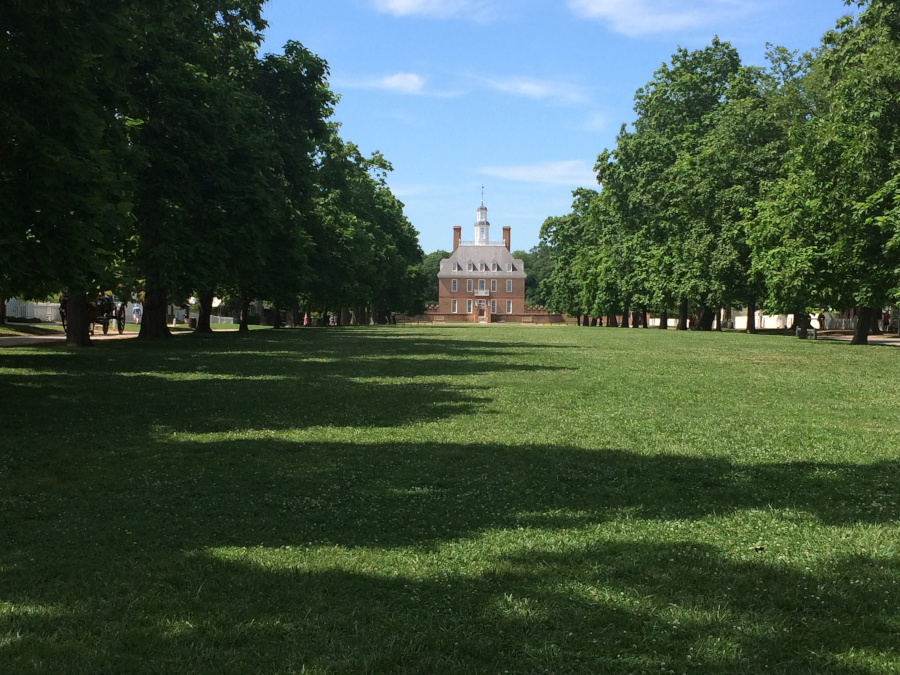
the Governor's Palace in Williamsburg was completed during Governor Spotswood's term