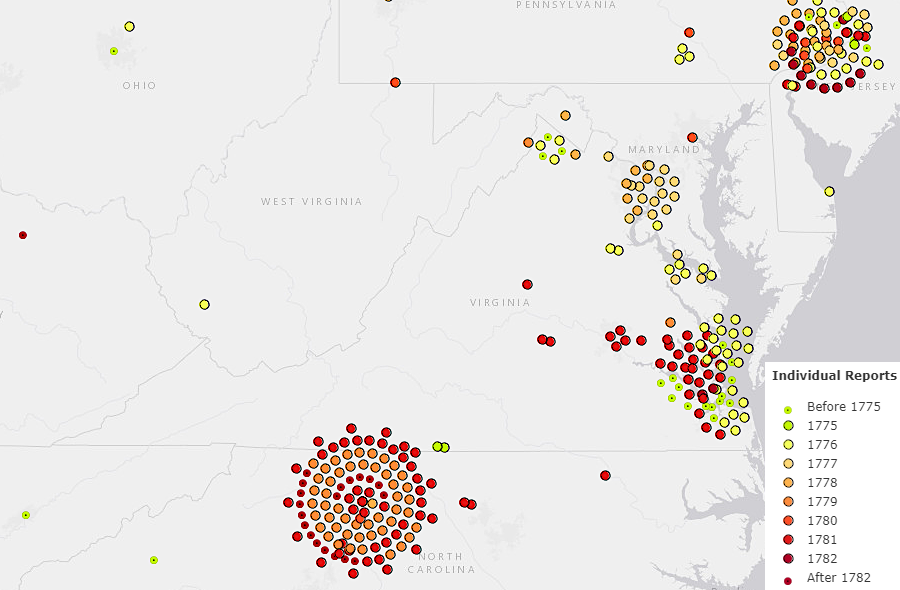
reports of smallpox in the time of the American Revolution
Source: University of Georgia, Pox Americana
reports of smallpox in the time of the American Revolution
Source: University of Georgia, Pox Americana
George Washington was infected with smallpox in 1751 when he was 19 years old and visiting his brother Lawrence on Barbados. He recovered, and ever afterwards was immune.
When he took command of the Continental Army outside Boston in July, 1775, he prohibited the soldiers from getting inoculated against smallpox. During the five weeks of isolation and recovery from the inoculation, soldiers would be too weak to fight if the British attacked.
At the same time, smallpox raged within the civilian population in Boston. Washington prohibited refugees from the city from coming to his military encampments, fearing an epidemic would break out among the Continental Army. His strategy was to limit the contact of soldiers to those who might be infected, including both other soldiers and civilians.
In the winter of 1775-1776, troops sent by the Continental Congress to capture Quebec in Canada were devastated by a smallpox epidemic. Benedict Arnold had to abandon efforts to capture Quebec and marched south before British reinforcements arrived.
Throughout 1776, Washington struggled to recruit and retain troops for the army that tapped General Thomas Gage inside Boston. Enthusiasm for the revolt against King George III and Parliament was high and men were willing to fight as soldiers in Washington's army, but potential recruits were reluctant to join because enlistment could be followed by disease and death while in camp.1
Washington changed his approach to managing smallpox earlier in 1776, after realizing that isolating the sick in Massachusetts was not going to allow him to maintain an effective army. New recruits would continually bring the disease; eventually an outbreak would incapacitate his army.
On February 5, 1777, Washington notified the Continental Congress that all new recruits had to be inoculated before they could come to Massaschusetts. Washington issued a directive on February 6, 1776 saying:2
After the British evacuated Boston in March 1776, Washington sent 1,000 soldiers who already had immunity to the occupy the city first. He also made arrangements to inoculate all his soldiers between April-August 1776.
The process required placing people temporarily in quarantine. Segregated hospitals were guarded to prevent friends/family from visiting while those who had received the live virus were still contagious.3
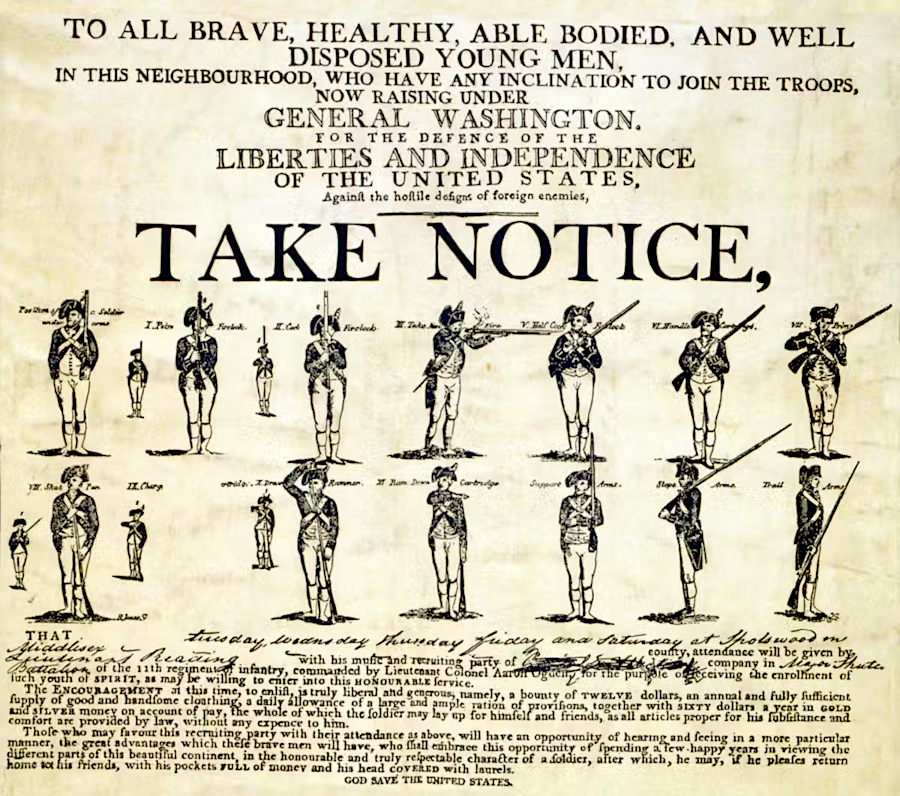
starting in 1777, George Washington required the Continental Army to be inoculated
Source: Library of Congress, To all brave, healthy, able bodied, and well disposed young men in this neighbourhood...
Smallpox killed many of the recruits to Governor Dunmore's Ethiopian Regiment. Dunmore had established a base at Tucker's Point in early 1776, and sailors ill from typhus could be isolated there from the remaining healthy men on the ships. An enslaved worker escaping from a Virginia plantation may have been the source of the smallpox which spread through the camp. All the people at Tucker's Point were at risk; roughly two-thirds of the black refugees died.
Governor Dunmore decided to abandon his land base in Hampton Roads and the captain of the Roebuck arranged for inoculation of the remaining men in the Ethiopian Regiment. The British sailed from Tucker's Point to Gwynn's Island. Despite the inoculations, many white and black loyalists continued to die from smallpox on the trip and at the island. The Virginia militia was well aware of the impact of the disease; bodies washed ashore from Gwynn's Island regularly.
Dunmore could not get the reinforcements he needed to return to Williamsburg and re-establish royal control in Virginia. Smallpox prevented him from creating a large enough army locally from white and black loyalists who were willing to fight. Roughly 500 of the enslaved workers and 150 white loyalists died from smallpox after joining up with Governor Dunmore.
At the new base on Gwynn's Island, the Ethiopian Regiment and Queen’s Own Loyal Virginian were so shorthanded that Royal Navy marines had to come ashore from the ships to perform routine military duties in the camp. When the Virginia militia finally attacked, there were too few men to resist and the British fled their last Virginia base.
Dunmore wrote:4
British forces marched through Virginia in 1781. On their way to establishing a base at Yorktown, the Marquis de Lafayette and General "Mad Anthony" Wayne threatened the rear of the British Army near Jamestown.
According to an American officer, the British sought to delay the Americans by forcing them to bypass people with smallpox infections:5