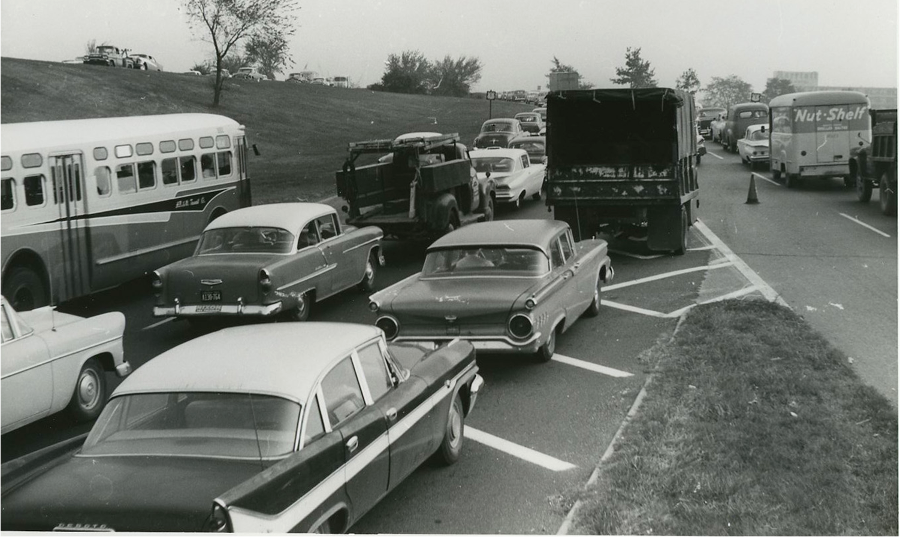
the Shirley Highway (now I-395/I-95) remains clogged with traffic despite multiple expansions since the initial two lanes reached the Occoquan River in 1949
Source: George Mason University Special Collections and Archives, Traffic congestion, Shirley Highway, 1960
Transportation corridors have affected the location of Virginia development since Native Americans adopted agriculture and created the first settlements. Trails along the Fall Line and across shallow river fords created opportunities for trade or threats of attack. John Smith's map documented how waterways offered easy access via canoes to towns located along the edges of rivers.
Developers proposing new subdivisions in Northern Virginia, outside Richmond, and in Hampton Roads pressure state officials to approve expansion of existing highways, construction of new roads, and expansion of rail service in order to justify rezonings allowing more houses.
Local officials who control land use decisions recognize that new houses result in greater traffic congestion on existing transportation routes, causing existing residents to object to new development. However, if the state officials on the Commonwealth Transportation Board would fund a new transportation project, then local officials could claim that the new "demand" for transportation created by rezoning decisions would be matched by a new "supply" and new houses would not create greater congestion.
In 1980 the Metropolitan Washington Council of Governments (MWCOG) recognized the relationship between land use planning and traffic congestion, and why transit upgrades were not eliminating traffic jams:1
Our recent transportation and land use studies confirm that land development decisions have a much greater impact on travel demand than decisions on transportation alternatives... There is a strong need for land use planners and decisionmakers to develop and implement land use planning and zoning procedures to reduce the number and length of auto trips required, so as to reduce the area's reliance on the private automobile and to increase the accessibility and attractiveness of public transportation.
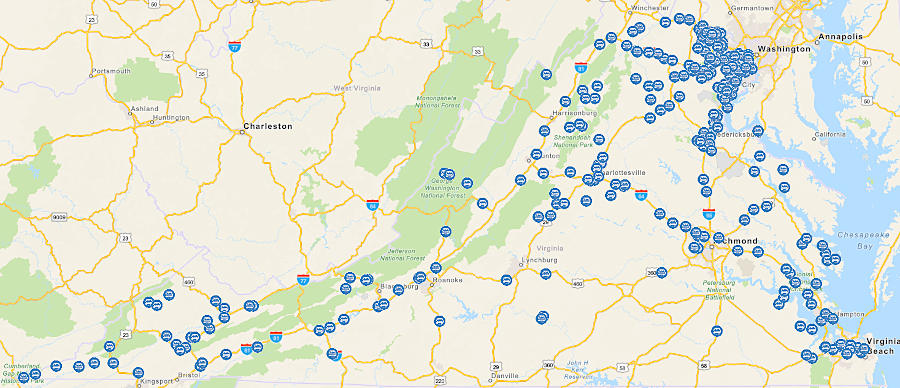
park-and-ride lots are symbols of the gaps between where people live and work
Source: Virginia Department of Transportation (VDOT), Park and Ride Maps
But are costs actually reduced by roads, or just shifted? The Coalfields Expressway won't be built for free. Innovative financing may push the costs into future budgets, but the taxpayers of Virginia far from Buchanan, Dickenson, and Wise counties will be paying for that transportation improvement. The local wildlife will also be affected - greater convenience for people usually involves impacts on the natural environment.
Investments in transportation are not neutral - they steer growth towards an area. Failing to build roads or interchanges, or failing to maintain/existing ones, will deter growth. It's no secret that housing and transportation are intimately connected - though the government agencies that deal with one often fail to coordinate effectively with the other.
In the Housing Act passed in 1961, the federal government assumed a role in financing mass transit so state and local governments could purchase buses, trolleys and trains. In theory, mass transit would enable low-income residents without a car to have access to jobs in the area. That requires mass transit managers to offer reasonable connections from the various housing developments to the employment centers. Since 1961, the character of many downtowns have shifted dramatically. While many jobs moved to the suburbs, not all of the bus systems have been able to expand.
Chesterfield County has openly opposed the efforts of the Richmond-based bus system to offer service in the county. The opposition was based in part upon the rivalry between the two jurisdictions, but illustrated more clearly the prejudices based on the income level and the racial makeup of inner-city vs. suburban residents.
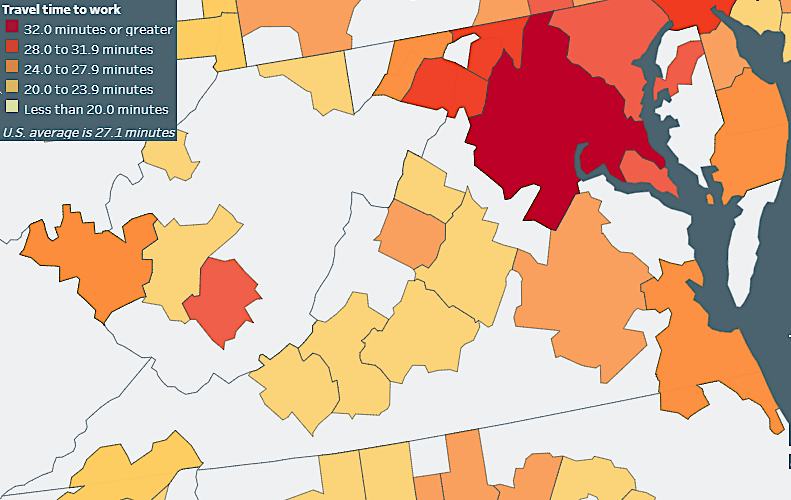
travel time between home-work is highest in regions where many people choose to live at a great distance from their jobs, clogging the commuter roads with traffic at rush hours
Source: Census Bureau, Average Travel Time to Work in the United States by Metro Area (October 16, 2019)
Transportation is a hotly-debated issue across the state, and the predominant issue (along with schools) for local politics in Northern Virginia. The local business community (and the Washington Post newspaper in particular) constantly advocate greater investment in local transportation. Legislators in the region strongly supported increased funding for local (all politics is local...) road improvements to be included as "priority projects," when the General Assembly's specifically directed funding for a six-year, $2.6 billion statewide transportation package in the 2000 session.
In Northern Virginia, as in Southwestern Virginia, new roads are also recognized as stimuli for new development. In the suburban counties of Loudoun, Prince William, and Fauquier, however, strong opposition has developed against proposed roads such as the Western Transportation Corridor. These are perceived as "developer highways" to stimulate new housing in rural areas, helping farmers convert fields to subdivisions - but not easing the clogged commutes of current residents.
Talking points from the Voters To Stop Sprawl in Prince William County included:
Transportation money should not be used to build roads whose major impact will be to promote sprawl development and to generate unaffordable infrastructure needs.
Transportation money should be used to encourage livable, walkable communities that rely much more heavily on public transportation and telecommuting rather than reliance on private automobiles.
Transportation money should be used to favor public transportation approaches within and connecting urban areas using such techniques as light rail in existing corridors, express bus lanes and other rail approaches such as the highly successful VRE which should be expanded.
The future costs the use of the private automobile are certain to increase dramatically as a result of inevitably increasing energy costs, and the recognition of the environmental costs of
the use of automobiles compared to the alternatives. Planning for these changes should be obligatory now rather than 20 years from now.
The Northern Virginia Transportation Alliance highlights that more roads (and transit) are required where the people are actually living, not where the planners want them to live. An April 12, 2004 "NVTA Alliance Alert" put it clearly:
"Another Alexandria" Beyond the Beltway in Just Three Years
It's taken the City of Alexandria nearly three centuries to achieve a population of 128,000.
The latest U.S. Census figures show that the increase in populations of Fairfax (+30,656), Loudoun (+52,147), Prince William (+44,511) and Stafford Counties (+18,575) total 145,000 people in just three years. Most of Fairfax's growth has been outside the Capital Beltway.
During that same time period, the District of Columbia lost 8,053 residents, Arlington County lost 1,580 residents and the City of Alexandria added only 640 residents.
Yet regional transportation policy and most area elected officials continue to promote the notion that more miles of rail leading into the area's central jurisdictions (with declining populations), not more roads and bridges connecting and serving suburban communities (with growing populations), should be the area's top transportation priority.
Ignoring the realities of where and how people choose to live and travel doesn't change those realities. It only produces more congestion.
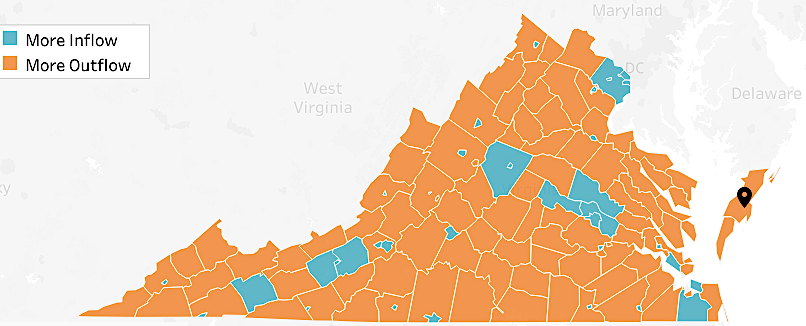
in most Virginia counties, more workers commute to another jurisdiction for work
Source: Demographics Research Group, VA_Commuting_Patterns_2022
The Urban Mobility Study of the Texas Transportation Institute has examined the traffic congestion in the Washington, DC-Maryland-Virginia region. In 1999, that region had expanded to 1,000 square miles, with a population density of 3,465 people/square mile. The mobility report shows that traffic has increased far faster than the region's population in the last two decades:
1982
1983
1984
1985
1986
1987
1988
1989
1990
1991
1992
1993
1994
1995
1996
1997
Population
2,700
2,780
2,810
2,860
2,920
2,980
3,040
3,080
3,100
3,280
3,285
3,400
3,445
3,455
3,460
3,465
Daily VMT
44,960
45,445
48,870
53,585
58,265
60,590
61,475
62,980
64,325
65,070
68,295
70,185
73,915
77,630
81,700
81,620
Freeway VMT
16,085
16,150
18,065
19,885
22,405
22,910
23,600
25,020
25,080
25,650
27,985
29,320
31,765
32,460
33,045
33,340
VMT=Vehicle Miles Traveled
Population and VMT are in thousands. In 1992, the regional population of 2,700,000 people
drove a total of 44,960,000 miles - and of that total, 16,085,000 vehicle miles were driven on
freeways
To highlight the point that population growth was not the only reason for increasing
traffic congestion, consider these changes between 1982-1997:
The cost of traffic congestion is not just a decrease in the quality of life, leading to "road rage." There's an actual pocketbook cost, increased taxes for current residents to provide the infrastructure to support new suburban residents. The costs of sprawl are somewhat hidden, and highly debatable. There is, after all, a reason that people choose the live in the suburbs. Typically a family can get a larger house, with more yard space for children to play, by
moving away from the job center and commuting to work. Some commuters even enjoy the solo experience of driving in their cars, referring to "road zen" for the hours they get to be undisturbed, in total control of the radio, air conditioning, etc.
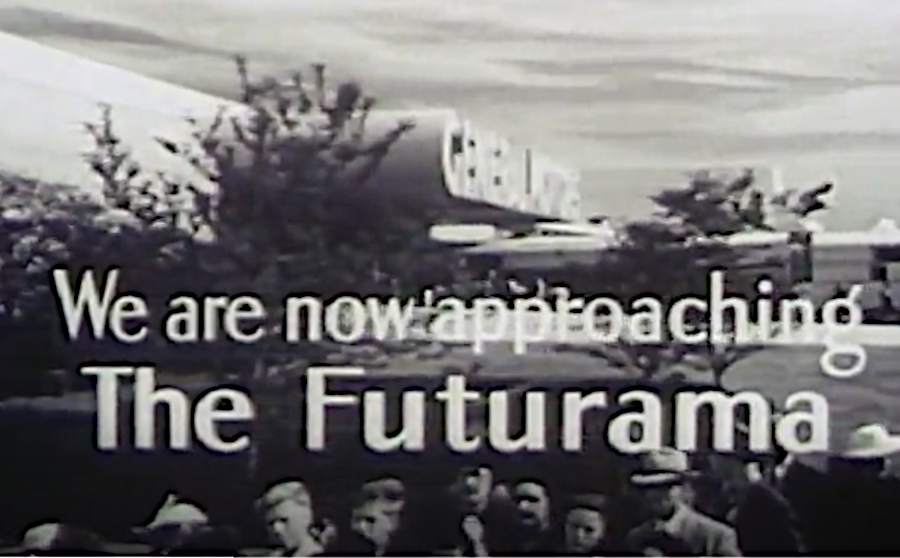
General Motors' "Highways and Horizons" exhibit at the 1939-40 New York World's Fair included the Futurama (click to see video)
Source: Archive.org, To New Horizons (1940)
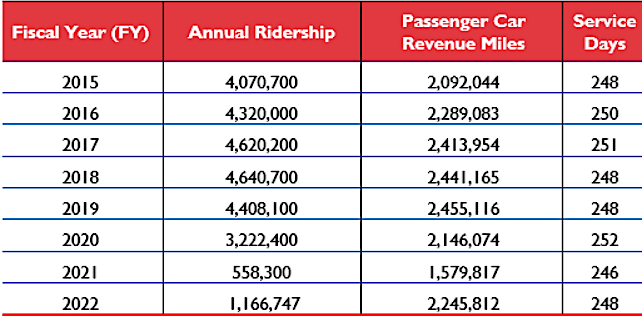
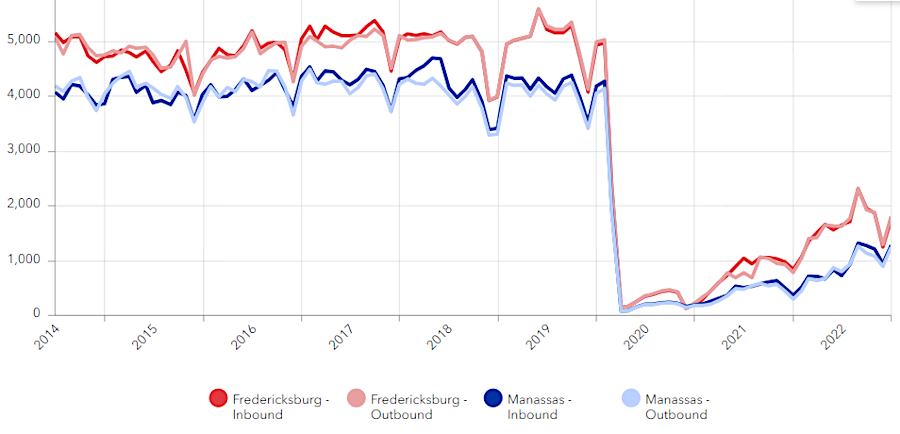
COVID-19 disrupted Virginia Railway Express (VRE) commuting from the suburbs into Washington DC
Source: Virginia Railway Express (VRE), Ridership Trends and Market Analysis
References
1. "Metropolitan Policy Guide," Metropolitan Washington Council of Governments, 1980, p.127