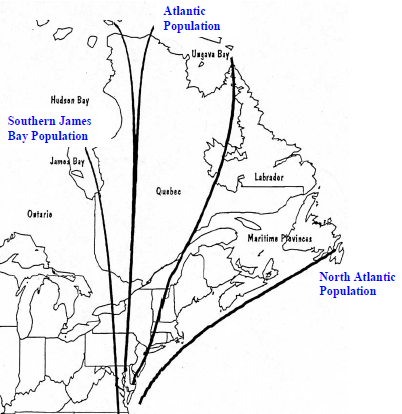
Canada geese migrate north from Virginia to three destinations
Source: Virginia Department of Game and Inland Fisheries (DGIF), Canada Goose Harvest Management
Canada geese migrate north from Virginia to three destinations
Source: Virginia Department of Game and Inland Fisheries (DGIF), Canada Goose Harvest Management
Migration reflects the discovery by a species, over time, that there are "easier pickings" in another location at a different time of year. Canada geese did not migrate north from Virginia each Spring 18,000 years ago, when the glaciers covered Canada. As the ice melted, however, some of the geese living south of the glaciers explored the newly-exposed landscape and found high-quality habitat for nesting and raising young goslings.
Those who nested in the new habitats south of the glaciers had a relatively high percentage of offspring who survived. Those geese that continued to nest in the old habitats produced young birds as well, but not as many as the relatives who were migrating.
The summer habitat in the north was better - more young birds survived up there, despite the risks associated with flying back and forth twice a year. Ultimately, the vast population of geese in the winter feeding grounds were those who had been born in the north. The non-migratory part of the population diminished, and geese (and other species) developed regular migration paths known today as "flyways."
Once colonial settlers arrived in North America, the Canada goose faced a new predator that harvested a high percentage of the migrating birds. In the 1930's, hunters worked with the Roosevelt Administration to establish a special fee for hunting migratory waterfowl (the "Duck Stamp") and funded creation of the National Wildlife Refuge System. Ducks and geese are hunted at the refuges, such as Chincoteague National Wildlife Refuge in Virginia, but the length of the hunting season is managed to ensure a steady population of birds.
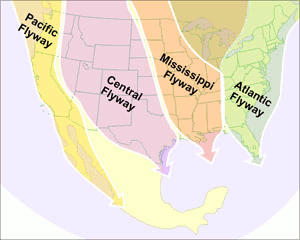
Source: US Fish and Wildlife Service
Restoration of the Canada goose population has been a major wildlife management success story. Until the 1960's, the "honk" of a Canada goose was a special moment in most of Virginia. However, during restoration efforts over the last century, "resident" Canada geese that do not migrate during the summer have been established in the Atlantic Flyway.
The resident geese occupy new habitats - golf courses, office parks, and suburban parks. If a stormwater management pond includes an island, where raccoons and foxes are unable to get to the next, then the reproductive success of the resident geese can be very high. The unattractive cylindrical droppings of geese cover sidewalks and ballfields at schools and parks.
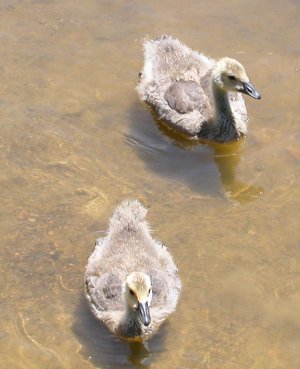
baby geese (goslings) on Pandapas Pond (Giles County)
The geese are stuffing themselves all summer long on grasses, enjoying the quality habitat in suburbia without having to fly back and forth. Generations of goslings hatched in Virginia, rather than Canada, mimic the behavior of their parents and stay in Virginia during the entire year. Why migrate, when they have all the goodies in one place?
The high number of Canada geese during the summer months is now a health and esthetic problem in Virginia. The stay-home-and-eat-grass-at-the-office-park geese are now so numerous, they have become "nuisance geese." George Mason University brought in border collies from Windchazer in 2006, to chase away the geese that were cluttering up the Fairfax campus. Other proposals for reducing the excessive goose population include destroying nests in the Spring before eggs are laid, coating eggs to prevent hatching, and special hunting seasons to harvest resident geese before the migrants arrive in the Fall.
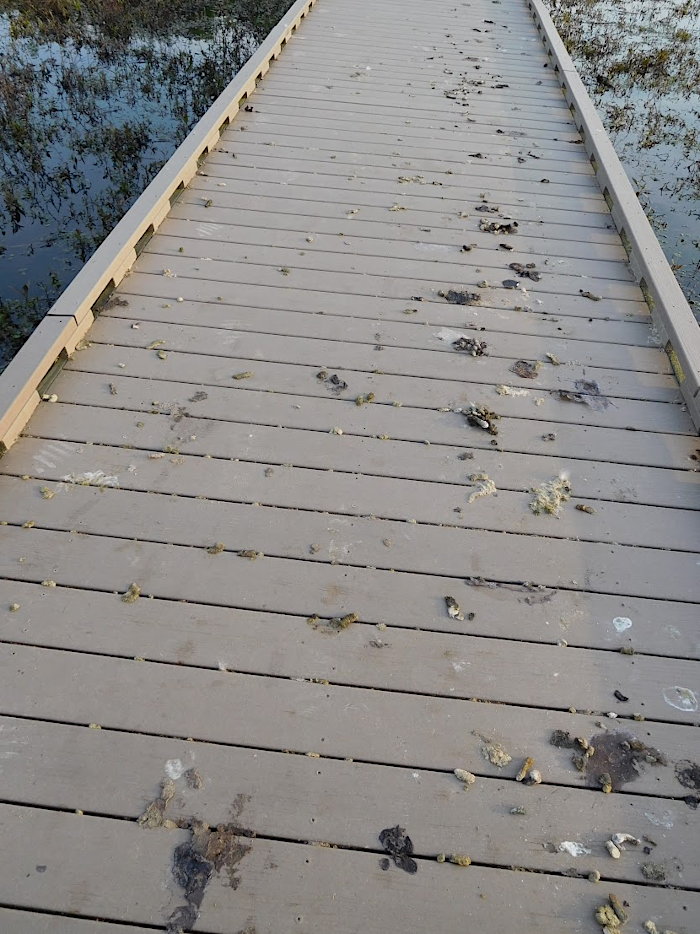
goose poop is a hazard on boardwalks
Capture-and-euthanasia is practiced as well. Capture-and-release-in-another-location is not viable, because there are no locations where resident Canada geese would be welcome and are not already present. There is no unoccupied habitat in Virginia that could be stocked with transported, non-migratory geese.
In the 1960's, the property owner of what is now Green Spring Garden Park in Fairfax County constructed ponds that were designed to attract geese. The neighbors at Lake Barcroft complained, and ultimately a state game warden rounded up the geese. The Fairfax County Park Authority described what happened:1
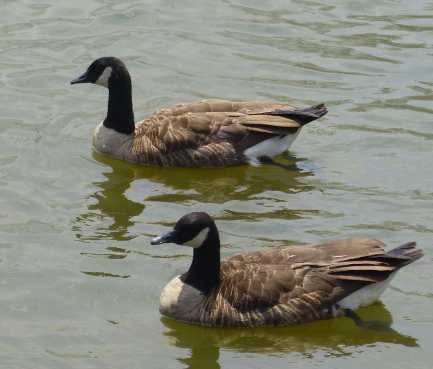
adult geese swimming in stormwater pond during the summer
The objective of the harassment is to shift the population balance so migrating geese will remain in the majority. The US Fish and Wildlife Service (FWS) is the Federal agency responsible for managing migratory birds. In the "Atlantic Flyway Resident Canada Goose Management Plan," the FWS proposed reducing the population of resident geese by roughly 50% (from 1.1 million birds in 1999 to 650,000 birds in 2005).2
The reduction in the percentage of non-migratory geese must be accomplished before the resident Canada geese are the only ones left. Right now, geese that spend the winter in Virginia migrate to three nesting areas in Canada. If the population with the migratory instinct is lost, it may never be restored among wild birds. The circumstances where migration was a good adaptation were based originally upon the retreat of the glaciers. Federal and state agencies are willing to go to extremes now to ensure that "memory" is not lost.
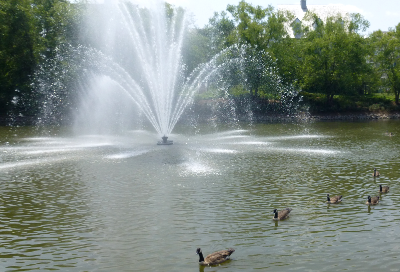
why migrate, if there is food and breeding habitat now in suburbia?
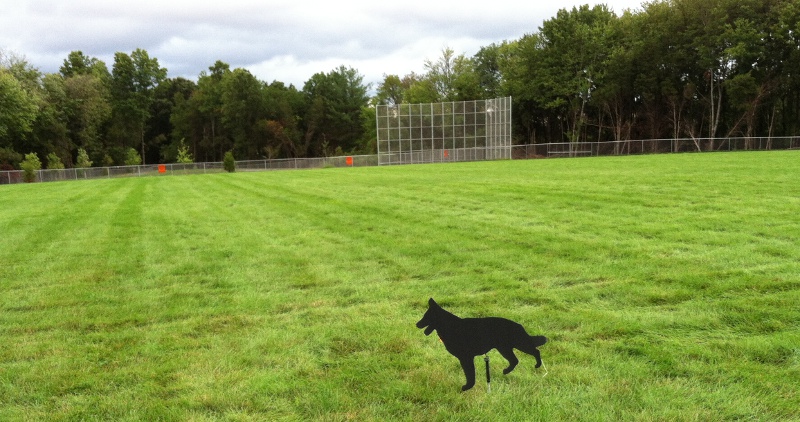
metal cutout of dog swinging on spring, used to protect newly-planted grass from Canada geese at Tyler Elementary School (Town of Haymarket)