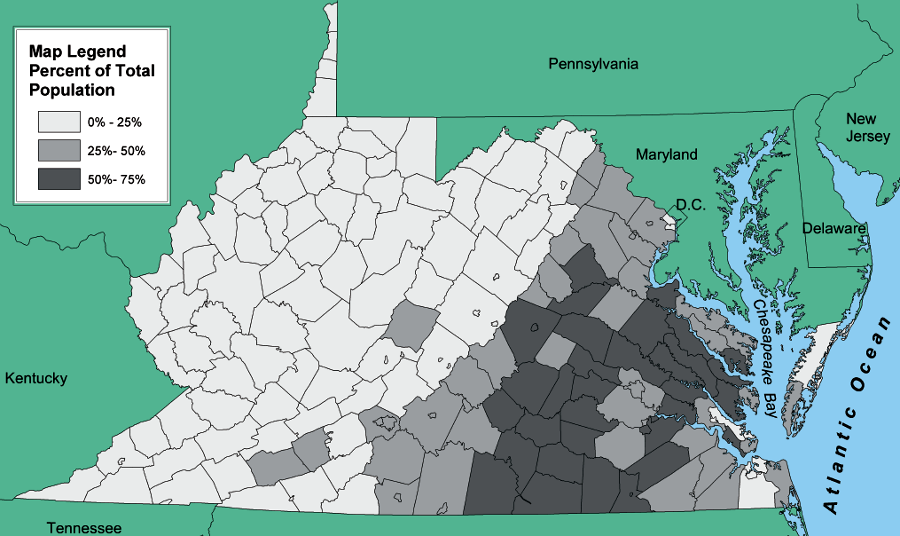
in 1860, the Blue Ridge defined a clear boundary in different counties regarding the percentage of slaves in the population
Source: Virginia Geographic Alliance, Slaves in Virginia’s Population, 1860 (derived from Map 28 in "An Atlas of Virginia")
in 1860, the Blue Ridge defined a clear boundary in different counties regarding the percentage of slaves in the population
Source: Virginia Geographic Alliance, Slaves in Virginia’s Population, 1860 (derived from Map 28 in "An Atlas of Virginia")
In 1747, Quaker abolitionist leader John Woolman traveled through Maryland and Virginia. He was pained to see his fellow Quakers keep slaves. While in the Shenandoah Valley south of Cedar Creek, they told him that slavery was justified in the Bible. He responded:1
In 1772 Lord Mansfield (in "Somerset's Case") ruled that slavery in England was not legal and all slaves in England were free. No legislation had been passed by Parliament that positively defined it as legal, and there was no clear acceptance of slavery in British common law. Slavery in England was thus ended by a court decision - but the British government continued to support slavery across the Atlantic Ocean, in the American colonies, by having the king veto laws proposed by Virginia to ban the importation of slaves. The General Assembly of the Virginia colony was not trying to end slavery - just the competition from foreign sources. If the slave trade could be blocked, then the slaves who were born in Virginia could be sold for higher prices to planters in the new agricultural areas on the Western frontier (at that time, Alabama and Mississippi...).
In 1782, when Virginia leaders were intensely debating the meaning of "liberty" after the British surrender at Yorktown, the General Assembly relaxed the limits on manumitting or freeing slaves. These limits were established originally to require slaveowners to retain their property" until death, rather than to free old slaves and try to dump the costs of caring for those no longer productive as agricultural laborers onto the general taxpayers. The constraints on manumission were re-imposed in 1806, when the Removal Law established that freed must leave Virginia within a year. Free blacks were seen as a serious threat to slavery...
The Constitution was written and ratified when southern states depended upon cheap labor - slaves - to grow staple crops. In Virginia the primary agricultural product was tobacco, just as it had been since John Rolfe's 1613 crop was such a commercial success. Virginia depended upon either Europe or the northern states to provide manufactured goods. Many of the political debates between 1790-1860 revolved around whether a high tariff would make the American products competitive with imported goods, and whether southern states should subsidize northern manufacturers rather than enjoy free trade with Europe.
This ensured that the Congress could not prohibit the slave trade until 1808. When that date arrived, the slave trade was banned. By then, Virginia was exporting slaves. It did not want the competition from Africa or the Caribbean - a ban on the slave trade would reduce the supply and thus increase the value of the slaves in Virginia.
Virginia planters expected the ban on the slave trade to result in a higher price when selling their slaves "down south." Labor was needed to clear land and plant cotton on Mississippi and Louisiana plantations, while Virginia had a surplus of slaves. The Virginia slave population was reproducing faster than local demand could absorb, and many were marched through Cumberland Gap when "sold down the river."
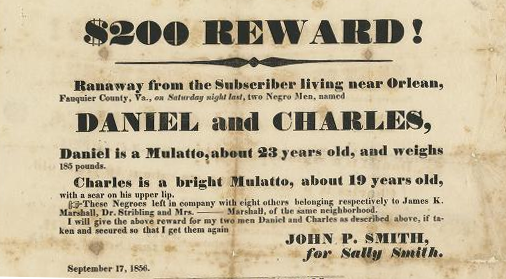
slaveowners offered rewards for recapture of escaped slaves
Source: Library of Virginia, Broadside Collection