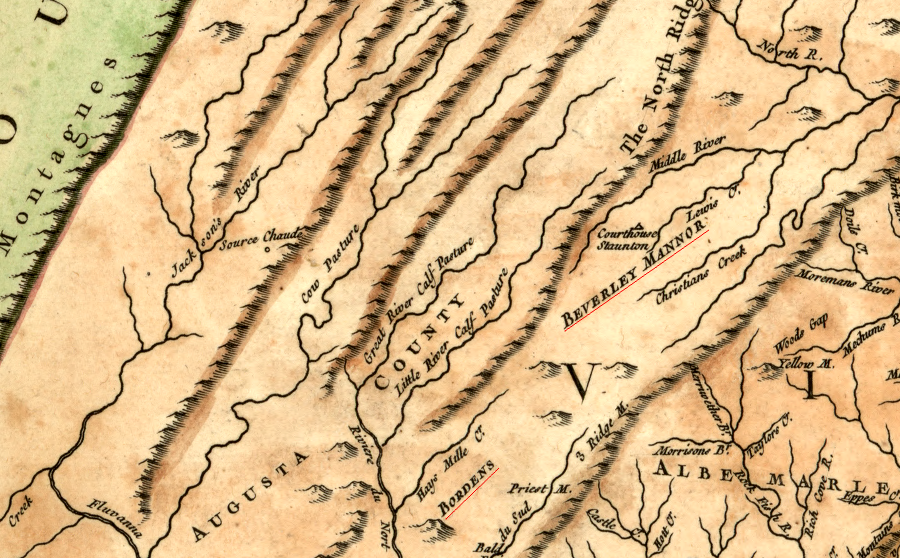
the Borden Grant was located south of Beverley Manor
Source: Library of Congress, Carte de la Virginie et du Maryland (1757)
the Borden Grant was located south of Beverley Manor
Source: Library of Congress, Carte de la Virginie et du Maryland (1757)
In May 1735, the Governor's Council in Williamsburg authorized a 100,000 acre land grant to Benjamin Borden. Borden was an early immigrant into the Shenandoah Valley. He came from New Jersey, where he lived in 1726.
By 1734 he lived on his Great Spring Tract, a 3,134 acre parcel adjacent to Lord Fairfax at Greenway Court. The two appeared to have a friendly business relationship. At the time, Fairfax was contesting other land claims, saying that he - rather than colonial officials in Williamsburg - had the right to sell land in the northern part of the Shenandoah Valley.1
Borden lacked the family connections of many others who obtained grants of western lands, such as William Beverley or the members of the Ohio Company and the Loyal Land Company. It is likely that Borden developed business connections as he brought goods to the Chesapeake Bay and traded with the First Families of Virginia.
He may have earned the special favor of Governor William Gooch by giving him a buffalo calf. According to another tradition, Borden got his 100,000 acre land grant after playing cards in Williamsburg with the son-in-law of the governor.
Borden must have ingratiated himself with Virginia's leaders in a variety of ways, but 100,000 acre land grants were approved by the Governor's Council. Such grants were not awarded carelessly to people unknown to the members of the Governor's Council, all of whom were members of the gentry. Members of the Council were jealous of their authority. They did not allow a colonial governor, appointed by the king, to issue grants as if they were a personal gift.2
The land to be selected and surveyed for Borden's tract was located south of the area claimed by Lord Fairfax in the northern part of the Shenandoah Valley, and south of William Beverly's grant. The petition in 1737 started with:3
Borden was unfamiliar with the territory when he first walked south in search of the land. On the way to see it one night he stopped at the home of the Ephraim McDowell family. They had come from Ulster and were planning to purchase land from William Beverley.
John McDowell, Ephraim's son, was a surveyor, and that evening the family negotiated a deal with Borden. Borden offered 2,800 acres in exchange for McDowell building houses and a packhorse trail to Borden's grant, and validating that others had settled on Borden's land. The next day, he sweetened the deal and offered 100 acres for each cabin they built plus the right to purchase adjacent land at just 6 pence/acre. At the time, land in Pennsylvania was selling for almost 30 times that price.
in the end, McDowell was promised 1,000 acres. Knowing the territory well, he selected high-quality land on Timber Ridge. Borden tried to force him to accept lower-quality land, but McDowell went to court and won his claim.
John McDowell became a captain in the Augusta County militia. In 1742, he commanded members of the militia who were told to escort a raiding party of Iroquois through the county. Virginia provided no supplies to such raiders headed south to attack the Catawba, and settlement had reduced the deer and bear population. Farmers with cattle were concerned about losing their livestock.
The Iroquois and the militia ended up shooting at each other. On each side, 11 men were killed - including John McDowell. Benjamin Borden Jr. married McDowell's widow, Magdalen, in 1744.4
Just to the north of Borden's grant, William Beverley had a land grant that was originally for 60,000 acres. It ended up being 118,491 acres due to a supposed surveying error.
While it is possible Beverley's surveyor was unfamiliar with the territory, it is difficult to imagine how recording the metes and bounds measured each day could result in a mistake that nearly doubled the acreage. Beverley was a well-connected member of the Virginia gentry. Borden was not the beneficiary of such an survey adjustment, and ended up with just 92,100 acres.
The terms of Borden's grant from the Governor's Council required him to recruit 100 settlers (one family per 1,000 acres) within two years. Borden lived on his grant for two years, then returned north to his Great Spring Tract. He directed all potential purchasers to McDowell, who served as his land agent. Eventually, there were 145 buyers for his land.
Borden received the official land patent for his grant on November 5, 1739, after getting an extension of one year to allow enough time to recruit the required number of families. Many came from New Jersey. Borden was competing with William Beverley to convince people in the area around Philadelphia to move south into the Shenandoah Valley wilderness.
Few of the new immigrants landing at Philadelphia had enough wealth to purchase expensive land near that city. The new arrivals had to go into the backcountry, if they wanted to acquire land. That required hard labor and personal risk - clearing trees, building cabins, creating churches, and dealing with the threat of Native Americans and the French.
Borden's settlers were probably recruited in person by land agents rather than advertisements in the Pennsylvania Gazette, presumably because they were illiterate. So many were Scotch-Irish Presbyterians that the area became known as the "Irish Tract."
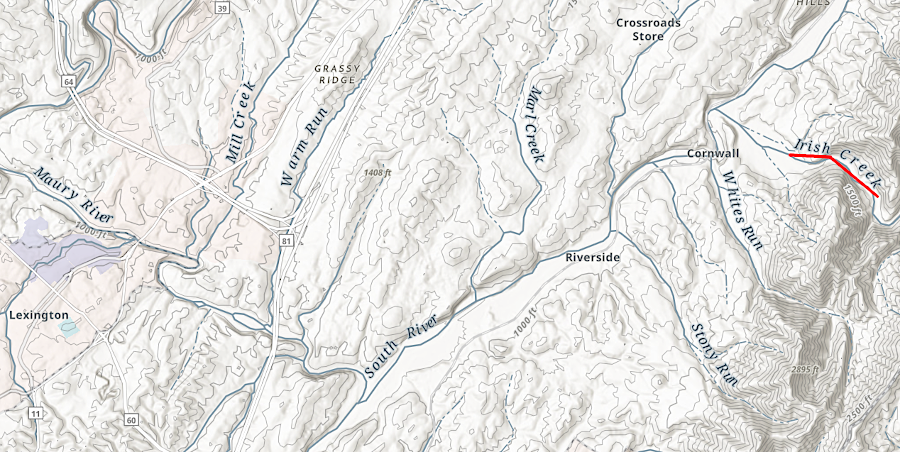
the first colonial settlers in Rockbridge County are still remembered by place names
Source: ESRI, ArcGIS Online
Getting long-term residents to live on Borden's grant would help protect the backcountry, but the grant's terms did not require Borden to sell all of his property to the settlers that he attracted. He certified that he had attracted the number required to qualify for the grant, but was under no obligation to sell land to any of the settlers.
Practically, he had to commit to sell some land in order to recruit families to migrate into Virginia and his profits depending upon making sales. However, he was not obliged to sell 1,000 acres to each family. Borden was allowed to hold as much acreage as he wished, so he could operate as a speculator. He could wait for a future increase in the price per acre, as population and the demand for farmland increased in the Shenandoah Valley.
To attract settlers, Borden gave those who constructed a house 100 free acres. He acquired for himself 900 additional acres for every 100 acres he gave to a family that settled on his grant. Once he patented the 1,000 acres per settler, he had to pay quitrents on the unsold land.
Parcels within his 92,100 ace tract transferred to the settler only when a survey of that specific parcel was approved and the patent (deed) was granted by the royal government in Williamsburg. The first such property transfer occurred in 1741:5
Benjamin Borden could sell the extra 900 acres at the going market price rather than pay annual taxes, or he could absorb the annual carrying cost and gamble that land values would rise quickly. Since so much additional land was becoming available as land companies obtained new grants south of the Irish Tract, it was in Borden's interest to offer a good price. Immigrants coming from Pennsylvania had the option to settle on William Beverley's land or keep going south, where they could settle in the New River Valley or the Carolina Piedmont.
Borden's offer of a free 100 acres was sufficient land to start a small farm, but settlers often wanted more acreage. They planned for intergenerational transfers of family wealth so each of their sons could inherit enough acreage to start their own farm. In the 1740's, there was a common assumption was that the value of land would rise steadily as population west of the Blue Ridge continued to grow.
The first families to settle on Borden's grant were the first candidates to buy land:6
Borden obtained his grant when that land was located within Orange County, with a courthouse on the east side of the Blue Ridge. In the 1730's, that county had the only surveyor authorized to approve surveys west of the Blue Ridge. Borden was appointed by the governor to the Orange County Court in 1735.
Many settlers established their farms before the land was surveyed. They were not guaranteed that the 100 acres from Borden would include the land which they improved. Borden promised land to one group of 18 families whose settlement would help validate the grant, but transferred deeds to only four families before dying. Borden's son, also named Benjamin, did not consider himself bound by the promises which settlers claimed had been made but he had not heard. He refused to give the remaining 14 families the land they expected to receive.
The longest land dispute in the Borden land grant involved his family. Benjamin Borden's will included a gift of 1,000 acres of "good land" to each of his five daughters. Processing that bequest was complicated, since under colonial rule no single survey could encompass 5,000 acres of good land. Separate parcels had to be surveyed and patented. Lawsuits among the heirs continued until 1885.7
In 1735, Benjamin Borden was appointed a justice of the peace for Orange County. The General Assembly chartered Augusta and Frederick counties, the first two completely west of the Blue Bridge, in 1738. However, county courts were not appointed until there was a critical mass of settlers. County governments with justices of the peace were finally organized in 1743 for Frederick County and 1745 for Augusta County.
Borden then was appointed by the governor to serve on the Frederick County Court, but he died before the Frederick County Court began to operate. Today the "Irish Tract" is in Rockbridge County.8