Was Virginia Destined To Be English?
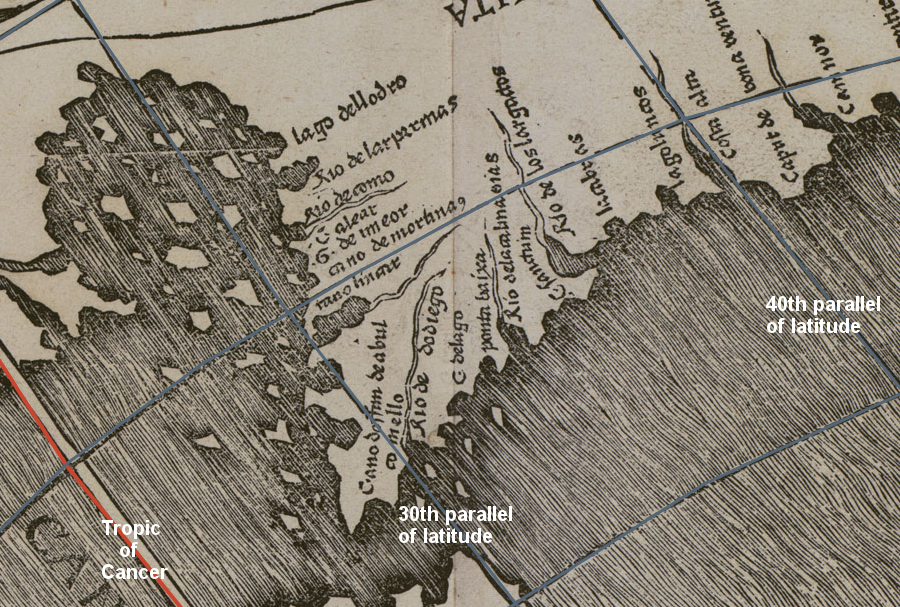

the eastern edge of North America, including the latitudes of Virginia, was displayed on the first map to use America as a place name
Source: Museo Galileo - Institute and Museum of the History of Science, A Land Beyond the Stars: Amerigo Vespucci and Martin Waldseemuller's Map of the World (by Martin Waldseemuller, 1507)
The very first people to colonize Virginia were not the English. The first permanent Virginia residents arrived 15-20,000 years ago, long before Columbus and the Europeans who sailed to Virginia. Many people came to North America and Virginia before John Smith and about 100 others got off three ships in 1607.
Some of the first people in Virginia included Asians who walked across the Bering Land Bridge. It is possible that some of the very first may have included Europeans, using boats to hunt marine mammals along the edge of the ice before the glaciers started melting 18,000 years ago.
In 1021 Common Era (CE), according to Viking sagas and archeologic evidence, Scandinavian explorers sailed west from Greenland and built a village at L'Anse Aux Meadows in modern-day Newfoundland. The first crossing of the Atlantic Ocean led to a Viking settlement in North America 1,000 years ago.
Those Scandinavians were attracted not by a desire for gold, religious freedom, or conquest. They sought fish, especially the Atlantic cod that provided protein for the Scandinavian diet. Their boats were built using the "clinker" construction method, with planks that overlapped each other on the edges. It would take another 500 years for the Scandinavians to adopt the Southern European "carvel" construction method, where hull planks were placed edge-to-edge.
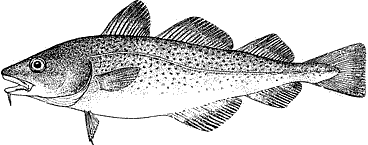
starting 1,000 years ago, Atlantic cod and other fish were the initial reason for European exploration of North America
SOURCE: National Oceanic and Atmospheric Administration (NOAA), The Fisheries and Fisheries Industries of the United States

the "Terra nova dos bacalhaos" was the "New land of cod," now "Newfoundland"
Source: Library of Congress, Theatrvm orbis terrarvm (Plate 18, by Abraham Ortelius, 1570)
The value of the protein was obvious to the Vikings, and later to other Europeans. The fastest European response to Columbus' discoveries was not to send people to occupy the new land, but to send fishing boats to the North Atlantic. European sailors built huts on the coast of Labrador, staying just long enough each fishing season to dry and salt their catch so the fish would not spoil in transit back to Europe.1
Today, we know the first Europeans to settle permanently in Virginia were English. However, claims that "Jamestown is the oldest settlement in North America" are far from correct.
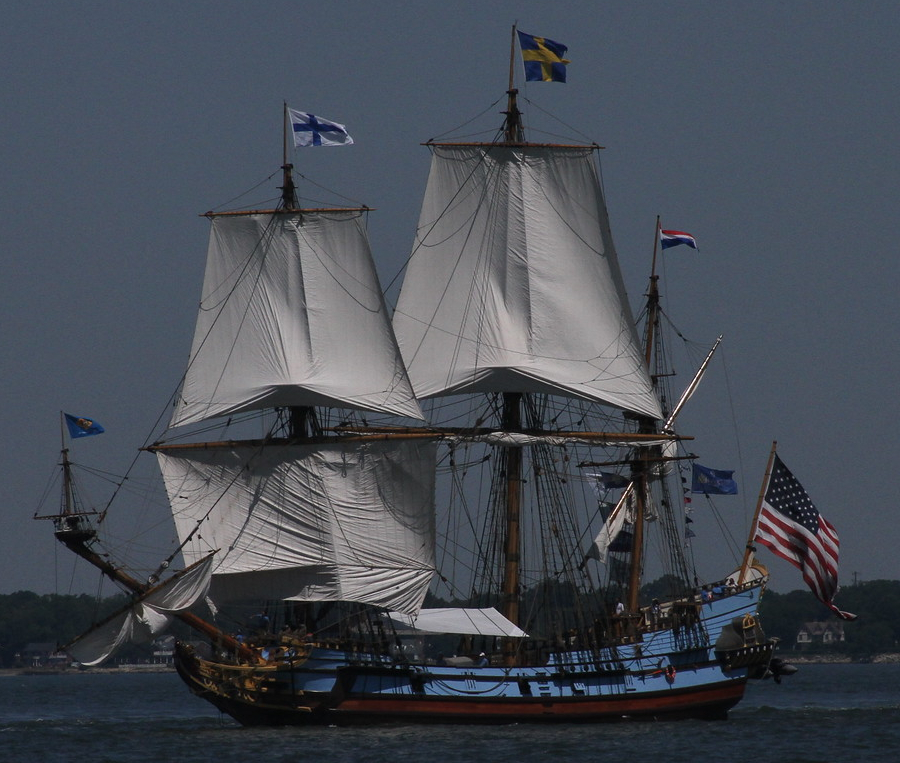
a replica of the ship that brought the first Swedish colonists to North America in 1638 sailed into Hampton Roads in 2012
Source: US Army Corps of Engineers, 120608-A-ET072-113
Jamestown is not even the oldest continuously-settled English city in North America. The oldest continuously settled English city in North America is Hampton, with a history of occupation dating back to 1620. Jamestown was settled 13 years before Hampton, but has been abandoned. The first permanent English settlement in North America is just a historic site now, managed cooperatively by the National Park Service and Preservation Virginia.
The oldest continuously-settled city in North America may be Mexico City, with a history dating back nearly 700 years to the founding of Tenochtitlan by the Aztecs.
The oldest continuously settled city founded by Europeans in the New World is Santo Domingo in the Dominican Republic, dating back to 1496. The oldest continuously settled city founded by Europeans on the North American continent is St. Augustine in Florida. It has been occupied steadily since 1565, 42 years before the Susan Constant, Discovery, and Godspeed arrived in the Chesapeake Bay and sailed upstream to initiate Jamestown.
The French started Quebec in 1608, and the "official" date of Spanish settling at Sante Fe in New Mexico is 1610.2
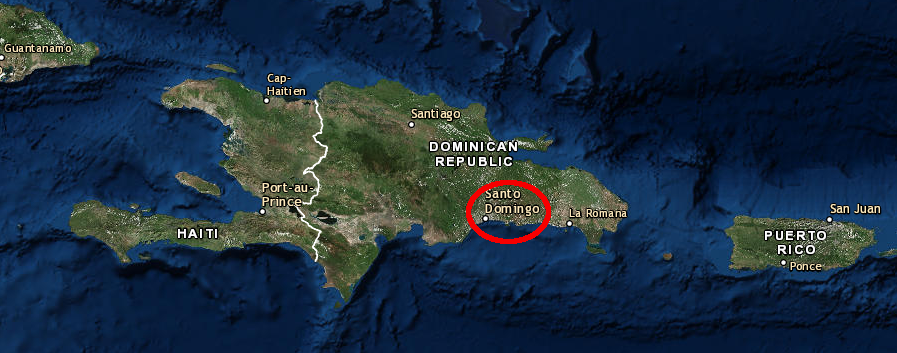
Santo Domingo on the island of Hispaniola was founded in 1496, more than a century before Jamestown
Source: ESRI, ArcGIS Online
England was not the second European nation to establish colonies in North America; that honor belongs to France. French colonization efforts in the New World started in 1541 when Jacques Cartier built Fort Charlesbourg-Royal on the St. Lawrence River. Though it lasted only two years, Charlesbourg-Royal was started 66 years before John Smith arrived in Virginia.
45 years before the Susan Constant, Godspeed, and Discovery reached the Chesapeake Bay, the French tried again. They settled in the southeast between modern-day Savannah and Jacksonville, starting in 1562 with the Charlesfort settlement in modern South Carolina and then in 1564 with Fort Caroline in Florida. Neither settlement lasted more than a year.
In 1604, three years before Jamestown, French settlers occupied St. Croix Island next to the border between the US and Canada today. In 1605 they moved to Port Royal in what is now Nova Scotia, surviving there until 1607 (with a brief renewal in 1610-13). In 1608, Samuel Champlain founded the city of Quebec, which in contrast to Jamestown is still a thriving city today.3
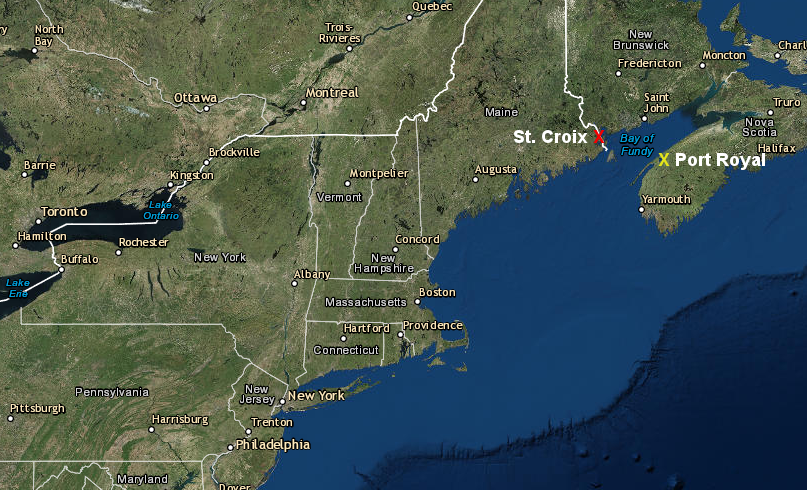
French settlers started at St. Croix Island in 1604, then moved a year later to Port Royal (Quebec started in 1608, and Montreal in 1642)
Source: ESRI, ArcGIS Online
The English were not the first Europeans to settle even in Virginia. Spanish Jesuits started a community at Ajacan 14 years before English colonists tried to settle at Roanoke Island, and over 40 years before Jamestown. Had Father Juan Baptista de Segura and Paquiquineo/Don Luis establish a working partnership in 1570-1571, Virginia could have become the northern edge of La Florida and the First Families of Virginia (FFV's) today would be celebrating their Spanish heritage.
When Europeans expanded their economic and political systems to the New World, inevitably the European conflicts came along with the settlement, technology, and other cultural patterns. North America was never "neutral territory," somehow exempt from the disputes in Europe. The fish in particular were valuable enough to fight over. Gaining control over the fishing grounds was an early priority for the European nations, and establishing colonies was a secondary concern. The English sent ships to destroy the Spanish fishing fleet in the North Atlantic, when Spain was preparing a fleet to invade England.
The earliest English attempts to establish a colony in modern North Carolina was interrupted by that Spanish Armada in 1588. Sir Walter Ralegh's "Lost Colony" was established in 1587, but resupply was blocked because England needed all ships to defend against the Spanish invasion. By the time help arrived in 1590, the colony was gone.
Roanoke Island was not the first European colony to be abandoned. The Scandinavians who initially settled at L'Anse Aux Meadows in Newfoundland 1,000 years ago did not maintain their trans-Atlantic settlements. In the "Little Ice Age," icebergs that could crush their wooden ships drifted further south, and colder weather limited their ability to graze cattle and grow food in the high northern latitudes.
The Scandinavian explorations were not followed by other European discoveries or settlement. Vikings were familiar with the New World long before Columbus sailed the ocean blue in 1492 and may have established more than one fishing village, but they abandoned North America 1,000 years ago.4
In contrast to the Scandinavians, the journeys of Columbus were critical in the development of Virginia because his discoveries triggered extensive exploration and then massive settlement by the Europeans. In 1497, only 5 years after Columbus arrived in the Caribbean, John Cabot explored the North American coast at the direction of Henry VII.
The French commissioned Giovanni da Verrazzano to explore the coastline and search for the Northwest Passage in 1524. Verrazzano sailed from the North Carolina to Newfoundland, missing the mouth of the Chesapeake Bay but finding the location in New York where the Verrazzano Bridge is now located. A second explorer working for the French, Jacques Cartier, discovered the St. Lawrence River in 1535.
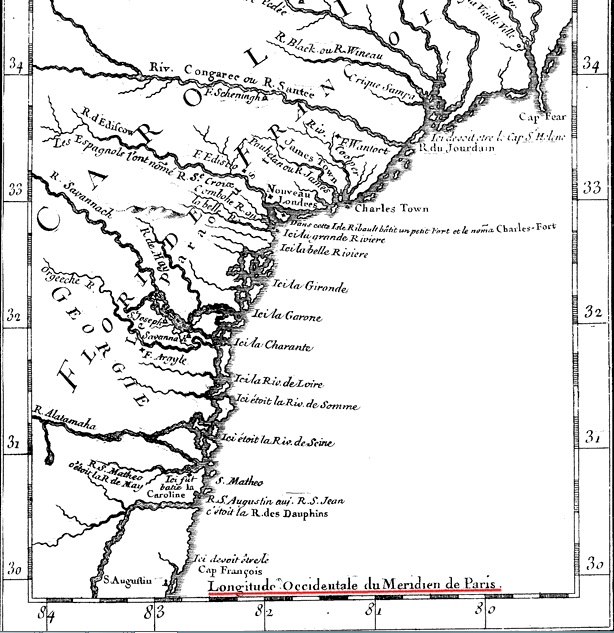
the French sought to control North America through colonization starting in 1562, and their mapmakers defined longitude based on a Prime Meridian that passed through Paris (rather than Greenwich, England)
Source: University of South Florida, Educational Technology Clearinghouse, Map of French Florida Colony, 1562
Being the first to discover lands in the New World (ignoring the obvious presence of Native Americans) had legal significance to the Europeans. The Europeans claimed ownership of land based on a "right of discovery" as well as a "right of conquest." Early explorations enabled countries other than Spain to establish legal title to various places in the New World.
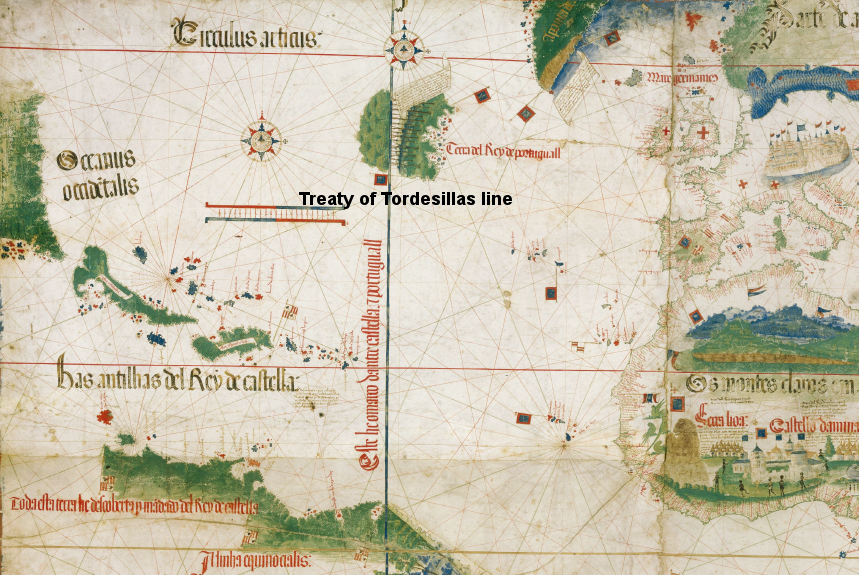
the Spanish and Portuguese divided the New World between them in the 1494 Treaty of Tordesillas, allocating a portion of Brazil to Portugal and all of the Caribbean islands and North America to Spain
Source: Biblioteca estense universitaria, Carta del Cantino (1502)
The different European nations often treated the details of their discoveries as state secrets; knowledge is power. Maps about the New World were often hoarded rather than published.
The Spanish still learned most of what the English discovered about as fast as that information was transmitted to the English royal court. Spanish spies copied the dispatches to London, and were successful in infiltrating many English expeditions as well. Dissent in early Jamestown included suspicion that some colonists were Spanish spies, and George Kendall was executed in 1608 for that reason.
After the Spanish discovered the gold that had already been mined by the Native Americans, many explorers had a "get rich quick" attitude towards their initial searches in the New World. It is possible that Spaniards associated with Juan Pardo's expedition in in 1567-68 may have reached Saltville, even before the attempted settlement at Ajacan.5
The English did not focus their colonization efforts exclusively in North America. Richard Hakluyt argued in 1584 that much of the coast of South America was unoccupied, with no Portuguese or Spanish colony. He claimed Guiana had a "greate plentie of golde, perle, and precious stones" and was available for English settlement.
Sir Walter Ralegh envisioned El Dorado to be on the coast of South America. He led an expedition to the Orinoco in 1595, and published The Discoverie of the Large, Rich, and Bewtiful Empyre of Guiana a year later. In 1604, Charles Leigh started a settlement on what is now called the Oyapock River. He quickly abandoned ideas about mining gold and tried to start growing flax, which was purchased at high prices by Dutch trading ships. Leigh died, however, and his colonists returned back to England in 1606.
The Spanish Empire lost control of the seas after the failure of the Armada in 1588. Spain's loss of military dominance, followed by a peace that James I and Phillip III accepted with the 1604 Treaty of London, created the opportunity for European rivals to cross the Atlantic Ocean and establish their own colonies. The French, English, Dutch and Swedes all created colonies in North America by 1640.

the Swedes planted a colony on the Delaware River, while the Dutch settled on the Hudson River
Source: Library of Congress, A mapp of Virginia discovered to ye hills, and in it's latt. from 35 deg. & 1/2 neer Florida to 41 deg. bounds of New England (John Farrar, 1667)
John Smith originally planned to travel to the Guianas in 1605, but that colonization effort did not materialize. He went to Jamestown instead in 1607. In 1609, Robert Harcourt took 20 settlers to Guiana. He returned to England and published A Relation of a Voyage to Guiana, leaving his brother in charge. When the brother died in 1612, the colony failed. Other initiatives also failed, including an Anglo-Dutch colony in Guiana that had 100 settlers in 1616.
The Mayflower in 1619 struggled to recruit a full complement of colonists in part because there was competition for proposed settlement in South America, where Guiana had two growing seasons and indigenous people seeking allies to counter the Spanish. The land of Guiana:6
- ...was rich, fruitfull, and blessed with a perpetuall spring, and a florishing greenes; where vigorous nature brought forth all things in abundance and plentie without any great labour...
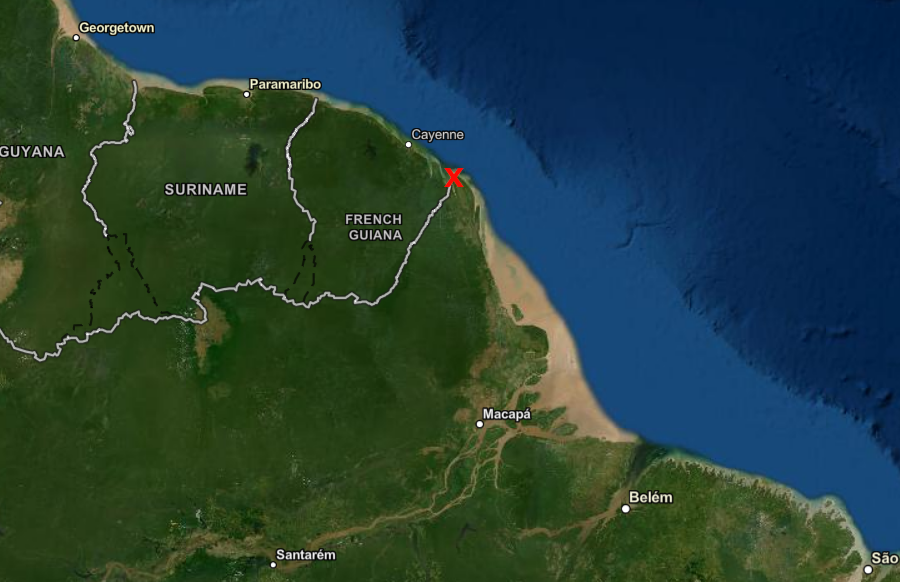
Charles Leigh started an English colony on the Oyapock River (red X) in South America in 1604, three years before Jamestown was settled in Virginia
Source: ESRI, ArcGIS Online
The English colonists in Virginia recognized that settlers in the area could have come from a large number of different nations. In 1650, when Edward Bland led a group of explorers from Fort Henry (Petersburg) southwest to meet with a chief of the Tuscaroras in North Carolina, he was tasked by Governor Berkeley with finding an English man and woman thought to be living with that tribe for the last 20 years.
When Bland met with his first Tuscarora near the North Carolina border, he paid him to carry a message to the main Tuscarora town. Recognizing that Native American reports of English-speakers living among the Tuscarora could include almost any European, Bland sent a message with the courier than was written in English, Latin, Spanish, French and Dutch.7
History is what happened, but the roads not taken in the past can inform speculation on what-could-have-been rather than what actually occurred.
If the Ming Dynasty had expanded upon the journeys of Zheng He after 1433, the history of New World exploration may have been written by the Chinese rather than the Europeans. The names of the passages would have been different, and the Prime Meridian might have been defined as the line of longitude through modern-day Xian or Beijing rather than London. If the North Americans had sailed first to Europe, crossing the Atlantic Ocean from west to east, the Prime Meridian might have been defined as the line that ran through Werowocomoco.
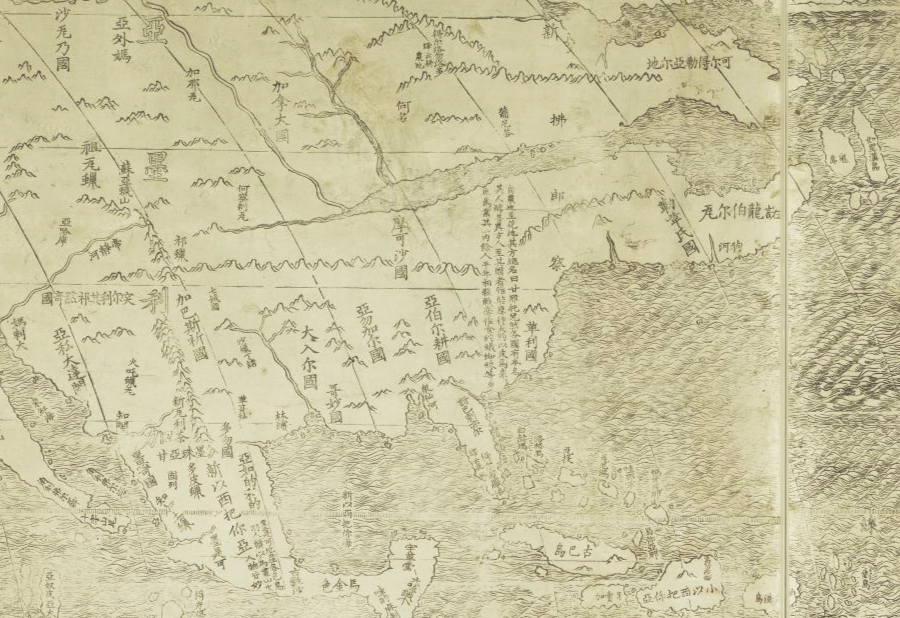
in China in 1602, Jesuit priest Matteo Ricci produced a map of the world that showed North America
Source: University of Minnesota, Matteo Ricci, Li Zhizao, and Zhang Wentao: World Map of 1602
The Manifest Destiny perspective suggests:
- initial English failures to settle on the North Carolina coast was just a prelude to the inevitable success at Jamestown, 20 years later
- Native Americans would inevitably transfer their land to English colonists and withdraw westward
- Spanish, French, Swedes, and Dutch colonists were destined by some higher power to lose the competition for North American domination and ultimately accept English authority between the Atlantic and Pacific oceans
- new settlers in North America were pre-programmed to establish a new nation based on a new form of democratic government, and ultimately become the dominant superpower in the world
In the 1580's, Walter Ralegh (often spelled "Raleigh" as well) sought to establish the Roanoke Colony. Ralegh thought that an English settlement in the New World had a reasonable chance to make him a profit and enhance his reputation. He knew the risks were high, but he was venturing his capital in an effort to succeed in his own time, and at his own chosen place.
He was not able to see the future. Ralegh was not trying to pave the way for John Smith and others to sail into the Chesapeake Bay in 1607. The Roanoke Colony was not intended to be lost, or just be a prelude to Jamestown. English colonization did not establish an inevitable path to creation of a new form of government "of the people, by the people, for the people."
In the 400 years after Columbus reported he had reached the Indies, a United States of America emerged with a political system deeply rooted in European philosophy - but in many situations, the story could have taken a different turn. There was no guarantee that Jamestown would be any more successful than the first attempted permanent colonial settlement at Tampa in 1521, or the second at San Miguel de Guadalupe in 1526.
Diseases of the New World could have overwhelmed the natural resistance in European bodies. Colonial settlement might have been limited to just fishing support and trading forts on the North American coastline, similar to the pattern established by Europeans for slave trading on the west coast of Africa in the 1500's and 1600's.
The French could have maintained their initial hold on 16th Century colonies established in South Carolina. Jean Ribault's colony at Charlesfort could have thrived in 1562, or the French settlement at Fort Caroline two years later could have defeated the Spanish in Florida.
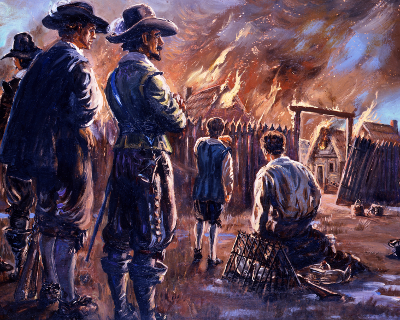
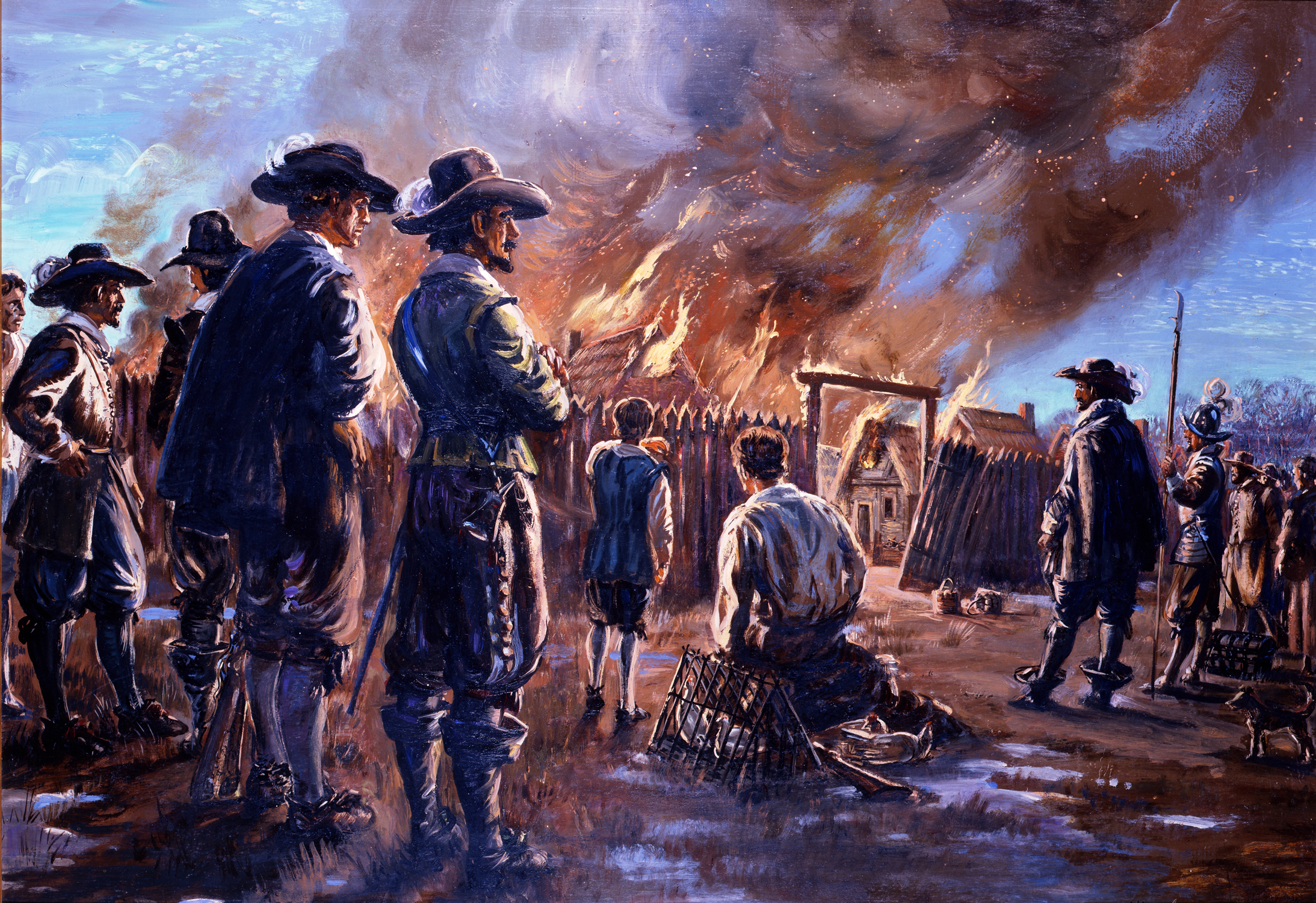
accidental burning of James Fort in January 1608, one of many events that could have resulted in the English abandoning Jamestown
Source: National Park Service, Jamestown - Sidney King Paintings Gallery
If the French had controlled that portion of the coastline, English efforts to initiate colonial settlement may have been forced further north than Jamestown. Later French colonization into the Tennessee and Ohio River valleys could have restricted the English to a small territory east of the Appalachia Mountains between the Delaware and Kennebec rivers. Dutch and Swedish colonies north of the Delaware Bay could have broken up the English domination of the eastern seaboard.

dotted lines on a French map indicate the presumed territories of France, England, Spain, and the Netherlands in 1650
Source: Library of Congress, Amerique septentrionale (by Nicolas Sanson, 1650)
Powhatan could have exterminated the Jamestown colonists and burned their wooden structures in 1609, after acquiring enough copper and iron goods to meet his needs.
When Lord de la Warre arrived in 1610, interrupting the abandonment of Jamestown after the Starving Time, he could have listened to Sir George Somers' praise of Bermuda and decided to relocate everyone there rather than rebuild James Fort.
The English explorations and settlements in the 17th and 18th centuries were not on a predestined journey to the Declaration of Independence in 1776. Such an assumption diminishes the very real dangers and economic risks that were taken by the early explorers and colonists, as well as the personal gambles and intellectual productivity of the leaders of the American Revolution.
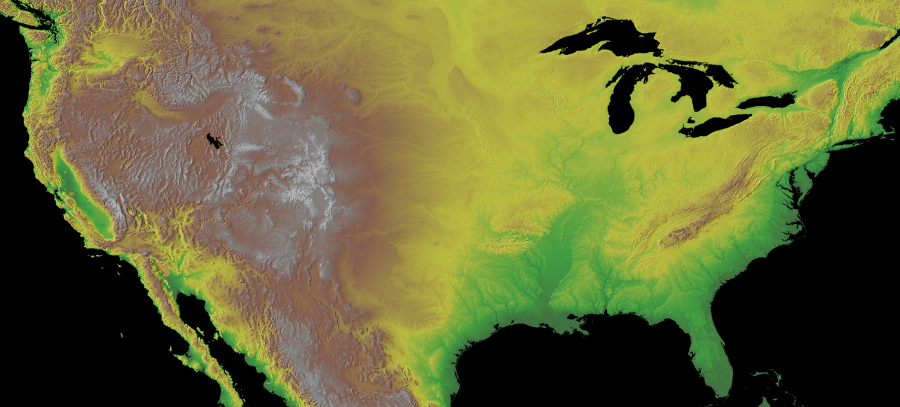
in 1491, no one anticipated or planned for European settlement to displace and disrupt Native American communities across the North American continent
Source: National Oceanic and Atmospheric Administration, GLOBE: A Gallery of High Resolution Images
Links
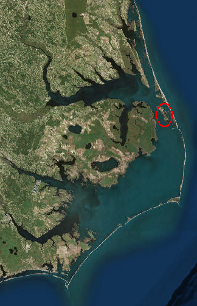
Roanoke Island and the Outer Banks
Source: ESRI, ArcGIS Online

the Swedes sought to settle on the Delaware River
Map Source: Library of Congress, Amérique septentrion.lle [i.e. septentrionale] (by Jean Baptiste Louis Franquelin, 1685)
References
1. Keith J. Crowe, A History of the Original Peoples of Northern Canada, McGill-Queen's University Press, 1991, pp.64-65, https://books.google.com/books?id=iBISw4pPaDoC; "European Migratory Fishery," Newfoundland and Labrador Heritage, http://www.heritage.nf.ca/exploration/efishery.html; "A Saga of Discovery," L'Anse aux Meadows National Historic Site of Canada, Parks Canada, http://www.pc.gc.ca/eng/lhn-nhs/nl/meadows/natcul/saga.aspx; "Vikings Were in the Americas Exactly 1,000 Years Ago," New York Times, October 20, 2021, https://www.nytimes.com/2021/10/20/science/vikings-newfoundland-age.html; "An Extraordinary 500-Year-Old Shipwreck Is Rewriting the History of the Age of Discovery," Smithsonian Magazine, November 2021, https://www.smithsonianmag.com/history/extraordinary-500-year-old-shipwreck-rewriting-history-age-discovery-180978825/; Margot Kuitems, Birgitta L. Wallace, Charles Lindsay, Andrea Scifo, Petra Doeve, Kevin Jenkins, Susanne Lindauer, Pınar Erdil, Paul M. Ledger, Véronique Forbes, Caroline Vermeeren, Ronny Friedrich, Michael W. Dee, "Evidence for European presence in the Americas in AD 1021," Nature, Volume 601 (2022), https://doi.org/10.1038/s41586-021-03972-8 (last checked August 7, 2022)
2. "Biography of Don Pedro de Peralta," New Mexico Office of the State Historian, http://newmexicohistory.org/people/biography-of-don-pedro-de-peralta (last checked April 4, 2016)
3. "History - Hard Times for the Colonists," Port-Royal National Historic Site of Canada, Parks Canada, http://www.pc.gc.ca/eng/lhn-nhs/ns/portroyal/natcul/histor/Hard%20Times.aspx (last checked April 23, 2016)
4. "Discovery Could Rewrite History of Vikings in New World," National Geographic, March 31, 2016, http://news.nationalgeographic.com/2016/03/160331-viking-discovery-north-america-canada-archaeology/ (last checked April 25, 2016)
5. Jim Glanville, "Unknown Holstonia: Southwest Virginia Before the Settling of Jamestown," talk presented to Second Virginia Forum on History, April 14, 2007 http://www.holstonia.com/files/Richmond2007.pdf (last checked August 2, 2009)
6. Melissa N. Morris, "Virginia and the Amazonian Alternative," in Virginia 1619: Slavery and Freedom in the Making of English America, Paul Musselwhite, Peter C. Mancall, James Horn (editors), University of North Carolina Press, 1619, pp.259-266, https://www.jstor.org/stable/pdf/10.5149/9781469651811_musselwhite.17.pdf (last checked May 12, 2022)
7. Edward Bland, "'The discovery of New Brittaine. Began August 27. anno Dom. 1650.' (1651)," Encyclopedia Virginia, Virginia Humanities September 30, 2022, https://encyclopediavirginia.org/primary-documents/the-discovery-of-new-brittaine-began-august-27-anno-dom-1650-1651/ (last checked May 12, 2025)
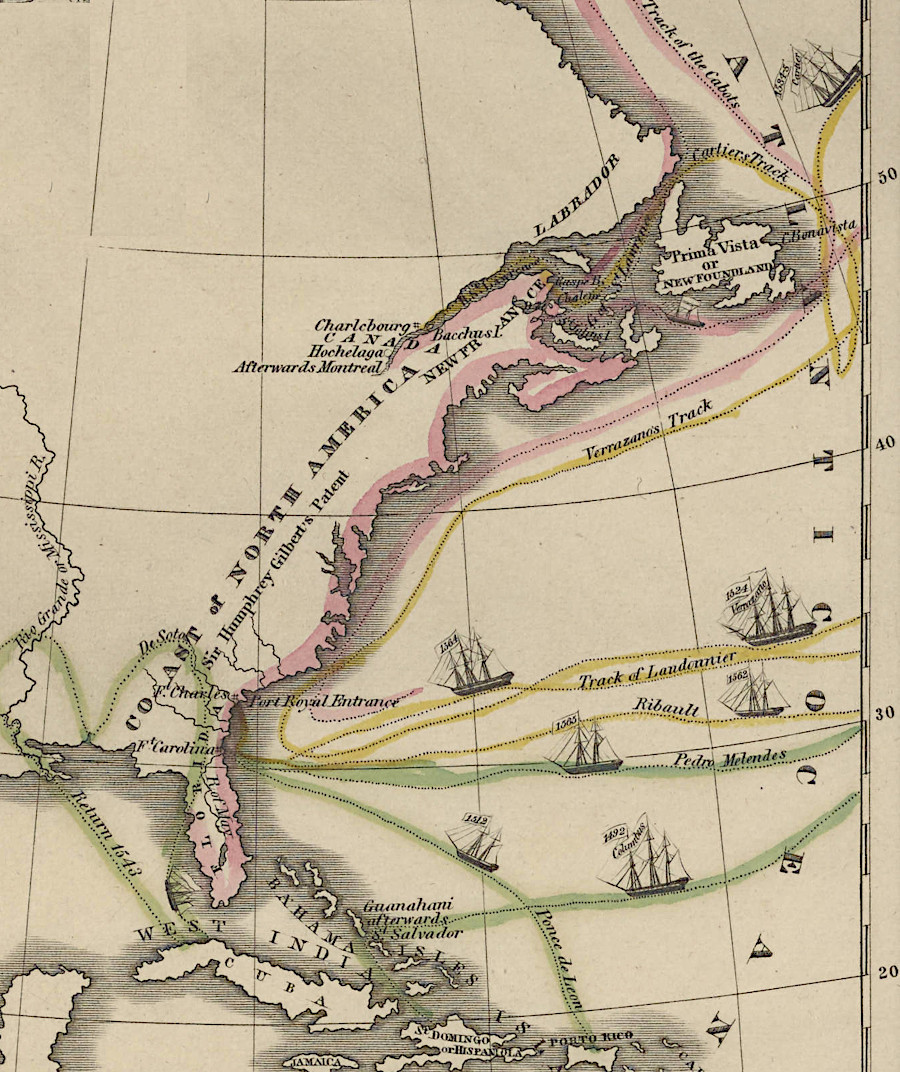
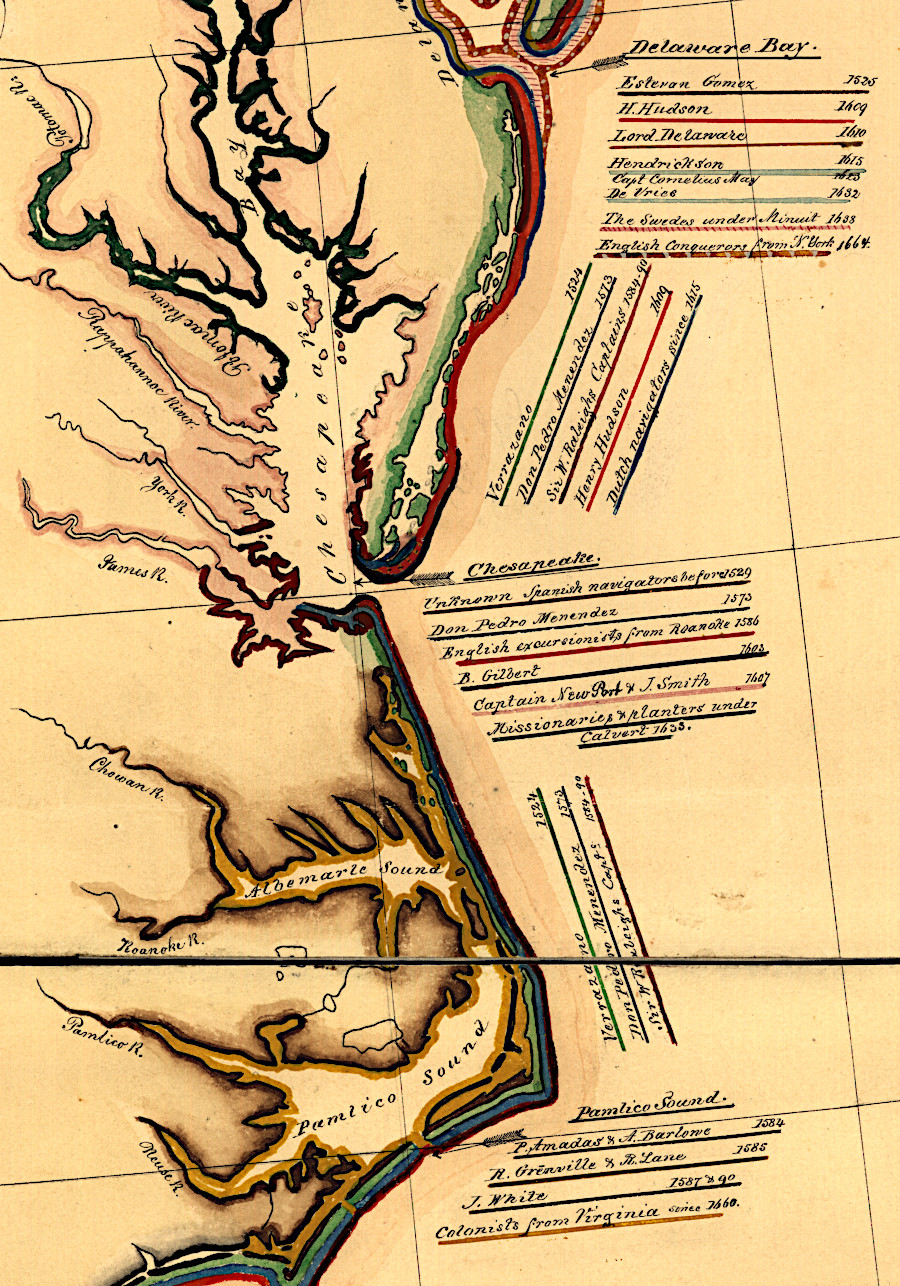
multiple European nations supported explorations of North America in the 1500's and early 1600's
Source: Pennsylvania State University, First map, or map of 1578 : [of the east coast of the United States] and Library of Congress, Map of the discovery of the East Coast of the United States
Exploring Land, Settling Frontiers
Virginia Places