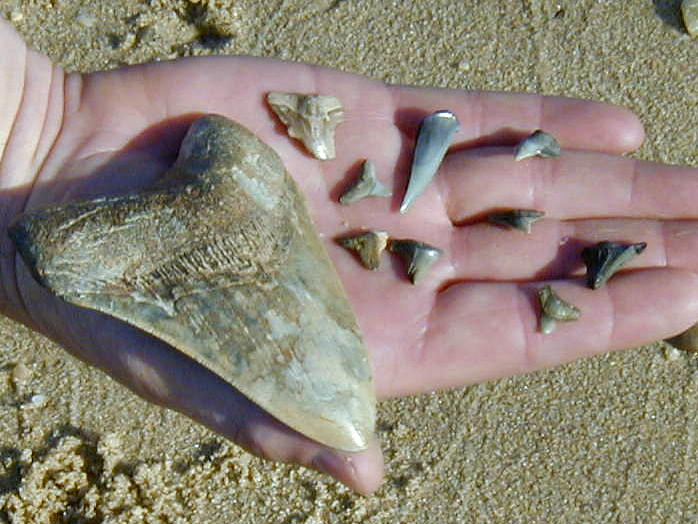
sharks' teeth are the most common fossil found in Virginia, and can include a large Megalodon tooth
Source: Virginia State Parks, Hidden Gems of Virginia State Parks
sharks' teeth are the most common fossil found in Virginia, and can include a large Megalodon tooth
Source: Virginia State Parks, Hidden Gems of Virginia State Parks
Sharks' teeth are the most common fossil found in Virginia. They erode out of cliffs along rivers in Tidewater. As portions of the cliffs collapse, the fossils are spread along the beaches are easy to find.
The teeth come from the exposures of the Aquia Formation (Paleocene Epoch) and the Calvert Cliffs Formation (Eocene Epoch) along the Potomac River. Sharks produce teeth throughout their lifetime, so many ended up being incorporated into sediments on the bottom of the Atlantic Ocean near the shoreline. The teeth consist of very hard material, enameloid covering a core of dentine. Those from the Aquia Formation have survived over 50 million years.
Sharks' teeth are so plentiful that at Chippokes State Park on the James River, visitors who must give the rangers any fossils they find are allowed to take home all the sharks teeth they can collect. Fossils may also be hunted at Westmoreland State Park and York River State Park, but the restrictions on taking them home are tighter.1
The oldest fossils found in Virginia are trace fossils of Skolithos linearis. The traces are evidence of tubes which worms dug into the sand about 500 million years ago, during the Cambrian Period. The tubes remained when the sand was compacted into the Antietam Formation sandstone; the soft bodies of the worms were not preserved.
The Antietam Formation is found west of the Blue Ridge. Rocks with those fossils were washed downstream after the Potomac River cut its water gap through the mountain at Harpers Ferry. The presence of those fossils east of the Blue Ridge, but only in formations younger than five million years old, indicates when the water gap at Harpers Ferry was formed.
No dinosaur bones have been found in Virginia. Trace fossils showing where they walked have been found. The traces are footprints on muddly shorelines, compacted into Triassic Basin shale formations and later Cretaceous sediments.
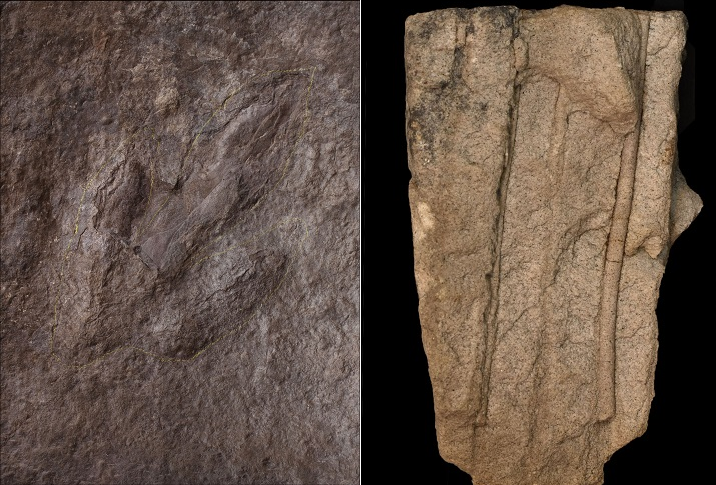
trace fossils found in Virginia include dinosaur tracks (left) and tubes that worms excavated in sand about 500 million years ago (right)
Source: Virginia Energy, Virginia Provinces and Fossils
. Virginia's state fossil is Chesapecten jeffersonius, a scallop found in the Lower Yorktown Formation. Species in the genus Chesapecten swam in shallow Mid-Atlantic waters for 5 million years during the Miocene and Pliocene epochs, between 8 million - 3 million years ago.
If any fossilized dinosaur bones had ever been discovered in Virginia, then children might have petitioned the General Assembly to designate a dinosaur species as the state fossil. Chesapecten jeffersonius won the honor in part because in 1687 it became the first fossil from North America to be described n a European scientific journal, and in part because:2
The sheer volume of surviving Chesapecten jeffersonius fossils have allowed fine-scale evaluation of how the species evolved, and how environmental conditions in the oceans shifted. Few other fossil records are sufficiently complete, with clear documentation of age, to assess change over time.
Though other scallop species replaced Chesapecten jeffersonius long before humans arrived in Virginia, Native Americans took advantage of the fossils to create scrapers. The Yorktown Formation was well-exposed on the Coastal Plain, and fossils could be extracted from the soft sediments by simply digging with a stick.3

the Virginia Museum of Natural History has drawers filled with the Virginia state fossil, Chesapecten jeffersonius
Source: Virginia Museum of Natural History, The Amazing Chesapecten
Caves are a rich resource of fossils. In 1996, a mammoth tooth was found in Endless Caverns near a former entrance to the cave.
It was the fifth mammoth fossil found in Virginia. Th first was discovered in 1831 near Warrenton in Fauquier County. Several whole and fragmentary teeth were found in 1896 near Saltville in Smyth County, with further discoveries later. Clam diggers dredging on the Outer Continental Shelf brought up mammoth fossils and what may have been a lanceolate spearpoint in 1996.
The Ratliff fossil site in Russell County yielded mammoth fossils in 1993. Teeth, a portion of a tusk, a fragment of a pelvis, and an ulna (forearm bone) were dated to around 30,000 years ago.4
In 2016, fossils of an American cheetah (Miracinonyx trumani) were found in Burja Cave in Lee County. A paleontologist from the Virginia Museum of Natural History was brought to the discovery site deep in the cave to identify the bones, which were estimated to be between 10,000 - 500,000 years old. All but the tip of the tail had been preserved, but were tightly fused by stone to the cave floor and to each other.
Removal required breaking the fossil into parts that could be wrapped, bagged, and hauled out. The process of removing the fossil to the mouth of the cave required roughly 30 hours of hiking and caving over two days. First, however, the paleontologist had to be trained over a year so he could safely:5
Remains of mastodons and other Pleistocene fauna, invertebrates and plants have been excavated at Saltville since 1917. Modern scientific investigations since the 1970's have defined the very different ecology of the valley during the Ice Age.6
Mastodon bones were discovered in 1811 on the south bank of the York River at what is today Cheatham Annex Naval Base. The fossils, including two tusks and four molars still attached to the jaw, were excavated 150 yards from the mansion house of Kings Creek Plantation owned by Gawin Corbin. Those fossils were kept at the College of William and Mary until being destroyed in an 1859 fire.
Fossil evidence of a mastodon has been discovered at City Point near Petersburg. When that animal died, much of the earth's water was trapped in ice sheets and the coastline of Virginia was an additional 40 or more miles east of the current edge of the Atlantic Ocean. Cold winds blowing off the ice sheet limited the ability of trees to grow outside of sheltered river valleys.
There is a recent mastodon excavation site near Yorktown. Bones there were preserved from decay in the acid Virginia soil because the animal died on a bed of oyster shells where the pH was higher, in a layer of sediments that geologists later named the Yorktown Formation. Radiocarbon dates indicate the animal died over 16,000 years ago. The Hart-Fiscella Mastodon is now featured at the Virginia Living Museum in Newport News.
Killing a mastodon must have provided an immense amount of food, perhaps more than one band of hunters/gatherers could consume before it spoiled. Almost all of the arm and leg bones at the Yorktown site are missing. Marks on remaining bones may be cuts from stone knives as the rest of the meat was removed. Those early Virginians may have butchered the mammoth and carried away the choice parts, leaving much of the meat behind.7
In 2023, excavation to double the size of the Hampton Roads Bridge-Tunnel uncovered mastodon bones from the sediments being processed from the tunnel boring machine ("Mary") at the slurry plant on South Island. That mastodon had grazed through the forest that existed in Hampton Roads during the last Ice Age about 13,000 years ago, when sea levels were up to 400 feet lower. The fossils ended up in sediments 50 feet deep, underneath the bottom of the James River in Hampton Roads.
The Virginia Department of Transportation expected to find cannonballs and historic shipwreck timbers, and inspectors were looking for debris which might damage he tunnel boring machine. A sharp-eyed worker spotted what turned out to be a mammoth tooth and a dozen bone fragments. They were mixed in with slurry moving at 16,000 gallons a minute on the conveyor belt, which he stopped in order to investigate the unusual items.
The project director commented:8
A fossil of a long-nosed peccary (Mylohyus) was discovered in Shenandoah Caverns in 2023, as the cave was being mapped. One of the pig-like animals weighing up to 150 pounds was probably chased by a predator into the cave at least 12,000 years ago, and was unable to climb back out. The events and group tours director for Shenandoah Caverns commented:9
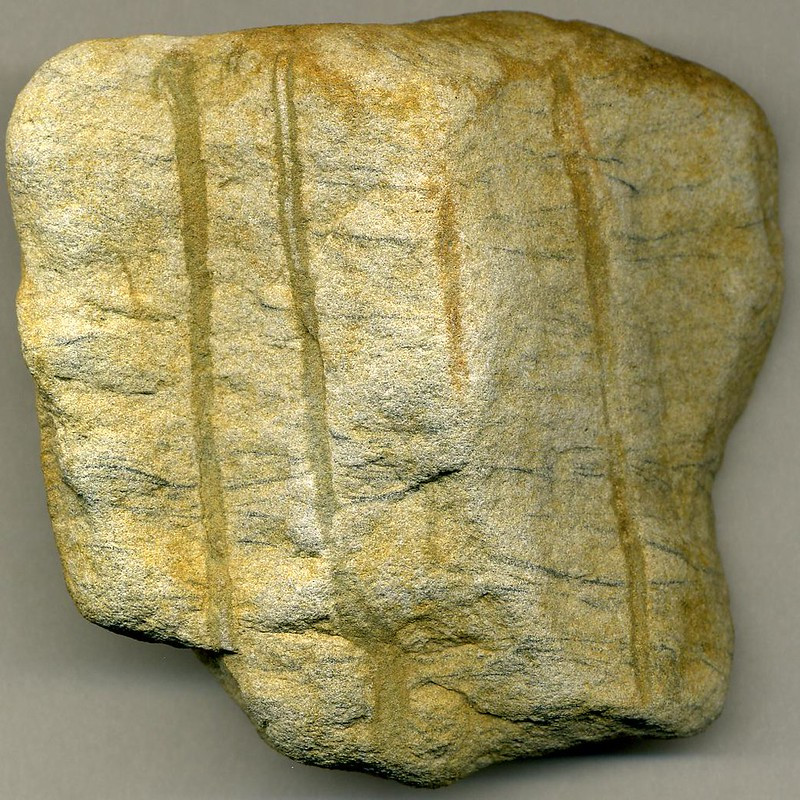
trace fossils of Skolithos linearis are the oldest found in Virginia
Source: James St. John, Skolithos linearis burrows in sandstone (Antietam Formation, Upper Cambrian)

Turitella fossils in Aquia Formation sandstone at the Virginia Energy office's rock garden in Charlottesville (car key for scale)