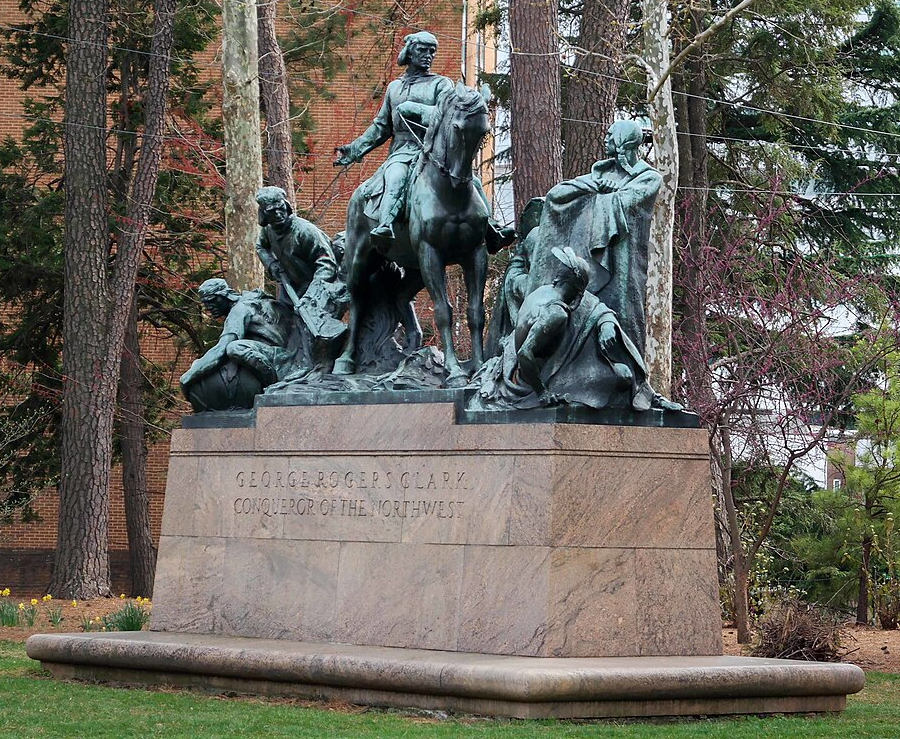
the statue in Charlottesville honoring George Rogers Clark was in place for nearly 100 years before it was removed by the University of Virginia on on July 11, 2021
Source: Wikipedia, George Rogers Clark Monument
the statue in Charlottesville honoring George Rogers Clark was in place for nearly 100 years before it was removed by the University of Virginia on on July 11, 2021
Source: Wikipedia, George Rogers Clark Monument
A statue honoring George Rogers Clark as "Conqueror of the Northwest" was installed on the grounds of the University of Virginia in 1921, enhancing a small park created two decades earlier to replace a coal bin and blacksmith shop. The sculptor placed Clark on horseback in a dominant position, towering over four submissive Native Americans. It was erected as one of four monuments funded by Paul Goodloe McIntire. The others honored Meriwether Lewis and William Clark, Stonewall Jackson, and Robert E. Lee.
As described in the nomination form to place the George Rogers Clark monument on the National Register of Historic Places:1
There were proposals in the late 1980's to move the statue, since it had been designed to be viewed head-on but ended up being placed parallel to the main roadway. The expected $250,000 cost for aesthetic reasons was judged to be too expensive at that time.
Circumstances changed after the election of Donald Trump in 2016 led to discussions on systemic racism and symbols of white supremacy. In 2017, City Council decided to move the statue of Robert E. Lee. That decision was followed by a white nationalist rally in Charlottesville in which a protester and two police officers died. That which drew nationwide attention, including controversial remarks by President Trump, and the Charlottesville City Council quickly decided to move the Stonewall Jackson statue as well.
After the murder of George Floyd in 2020, the University of Virginia decided to move the George Rogers Clark statue. With greater sensitivity to the perspective in Native Americans, the Board of Visitors could accept the estimated $400,000 cost to reduce the visibility of the statue's portrayal of Native Americans in a subordinate status.2
The University of Virginia's "Conqueror of the Northwest" statue was taken down in July, 2021 and placed in storage. The university acted one day after the city of Charlottesville was finally moving its statues of Robert E. Lee and Stonewall Jackson from city parks, after a long legal battle.
A co-founder of the Native American and Indigenous Studies program at the University of Virginia and leader of the George Rogers Clark Statue Disposition Committee described the removal as "bittersweet." While the statue represented to him the removal of indigenous nations from their homelands, it was also the only public, large-scale depiction of Native Americans on the "grounds" of the University of Virginia. Without the statue as a focal point for demonstrations, discussions about Native Americans could fade away:3
A separate statue of Meriwether Lewis, William Clark, and Sacajawea was removed on July 10, 2021. The "Their First View of the Pacific" statue had been installed in 1919 at the highly-visible intersection of West Main and Ridge streets, and was in front of the Federal courthouse.
William Clark was the younger brother of George Rogers Clark. He was co-leader of the expedition sent by Thomas Jefferson to explore the territory between the Mississippi River and the Pacific Ocean.
In 2019, the city determined that the statue of Meriwether Lewis and William Clark represented Sacagawea in an inappropriate subservient position, rather than acknowledging her significant contribution during the 1803-1805 journey to the Pacific Ocean. The statue's portrayal of Sacajawea, who had been essential to the survival of the American exploration group, was perceived as demeaning.
As described in a local paper:4
The Charlottesville City Council held an emergency meeting on July 10, 2021 to authorize the removal that day. The city used the contractor who had just removed the statues of Robert E. Lee and Stonewall Jackson from city parks. The company offered to move the city's statue of Meriwether Lewis, William Clark and Sacagawea at no extra cost, and in a quick vote the City Council took advantage of that opportunity.
The statue was moved to the Lewis and Clark Exploratory Center in Darden Towe Park on the banks of the Rivanna River. William Clark's family had lived on nearby land.5
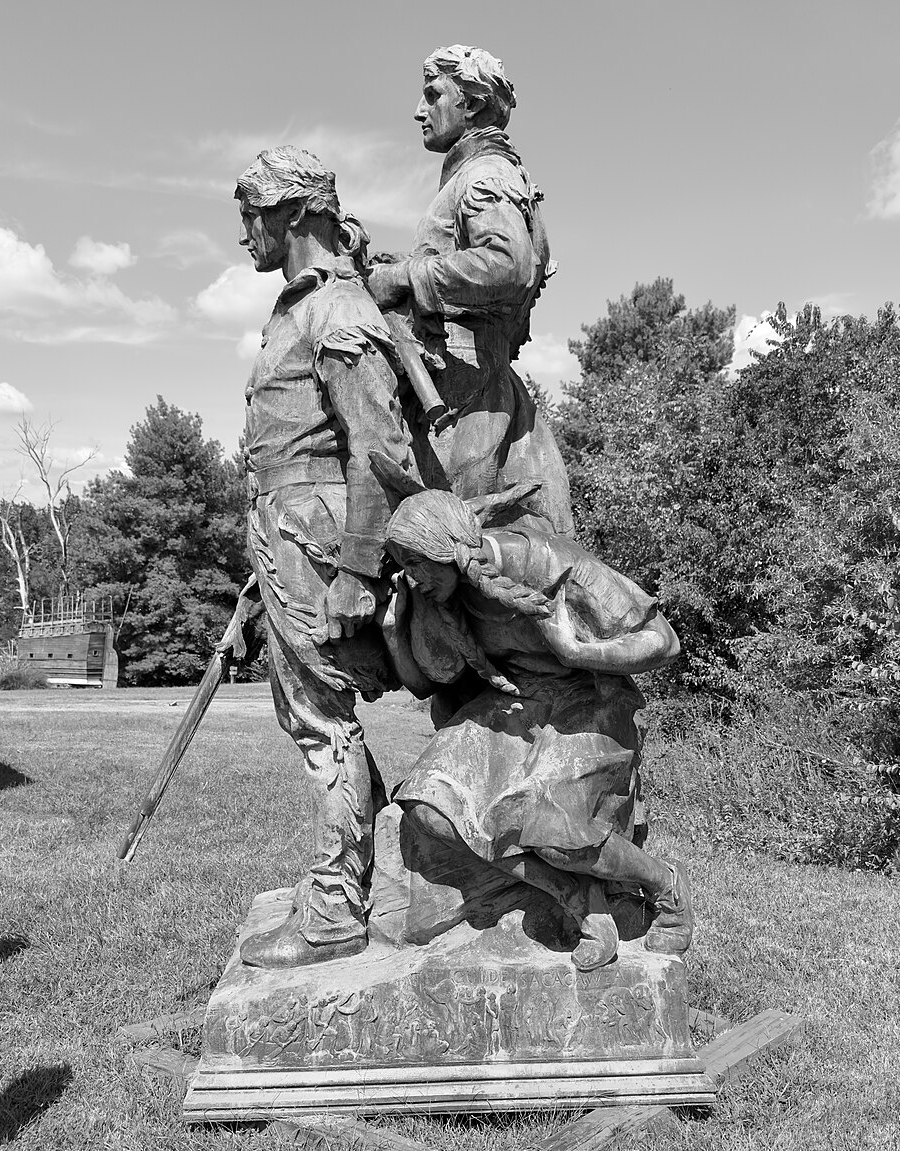
the statue of Meriwether Lewis, William Clark and Sacagawea was moved from its prominent position on Vinegar Hill in 2021 to Darden Towe Park
Source: Wikipedia, Meriwether Lewis and William Clark (sculpture)