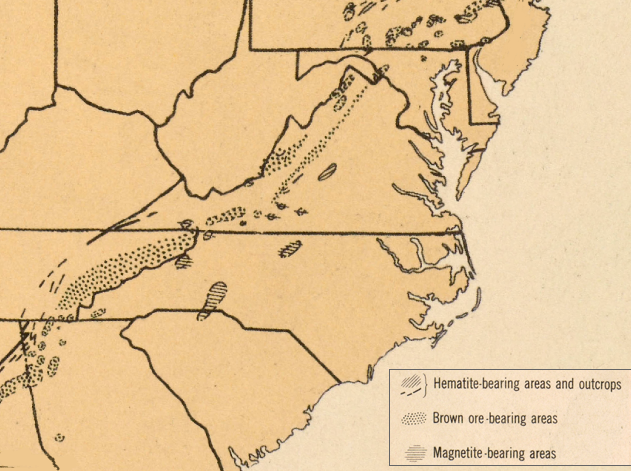
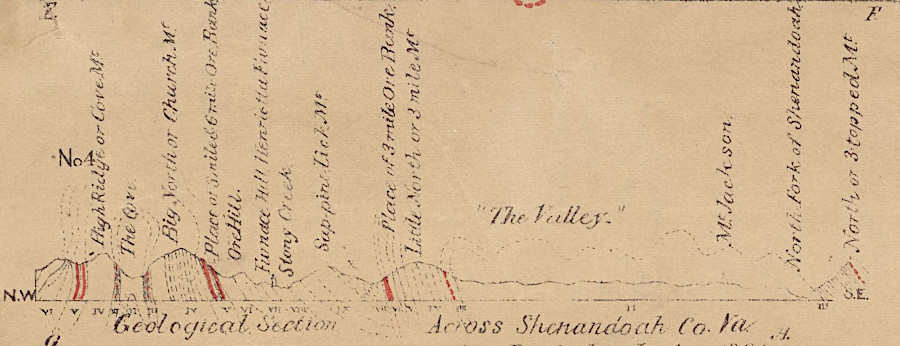
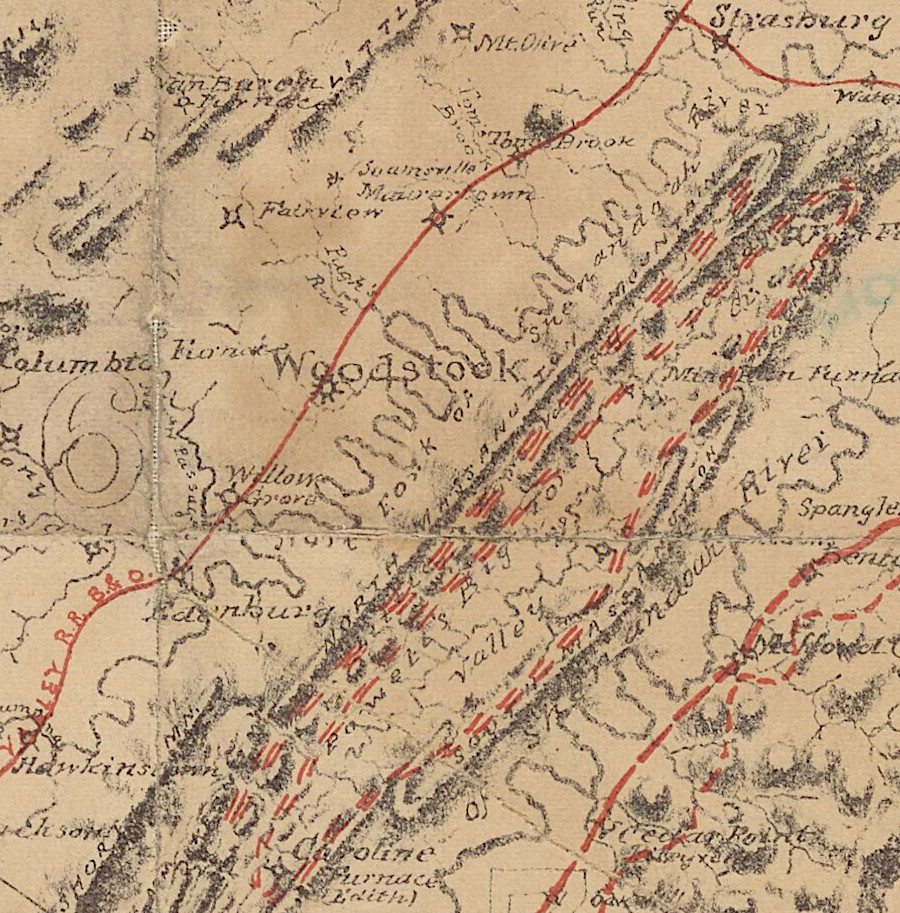
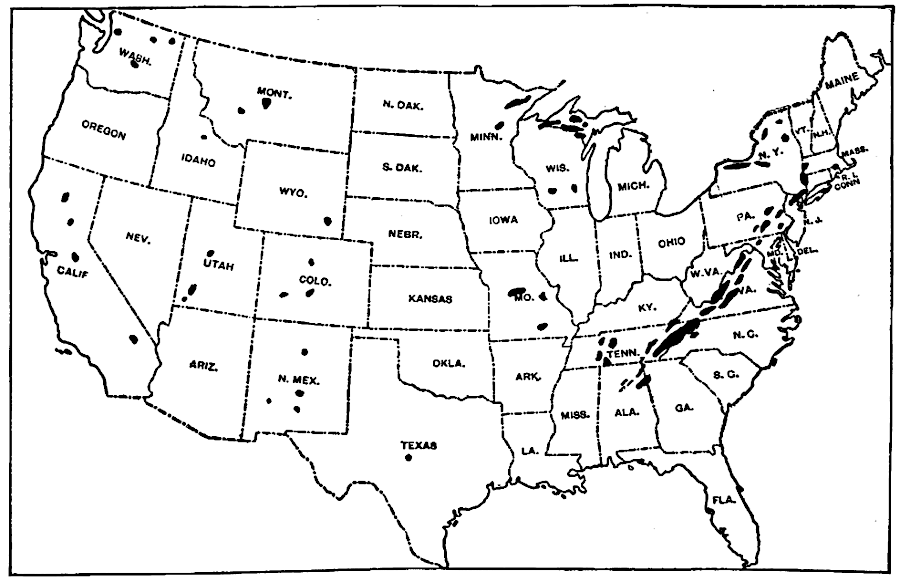
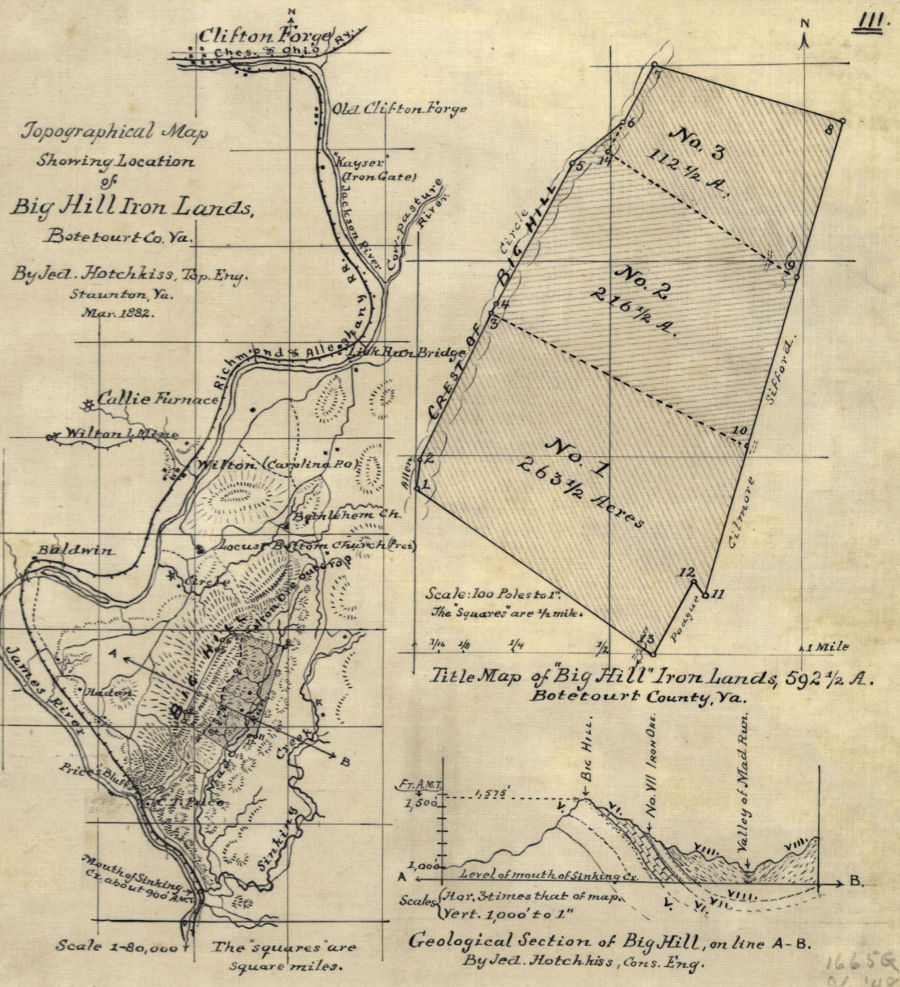
early furnaces during the colonial era utilized bog iron and small deposits or iron ore east of the mountains, until richer deposits were located west of the Blue Ridge
Source: Atlas of the Historical Geography of the United States, Distribution and Production of Iron Ore (Plate 6b, digitized by University of Richmond)
Iron is created in stars through fusion. When lighter elements (i.e., elements with fewer protons) fuse in the core of a star, they emit energy until forming iron. Further fusion starting with iron requires rather than releases energy, halting the process. Smaller stars then cool to become white dwarfs, then black dwarfs that drift through the universe. The iron in such stars remains in the core, unless a collision with another body releases it.
Stars with more than 25 solar masses spew their iron outward in a massive explosion. The conversion of silicon atoms into iron occurs within about one day, after which there is no more heat released from fusion:1
The sudden stoppage of energy generation causes the core to collapse and the outer layers of the star to fall onto the core. The infalling layers collapse so fast that they "bounce" off the iron core at close to the speed of light. The rebound causes the star to explode as a supernova.
When the earth coalesced 4.6 billion years ago, the heavy iron concentrated in the core. It stayed molten from the heat of compression and radioactive decay until 1-1.5 billion years ago, when the inner core crystallized and the iron (and about 4-8% nickel) "froze." The outer core or iron, nickel, and a few lighter elements has remained molten. The outer core next to the inner core is hotter than that portion at the core–mantle boundary. That temperature differential creates currents in the outer core, and the flow of molten iron creates the earth's magnetic field.2
One-third of the earth is iron, measured by weight. Other major elements are oxygen (31%), silicon (19%), magnesium (13%), nickel (1.9%), calcium (0.9%), and aluminum (0.9%). All remaining elements compose 0.3% of the earth. The iron is not evenly distributed; it is just 5% of the crust by weight. The crust is primarily oxygen (47%) and silicon (28%).
In the early days of Earth, iron was dissolved in the oceans. When cyanobacteria began to photosynthesize and the percentage of oxygen in the atmosphere increased, the iron oxidized and sank to the bottom of the ocean to form banded iron formations. Those formations are some of the most valuable mining sites for iron ore today, but no more banded iron formations will be created. There is too much oxygen in the atmosphere for "reduced" iron to accumulate and then precipitate in bands again.
Gas exchange between today's oxygen-rich atmosphere and the oceans quickly triggers precipitation of dissolved iron molecules as an oxide. Oceans have such low iron concentrations now that one proposal for removing carbon from the atmosphere is to dump iron particles into the middle of the ocean. The lack of dissolved iron in the middle of the oceans, away from continental edges where rivers constantly bring minerals eroded from the crust, is a limiting factor for algae to grow. Adding iron would create a spike of algae growth that would capture carbon dioxide, then carry it to the bottom to be incorporated into limestone, silicates, and other minerals which sequester carbon in sediments.3
Much of the iron deposited in Virginia's bedrock was formed by erosion at the end of the Taconic Orogeny. Mountains were lifted up during the collision of a chunk of continental crust with the edge of Virginia. The mountains eroded away during the Ordovician Period over 400 million years ago. By the time the mountains had been reduced to almost a flat peneplain, sediments were primarily quartz (SiO2). Hard-to-dissolve quartz was distributed from the last high spots, creating the sandstone formation known in different places as Tuscarora, Clinch, or Massanutten sandstone.
More material then eroded in the early Silurian Period and was deposited on top of the sandstone. In scattered patches, additional sediments settled on top of the Tuscarora/Clinch/Massanutten formation. The resulting Clinton/Cayugan series of sedimentary formations is unusually rich in iron. The high percentage of iron may be due to the source rocks being a former volcanic island arc.
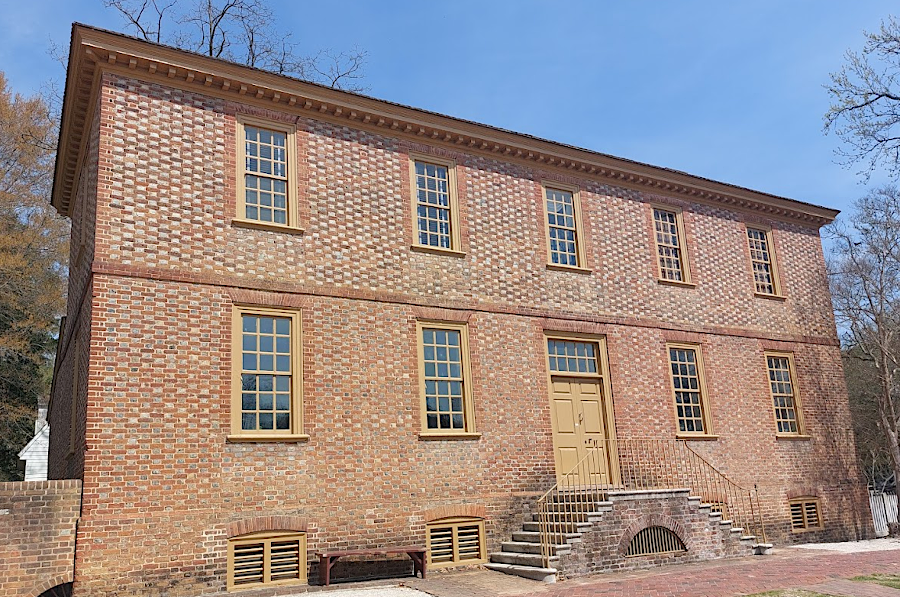
Rivers have carried iron downstream from Silurian sandstones in the Valley and Ridge physiographic province, and from later island arc terranes that accreted onto Virginia as Pangea formed and became part of the Piedmont. Clay particles from Chincoteague to Cumberland Gap are stained red with hematite (oxidized iron). The iron in the clay produces the red color of bricks across the state, except where potassium in the smoke from oak logs burning in kilns produces a darker grey hue.
builders in Williamsburg used bricks that were baked in different locations within kilns to create patterns of grey and red (Ludwell-Paradise house)
Iron ore is present in different forms in Virginia, with iron and oxygen atoms aligning together in different ways. The most common form processed in Virginia was yellow ore called limonite (Fe2O3+H2O). Iron production in Virginia ceased around 1930 at the start of the Great Depression.
Iron is also present in the form of hematite (Fe2O3), magnetite (Fe3O4), and siderite (FeCO3). Magnetite deposits have been mined near the Blue Ridge from Lynchburg to Grayson County in southwestern Virginia. During the 1800's, the great expansion of iron production that was centered around Pittsburgh relied upon burning coal/coke to smelt hematite.
The crystalline bedrock deep below Jamestown is rich in iron. Those ancient rocks are buried beneath Coastal Plain sediments. There are no bedrock outcrops east of the Fall Line where iron could be concentrated through chemical weathering and become accessible to colonists coming from Europe. The iron in Virginia's limonite deposits was first exposed on the surface in mountains uplifted during tectonic events, such as the Alleghenian Orogeny nearly 300 million years ago.
When minerals are exposed to water and oxygen at or near the surface, the iron-rich minerals dissolve slowly while others wash away. Limonite, created when faster-to-dissolve minerals washed away, includes roughly 60% iron (Fe).
When humans first reached Virginia about 20,000 years ago, eons of rainfall had leached iron from the soil at the surface. Rainwater which seeped into the soil carried dissolved iron ions deeper, down to where shells rich in calcium carbonate altered the water chemistry. Ions in the acidic groundwater were "reduced" when the pH rose and precipitated out of solution, typically concentrating the iron one-three feet beneath the surface.
The first settlers on the Coastal Plain, who arrived 15,000-20,000 years ago, found iron ore. It was limonite at the top of the Yorktown formation. Native Americans used it as a yellow, orange and red pigment.
There are limonite deposits in the Valley and Ridge physiographic province; most of the iron mining west of the Blue Ridge also involved limonite deposits. The first limonite mining was around 1760; that ore was processed in a bloomery near the Shenandoah River. Like all colonial-era iron production, the bloomery was fueled by charcoal. There were coal deposits near the Fall Line of the James River, but timber for making charcoal was abundant and closer.
There are limonite deposits in Pulaski and Smyth counties. In the shallow residual "mountain ore" deposits there, iron was originally combined with sulfur to form pyrite. In groundwater, the sulfur went into solution; the iron remained with the clay minerals to form "gossan" deposits.
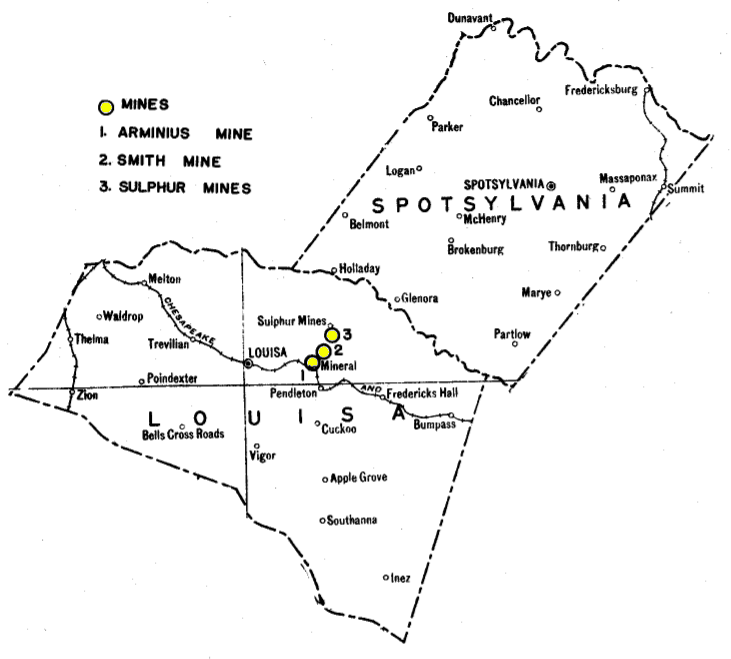
iron ore in Louisa County was mined along with pyrite in gossan deposits
Source: Virginia Department of Mines, Minerals and Energy, Iron in Virginia (Plate 5)
Other limonite deposits in the Oriskany sandstone and Helderberg limestone are located in the Shenandoah Valley and near Clifton Forge. The limonite was originally in Devonian shales, deposited on top of the limestone. Iron dissolved in groundwater and was transported down to the Helderberg, where it came out of solution and created concentrations of ore. A geological report notes:4
Outcrops of Oriskany ore are most commonly found on the lower slopes of the mountains a few hundred feet above the valley bottoms where they may appear for miles along the strike of the formation. Continuous ore bodies having a fairly constant thickness of from 8 to 25 feet have been worked for one-half mile. These ore bodies have not been deformed or fractured since they were deposited.
Iron began to replace bronze, the mix of copper and tin, around 800 BCE (Before Common Era) in Europe. Iron ore required higher heat to extract than copper, but ore was more available and processing iron into useful products required less skill than bronze. Within seven centuries, it became the primary metal used in everyday life for tools and for weapons. The technology of the blacksmith working at a forge stayed stable for the next 2,000 years, though charcoal was replaced with coal wherever available.
Native Americans in Virginia did not develop the technology to separate iron from the other minerals in limonite; their only metal was copper until Spanish and other European sailors arrived in the 1500's. The copper used in Virginia was produced by hammering the native copper ore; no smelting was involved.5
The European colonists who arrived in the 1600's were well aware of the potential to develop an iron industry in the English colonies.
During the Seventeenth Century, England's domestic iron industry was not sufficient to meet its needs, so England imported much iron from Scandinavia. At the start of the 18th Century, Sweden's neighbors joined forces in the Great Northern War. That destroyed Sweden's control over the Baltic, simultaneously ending Sweden's capacity to meet demand for iron throughout Europe.
England had relied upon Spain and Sweden for over 80% of its iron imports. Starting colonies offered the opportunity to find a new source of iron. The instructions written in 1606 to the colonists who settled at Jamestown included directions to use some men to build a fort and storehouse, others to serve as sentinels, and to send 40 men to search for gold, silver, copper, and iron:6
...when they Do Espie any high Lands or hills Captain Gosnold may take 20 of the Company to Cross Over the Lands and Carrying half a Dozen pickaxes to try if they Can find any mineral.
From the beginning, the Virginia Company hoped to produce iron in Virginia. A blacksmith was on one of the first three ships with colonists that sailed to North America in 1606, and John Smith shipped barrels with seven tons of ore back from Virginia in 1608. His men may have dug that ore at Falling Creek, near the Fall Line of the James River.
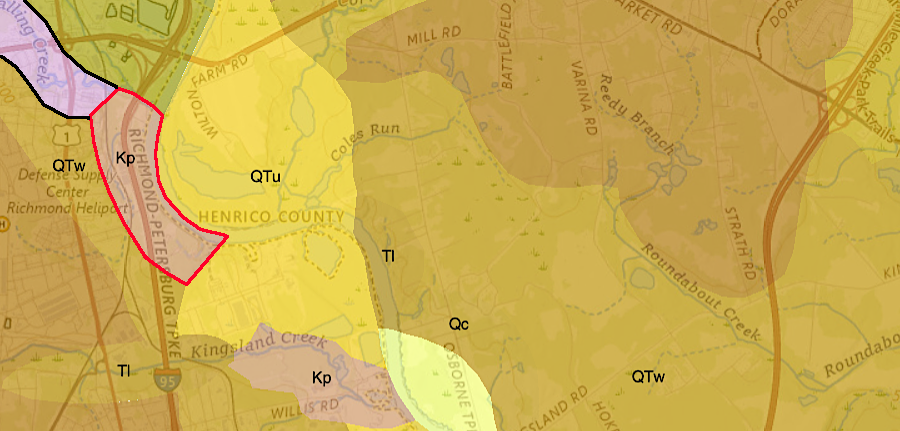
iron ore shipped to England in 1608 may have come from the Potomac Formation exposed at Falling Creek (red boundary), perhaps enriched from the adjacent Petersburg Granite (black boundary)
Source: Virginia Energy, Geology and Mineral Resources
Further north, at the Popham (Sagadahoc) colony established by the Plymouth Company, colonists used local bog iron as well as iron they had brought from England to make the hardware needed to construct a ship in the winter of 1607-1608.
By 1610, there were plans for constructing ironworks in Virginia. In 1619, the Virginia Company sent 150 workers with expertise in manufacturing iron to Virginia.
After Sir Edwin Sandys became Treasurer (equivalent to the Chief Executive Officer position in modern corporations) in 1618, the Virginia Company invested heavily in an attempt to generate profits from iron mining and production. Sandys sent another 20 ironworkers in 1621.
The iron ore found in Virginia was no better than the ore in England, but in the colony there was easy access to the trees needed for charcoal production. In contrast, England was nearly deforested. Establishing an iron industry in Virginia had promise mostly because of the low cost of energy there.
Sandys' team, led by Captain Blewett (also spelled "Bluett" and "Bleuets"), started to process ore and ship iron from Virginia to England in 1620. By 1622 the Virginia Company had constructed a furnace at Falling Creek, using funds originally intended for the new college at Henricus. Investing the college funds in the manufacture of pig iron was expected to generate a steady set of profits.
Excavating and shaping the stone required to construct a furnace chimney 25-30 feet high required a major commitment of labor that could have been used to generate more-reliable profits from tobacco. So did digging the limonite ore, gathering oyster shells for flux to lower the melting temperature of the iron in the ore, and making the charcoal to heat the stack.
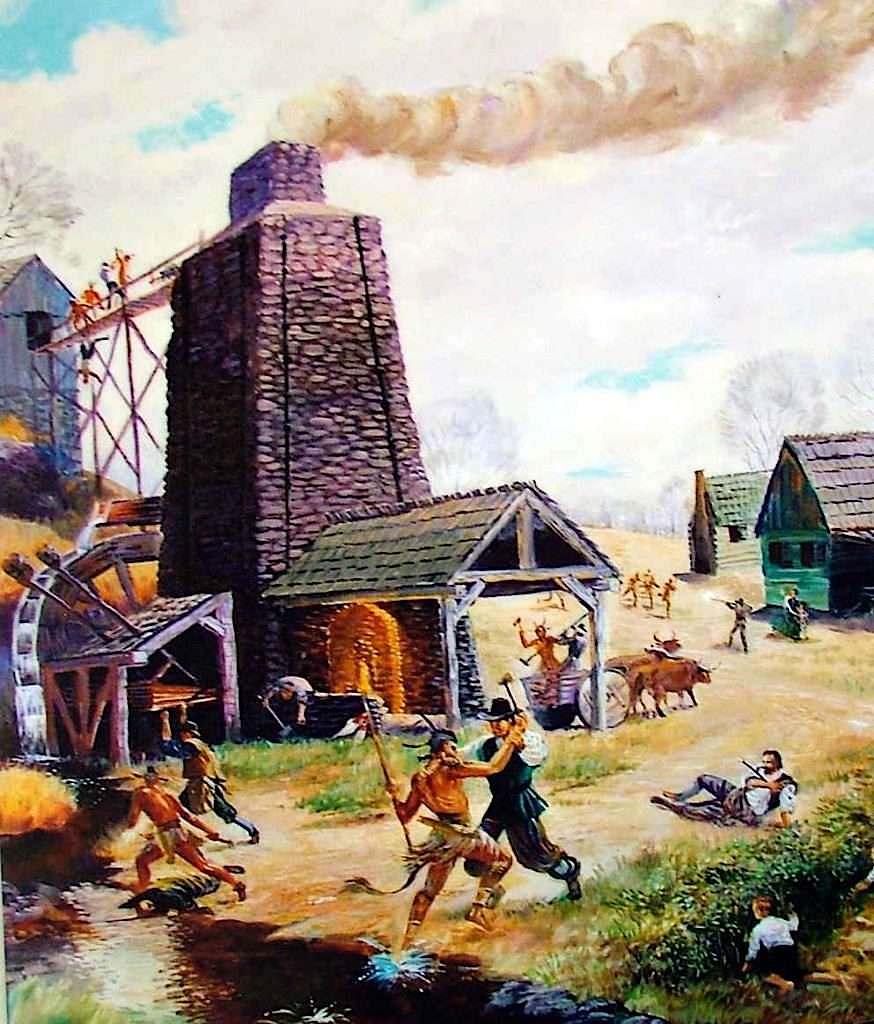
In the March 22, 1622 uprising led by Opechancanough, all 27 of the colonists at Falling Creek were killed and the ironworks was destroyed. That furnace, located at the far western edge of English settlement and exposed to future attacks, was not rebuilt in colonial times. The skilled workers who could have done so were dead; the equipment was either destroyed or tossed by Opechancanough's warriors into the James River.
Slag, charcoal, and cylinders of pig iron were found at the site in the 1880's through the 1950's. Stones from the blast furnace may have been repurposed and incorporated into the bridge constructed by the Richmond and Petersburg Turnpike over Falling Creek in 1823. Other slag was probably used as ballast when roads were constructed in the area.
The Virginia Company sent nine workmen in 1623 to create a bloomery, anticipating that would require less expertise and up-front construction costs. The historical records do not indicate if any iron was produced. The Virginia Company was dissolved by King James I in 1624. The venture capitalists had invested 5,000 pounds to send workers and supplies over four years to start an iron industry in the colony.
King Charles I was requested to fund a restart of the ironworks. He sent a man to Virginia in 1628 to assess the potential, but that person became embroiled in other issues. In 1630 Governor John Harvey visited the remains of the ironworks at Falling Creek. He recognized the site still had a good supply of iron ore, timber for charcoal, and water for powering a bellows to increase the temperature in the furnace.
A former investor in the Virginia Company, John Zouch, came to Virginia in 1634 and sought to renew iron production. Zouch joined the faction opposed to Governor Harvey and then returned to England in 1635 and William Byrd I acquired the land. He had sufficient acreage to produce the necessary charcoal, and in the 1690's he considered building an iron furnace.
The first person to actually process iron again at Falling Creek was Archibald Cary, who built the plantation house Ampthill nearby. In 1760 Cary apparently built a forge and processed pig iron imported from furnaces on the Rappahannock River and in Maryland. In 1781 the British, commanded by Benedict Arnold, burned the structures there during a raid from Portsmouth to Richmond.
England ended up obtaining its iron from sources other than Virginia. For a century after the 1622 destruction of the Falling Creek ironworks, Virginia depended upon European imports and small "bloomery" operations for iron items. Governor Spotswood finally began large-scale iron production again with construction of the Tubal Furnace around 1717.7
Both were in short supply during the colonial period. The charter of the Virginia Company was revoked in 1624 and England fell into civil war in the 1630's. King Charles II gained the throne in 1660, but did not provide investment capital to his "Old Dominion." The wealthy colonists who could afford to purchase indentured servants and later enslaved workers focused on tobacco production. Wood for charcoal and iron ore were readily available, but making iron in Virgina also required labor and capital.
Until the 1750's, Virginians relied almost exclusively upon imported bar iron to make local products such as nails and the strong iron bands holding staves together on hogsheads and other barrels. Manufactured iron products, such as guns and firebacks used to reflect heat and made fireplaces more efficient, were also imported.
British policy encouraged shipment of raw materials to England and discouraged manufacturing in the colonies. The mercantilist economic philosophy intended that the value added by processing raw materials into manufactured products would generate profits within the home country. Once Virginians finally started building iron furnaces and smelting the local ore, Britain officials directed that the iron be shipped across the Atlantic Ocean for further processing into useable products. English colonists were supposed to supply pig iron to the mother country; not to create products in North America. Manufacturing would compete with industries in England and take jobs away from workers in the British Isles.
Despite the mercantilist approach, colonists still managed to process some iron for local use. Little investment in infrastructure was required to build a small "bloomery" and produce iron in colonial Virginia. The immediate needs of colonists for producing nails and small tools such as hoes and shovels, and for repairing guns and other imported items, were satisfied by blacksmiths working with iron made at small-scale bloomery operations.
In a bloomery, charcoal-fueled fires heated chunks of bog iron ore about the size of a modern baseball. That raw material could be gathered from wetlands or mined from the Coastal Plain sediments.
The ore was raised to a temperature hot enough to melt the iron oxide and silicate minerals, and the bloom of hot ore was hammered repeatedly. That process gradually separated molten iron droplets from the silica and other undesired minerals in the raw ore, eventually creating a chunk of iron that could be used by a blacksmith.
Hammering the bloom oxidized carbon. The chemistry and physical character of a iron in a bloom was modified as ore was heated to create a "worked" (wrought) mixture of iron with a low percentage (0.1%) of carbon and 2-4% of silicates. A small percentage of the silicates in the ore, together with sulfur, phosphorous, and aluminum oxides, melted and bonded together with the iron in the fire.
Most minerals other than iron in the ore ended up as a glassy waste ("slag") and was discarded. Presence of slag at an archeological site is an indicator of an ancient bloomery.
In contrast to the wrought iron produced in low-cost bloomeries, iron furnaces built in the 1700's were capital-intensive manufacturing facilities that produced pig iron. To create pig iron, molten iron straight from a furnace flowed into molds on sand floors. Depressions in the sand were arranged in a pattern which resembled piglets sucking milk from their mother sow. Cylinders of iron cooled in those depressions into "pig iron."
Some iron straight from the furnace was directed in channels to sand molds shaped to create cast iron products such as stove parts and firebacks. Once cooled, the cast iron parts were ready to use; they were not hammered and shaped into a final product at a forge.
Cast iron is an iron-carbon alloy with 2-4% carbon. Molding products directly from cast iron did not require the labor of hammering to reduce the percentage of carbon, but cast iron was also more brittle than wrought iron.
Pig iron cylinders produced at an iron furnace were a cast iron product with a high (3% and higher) percentage of carbon. Pigs of cast iron were easy to ship to blacksmiths at plantations or in towns. Those blacksmiths, typically indentured servants and enslaved workers on large plantations, heated the pigs in a forge. They hammered the hot material to remove the carbon that was not chemically combined with the iron, producing wrought iron that could be hammered into the desired shapes and was not brittle like cast iron. Forges could be large scale operations, with hammers powered by water wheels.
Reheating and hammering pigs converted the material from the blast furnace from cast iron into wrought iron. Both the chemical percentages and the physical alignment of iron particles are different between cast iron and wrought iron. When cooled, wrought iron becomes a fibrous product that is more malleable than cast iron, in which iron molecules solidify into a flake-like pattern.
Wrought iron served as the basic material for manufacturing iron products until the development of steel. The main need in the colony was for farm tools. Blacksmiths made wrought iron so they could create hoes, plowshares, and other implements needed for agricultural operations.
Pig iron was also processed to create metal objects needed for buildings (such as nails and hinges) and ship construction. Demand fluctuated based on the colonial economy, which depended upon the selling price of tobacco and competition with bar and rod iron imported from Great Britain through Chesapeake Bay ports.
Wrought iron was welded together by using a flux or limestone or borax to prevent the edges of metal pieces from oxidizing during the welding process. Wrought iron was shaped by blacksmiths to create items such as tools, hinges, rims for wheels, and other products which Virginia colonists needed before the next ship arrived from England with manufactured goods for sale.8
Steel includes a higher percentage of carbon than wrought iron. Steel is an iron-carbon alloy with small grains, rather wrought iron's mixture of iron silicates aligned as fibers. It was not manufactured in significant quantities in North America until after the Civil War. Development of the blast furnace, using of coke for both heat and as a carbon source, facilitated the creation of modern steel.
Ductile iron, developed in the 1940's, is an iron-carbon alloy with more carbon that steel plus a "nodulizer" ingredient such as magnesium. Ductile iron can be bent or pulled more than cast iron. The addition of a nodulizer causes carbon atoms to form spheroidal nodules rather than the flat flakes in cast iron. The flat flakes create zones of weakness where a metal item is likely to break. Municipal and private utility companies are replacing cast iron water pipes, mostly installed before the 1960s, with ductile iron pipes to minimize waterline breaks and increase system reliability.9
The eventual construction of iron furnaces in the mid-1700's reflected the transfer of capital and expertise across the Atlantic Ocean, as well as the lower cost of charcoal in North America. Iron furnaces mark the beginnings of an industrial base in North America:10
Blast furnaces cannot exist without extensive capital, industrial organization, trade networks, and technical expertise, all of which were all but unknown in America when George I ascended the British throne in 1714.
New governor Alexander Spotswood initially requested funding from the Board of Trade in 1711 to construct a furnace to smelt iron ore. The Board of Trade declined to support iron production in Virginia; competition from a new source would reduce profits of existing iron producers in England. Spotswood was not deterred, however.
In 1714 the governor used a group of German immigrants to build the Tubal Furnace on his land in the Rappahannock River valley upstream from the Fall Line. Those immigrants had been recruited by Baron de Graffenried, who claimed there were silver deposits to be mined. That claim was based on discussions with Frantz Ludwig Michel, one of the first Europeans to explore the Shenandoah Valley.
Baron de Graffenried recruited Swiss Anabaptists and other Protestant refugees from the Palatinate during the War of the Spanish Succession and started a settlement in North Carolina. He founded the town of New Bern in 1710, but the Tuscarora soon killed most of the immigrants he settled further inland.
De Graffenried was captured but managed to survive, with help from Governor Spotswood. The baron traveled to Williamsburg to talk with the Virginia governor before returning to Europe.
Spotswood knew in advance that more miners from the Rhineland were coming from Great Britain to Virginia instead of North Carolina.
He took advantage of the available labor and got the Governor's Council to subsidize their initial settlement on his western lands. Spotswood used the immigrants as indentured servants to develop already-recognized iron deposits and started an iron furnace around 1717. William Byrd II called Spotswood Tubal-Cain, a character described in the Book of Genesis as "an instructer of every artificer in brass and iron."
The Tubal furnace was located where two tributaries flowed into the Rappahannock River; it is now archeological site 44SP12. Water was diverted into wooden pipes to power the bellows via a water wheel 20' in diameter.
Ore came from an iron deposit a mile away from the furnace. Holes were drilled into the sandstone with the ore and filled with gunpowder for initial excavation blasts. Tubal Furnace was engineered so temperatures rose high enough to extract iron from hematite; other colonial iron furnaces heated limonite ore to lower temperatures in order to melt the iron.
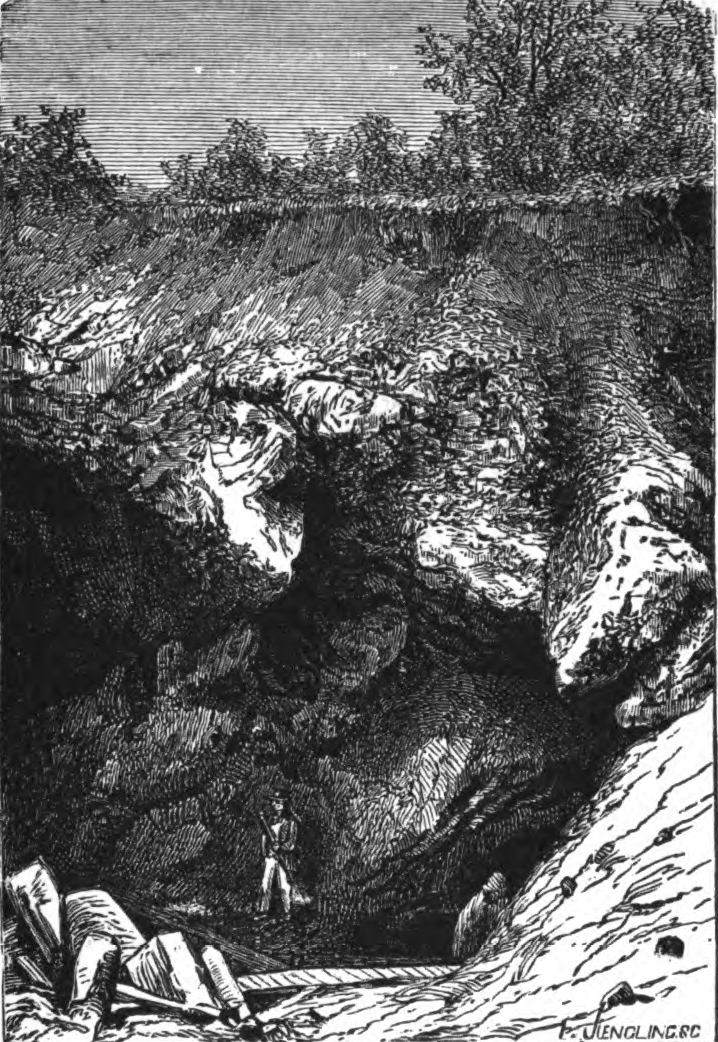
iron ore extraction was done primarily by hand, even after the Civil War
Source: "The Chesapeake & Ohio Railway Directory, Containing an Illustrated History and Description of the Road," View of Iron Ore Mines, Ferrol Furnace, VA. (p.302)
After ensuring he had enough settlers, Spotswood finally patented his 3,229-acre Germanna tract in 1716 and his 15,000 acre Mine Tract in 1719. When the Germans finished their term of indenture, Spotswood relied primarily upon enslaved black workers to operate the blast furnace plus two hired workers. One was a general overseer. The other was a "founder" with the technical skill to recognize when to tap the furnace and release the iron into the sand molds.
The Tubal Furnace was a self-sufficient industrial plantation. The enslaved workers built their own housing, grew their own food, even made their own shoes from the hides of the cattle that they raised. Spotswood claimed:11
...the whole of my ironworks is carried on by slaves who heve no wages and who will always be more subservient and observant of Orders than freemen in this country will be.
Spotswood built a second "air furnace" operation 15 miles away on Massaponax Creek. There his indentured servants and enslaved workers forged pig iron into pots and other goods for sale. Iron for cart wheels was shipped to other colonies and even the West Indies. Recognizing the bias towards mercantile policy, officials in the colony regularly reassured those in London that iron production in Virginia was unprofitable.
The Massaponax site has been destroyed by modern construction.
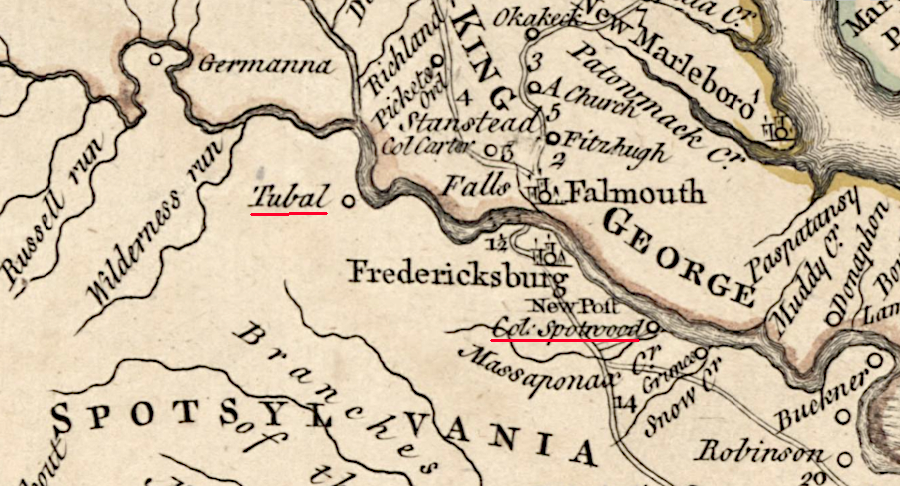
the Tubal and Massaponax furnaces were southeast of Spotswood's Germanna settlement
Source: Library of Congress, A map of the most inhabited part of Virginia (Joshua Fry and Peter Jefferson, 1755)
By 1734, there were three blast furnaces in Virginia producing pig iron plus the furnace at Massaponax. Prince William County had an iron furnace on Neabsco Creek in the 1730's, and George Washington's father Augustine managed a furnace in Stafford County.12
In the middle of the 1700's, officials in London replaced the policy of "salutary neglect" of the colonies with a more intrusive "imperial administration" approach. Advocates of mercantile policy supported the production of pig iron as a raw material in the colonies, but objected to processing it into bar iron that could be converted into products for sale in North America.
A petition to Parliament, Reasons Offered Against Encouraging Making Iron in America, included the claim that:13
The Encouraging the Making of Iron in America, will put them upon Manufacturing, and they will supply them selves first, and all the Colonies; so that the Manufacturers here must starve...
Fear of competition from manufacturing led Parliament to pass the Iron Act of 1750.
And on the other side, there was support for iron manufacturing in the colonies. The English were already importing most of their iron from Sweden, since the forests of England had already been exhausted while Scandinavia still had easily-accessible fuel resources.
Thomas Jefferson described Virginia's iron resources as follows:14
Iron The mines of iron worked at present are Callaway's, Ross's, and Ballendine's, on the South side of James river; Old's on the North side, in Albemarle; Miller's in Augusta, and Zane's in Frederic. These two last are in the valley between the Blue ridge and North mountain. Callaway's, Ross's, Millar's, and Zane's, make about 150 tons of bar iron each, in the year. Ross's makes also about 1600 tons of pig iron annually; Ballendine's 1000; Callaway's, Millar's, and Zane's, about 600 each. Besides these, a forge of Mr. Hunter's, at Fredericksburgh, makes about 300 tons a year of bar iron, from pigs imported from Maryland; and Taylor's forge on Neapsco of Patowmac, works in the same way, but to what extent I am not informed. The indications of iron in other places are numerous, and dispersed through all the middle country. The toughness of the cast iron of Ross's and Zane's furnaces is very remarkable. Pots and other utensils, cast thinner than usual, of this iron, may be safely thrown into, or out of the waggons in which they are transported. Salt-pans made of the same, and no longer wanted for that purpose, cannot be broken up, in order to be melted again, unless previously drilled in many parts.
In the western country, we are told of iron mines between the Muskingum and Ohio; of others on Kentucky, between the Cumberland and Barren rivers, between Cumberland and Tannissee, on Reedy creek, near the Long island, and on Chesnut creek, a branch of the Great Kanhaway, near where it crosses the Carolina line. What are called the iron banks, on the Missisipi, are believed, by a good judge, to have no iron in them. In general, from what is hitherto known of that country, it seems to want iron.
John Tayloe II ran the Neabsco ironworks and, after 1755, the Occoquan ironworks in partnership with Presley Thornton. In 1755, they bought 1,800 acres in Prince William County to supply fuel (charcoal) for the Occoquan furnace, and hired John Ballendine to build it. The furnace was in blast in 1756, but the partnership with John Ballendine ended in 1763.15
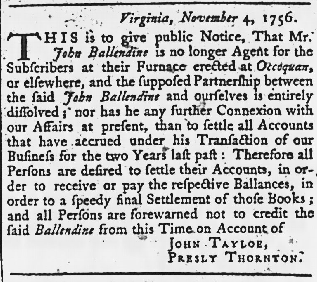
by 1756, the one-year old partnership at Occoquan between John Ballendine and John Tayloe II/Presley Thornton had broken down...
Source: Maryland State Archives, Maryland Gazette (November 25, 1756)
The Neabsco and Occoquan ironworks were supplied with iron from Maryland mines. They relied upon the waterpower from the Occoquan River and Neabsco Creek, charcoal from 20,000 acres of Prince William County forests owned by John Tayloe II, and oyster shells from Freestone Point used as the "flux" to lower the temperature in the furnace at which iron would separate out from the ore.16
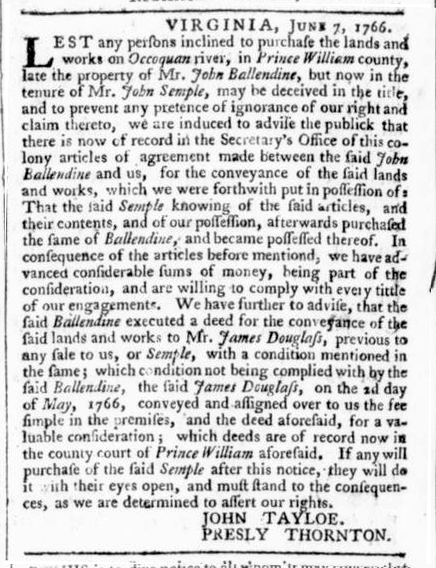
in 1766, John Tayloe II and Presley Thornton advertised that John Ballendine had no legal right to sell any claim to the Occoquan complex to John Semple or James Douglass
Source: Colonial Williamsburg, The Virginia Gazette (Purdie and Dixon, June 13, 1766)
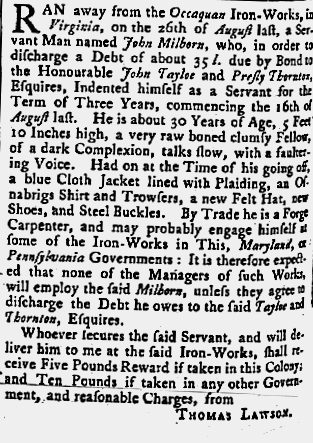
indentured servants, convict servants, and slaves fled from the Occoquan and Neabsco ironworks
Source: Maryland State Archives, Maryland Gazette (September 16, 1762)
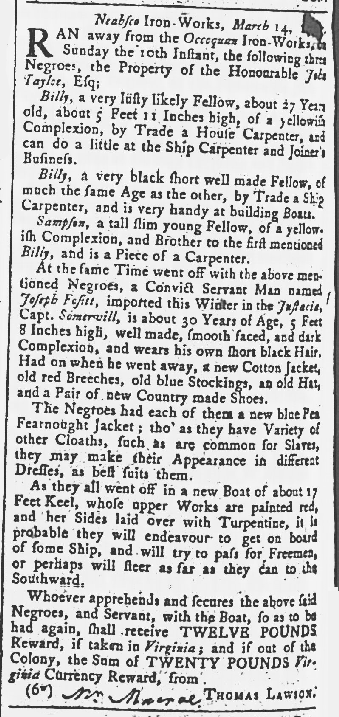
Billy, a ship carpenter, ran away from Occoquan in 1765 with fellow slaves and a convict servant
Source: Maryland State Archives, Maryland Gazette (April 4, 1765)
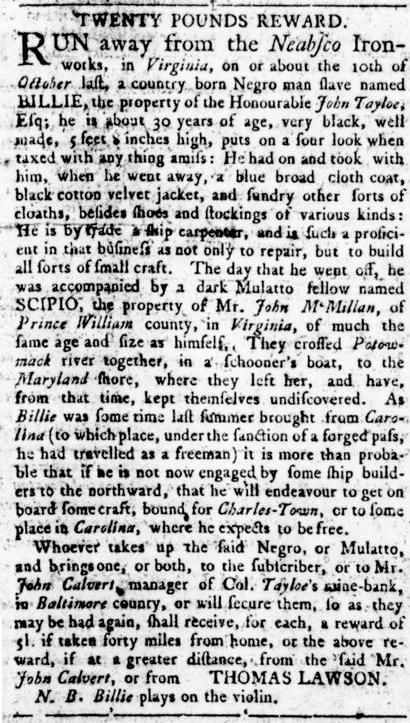
Billie ran away again in 1768
Source: Colonial Williamsburg, The Virginia Gazette (Rind, February 09, 1769)
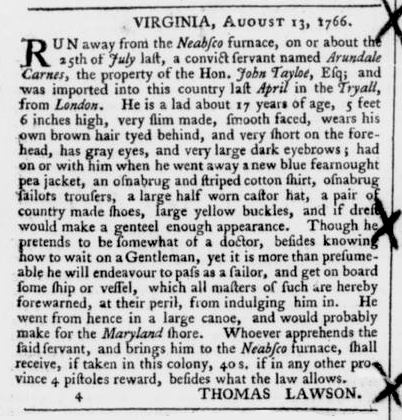
slaves, convict servants, and indentured servants fled from the Neabsco ironworks by crossing the Potomac River to Maryland, hoping to get a job on a ship leading away from Virginia
Source: Colonial Williamsburg, The Virginia Gazette (Purdie and Dixon, August 29, 1766)
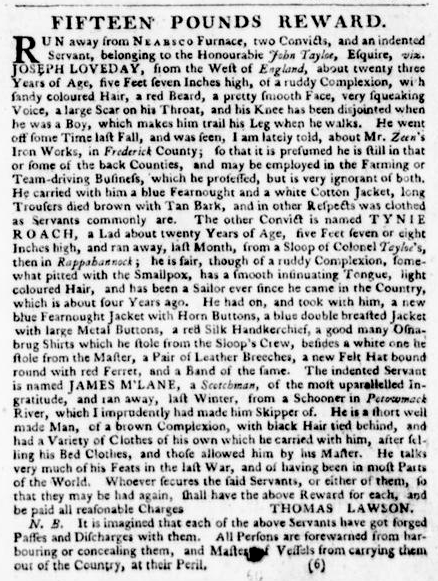
one runaway from Neabsco Ironworks may have sought employment at Zane's Ironworks in Frederick County
Source: Colonial Williamsburg, The Virginia Gazette (Purdie and Dixon, July 8, 1773)
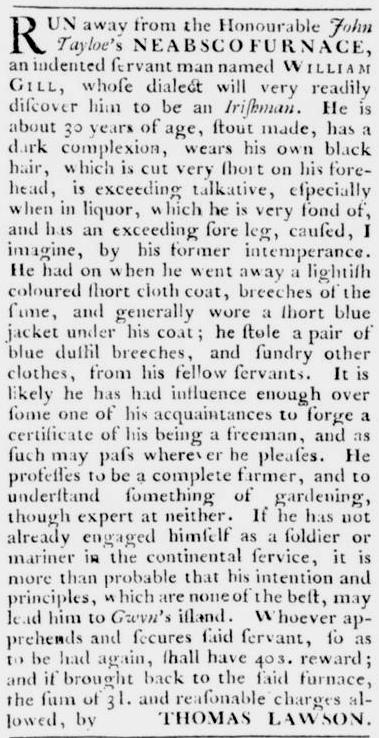
one runaway from Neabsco Ironworks may have fled to Gwynn's Island
Source: Colonial Williamsburg, The Virginia Gazette (Purdie, July 12, 1776)