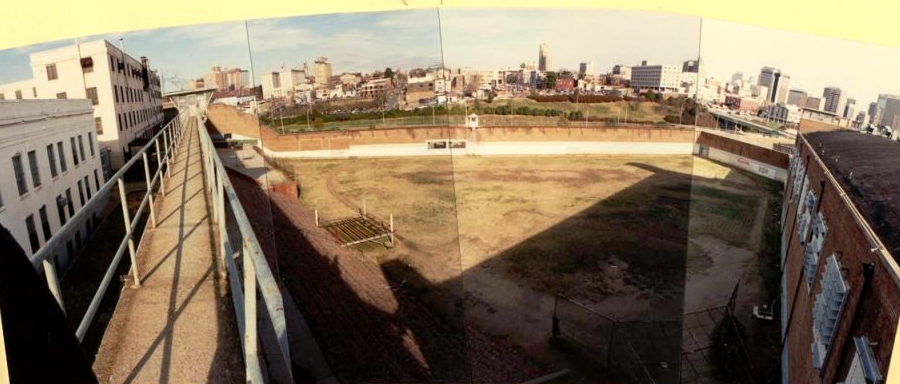
the exercise yard at the State Penitentiary in Richmond, which closed in 1990
Source: Library of Virginia, Virginia Memory, Virginia State Penitentiary Photograph Collection
the exercise yard at the State Penitentiary in Richmond, which closed in 1990
Source: Library of Virginia, Virginia Memory, Virginia State Penitentiary Photograph Collection
There was no long-term imprisonment for crimes in colonial Virginia. Many crimes were punished by fines. Those who were not members of the elite could be punished by a whipping, branding with a hot iron for first-time offenders, cutting off an ear, or by being placed in the "stocks" where the public could see them. The death penalty was used for major crimes.
Prisoners were held in jails before their trial, but "gaols" were intended for short stays until the county court justices could assemble. The colonists did not adopt the concept of threatening people with a long-term stay in a prison as a tool to deter crime.
Incarcerating someone was not a simple challenge. The initial structures built by the English colonists were "earth fast." The wooden timber frame of the building was placed directly on the ground without a stone foundation, and wood in moist soil rotted within a few years. A brick jail with a stone foundation was the obvious alternative, but Virginia counties could not afford to build many brick buildings.
Feeding a prisoner while prohibiting him from working was a high burden to impose on the rest of the colonial Virginians who paid taxes to finance government operations. The lower the cost of government operations, the lower the taxes. It made more sense to impose a fine or a whipping, rather than to impose a prison sentence to punish criminal behavior.
For similar reasons, vestries of Anglican parishes did not build orphanages. Children were indentured to someone who needed a laborer, and would absorb the costs of food and board in exchange.
The typical punishment for indentured servants who ran away before serving all of their time was to extend their term of service. By using a financial or physical punishment rather than imprisonment, the community was not burdened by the costs of jails or jailors.
The opportunity to extract value from slave labor was not wasted by imprisonment. Punishment for an enslaved person convicted of crimes included cropping their ears and whippings. Local county courts were authorized to condemn a slave to death, though white convicts accused of a capital crime had to be sent to Williamsburg for trial by the General Court.
If an enslaved person was executed for committing a capital crime in pre-Civil War Virginia, the slaveowner was reimbursed the value of the slave by the colonial/state government. Unless slaveowners were reimbursed, they would hide their valued workers from execution. Protecting a slaveowners personal economic investment would expose the community to the risk of future criminal behavior.
During the pre-Civil War era, fears of slave insurrections were always present. The number of actual armed rebellions were few, but individual resistance was common. In cases where enslaved workers were convicted of a crime and expected to remain a troublemaker, they might be shipped to a more-southern colony or to the West Indies where conditions were more brutal.
After county governments in Virginia were established in 1634 the local courts handled civil and almost all criminal cases, along with legislative issues and executive management of the county. Local jails were built next to local courthouses to hold the accused until the members of the court would assemble each month. When debtors were imprisoned to try to encourage them to repay their obligations, the debtors themselves (or the creditors demanding to be paid) were required to pay for the room and board at the county jail.
Criminal justice was usually very swift, though civil issues often involved delays until witnesses were gathered and evidence submitted. If a case was a capital crime where a verdict of guilty would be followed by execution, the local court would decide if the defendant should be released or transferred to Jamestown/Williamsburg for trial by the colonial General Court which met every three months.
There was no Death Row in colonial Virginia. People convicted of capital crimes were executed at the gallows in Jamestown or Williamsburg soon after the General Court condemned them. Admiralty courts also had the power to order executions, and some pirates associated may have been hung at Hampton. For Blackbeard's pirates captured in 1718, their jail before trial and execution was a ship.1
Shortly after the capital of Virginia was moved from Jamestown to Williamsburg in 1699, a sturdy brick "gaol" (jail) was constructed in Williamsburg next to the colonial Capitol building. The whole jail was 20x30 feet, the size of a modern great room in today's suburban homes. In the first version of that tiny jail, there were two even tinier 10x10 foot cells.2
The sanitary and jail crowding standards of that time were far different than today. In 1779, seven prisoners were incarcerated in just one cell, and that space included the toilet. The top British official captured at Detroit, Lieutenant Governor Henry Hamilton, wrote:3
At the time of the American Revolution, a new concept in punishment was advocated by the Quakers in Pennsylvania. They proposed to reform criminals by placing them in a building for a period of time, during which they could contemplate their past, become penitent, and change their behavior before being released.
Thomas Jefferson led the charge in Virginia to modify state laws and shift away from extracting vengeance. In 1779, he drafted "A Bill for Proportioning Crimes and Punishments in Cases Heretofore Capital." Bill 64, one of 126 laws to revise Virginia's legal code after declaring independence, limited the death penalty to just the crimes of murder and treason. One proposed revision was reducing punishment for rape, polygamy, or sodomy from the death penalty to castration for men and cutting a hole in the nose of women.
The code revision was addressed by the state legislature in 1785-86. Bill 64 was rejected by one vote, perhaps because legislators wanted horse theft to remain a capital crime.4
The General Assembly did adopted a modified version of Jefferson's bill in 1795, and in 1800 a state penitentiary was built in Richmond. That structure represented the new approach to punishment, with imprisonment preferred over physical punishment or execution. Typical sentences served at the state prison lasted 3-5 years, except rapists and murderers not given the death penalty were sentenced for 25 years to life.5
Virginia's prison system was segregated by race into the 1970's. The Mason v. Peyton case led to a Federal court ordering desegregation in 1969. Desegregation was completed after the Landman v. Royster decision by another Federal judge that the prison system was practicing cruel and unusual punishment.
In Landman v. Royster testimony, it became clear that:6
State judges had considered the treatment of prisoners after conviction to be outside their area of jurisdiction or concern. Federal judges intervened ruling that the mechanisms of punishment violated the US Constitution. The Landman v. Royster revealed the unacceptable practices:7
The "state pen" was located west of the state capitol until it was closed in 1990, after all inmates were transported to other prisons. A new Death Row was established first at the Mecklenburg Correctional Facility, then at Sussex I State Prison in Waverly. Ethyl Corporation demolished the state penitentiary buildings on Gambles Hill and built its headquarters there.
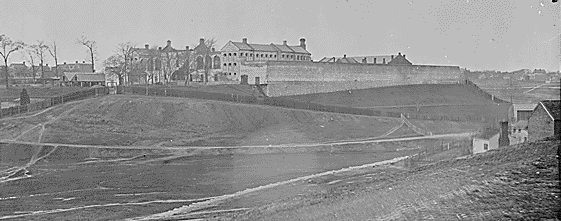
state penitentiary in Richmond, 1865
Source: National Archives, State Penitentiary, Richmond, Va
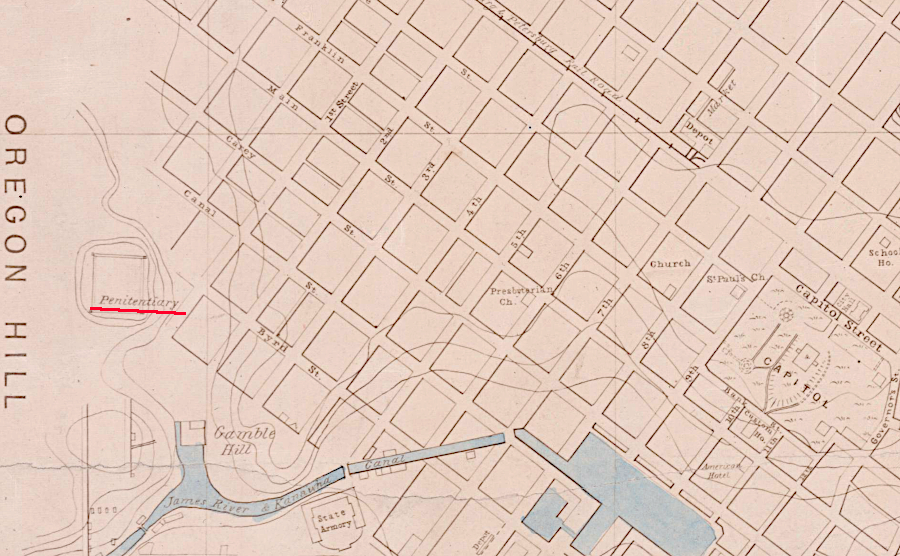
the state penitentiary was located west of the Capitol on Byrd street for nearly two centuries
Source: National Archives, Map of City of Richmond, Virginia (c.1858)