The Virginia Navy in the American Revolution
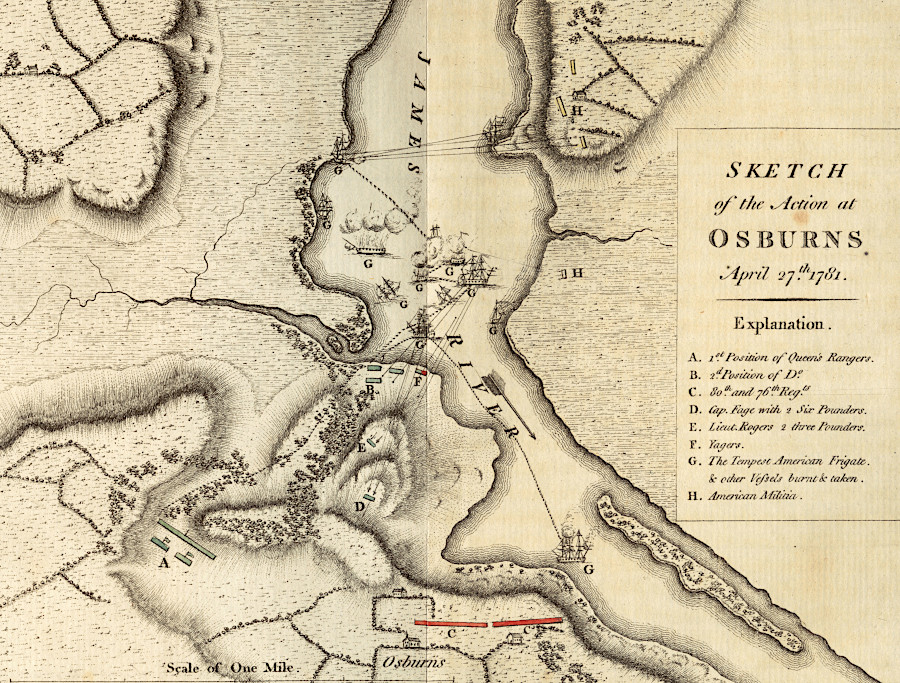
nine remaining ships in the Virginia State Navy were destroyed by Benedict Arnold at Osbourne's Landing on April 27, 1781
Source: Norman B. Leventhal Map & Education Center at the Boston Public Library, Sketch of the action at Osburns, April 27th. 1781 (by Colonel John Simcoe, 1787)
As the American Revolution developed into a shooting war in 1775, the colony of Virginia had a militia which could morph into independent companies and then an army. However, it had no navy. Creating a replacement for the Royal Navy would be the act of an independent nation.
George Washington started to create a navy in September 1775. It was created as a component of his Continental Army, even though a water-based force had not been authorized by the Continental Congress.
He did not intend the eight ships that he authorized to challenge the warships of the British Royal Navy, the most powerful one in the world. He did expect to interrupt the delivery of supplies to the British army bottled up in Boston. In addition, his own troops needed the food, clothing, guns and gunpowder captured from British transports and supply ships.
Later in 1776, Washington relied upon soldiers with expertise in managing boats to evacuate Long Island and save his army as the British captured New York. That was the first amphibious assault of the British in the American Revolution. Royal Navy sailors and marines had attacked Hampton and Norfolk in 1775, but did not seize control of those towns.
Washington needed the expertise of his soldiers in December 1776. They rowed his few remaining troops across the Delaware River through the floating ice, before the successful attack on Trenton. He depended upon soldiers already enlisted in his army regiments for the 1776 operations on the East River and the Delaware River, rather than the separate Continental Navy or privateers. They operated primarily in the Atlantic Ocean.
The Continental Congress made the decision to create a distinct Continental Navy on October 13, 1775. Initially, eight merchant ships in Philadelphia were purchased and converted into national warships. In December 1775, the Continental Congress decided to build 13 new frigates.
The Royal Navy had several hundred warships in 1775 and expanded significantly by 1783; it was always far larger than the naval forces assembled by the rebelling colonists. The Continental Congress recognized from the beginning that it would depend upon France or Spain to use their navies to challenge the British in the Atlantic Ocean.
The role of the ships commanded by European allies was demonstrated most clearly in October 1781. The joint American-French capture of General Cornwallis and his army at Yorktown was possible only because the French Navy had won the Battle of the Capes earlier in September. The French Navy prevented reinforcements from reaching Cornwallis, and blocked evacuation of the British Regulars and loyalists troops from Yorktown to New York.
During the war, the impact of the Continental Navy and the colonial/state navies was dwarfed by the impact of privateers who were authorized to attack British merchant ships. Their threat of attack eventually forced British merchant ships to travel in convoys as they brought troops and supplies to North America. By forcing the Royal Navy to divert powerful warships to protect the convoys, the privateers reduced the capacity for British amphibious assaults on port towns in Virginia and other colonies.
The first mission of the navy authorized by the Continental Congress was supposed to be an attack on Governor Dunmore's fleet in the Elizabeth River. The Virginia Convention was requested to provide two hundred riflemen, to be picked up by a Continental Navy ship at Cape Henry.
The initial orders were prepared on January 2, 1776 - before the Continental Congress learned of the burning of Norfolk the previous day. The orders to Captain Esek Hopkins were clear:1
- Enter the said bay, search out and attack, take or destroy all the Naval forces of our Enemies that you may find there.
After forcing the British away from Virginia water, Captain Hopkins was supposed to lead his ships south and chase the Royal Navy from the coastline of North Carolina. However, he was given latitude to use his best judgement if weather conditions or other factors affected his ability to perform as directed.
The first commander of the Continental Navy chose to ignore his orders. He decided to sail past the mouth of the Chesapeake Bay and went instead to the Bahamas, which was lightly defended.
The Continental Navy was successful there; it captured Nassau on March 3. In the first amphibious operation of what became the US Navy, marines and sailors seized the Governor and Lieutenant Governor of that colony. They also captured artillery and some of the gunpowder, but the British managed to ship most of that to St. Augustine before the men commanded by Hopkins went onshore.
In a later investigation by the Continental Congress, Captain Hopkins claimed his sailors were sick and he had sailed to the Bahamas to provide warmer weather for their recovery. Members from southern colonies complained that they did not receive the protection intended when the Continental Navy was created. Hopkins was censured and his career in the navy soon ended.
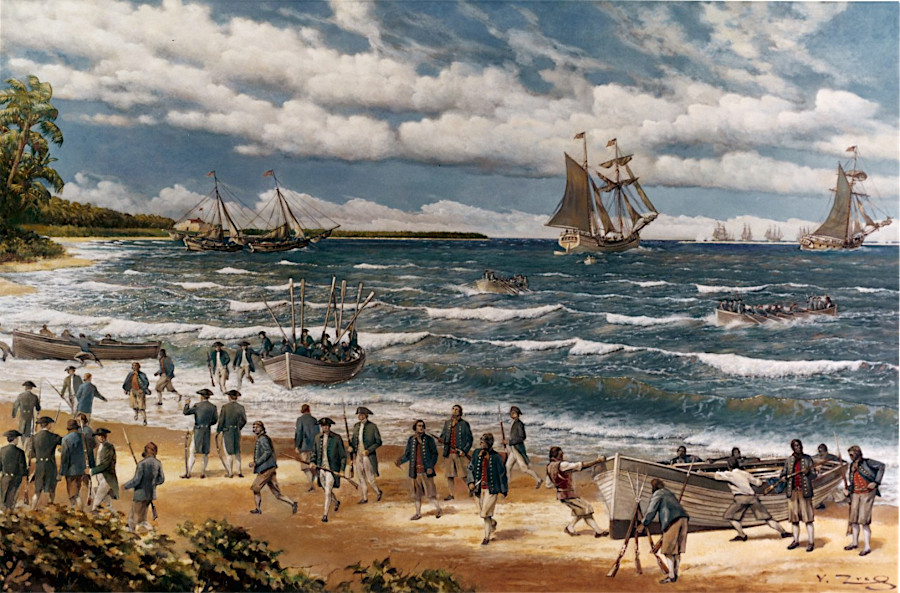
instead of attacking the British fleet supporting Governor Dunmore in 1776, the first expedition of the Continenal Navy went to the Bahamas
Source: Naval History and Heritage Command, NH 79419-KN New Providence Raid, March 1776
A second Continental Navy ship did provide some assistance to Virginia. Tt captured a British sloop in the Atlantic Ocean near the Chesapeake Bay in April, 1776. Another captain later sailed a Continental Navy ship to the York River in 1777. He encountered a British warship there, but was too timid to engage in a fight and sailed away.2
Most of the 13 rebelling colonies in North America created their own navies, and some authorized privateers as well. In Virginia, the Committee of Safety started the process of creating the Virginia Navy in December 1775. James Barron was given the responsibility of outfitting ships and put 10 swivel guns on a former pilot boat named the Liberty. That ship survived multiple engagements and was still afloat at the end of the American Revolution.
The Liberty started its career by capturing ships of loyalists. The officers and men on the Virginia Navy ships were awarded the value of the ships and cargo they captured, creating an incentive for them to be aggressive.3
In May 1776, a Continental Navy ship captured a British transport, the Oxford. It was loaded with Scottish soldiers (Highlanders) in the 42d Regiment of Foot. As the captured ship was being sailed by a small prize crew to a Massachusetts port, the Highlanders regained control. They chose to sail to the Chesapeake Bay, hoping to join Governor Dunmore's fleet.
After reaching Hampton Roads, two schooners sailed out to the Oxford. The prize crew, now held captive by the Highlanders, managed to communicate their situation to the Virginians in the schooners. Later that evening the schooners returned and captured the transport in a successful Virginia Navy operation.4
In 1777 the Virginia Committee of Safety ordered a shipyard to be constructed on the Chickahominy River and appointed James Maxwell to be Superintendent. Maxwell could build ships and rig them, but struggled to find sailors. In early 1781, he had only 78 men of the 590 men needed to fully man seven completed ships. Four of them had just 10 men each, and two additional ships had no crew at all.5
For most of the American Revolution, the small ships of the Virginia Navy were focused on protecting trading vessels from loyalist privateers and British warships, capturing merchant vessels of the loyalists, and harassing the British. When Sir George Collier and Brigadier Edward Mathew arrived in the Chesapeake Bay and captured Portsmouth in May, 1779, the Virginia Navy could offer no resistance for the two weeks that the British chose to stay.6
Recruiting for the Continental Navy and the Virginia Navy was difficult. The official sailors were guaranteed pay, but privateers offered greater opportunity for wealth if they managed to capture a ship. At least 72 free blacks and enslaved men were in the Virginia Navy. Those were served as substitutes for their white masters were given their freedom at the end of the war.
Cesar Tarrant, enslaved by Carter Tarrant, was one of four enslaved men who served as a skilled pilot. He was not emancipated at the end of the war, but after his master died the General Assembly purchased him and set him free in 1789.7
British General William Phillips brought another force to Portsmouth in 1781. In mid-April, he sailed up the James River with 2,000 men, including loyalists serving in the Queen's Rangers. Colonel Robert Abercromby (Ambercombie) led a flotilla of shallow-bottomed boats up the Chickahominy River.
The British destroyed the shipyard and two large vessels under construction there, including twenty-gun brig "Thetis." The fire of the burning materials could be seen for miles. The bottom of the Chickahominy River is state-owned land and the archeological remains of the ships there are protected resources; a permit from the Virginia Marine Resources Commission is required to disturb them.8
Many of the Virgina Navy ships moved upstream on the James River while General Phillips raided Williamsburg, then crossed the James River to City Point and captured Petersburg. The British split their forces when marching north from Petersburg towards Richmond. Phillips went to Chesterfield Court House and destroyed military barracks there. Benedict Arnold led a group which included the loyalists in the Queen's Rangers to Osborne's Landing upstream of City Point, near Dominion Energy's power plant site and Henricus Historical Park.
Arnold offered the commander of the nine Virginia State Navy ships there, plus a dozen merchant ships loaded with tobacco, a deal. If they surrendered without a fight, he would take only half of the valuable cargoes. The response was clear:9
- We are determined and ready to defend our ships, and will sink them rather than surrender.
The ships lacked the personnel to sail away or to provide an effective defense, but the Virginians chose to fight. After rejecting Arnold's offer, the Virginia Navy opened fire:10
- A brisk fire was immediately opened by the Tempest the Henoxon of twentysix guns, the Jefferson of fourteen guns, and some smaller vessels, as well as by a body of militia, who occupied the northern bank of the river; but, when the greatly superior force of the enemy is considered, the contest was too unequal to be either long-continued or successful to the Americans. A shot from one of the enemy's pieces having cut the cable of the Tempest she sheered around, and exposed herself to a raking fire from Lieutenant Rogers' threepounders, when the crew, taking to the boats, attempted to escape. As the enemy had no boats, and the wind was blowing quite hard, he could not take advantage of the panic into which the entire squadron appears to have filled, yet two ships, three brigs, two schooners, and five sloops, all laden with tobacco, flour, cordage, etc., were taken, and four ships, five brigs, and several smaller vessels, similarly laden, were burned or sunk.
- Upwards of two thousand hogsheads of tobacco, besides other stores, were destroyed...
British artillery shredded rigging, and Arnold's men quickly captured and destroyed the nine ships of the state navy. The captured merchant ships became booty for the British officers, after being sold with their cargoes as prizes. Benedict Arnold won a naval battle at Osbourne's Landing without having a single ship under his command.11
The last exploit of a ship in the Virginia Navy occurred in the summer of 1781. Captain John Cox, who had been in charge of one of the vessels destroyed by Benedict Arnold's force at Osbourne's Landing, went to the Eastern Shore and took charge of a merchant ship. He sailed the Game Cock to Bermuda and seized the gunpowder, bringing it back to Williamsburg soon after General Cornwallis surrendered at Yorktown.
It was the second time a Virginia ship had seized gunpowder stored on Bermuda. In August 1775, Bermudians who supported the colonists conspired to break into the storehouse on the island. They carried about 100 barrels of gunpowder to the Lady Catharine, which had sailed from Virginia for the raid. The Lady Catharine then sailed to Philadelphia.12
Links
- American Battlefield Trust
- American Revolution Institute
- Marine Corps Association
- Naval History and Heritage Command
- RevolutionaryWar.us
- US Naval Institute
References
1. "Continental Navy," Mount Vernon, https://www.mountvernon.org/library/digitalhistory/digital-encyclopedia/article/continental-navy; Vincent S. Dowdell Jr., "The Birth Of The American Navy," Proceedings, United States Naval Institute, Volume 81, Number 11 (November 1955), https://www.usni.org/magazines/proceedings/1955/november/birth-american-navy; Kylie A. Hulbert, "The Continental Navy in Virginia during the American Revolution," Encyclopedia Virginia, Virginia Humanities, October 10, 2025, https://encyclopediavirginia.org/entries/the-continental-navy-in-virginia-during-the-american-revolution/; Eric Sterner, "Congress and the Commodore: Esek Hopkins and the Raid on Nassau," Journal of the American Revolution, April 9, 2024, https://allthingsliberty.com/2024/04/congress-and-the-commodore-esek-hopkins-and-the-raid-on-nassau/ (last checked March 18, 2026)
2. "Esek Hopkins," Naval History and Heritage Command, https://www.history.navy.mil/browse-by-topic/people/historical-figures/esek-hopkins.html; Kylie A. Hulbert, "The Continental Navy in Virginia during the American Revolution," Encyclopedia Virginia, Virginia Humanities, October 10, 2025, https://encyclopediavirginia.org/entries/the-continental-navy-in-virginia-during-the-american-revolution/; Eric Sterner, "Congress and the Commodore: Esek Hopkins and the Raid on Nassau," Journal of the American Revolution, April 9, 2024, https://allthingsliberty.com/2024/04/congress-and-the-commodore-esek-hopkins-and-the-raid-on-nassau/; "Dispatch from 1776: Continental Navy sent to defend Virginia; it unexpectedly raids the Bahamas instead," Cardinal News, March 17, 2026, https://cardinalnews.org/2026/03/17/dispatch-from-1776-continental-navy-sent-to-defend-virginia-it-unexpectedly-raids-the-bahamas-instead/ (last checked March 18, 2026)
3. Michael Romero, "Virginia's Unconquered Liberty," Naval History, October 2018, https://www.usni.org/magazines/naval-history-magazine/2018/october/virginias-unconquered-liberty (last checked February 24, 2026)
4. Michael Romero, "Virginia's Unconquered Liberty," Naval History, October 2018, https://www.usni.org/magazines/naval-history-magazine/2018/october/virginias-unconquered-liberty (last checked February 24, 2026)
5. "'they have totally destroyed it...' The Chickahominy Shipyard," Emeging Revolutionary War, January 15, 2021, https://emergingrevolutionarywar.org/2021/01/15/they-have-totally-destroyed-it-the-chickahominy-shipyard/ (last checked February 24, 2026)
6. Michael Romero, "Virginia's Unconquered Liberty," Naval History, October 2018, https://www.usni.org/magazines/naval-history-magazine/2018/october/virginias-unconquered-liberty (last checked February 24, 2026)
7. Randolph Walker, "Cesar Tarrant (ca. 1740-1797)," Encyclopedia Virginia, Virginia Humanities, October 13, 2025, https://encyclopediavirginia.org/entries/cesar-tarrant-ca-1740-1797/ (last checked February 24, 2026)
8. "'they have totally destroyed it...' The Chickahominy Shipyard," Emeging Revolutionary War, January 15, 2021, https://emergingrevolutionarywar.org/2021/01/15/they-have-totally-destroyed-it-the-chickahominy-shipyard/; "David Jameson to James Madison, 28 April 1781," Founders Online, National Archives, https://founders.archives.gov/documents/Madison/01-03-02-0044 (last checked February 25, 2026)
9. "Engagement at Osborne's Landing, VA," Emerging Revolutionary War, January 22, 2021, https://emergingrevolutionarywar.org/2021/01/22/engagement-at-osbornes-landing-va/ (last checked February 25, 2026)
10. Henry B. Dawson, Battles of the United States, by sea and land: embracing those of the revolutionary and Indian wars, the war of 1812, and the Mexican war: with important official documents, 1858, p.688, https://archive.org/details/battlesofuniteds01daws (last checked February 25, 2026)
11. "Engagement at Osborne's Landing, VA," Emerging Revolutionary War, January 22, 2021, https://emergingrevolutionarywar.org/2021/01/22/engagement-at-osbornes-landing-va/ (last checked February 25, 2026)
12. "Virginia's Very Own Navy," Colonial Williamsburg, https://research.colonialwilliamsburg.org/Foundation/journal/Spring02/navy.cfm; February 7, 1835 letter by John Cox to J. L. Edwards, Commissioner of Pensions, in "Pension Application of John Cox S8223," Southern Campaigns Revolutionary War Pension Statements & Rosters, https://revwarapps.org/s8223.pdf; Hugh T. Harrington, "The Bermuda Powder Raids of 1775," Journal of the American Revolution, November 24, 2014, https://allthingsliberty.com/2014/11/the-bermuda-powder-raids-of-1775/ (last checked February 25, 2026)
Military in Virginia
Virginia Places