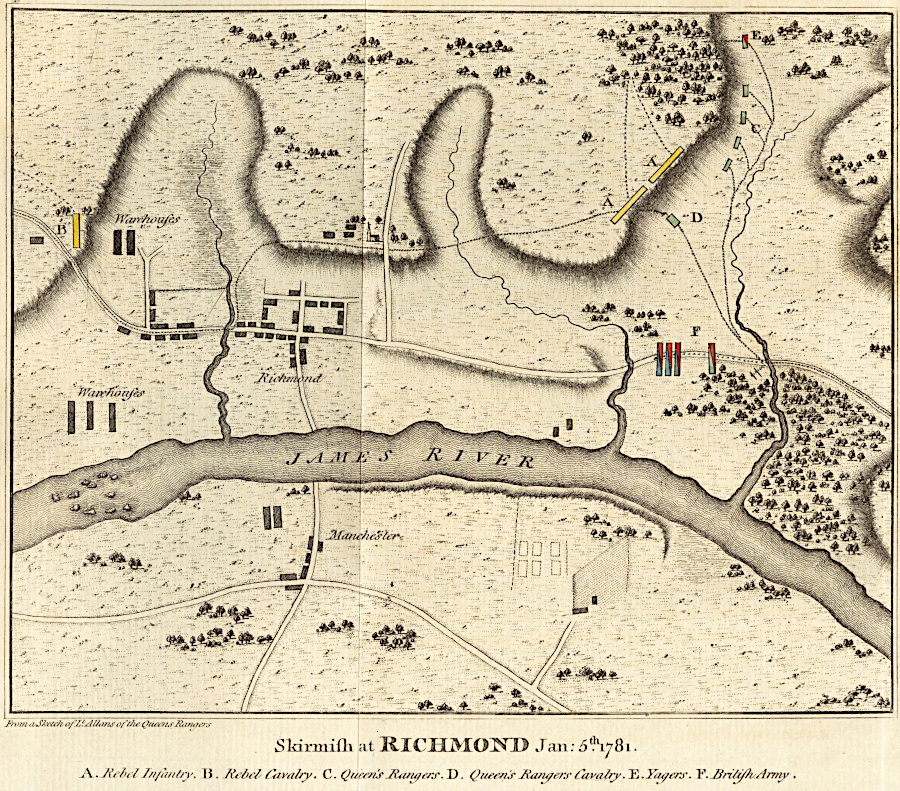
British forces under Benedict Arnold reached Richmond in January, 1781
Source: Leventhal Map Collection, Boston Public Library, Skirmish at Richmond Jan. 5th. 1781
British forces under Benedict Arnold reached Richmond in January, 1781
Source: Leventhal Map Collection, Boston Public Library, Skirmish at Richmond Jan. 5th. 1781
Between 1775-1783, 13 colonies openly rebelled against Great Britain and successfully fought a war that enabled the creation of the United States of America. The conflict began long before the actual fighting. Just before the outbreak of the French and Indian War, which was triggered by a military force led by George Washington that killed a French officer in 1754, London officials shifted their approach to managing the North American colonies.
Throughput the 1600's, there was little oversight or interference in local government by Parliament or the ministers of the king/queen. In the 1720's, Navigation Act restrictions on trade were relaxed. Prime Minister Sir Robert Walpole endorsed "salutary neglect" of the mercantile restraints on trade with other European countries. That policy, along with ineffective administration from royal officials chosen more for patronage rather than competency, allowed the colonial economies to grow. Virginians acquired agricultural tools, cloth, consumer products, and enslaved Africans from ships sailing from the Netherlands, France, and Caribbean islands at a lower cost than from ships Great Britain.
The new approach, "imperial administration," constrained the power of the General Assembly. Virginia's leaders objected to the imposition of new bureaucratic regulations and especially new taxes. Colonists drew a philosophical distinction between taxes to regulate trade vs. "internal taxes" designed to raise revenue and pay off debts incurred by King George II, King George III, and Parliament.
From the colonial perspective, taxes for revenue were unacceptable because the colonies had no representation in Parliament and no opportunity to constrain such taxes from becoming excessively high. The colonial system lacked effective checks and balances to protect the landowners and businesses in the colonies from seeing too high a percentage of their wealth drained away.
Virginians expressed their objections to imperial administration in their response to the Proclamation of 1763 and the Parson's Cause case that same year. In response to the 1765 Stamp Act, Virginians joined in boycotting British imports. No Virginia delegation was sent to the Continental Congress in 1765 because the House of Burgesses was not in session to select representatives.
The Townsend Acts triggered another boycott in the different colonies, but the strongest reaction to imperial administration was in Massachusetts. I 1765 a mob destroyed Governor Thomas Hutchinson's house in protest of the Stamp Act. Samuel Adams quickly organized the Sons of Liberty to agitate against the exercise of colonial power emphasizing "No Taxation Without Representation."
To reduce smuggling and increase the collection of revenue, British customs commissioners were sent in 1767 to Boston. A British warship arrived in 1778. After John Hancock's Liberty was seized for smuggling in June 1768, a mob rioted and forced the collector of the port to flee to England. In response, British troops were sent to occupy Boston.
Benjamin Franklin in London correctly predicted that troops on garrison duty, with little to do, would create trouble. He wrote:1
The riots were followed by the Boston Massacre in 1770, in which troops were provoked to open fire and five men were killed. The Tea Party in 1773 showed the intensity of local feeling.
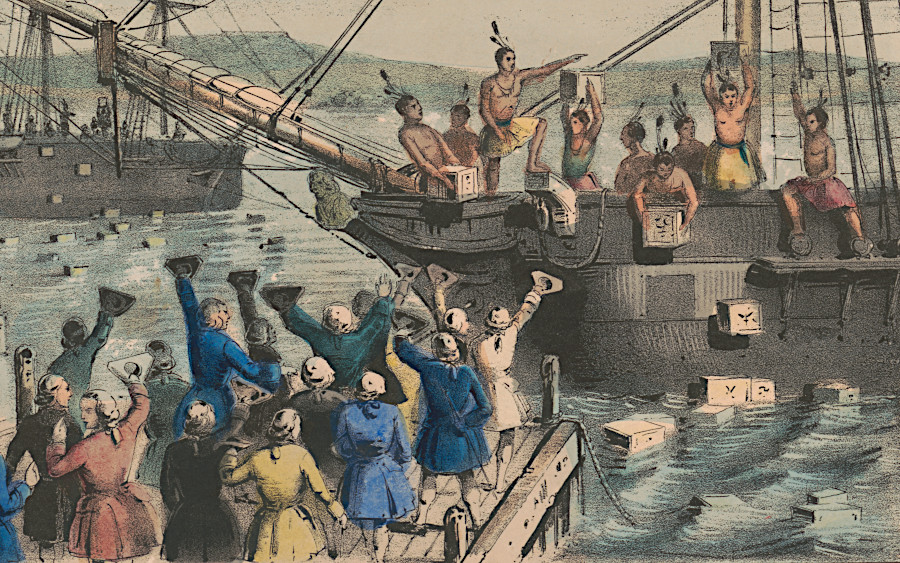
the Tea Part in 1773, unlike other mob actions organized by the Sons of Liberty in Boston, was non-violent
Source: Library of Congress, Skirmish at Richmond Jan. 5th. 1781
Even though the British debts were in part to pay off the costs of winning the French and Indian War, the dispute over taxation without representation led to a transformation in the political connections between 13 colonial governments vs. King George III and Parliament.
Virginians played a leading role in both the political and military components of the American Revolution. At the local level, independent companies separate from the authorized colonial militia began to form in 1774.
Settlers in the western counties as well as Tidewater elite investing in the Loyal and Company, Ohio Company, and other land grant companies objected to the constraints on settling the territory west of the Eastern Continental Divide. The Proclamation of 1763 blocked awarding clear title to grants awarded to veterans of the French and Indian War as well.
The royal governor sought to appease the land hungry colonists by launching Dunmore's War in August, 1774. After the Shawnee, Mingo and Delaware were defeated at the Battle of Point Pleasant, they agreed in the Treaty of Camp Charlotte to cede their claim to lands south of the Ohio River. However, Virginians were not satisfied that the British would change their policies blocking settlement of western lands, or limit their right to impose taxes without involvement of elected representatives in the General Assembly.
The milita returning from Camp Charlotte stopped on the Ohio River and passes the Camp Gower Resolves on November 5, 1774. They expressed the willingness of backcountry settlers to fight, if necessary, to get officials in London to resolve colonial grievances.
The initial outbreak of fighting was in Massachusetts, first at Lexington and Concord on April 19, 1775 and then at Bunker Hill on June 17. Between 1775-1776 the members of the Virginia General Assembly organized five unauthorized conventions that replaced royal government. The Fifth Virginia Convention declared independence in May, 1776 and adopted the first state constitution a month later.
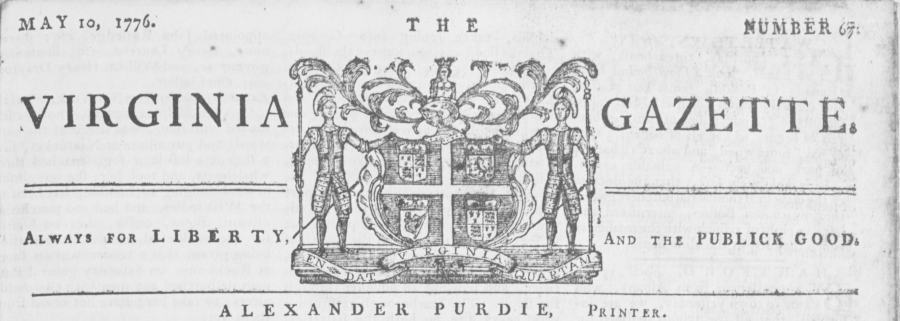
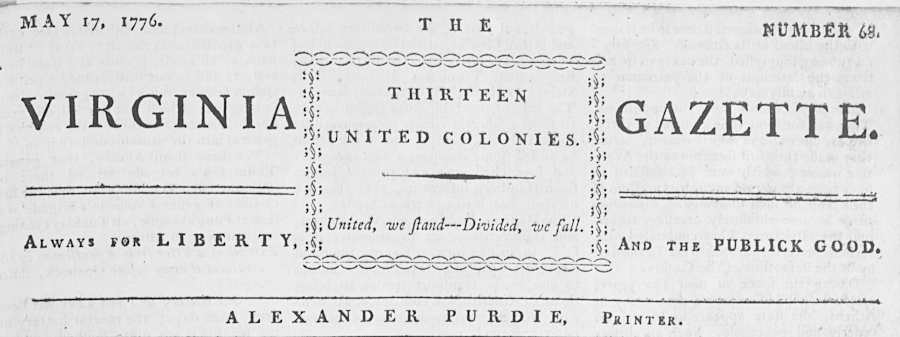
after the Fifth Virginia Convention declared the colony to be independent, the Virginia Gazette changed its masthead to eliminate reference to King George III
Source: Virginia Chronicle, Virginia Gazette (May 10, 1776, May 17, 1776)
British reinforcements for military operations were sent to Boston, not to Virginia. Realizing he could not obtain enough reinforcements from Great Britain, Governor Dunmore issued a proclamation in November 1775 inviting enslaved men to obtain their freedom by fighting for the British military. His willingness to overturn the social structure and provide arms to black men pushed many reluctant whites into supporting the rebellion.
The British efforts to end the insurrection in the 13 colonies was counter-effective. Rather than accommodate concerns and mobilize support within each colony from those willing to stay loyal, officials in London focused on forceful suppression without proposing substantive offers for policy and symbolic changes that would lead to reconciliation. George III was strongly in favor of using military force to retain control over the American colonies.
King George III and Parliament assumed at the beginning that the conflict was existential. If 13 colonies escaped the empire, then colonists and enslaved people in the more-valuable sugar colonies in the Caribbean would follow. Ireland would fall like another domino and Great Britain would be limited to just England, Scotland, and Wales.
As part of the effort to expel the royal governor and the British fleet providing support, the city of Norfolk was totally destroyed in January-February, 1776. Though the British started the destruction, the Virginia and North Carolina troops did far more of the damage in order to block the Royal Navy from using the city as a Chesapeake Bay base. Hampton, Portsmouth, Suffolk, Petersburg, and Richmond were raided and damaged by British forces during the war, along with Tidewater plantations, but the burning of the largest city in Virginia was done by the command of Virginia's revolutionary leaders.
Many of the formerly enslaved who fled to Governor Dunmore's bases on the Elizabeth River and his fleet died of typhus and smallpox before they could fight. In the end, Dunmore was unable to recruit and retain enough men, white and black, to create a loyalist army and return to Williamsburg. He was forced to leave his last base on the Chesapeake Bay in August, 1776.
Virginia was largely free of British forces between August 1776-December 1779. During that period, it was a major source of supplies and troops. The lead mines on the New River were expanded, and with forced labor supplied bullets to the Continental Army and state forces. The most direct impact of the American Revolution on most Virginia families before British troops began marching through the countryside in 1780 was the number of men who were killed or wounded, or who died from disease while in a military unit.
At the first Continental Congress in 1774, the delegates from Massachusetts (the most aggressive colony challenging royal authority) intentionally pushed for Virginia delegates to have the most prominent role. Peyton Randolph, Speaker of the House of Burgesses in Williamsburg, was elected to preside over the first meeting on the Continental Congress in Philadelphia.
Unhappy British Americans were pressing at the time for resolution, not revolution. There was still a chance for King George III and Parliament to settle differences with the 12 colonies who sent delegates to Philadelphia in 1774.
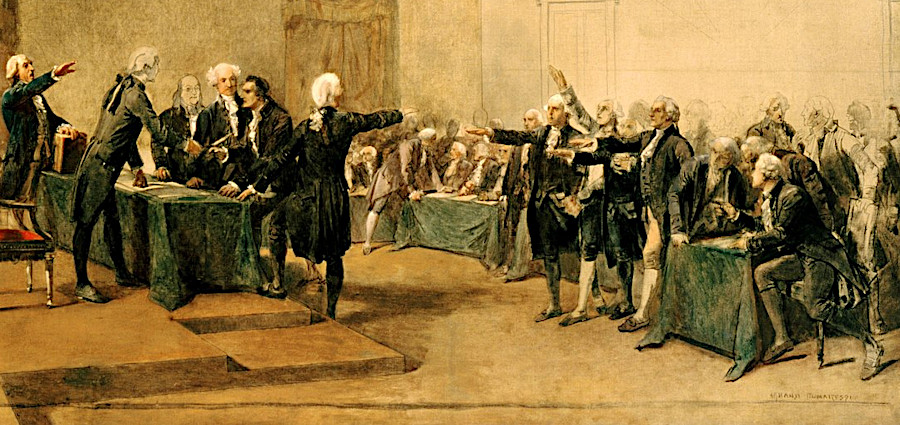
in 1774, representatives from 12 colonies meeting in a Continental Congress sought a peaceful resolution of grievances rather than a military revolution
Source: Wikipedia, Continental Congress (by Charles Édouard Armand-Dumaresq, 1873)
After the first major fighting at Lexington and Concord in April 1775 and then at Bunker Hill in June, the British government sought to regain control over the colonies by using bullets and bayonets. It did not use counterinsurgency tactics to win the "hearts and minds" of the dissatisfied British citizens. Before the colonists declared independence in 1776, the opposition to George III in Parliament highlighted that he was exacerbating rather than resolving the conflict with policies articulated "in the language of vengeance and not of sense."
The Second Continental Congress adopted a two-prong strategy. On June 14, 1775, it established a Continental Army. Reorganizing the militia companies keeping the British Regulars trapped in Boston into an army, independent of British control, was a clear step towards separation from royal rule. At the time, none of the colonies proposed to alter their official status as colonies.
A day later, the delegates in Philadelphia appointed George Washington to be the army commander. He was an ideal candidate. He had military experience and came from Virginia, demonstrating that the insurrection was broader than just Massachusetts. Washington was politically astute. He acknowledged that he served under the authority of the Continental Congress, and he had never been commissioned in the British army - unlike potential commanders Charles Lee and Horatio Gates.
On July 8, 1775, the Second Continental Congress tried its other prong and approved the Olive Branch Petition. That appeal was intended to re-establish the legitimacy of Parliamentary rule under new conditions. John Dickinson rewrote Thomas Jefferson's draft to ensure the tone emphasized reconciliation rather than independence. King George III refused to read it and declared the colonies to be in open rebellion on August 23, 1775.
In 1776, Richard Henry Lee introduced the resolution in the Continental Congress calling for the colonies to declare independence from Great Britain.
Though Virginians shaped policies in the Continental Congress, General George Washington ended up as the "indispensable man." He managed to organize a scattered group of militia into a Continental Army. He keep a military force in the field despite political rivalries among the colonies/states, poorly trained and poorly-equipped troops, inadequate funding by the Continental Congress to pay soldiers and acquire supplies, and numerous defeats by more-professional troops from Great Britain and what today is Germany.
He negotiated conflicting agendas of the members of the Continental Congress and officials in evolving state governments, managed the egos of officers and soldiers so most remained committed to the war effort, and personally faced down at least one attempted mutiny in 1782.
When the Continental Congress approved the Declaration of Independence, there were no British troops in the colonies. However, military success was not guaranteed. The British fleet arrived at New York on July 12, 1776. The Continental Army was defeated in the battles of Long Island in August, Harlem Heights in September, and White Plains in October.2
After the British captured Fort Washington in November, the remnants of the Continental Army retreated across New Jersey to the opposite side of the Delaware River. Enlistments were due to expire at the end of the year, and George Washington feared that he would be unable to offer resistance to the British Army with just the remaining Virginia regiments and militia from other colonies. He wrote to his nephew Lund Washington on December 17, 1776:3
Many times it looked like the American army would collapse as soldiers returned home as their enlistments expired or simply deserted. One key general chose to betray the new country and help the British capture the key fortress at West Point, while others demonstrated a lack of competence. While in camp at Valley Forge in December 1777, Washington wrote that because of the inadequate amount of food and clothing:4
Throughout the war, Washington established the pattern of civilian control over the military. He made decisions, and changed some, based on the authority of civilian leaders in the Continental Congress. After the Treaty of Paris was signed in 1783, he resigned his commission at a time when he could have established control over the new nation as a form of dictator or substitute monarch. George III supposedly said that his resignation would make Washington "the greatest man in the world."5
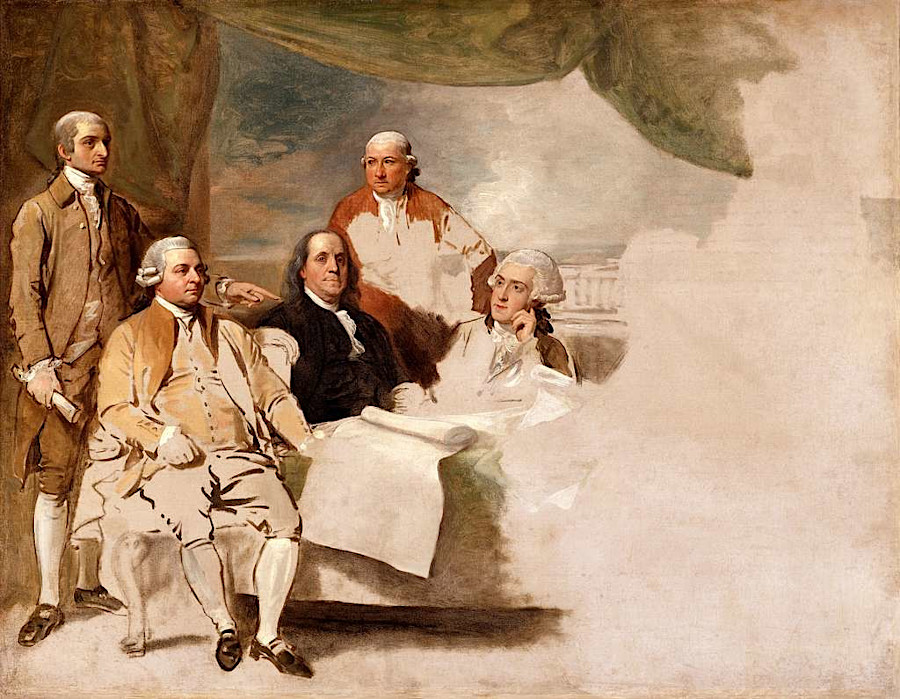
the British commissioners who negotiated the 1783 Treaty of Paris declined to show up for their portrait
Source: Maryland State House, American Commissioners of the Preliminary Peace Negotiations with Great Britain (by Benjamin West, unfinished in 1783)
Suppression of loyalists in 13 colonies was effective in 1775-1776. In Virginia the land and personal property of outspoken loyalists were seized, including all of Lord Dunmore's assets that he could not take with him when he fled Williamsburg in June 1775.
Norfolk, the center of loyalist support, was totally destroyed in January/February 1776 by order of the rebel Virginia leaders. They wanted to block the British from using the town as a military base. The shipyard at Gosport on the Elizabeth River was also burned.
The order to destroy Norfolk reveals that effective royal rule had been eliminated in Virginia. In May 1776, the colony became an independent state in a loose confederation with 12 others.
The rebels/patriots forced Governor Dunmore and the British forces to sail out of the Chesapeake Bay in August 1776. Troops and supplies were then sent from Virginia to support the Continental Army; Virginia served primarily as a supply base through 1780.
In 1775-78, the Revolutionary War was fought primarily in the north between Quebec and Pennsylvania. Until 1781, the number and significance of battles fought in Virginia were relatively few.
The initial British strategy was to isolate Massachusetts, Connecticut, Rhode Island, and New Hampshire from the other colonies. The divide-and-conquer approach was expected to deter the mid-Atlantic and southern colonies from joining the insurrection, while the British Army captured the leading rebels and suppressed the nascent rebellion in New England.
After the Battle of Bunker Hill, rebelling colonists surrounded Boston with militia forces. George Washington began to organize the "army of observation" into a Continental Army starting in July 1775.
Two other rebel armies failed to capture Quebec at the end of 1775, but in 1776 Henry Knox brought cannon to Dorchester Heights. After an 11-month siege, the British evacuated Boston on March 17, 1776. General William Howe then organized the army at Halifax, and with his brother Admiral Richard Howe sailed south to capture New York City in August 1776. That city became the primary British base for the rest of the war; George Washington was never able to attack it successfully.
Washington barely escaped total destruction of his army in the Battle of Long Island. By the end of 1776, the defeated Continental Army had fled through New Jersey and across the Delaware River. In a surprise attack, Washington crossed the river and won victories at Trenton and Princeton. That built morale, spurred recruitment for the Continental Army, and forced the British to evacuate New Jersey.
Washington went into winter quarters in early 1777 winter at Morristown. Both sides waited until spring before choosing to engage in large battles, when there would be enough forage for horses to be able to pull wagons and artillery to a fight.
That initial British strategy to suppress the rebellion by isolating New England from the other newly-independent states collapsed in October, 1777. A British army invading from Canada, led by by General John Burgoyne, was defeated at Saratoga in New York by a rebel army led by General Horatio Gates. Burgoyne's army ended up being marched to Virginia as prisoners of war; few were exchanged or released before the end of the American Revolution in 1783.
General Howe was supposed to join up with Burgoyne, marching up the Hudson River from New York to Albany. Instead, he took his army from New York into the Chesapeake Bay, finally landing at the mouth of the Elk River in Maryland. After defeating George Washington at the Battle of Brandywine on September 11, 1777, the British occupied Philadelphia. Washington tried attacking at Germantown, but after that failed he led his army to Valley Forge for the 1777-78 winter camp.
While in winter quarters at Valley Forge, some Continental Army officers compared the success of Horatio Gates at Saratoga to the failure of George Washington at Brandywine. Led by Brigadier General Thomas Conway, they hinted that the Continental Congress should replace the losing general with the winning one as commander-in-chief. Washington mobilized his support in the Continental Army and Congress, and the "Conway Cabal" to put General Gates in charge collapsed.The entry of France into the war in 1778 forced a change in British strategy. The Continental Army had managed to survive, and public support for the rebellion continued despite British capture of the two largest cities in North America. Perpetuating the cat-and-mouse game with Washington, trying to win more military victories in the north, would risk exposure to a French fleet eventually capturing New York.
To ensure there were sufficient Regular Army and Royal Navy forces to counter the French (and later the Spanish and Dutch) in the Caribbean, Mediterranean Sea, and India, the British pivoted to a new "southern strategy." They focused on regaining control in Georgia and the Carolinas, not in New England. The southern strategy was based on military capture of the southern colonies, followed by restoration of royal rule.
The large number of loyalists assumed to be in the southern colonies were expected to re-establish a loyal civil government. The colonial assemblies would be filled with men elected by colonists who supported having a royal governor again.
After a year of fighting partisans and Continental Army units in the southern colonies, British victory in the south would free up the army units and ships. They would return to New England, defeat the Continental Army surrounding New York City, reoccupy Boston, and finish suppressing the rebellion. Royal government would be effective again in all 13 colonies. The leading traitors, including many who had signed a declaration declaring independence, would be hung by the neck until dead.
To concentrate the British army at New York and block Washington and the French from capturing it, General Howe abandoned Philadelphia in 1778. The army marched across New Jersey because the Royal Navy could no longer provide ships for transport, now that it's control of the seas was threatened by the French Navy. Troops, ships, and other resources that could have been allocated to offensive operations in North America were redirected to the Caribbean in order to protect the more-valuable sugar islands from the French Navy there.
To implement the new strategy, Sir Henry Clinton replaced General William Howe as British commander of land forces. Clinton maintained the occupation of New York City, but that force was not expanded to the size necessary to defeat George Washington's army which surrounded the city. As the focus shifted to regaining control of the southern colonies, British units were sent to Georgia and South Carolina. They were expected to march north and regain control at least up to Virginia.
The first major combination of American and French forces was an attempt to capture Newport, Rhode Island in August 1778. The efforts of the rebel land force and the French ships were uncoordinated and that attack was a complete failure.
Britain's offensive operations in the south targeted Georgia first; Savannah was captured in December 1778. Georgia became the first colony which had declared independence to be returned to colonial status.
There was another combined rebel-French effort to recapture Savannah in 1779 . That had some initial success, but the British refused to surrender and the siege was abandoned.
General Henry Clinton led the capture of most of the Continental Army forces in the south after surrounding Charles Town, South Carolina. When General Benjamin Lincoln surrendered in May 1780, there was the potential for the British to energize loyalists and retake all the southern colonies. When Clinton returned to New York, leaving General Charles Cornwallis in Charles Town to recapture the south, the "southern strategy" was succeeding in regaining territory.
More British victories followed. Colonel Banastre Tarleton defeated the Virginians fleeing north at Waxhaws on May 29, 1780, with his troops reportedly slaughtering the survivors who tried to surrender. Newly-arrived Continental Army forces and local militia led by General Horatio Gates were overwhelmed by General Cornwallis at Camden on August 16, 1780. Gates fled on a horse, not stopping until he reached Charlotte.
The British strategy brought several thousand Regulars and Hessian soldiers to South Carolina. They seized fortified locations and won fixed battles fought against Continental Army troops. However, the southern strategy also required the loyalists to defeat isolated bands of partisans and militia, take control of the countryside, and restore the system of colonial government that had existed before 1776.
The British captured Savannah and Charles Town. The Regulars, together with units of well-organized loyalists, defeated the Continental Army at Waxhaws and Camden. A royal governor did return to Georgia, but only briefly.
The capacity to suppress the rebels and restore royal rule was greatly diminished after a loyalist army led by Patrick Ferguson was annihilated by American forces at Kings Mountain on October 7, 1780. Major Ferguson was the only non-American in that battle, reflecting how the American Revolution was a civil war. volunteers from west of the Blue Ridge, the Overmountain Men, included Virginians who had marched south from Abingdon.
After Ferguson's defeat at Kings Mountain, Cornwallis still retained the ability to take his army anywhere he wished to go in the Carolinas - but he was unable to control the territory after he left. Loyalists would welcome the arrival of the British troops, but would not join the fight in sufficient numbers. When the British army marched away, the rebels regained control of the Carolina territory. In the civil war, there was harsh and cruel behavior on both sides.
After General Gates was defeated at Camden and fled the battlefield, the next leader of Continental troops and militia in the south was General Nathaniel Greene. He engaged in a war of attrition against the British. Greene avoided major engagements while steadily reducing the size of Cornwallis' army as it marched through the Piedmont, far from any port on the Atlantic Ocean where new supplies and men could be delivered.
Recruitment of loyalists was made even more difficult after Americans under General Daniel Morgan defeated Col. Banastre Tarleton's dragoons at Cowpens on January 17, 1781. After that battle, the two armies raced to the Dan River, which provided Morgan with an effective defense barrier. As Cornwallis marched into North Carolina, he did not create new pockets of loyalist control. Instead, his army was gradually reduced by battles and skirmishes.
After Greene go across the Dan River first and collected all the boats, Cornwallis could no longer follow him. He withdrew south to Guilford Courthouse. After getting reinforcements, Greene chose to re-cross the Dan River to fight. Once again, the Continental Army was defeated.
The British won a technical victory at Guilford Courthouse because they controlled the battlefield afterwards, but once again the size of Cornwallis' army was reduced. Cornwallis was forced to march to the port at Wilmington in order to get more supplies. From Wilmington, Cornwallis led the British army north into Virginia. He joined another force, brought by General William Phillps and Benedict Arnold, at Petersburg.
Nathaniel Greene stopped chasing Cornwallis and took his army back to South Carolina. He forced the British to abandon outposts and trapped them in Savannah and Charles Town.
General Nathaniel Greene, who was chased out of South Carolina and North Carolina until he could use the Dan River in Virginia as a defensive barrier, summarized the tactics of the Continental Army hat created success in the south:6
Source: American Battlefield Trust, The Revolutionary War in the South: Animated Battle Map
Green depended upon troops and supplies coming from Virginia. Cornwallis justified marching from Wilmington into Virginia, rather than returning to defend bases in South Carolina, because he could interrupt Greene's supply chain. A British army in Virginia would not fight Greene directly, but it could seize his food, guns, ammunition, and clothing while preventing new troops from marching south.
Cornwallis' justification for marching into Virginia was weakened by the fact that before left Wilmington, there was already a British army in Tidewater. Benedict Arnold had brought a force and sailed into the Chesapeake Bay at the end of 1780.
It was not the first time a raid had been conducted to disrupt the supply chain. In 1779 Commodore George Collier and General Edward Mathew spent two weeks intercepting troops, clothing, and weapons. At the end of 1780, a force led by now-British General Benedict Arnold conducted more raids up to Richmond from a base established at Portsmouth.
His ships moved up the James River and troops unloaded at Westover on January 4, 1781. Arnold led a combination of British troops, loyalists in the Royal American Regiment (Robinson's Corps), and Hessians commanded by Captain Johann Ewald to Richmond.
Threat of British attack forced the shift of the state capital from Williamsburg to Richmond in 1780. The few public buildings in the new capital were destroyed - no grand capitol or governor's mansion had been built yet, so there were no major civic buildings in the new capital. Arnold was able to loot valuable tobacco from riverfront warehouses.
After the capture of Virginia's capital on January 5, Arnold's force went upstream to Westham; there they destroyed cannons and gunpowder at the Westham Armory.
Governor Thomas Jefferson and the General Assembly fled west to Charlottesville. Arnold did not follow. Traveling west through the Piedmont would separate him from his supply line, which as based on ships in the James River which could not get upstream of the Fall Line. He took his men back to Portsmouth on January 19, 1781.
George Washington had hoped to partner with the French Navy, marching south from New York and trapping Arnold. The inability to coordinate a land attack with an adequate number of French ships, then the arrival of General Phillip's force, ended that plan.
Two months later in March 1780, General William Phillips arrived and took command fom General Arnold. Near the end of April, 1781, Phillips and Arnold moved upstream again. They occupied Petersburg and then Manchester, just south of Richmond. Military facilities such as the barracks at Chesterfield Court House were destroyed.
Phillips was planning to return to Portsmouth when he received word that Cornwallis would march from Wilmington, so Phillips returned to Petersburg to meet Cornwallis there. Phillips died from disease on May 13. Cornwallis arrived a week later. Benedict Arnold turned over command and Cornwallis quickly sent him back to New York; British officers had no desire to serve with the rebel traitor.
Cornwallis marched across Virginia at will. He was harassed by General Lafayette, but he had few troops and no cavalry. The main forces of the Continental Army were surrounding New York City or serving with General Nathanael Greene in South Carolina.
General Washington had tried to bring his army south from New York in early 1781 to surround the British and capture Benedict Arnold at Portsmouth. He could not get the French Fleet to cooperate in time; that opportunity was missed.
Later in 1781, after General Cornwallis encamped at Yorktown and waited for resupply and reinforcement, the French fleet committed to sail to Virginia from the Caribbean. This time the French and and Americans were able to coordinate effectively.
Washington and the Compte de Rochambeau slipped away from New York City and Newport, Rhode Island and marched to Williamsburg. The French fleet at Newport led by Admiral de Barras, and the larger fleet in the Caribbean led by Admiral Comte de Grasse, sailed to the Chesapeake Bay.
The French ships prevented British Admiral Thomas Graves from rescuing Cornwallis. The surrender of the British army at Yorktown in October 1781 convinced Parliament and ultimately King George III to stop fighting in North America, while the British war with France, Spain, and the Netherlands continued into 1783. The end of the American Revolution did not occur until the Treaty of Paris was signed on September 3, 1783 and then ratified in 1784.
The American Revolution led to independence from Great Britain for the citizens of Virginia. Some of the non-citizens also found freedom - if they managed to leave Virginia with the British.
Wherever British troops marched, enslaved people had taken the opportunity to escape. Royal Navy raids on plantations in Tidewater also created opportunities to flee to freedom. In many cases, the raiders were guided to places with livestock to seize by those who had escaped. In the process, the guides helped their families and others to join them on British ships. Many of the enslaved escapees ended up succumbing to smallpox, typhus, and other diseases, but some ended up leaving Virginia with British forces between 1776-1783.
Thousands of troops marching across Virginia, accompanied by fleeing slaves and other camp followers, had left a trail of destruction. At the very start of the conflict Norfolk, the largest town in the colony, was burned to the ground. and a new Virginia Navy shipyard built on the Chickahominy River were also burned.
Plantations from the Chesapeake Bay to the Blue Ridge were raided, with the destruction of livestock and crops, fences, farm equipment, and houses.
The British army led by now-British General Benedict Arnold then torched the public buildings in Richmond. Norfolk and Yorktown were destroyed during the war. So were plantations in Tidewater within reach of Navy raiders, such as William Brent's house on Aquia Creek, but George Washington's Mount Vernon was spared. The Governor's Palace in Williamsburg burned, by arson or accident, at the end of 1781.
Virginia's biggest industry, agriculture, was impacted during the American Revolution. On a small scale, individual farms in the Piedmont on the route of Cornwallis' army in 1781 were looted. On a larger scale. most acres that had grown tobacco for export before the war were converted to growing crops for food and fiber. The Royal Navy's control of the seas made shipping tobacco too hazardous, while Scottish merchants were viewed as as dangerous loyalists and forced to leave in 1776.
The demographic shift of the population westward continued even during the war, and settlers willing to move deep into the backcountry remained vulnerable to Native American raids. The military successes of George Rogers Clark led to Great Britain ceding land stretching westward to the Mississippi River, but the original occupants had not been displaced. Following the Treaty of Paris, the new United States government tried the same techniques as the British. It sought to constrain settlement of western lands in order to minimize warfare with the tribes.
The institution of slavery remained intact in 1783. Philosophical arguments about fighting for American liberty did not extend to freeing the enslaved people owned by white Virginians. Even Lord Dunmore never planned to emancipate all of the enslaved. He desired to raise an army by promising freedom to those who had been enslaved by the rebelling Virginians, while protecting the "property" of loyalists.
White Virginians reacted strongly to Governor Dunmore's Emancipation Proclamation. It raised fears of a general uprising of the 40% of the population held in bondage, causing whites to become radicalized and support independence. Most of the enslaved people who fled to the British and were recaptured were returned to their masters, or forced to work in the lead mines of Fincastle County.
Almost all revolutions transform societies and re-allocate power and wealth from the initial elite to one or more groups at the end of fighting. However, the gentry in Virginia retained control throughout the war. The wealthy landowners (and slaveowners) kept populist leaders such as Patrick Henry under control; there was no uprising of the landless and small farmers as occurred during Bacon's Rebellion in 1676. In 1783 the political, economic, and social power remained with the same class as at the start of the revolution.
The 1776 constitution created representation to accompany taxation. The new form of government restructured the General Assembly and minimized the authority of the governor. The electorate remained restricted to while, male property owners. Those who could vote continued to select from the wealthy elite in each county to serve as delegates and state senators, while the state legislature itself chose the governor.
To gain support for the revolution, the elite did grant religious freedoms to Baptists, Presbyterians, Catholics, and other religious minorities. The General Assembly eliminated the mandatory tax used to fund salaries for Church of England ministers. Most of them moved to England early in the war, along with Scottish merchants. Without ministers or support from members of the vestry, most of whom were unwilling to consider the king as the head of their church, the power of the state-established church waned.
With the signing of the 1783 Treaty of Paris, land companies lost the opportunity to survey and sell the acreage they had been granted prior to the revolution. Virginia ceded its claim to the Northwest Territory to the new national government, abandoning claims to the Pittsburgh area. New settlers would acquire ownership from the Confederation Congress and then the Federal government established in 1789, except for military reserves established first in what became the states of Kentucky and Ohio. Those acres were dedicated to fulfilling land bounties promised to military veterans due to their service.
Virginia did re-open its land office in 1779. While it ceded the Northwest Territory to the national government and supported Kentucky becoming a separate state, Virginia officials retained control of land stretching west to the Ohio River until the creation of West Virginia in 1863.
Source: American Battlefield Trust, The Revolutionary War in the North: Animated Battle Map
French support was essential to the success of the American Revolution. By the end of the American Revolution, George Washington and other American generals had won few military battles. Washington's Continental Army was forced out of New York City in 1776 and Philadelphia in 1777. The largest surrender of the rebelling colonists occurred in 1780, when General Benjamin Lincoln was besieged in Charles Town. The Virginia Line of the Continental Army ended up as prisoners of the British.
French troops, guns, and ships provided the essential support needed to achieve military success. The entry of the French, and later the Spanish and Dutch, transformed the war in North America into a worldwide conflict. The British Navy was forced to disperse its ships to places as far away as the Indian Ocean. The longest battle was far away from North America, the 1779-1783 siege at Gibraltar. The attack by the French and Spanish there in September 1782 was also the largest battle of the war.7
General Henry Clinton in New York had to reduce his army and send reinforcements to the Caribbean, in order to protect the more-valuable sugar islands. Clinton abandoned Philadelphia in 1778 and Newport (Rhode Island) in 1779, concentrating his troops in New York to prevent George Washington from capturing that city.
General Charles Cornwallis was forced to rely upon loyalists in his failed efforts to conquer and hold onto South Carolina and North Carolina; there were not enough Regulars to station a critical mass of troops at each outpost. Cornwallis controlled territory only when his troops were nearby; when he marched away, the loyalists were overcome in the civil war that raged particularly in South Carolina.
The scattered pattern of loyalists prevented them from gaining dominance over any colony, though the royal governor did return briefly to Georgia. The loyalists failed to organize effectively in the southern colonies, and the British failed to station enough troops at outposts to protect those loyalists who did assemble publicly.
Between May-September 1781, the British had complete military dominance in Virginia thanks to their superior numbers (over 7,000 men) and especially their cavalry. As soon as Regulars and Hessian troops marched away from a location in Tidewater or the Piedmont, advocates for independence ("patriots") regained control. After 1776, there were too few loyalists remaining in Virginia; openly expressing support for King George III risked having one's property seized and being exiled to west of the Blue Ridge.
French money, distributed as partial compensation for back pay, was key to uplifting morale of George Washington's troops around New York before they started south to Yorktown. The siege there depended upon the compte de Rochambeau's artillery.
Without the French fleet led by Admiral François-Joseph-Paul, comte de Grasse, the British fleet from New York would have been able to evacuate or reinforce Cornwallis in September 1781. The Battle of Yorktown was won at sea at the Battle of the Capes by the French ships before the first cannon was fired at the land fortifications occupied by Cornwallis's troops.
The persistence of the soldiers in the Continental Army and Navy, plus various state forces, was the most important factor in convincing the British Parliament and King George III that the war was un-winnable. There were not enough loyalists in the 13 states, not even in Georgia and South Carolina, to restore royal control. The British could capture territory, but could retain control of only a few cities along the Atlantic Ocean coastline and a few forts deep in the backcountry.
Public support for independence, and the willingness of soldiers and sailors to continue the fight, determined the final military outcome of the American Revolution. Great Britain grew tired of the conflict and the expense, while the rebelling colonists showed a willingness to keep fighting despite military defeats. Releasing its claim to the 13 colonies allowed it to focus resources of fighting France, Spain, and the Netherlands.
The political result of the 1783 Treaty of Paris was a new United States of America in which the central government exerted little control. It was responsible for a war debt which could not be repaid, and there were deep-seated conflicts between the different states over control of western lands. European nations anticipated the colonies united in 1783 would fragment into separate nations; some might even become colonies again.
Virginians played a leading role in creating the new nation after the fighting ended. What Great Britain recognized as an independent nation in 1783 was a weak confederacy of 13 separate nation states. The Articles of Confederation finally were discarded and replaced with a new US Constitution in 1789. After eight years of leadership by an "indispensable man," George Washington, in 1796 the different states in the United States of America were united enough to be governed effectively by elected leaders.
By the end of the American Revolution in 1783, the death toll from disease was far greater than from actual fighting. According to historian Woody Holton:8
Roughly 24,000 British soldiers died, plus 7,500 of the hired Germans. The American Battlefield Trust calculates that of the 30,000 German troops who arrived over the course of the war in North America, 1,200 were killed in battle. Another 6,354 died of disease and 5,500 deserted.
A detailed 1974 study identified 25,534 American combatants who died in the American Revolution. Of that total, 8,624 (27%) died in one of the 1,331 land engagements and 215 naval engagements rather than from disease. About 10,000 Continental Army/militia soldiers died while in camp or marching.
The American death toll, including those who served in state militias, was 1% of the population. That would be equivalent today of over 3,000,000 deaths.
The 1974 study determined that 8,500 men died while imprisoned by the British. The prison ships were "petri dishes of disease." The Jersey was one of several decommissioned British ships used to imprison sailors, privateers and soldiers. In New York, ships were anchored in Wallabout Bay between the modern Williamsburg Bridge and Manhattan Bridge.
According to the American Battlefield Trust:9
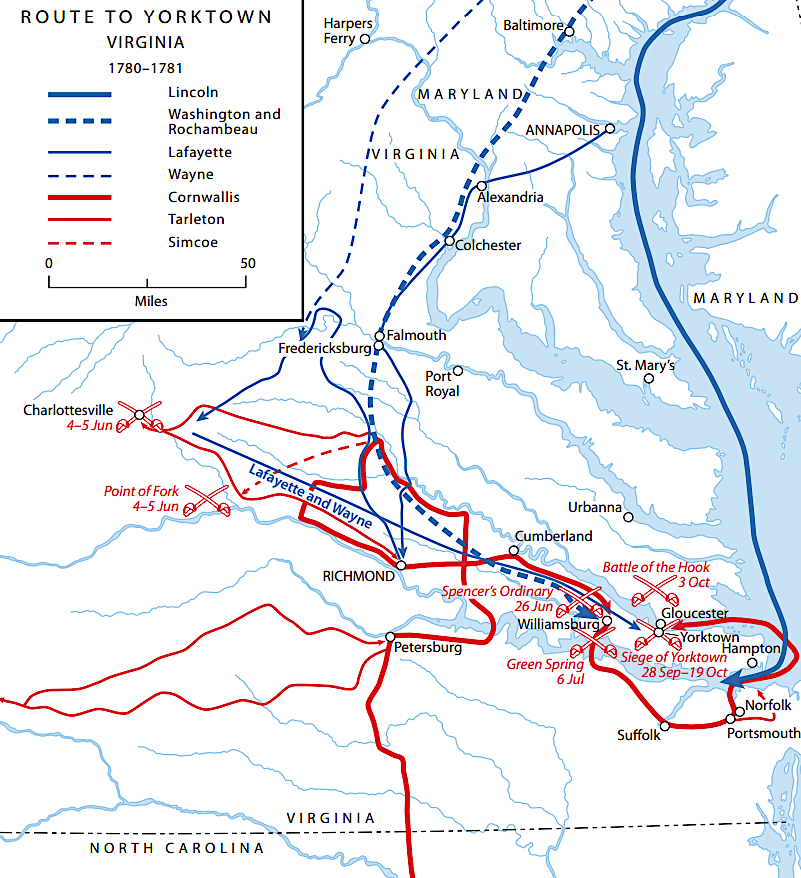
General Cornwallis marched across Virginia between May-September 1781 before establishing a base at Yorktown
Source: US Army Center of Military History, The War in Virginia, 1781 (Map 2)
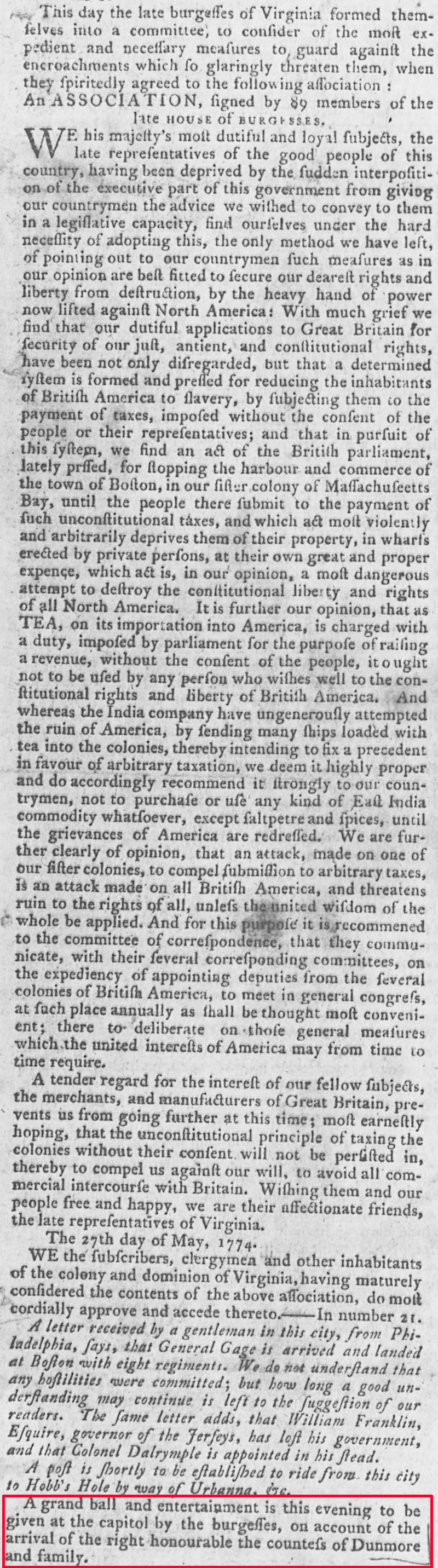
the burgesses initially used economic pressure to forces changes in British policy, and continued to socialize with Governor Dunmore even after he dissolved the House of Burgesses in May 1774
Source: Virginia Chronicle, Virginia Gazette (May 26, 1774, p.3)