The Heartland Corridor
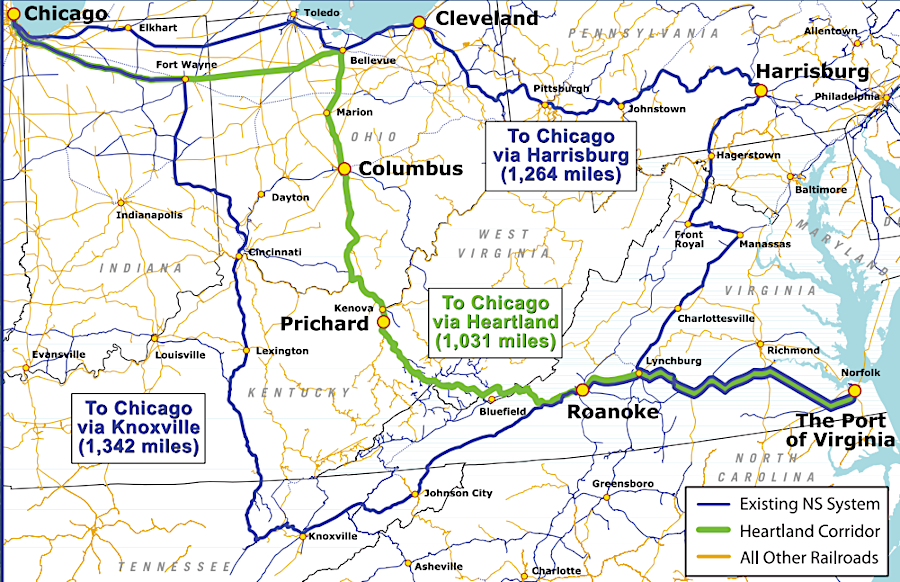
Heartland Corridor rail improvements completed in 2010 reduce trips to Chicago by over 230 miles (and divert trains away from Charlottesville, Manassas, Front Royal...)
Source: Appalachia Regional Commission, The Heartland Corridor:
Opening New Access to Global Opportunity
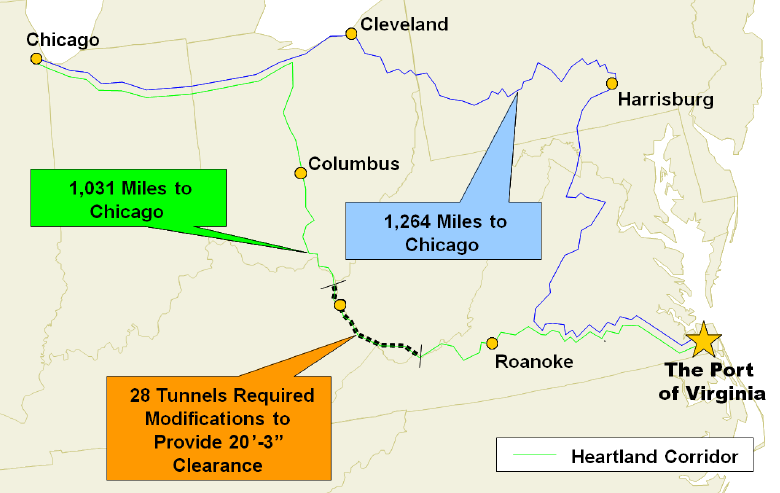
Heartland Corridor rail improvements completed in 2010 reduce trips to Chicago by over 230 miles (and divert trains away from Charlottesville, Manassas, Front Royal...)
Source: The Port of Virginia Infrastructure Update - Norfolk (February 16, 2012)
The Central Corridor Double-Stack Clearance Project of the Heartland Corridor was a public-private partnership to expand the capacity of the Norfolk Southern line between Norfolk and Columbus, Ohio. Norfolk Southern contributed $98 million, the Federal government provided $83 million, and the Virginia Rail Enhancement Fund added $10 million.1
Competing railroad CSX also upgraded its capability to carry containers from the APM terminal in Portsmouth - now known as the Virginia International Gateway (VIG) - to Ohio. The National Gateway project cost $850 million by 2018. Tunnels between Mid-Atlantic States and their ports to Midwest markets were expanded to achieve a minimum of 21 feet of clearance, and a bypass through Acca Yard in Richmond was added. The closest tunnel to Virginia to be upgraded was the Virginia Avenue Tunnel in southeast Washington, DC.2
CSX's National Gateway project did not address one major bottleneck which slowed freight and passenger trains going between Alexandria and Washington, DC - the inadequate capacity of the two-track Long Bridge across the Potomac River. The Virginia Passenger Rail Authority (VPRA) funded the Long Bridge Project to add two more tracks, with construction planned between 2026-2030. That investment made CSX, hauling trains from the Port of Virginia through Washington DC, more competitive with the Heartland Corridor route.3
Norfol Southern's Heartland Corridor project enabled double-stacked container trains to pass through old tunnels that were designed to transport coal. The low height of tunnels allowed Norfolk Southern trains to transport just one container per rail car; stacking one container on top of another was not possible..
The Norfolk and Western Railroad had built tunnels in 1881-1883 through the Allegheny Mountains to Pocahontas, West Virginia. Two decades later, it acquired the Scioto Valley Railway and created a connection further west to Columbus. That allowed the railroad to ship West Virginia coal eastward to Hampton Roads and westward to the Great Lakes.
The original track constructed along the New River west of Radford included 8 tunnels. To relocate track in order to reduce steep curves and grades, eventually over 35 tunnels were constructed. Some of the original tunnels, such as the original Eggleston Tunnel #1 and #2, were replaced as track was realigned.
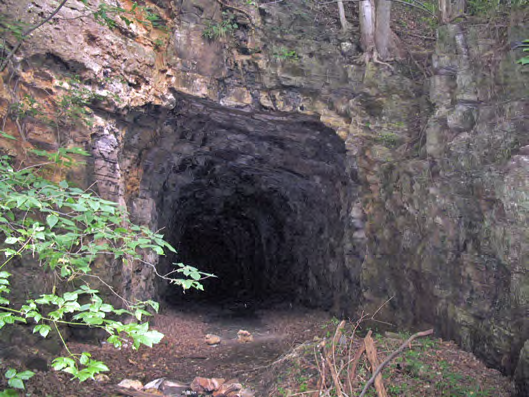
the original Eggleston Tunnel #1, built by the Norfolk and Western Railroad, was replaced by a concrete-lined version which was later expanded in the Heartland Corridor project
Source: US Department of Transportation, Through the Coal Fields: The Development of the Norfolk & Western Railway Through Southwestern Virginia and Southern West Virginia (last checked July 25, 2026)
After the development of containerized shipping, merchandise as well as raw materials was carried on that route. However, the tunnels built a century earlier were too narrow and low to permit stacking of containers. In 2001 Norfolk Southern proposed expanding the tunnels. The track through West Virgina was 200 miles shorter than the two options, turning north at Roanoke towards Hagerstown or turning south towards Chattanooga.
Expanding track capacity would increase business for Norfolk Southern, but costs exceeded the benefits to the railroad. Getting other partners, especially $140 million from the Federal government, to fund the investment was necessary.
The Virginia Port Authority contributed an additional $60 million for the Commonwealth Railway Mainline Safety Relocation Project to speed train traffic at Hampton Roads. That project, also known as the Western Freeway Rail Relocation project, moved 4.5 miles of track into the median of I-664 to service the APM/Maersk Terminal.4
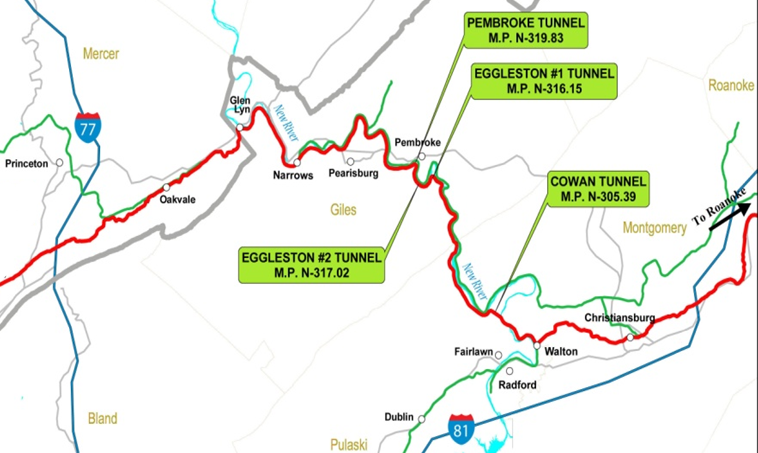
four railroad tunnels in Virginia had to be enlarged to permit double-stacking containers on the Heartland Corridor
Source: 11th Annual Geohazards Impacting Transportation in the Appalachian Region Technical Forum, Heartland Corridor Clearance Improvement Project
By 2010, Norfolk Southern improved 28 tunnels and 24 other overhead obstructions between Roanoke and Columbus, Ohio. Four tunnels were in Virginia - the Cowan, Eggleston #1 and #2, and Pembroke tunnels.5
The original tunnels were 19.5 feet tall. Trains with double-stacked containers required an additional 36 inches.
In five of the 28 tunnels, the floors were cut lower. Lowering floors was not feasible where tunnel entrances were close to bridges with their fixed elevations.
Most tunnels had to have their roof raised. In some places, cutting notches in the crown added the necessary additional height. Other tunnels required major excavations, with installation of rock bolts to prevent cracking and rockfalls later. One tunnel was bypassed completely.6
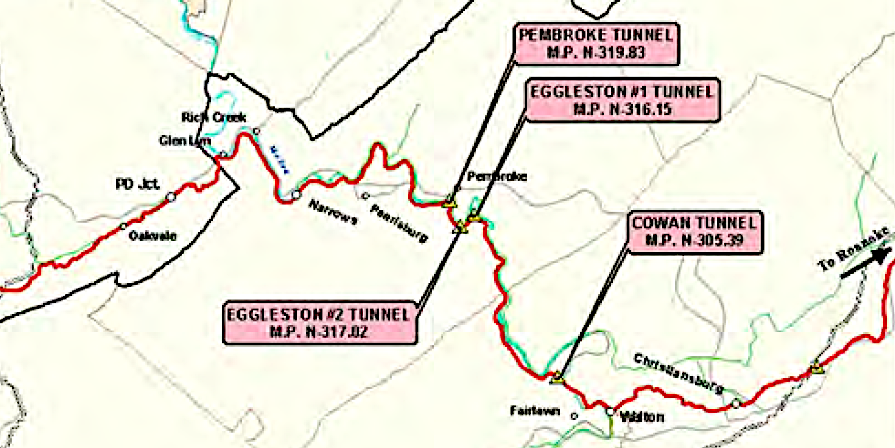
four Norfolk Southern tunnels in Virginia were expanded for the Heartland Corridor project
Source: Through the Coal Fields
Part of the original project scope was construction of an intermodal facility near Roanoke. Plans were developed for a site in Montgomery County near Elliston. The county tried to block the state approval due to community objections to the increased truc traffic, but the Supreme Court of Virginia upheld the authorization in 2011. By then, cost estimates had climbed from $36 million to $79 million. Norfolk Southern recalculated that the project would not justify the required level of investment, even though the state would be paying 70% of the cost.
Legislators in the General Assembly from Southwest Virginia continued to advocate for an inland port, seeing it as an economic development opportunity for the ecoomically struggling region. In 2023 the Virginia Economic Development Partnership (VEDP) and the Virginia Port Authority (VPA) completed the "nland Port Study: Feasibility Analysis of Locating an Inland Port in the Commonwealth" study. The study identified the Oak Park Center for Business and Industry in Washington County as the preferred site, south of the Heartland Corridor.7
Links
- Appalachian Regional Commission
References
1. "Project Profile: Heartland Corridor," Federal Highway Administration, US Department of Transportation, https://www.fhwa.dot.gov/ipd/project_profiles/wv_heartland.aspx (last checked August 4, 2026)
2. "Virginia Avenue Tunnel," CSX, https://www.csx.com/index.cfm/about-us/projects-and-partnerships/virginia-avenue-tunnel/; "CSX Commits Additional $160 Million to National Gateway," CSX, https://www.csx.com/index.cfm/about-us/media/press-releases/csx-commits-additional-160-million-to-national-gateway/; "Virginia Capacity Projects," CSX, https://www.csx.com/index.cfm/about-us/projects-and-partnerships/virginia-capacity-projects/; "Tunnel Vision," Site Selection, https://siteselection.com/tunnel-vision/ (last checked August 4, 2026)
3. "Long Bridge Update," Virginia Passenger Rail Authority, https://vapassengerrailauthority.org/projects/longbridgeproject/ (last checked August 7, 2026)
4. "The Heartland Corridor: Opening New Access to Global Opportunity," Appalachian Regional Commission, July 2020, p.5, https://www.arc.gov/wp-content/uploads/2020/07/HeartlandCorridor.pdf (last checked July 24, 2026)
5. "Project Profile: Heartland Corridor," Federal Highway Administration, US Department of Transportation, https://www.fhwa.dot.gov/ipd/project_profiles/wv_heartland.aspx; "Through the Coal Fields: The Development of the Norfolk & Western Railway Through Southwestern Virginia and Southern West Virginia, Including a Survey of Historic Tunnels and Bridges Along the Radford and Pocahontas Divisions," US Department of Transportation, January 1, 2010, https://rosap.ntl.bts.gov/view/dot/75177 (last checked July 25, 2026)
6. "Norfolk Southern raises the roof on 'the Heartland Corridor'," The Virginian-Pilot, May 2, 2010, https://www.pilotonline.com/2010/05/02/norfolk-southern-raises-the-roof-on-the-heartland-corridor/ (last checked August 27, 2026)
7. "Virginia approves construction of intermodal terminal," Freight Waves, August 17, 2008, https://www.freightwaves.com/news/virginia-approves-construction-of-intermodal-terminal; "WOYM: Intermodal port proposal in Elliston remains dormant," Roanoke Times, April 7, 2019, https://roanoke.com/news/local/article_9005345c-3f23-56f8-a500-f89d1aae5d06.html; "Southwest Virginia continues push for inland port," Virginia Business, April 29, 2026, https://virginiabusiness.com/virginia-second-inland-port-washington-county-workforce/; "Virginia Inland Port Study, Q4 2023 General Assembly Update," Virginia Port Authority, December 1, 2023, https://rga.lis.virginia.gov/Published/2023/RD678/PDF (last checked September 5, 2026)
Railroads of Virginia
Virginia Places