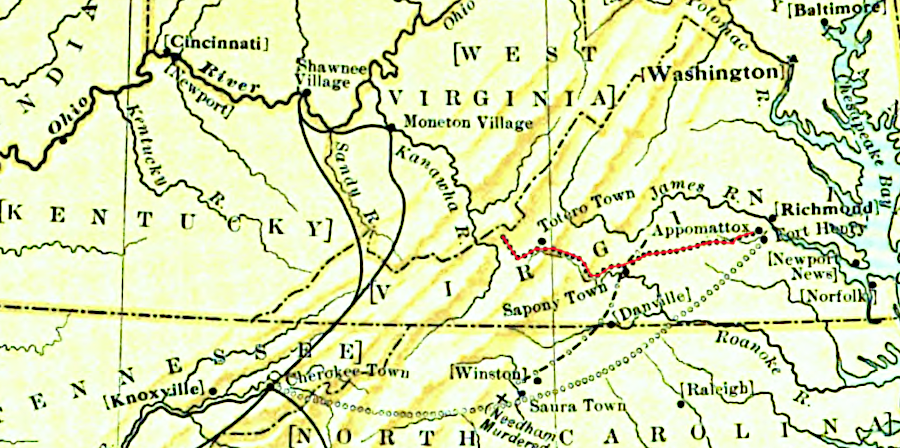
one possible route of Batte and Hallom, stopping short of climbing over East River Mountain into modern West Virginia
Source: Clarence Walworth Alvord, The first explorations of the Trans-Allegheny region by the Virginians, 1650-1674 (1912)
one possible route of Batte and Hallom, stopping short of climbing over East River Mountain into modern West Virginia
Source: Clarence Walworth Alvord, The first explorations of the Trans-Allegheny region by the Virginians, 1650-1674 (1912)
Abraham Wood established his trading center at the falls on the Appomattox River, the edge of colonial settlement after William Berkeley was restored as the colonial governor in 1660. Wood was a fur trader; he acquired deerskins and other furs from as far away as the Cherokees living on the Tennessee River.
Acquiring deerskins was not a routine business operation. Dealing with the tribes required an understanding of what each society valued and, in case of a trading dispute, what each society feared.
Abraham Wood wanted to obtain intelligence about the tribes and the territories in which they hunted. He may have been trying to bypass the Ocanneechi and other tribes who lived near Wood's trading post, and served as middlemen in the trade. The Occaneechi Trading Path extended through modern-day Winston-Salem, Salisbury, and Charlottee to the Cherokee towns on the west side of the Blue Ridge in the Tennessee River valley.

Abraham Wood, who received furs via the Occaneechi Trading Path through North Carolina, sent Thomas Batte and Robert Hallom westward to make connections with sources
Source: Clarence Walworth Alvord, An accurate map of North and South Carolina, with their Indian frontier
Woods sent Thomas Batte and Robert Hallom, together with Thomas Woods (possibly Abraham Wood's son), to explore inland in 1671. In addition to serving as fur trading agents, they were tasked to note the location of valuable minerals and other natural resources. The explorers left Fort Henry on September 1, 1671 and returned a month later on October 1, having traveled by horse and foot roughly 200 miles to the west.
English spelling was not standardized at the time, and the surviving copies of Hallom's journal spelled the last names of Batte and Hallom as "Batts" and "Fallam."1
Native Americans had known about the river for thousands of years. The Europeans who "discovered" the river in the 17th Century were not the first humans to see it, but they were the first to document their trips in writing.
Batte and Hallom were not the only explorers sent west by colonial leaders. Between 1669-1670, John Lederer traveled west across the Piedmont three times. According to some interpretations of his reports, he reached the Roanoke River. Lederer climbed up the Blue Ridge west of the modern town of Orange and once near Front Royal, in addition to reaching what may have been the New River valley.
In 1705, early Virginia historian Robert Beverley II credited Governor Berkeley rather than Abraham Woods with sending Batte westward, and claimed he took more colonists that Hallom recorded in his journal:2
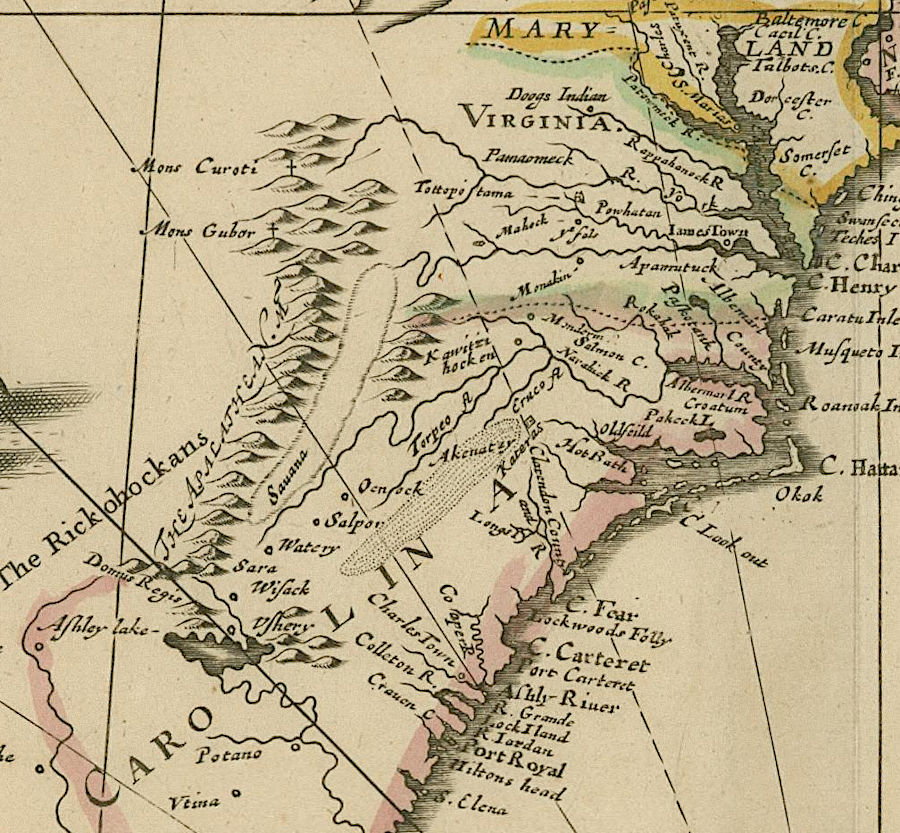
little was know of Virginia west of the Fall Line in 1671
Source: John Carter Brown Library at Brown University, A New Map of the English Plantations in America, both Continent and Ilands (by Robert Morden and William Berry, 1673)
As noted by Beverley, the starting point of the journey was Fort Henry. That was Abraham Wood's trading base on the Appomattox River near modern Petersburg. A guide from the Apppomattoc tribe, known as Penecute or Perecute, led the three Europeans west across the Roanoke or Staunton River. They recruited additional Siouan-speaking Appomattoc and Saponi guides there. Thomas Woods dropped out of the expedition in what today is Charlotte County. He was "dangerously sick of the Flux," and soon died.
The guides led them across the Blue Ridge, apparently choosing a gap about 15 miles south of where the river cuts through the ridge. They reached Totero Town, where they were "exceedingly civilly entertain'd" and left their horses. In the 1990's, the City of Salem constructed the James I. Moyer Sports Complex on the the Graham-White archaeological site, what may be Totero Town. Others suggest Totero Town was as far south as Patrick County, or on the New River.

Totero Town may have been on the Roanoke River in Salem
Source: ESRI, ArcGIS Online
The explorers and guides then crossed the Eastern Watershed Divide, climbing over Christiansburg Mountain into the New River Valley. The Batte-Hallom party then moved downstream from near modern-day Radford to East River Mountain, climbing various ridges before re-encountering the river. They may have stopped at Pearisburg, or gone across East River Mountain as far as 50 miles into West Virginia to the Tug Fork, or perhaps to the Falls of the Kanawha River.
Navigating through the Ridge and Valley physiographic province using the sun and dead reckoning, going up and down "mountains and Hills as if piled one upon another" following trails that were recognized only by the Native American guides, must have been very challenging.
If they did choose to climb 1,200 feet up East River Mountain, the sight of repetitive ridges to the west rather than the Pacific Ocean must have been disappointing. They had expected that North America was a narrow continent, and convinced themselves that the water in the river was ebbing and affected by ocean tides.3
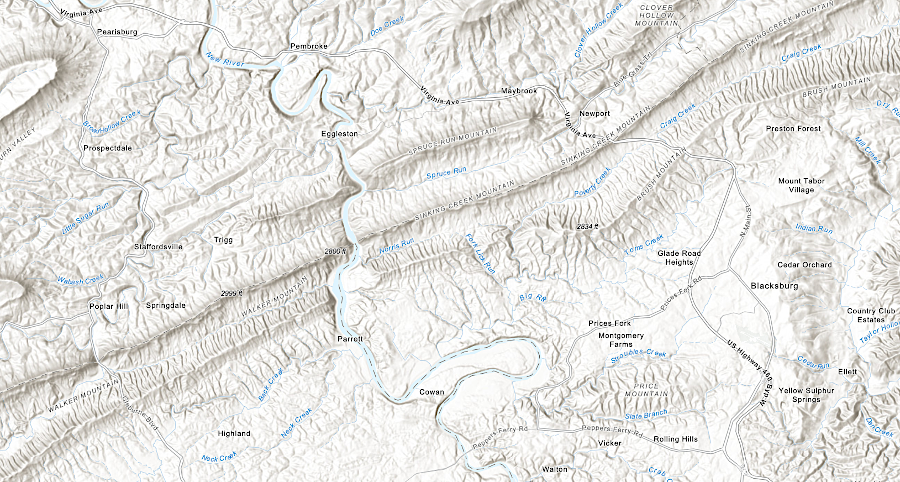
Batte and Hallom traveled over steep mountain ridges in 1671
Source: ESRI, ArcGIS Online
Batte and Hallom found out when they returned back to Totero Town that William Byrd, a rival fur trader based at Fort Charles near modern-day Richmond, was exploring nearby. The financial driver for sending Batte, Hallom, and others on western expeditions was not the search for minerals or the Northwest Passage, but a desire to expand access to deerskins and other furs.
Wood and Byrd had to deal with Governor William Berkeley's attempts to control the fur trade and manage trade in order to minimize a potential war with the Native Americans. Byrd was so frustrated that he initially joined Nathaniel Bacon in his 1676 rebellion against Governor Berkeley.
Whether or not Abraham Wood had been to the Roanoke River or even the New River first, Batte and Hallam were not the first English to cross into the Mississippi River watershed. They found a tree marked by a previous explorer using coal to show "MANI," and "MA" had been carved into a tree with a knife or sharp rock. Batte and Hallom brought marking irons and scarred four trees with symbols to honor King Charles II, Governor William Berkeley, Abraham Wood, abd their guide Perceute.
One Native American told Batte and Hallam that the trip from Totero Town to the Tug Fork was halfway to his town, where there was an "abundance of salt" and "a great company of Indians that lived upon the great Water." The optimism of Batte to spot the Pacific Ocean was recorded by Hallom in his journal, after they reached one mountain crest and looked across a series of other ridgetops:4
Source: Salem Museum,
350 Years Ago: Batts and Fallam Meet the Totero
William Byrd I, a fur trading rival of Abraham Wood, reached the Totero Town as Batte and Hallom returned from the New River. In 1673, Byrd sent James Needham and Gabriel Arthur to the Tennessee River in hopes of enhancing his ability to obtain deerskins and other furs from the western tribes.5