Coal and Transportation in Virginia
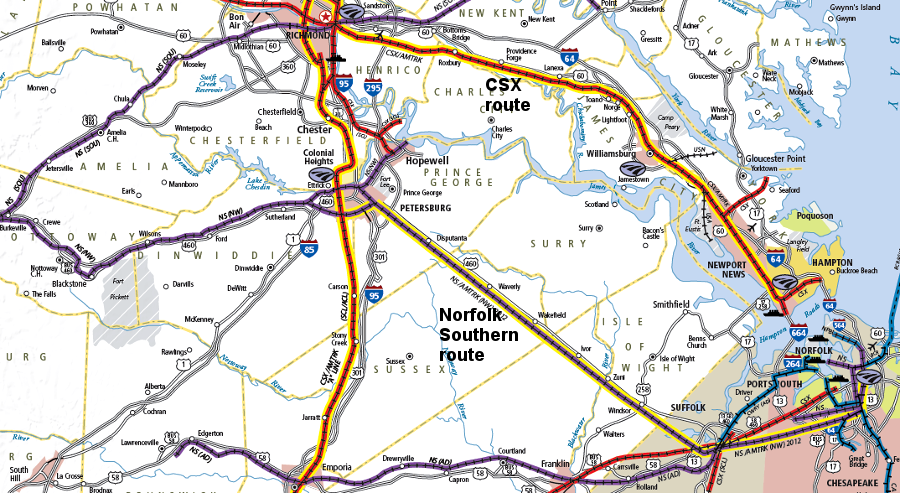
CSX hauls coal through Richmond/Williamsburg to an export terminal at Newport News, while Norfolk Southern hauls coal through Roanoke/Petersburg to Pier 6 at Norfolk
Source: Virginia Department of Rail and Public Transportation, Virginia
Railroad Map
The first coal mines in Virginia were developed in the early 1700's, as the Richmond area was settled by European immigrants. The coal was carried from the mines in the Triassic Basin, near Midlothian in Chesterfield County and near Tuckahoe in western Henrico County, to be transported on boats via the James and Appomattox rivers.
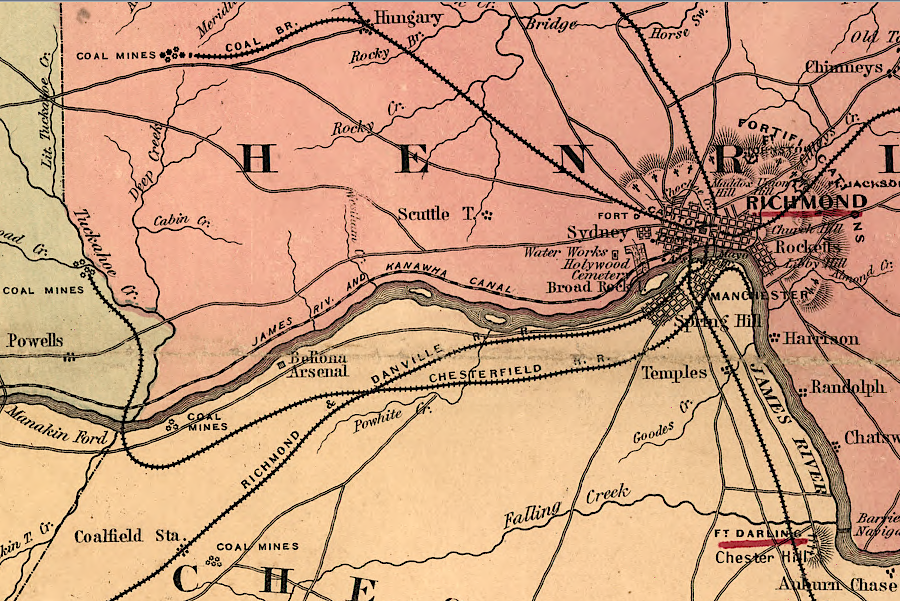
rail was essential for transporting the Triassic Basin coal to market at Richmond
Source: Library of Congress, Hare's map of the vicinity of Richmond, and Peninsular campaign in Virginia (by J. Knowles Hare, 1862)
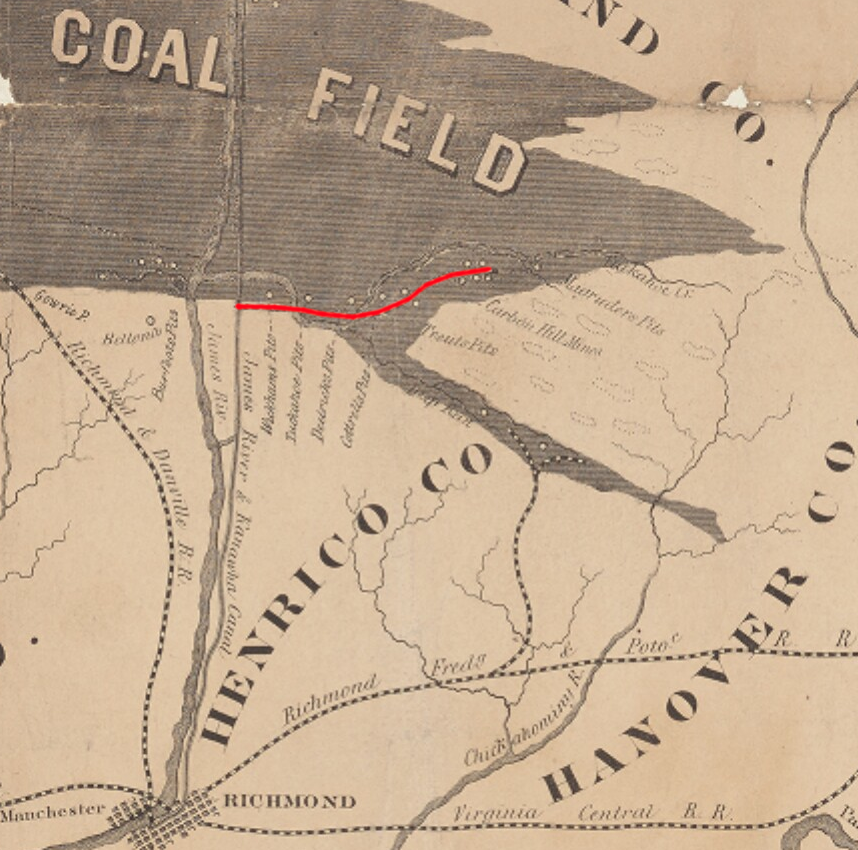
coal in Henrico County was transported by rail parallel to Tuckahoe Creek, to the James River and Kanawha Canal
Source: Yale University, Map of the Richmond coal field (by S. Herries DeBow, 1858)
The Chesterfield Railroad was the first Virginia railroad and the second commercial railroad in the United States. The rails were wood with an iron strap on top - and the railroad started without any locomotives. Cars loaded with coal moved by gravity downhill to the docks on the James River. In places where the line ran uphill, mules helped the cars climb some slopes. The empty cars were hauled back uphill by the mules to the mine, to be reloaded again:1
- Chesterfield County's first railroad, which began operating in 1831, was the second commercial railroad to be built in the United States. It was a 13 mile long mule-and-gravity powered line that connected the Midlothian coal mines with wharves that were located at Manchester. The Chesterfield Railroad was supplanted by the Richmond and Danville Railroad, which reached Midlothian in 1850. The Richmond and Petersburg Railroad (chartered in 1836), the Winterpock railroad (chartered in 1840 to haul coal from southwestern Chesterfield's mining district to the Appomattox River) and other rail lines were built to several coal pits.
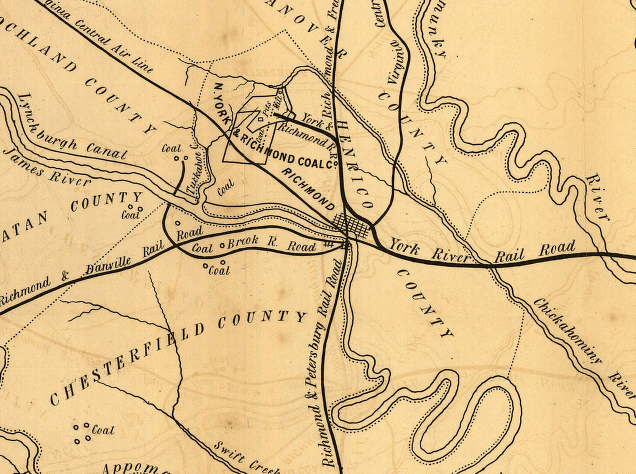
coal-hauling railroads around Richmond (1856)
Source: Library of Congress, Map of the Springfield & Deep Run estates on the Coal Lands of the N. York & Richmond Coal Co, in Henrico Co. Virginia
The major coal fields in western Virginia were not developed until the arrival of the railroads in the 1880's. Locomotives were powered by steam, which was produced in the engines by burning the same bituminous coal being hauled to customers and to ports for export.
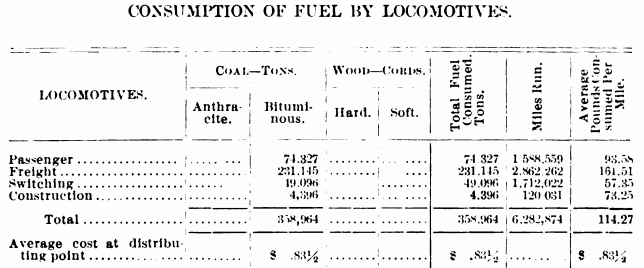
in 1905, the Chesapeake and Ohio Railroad relied 100% on bituminous coal to power its steam locomotives
Source: Annual Report of the State Corporation Commission of Virginia - Volume 2 (1905), Chesapeake Western Railway (p.118)
Today, the coal in Virginia that is economical to mine is concentrated in the mountainous southwest. The value of Virginia coal depends upon its:
- coal quality (measured in British Thermal Units, with a higher BTU number meaning the coal packs more energy per pound)
- cost of extraction (usually based on the amount of "overburden" above a profitable-to-mine coal seam, especially if strip mining is not feasible and underground mining is used)
- distance from final market
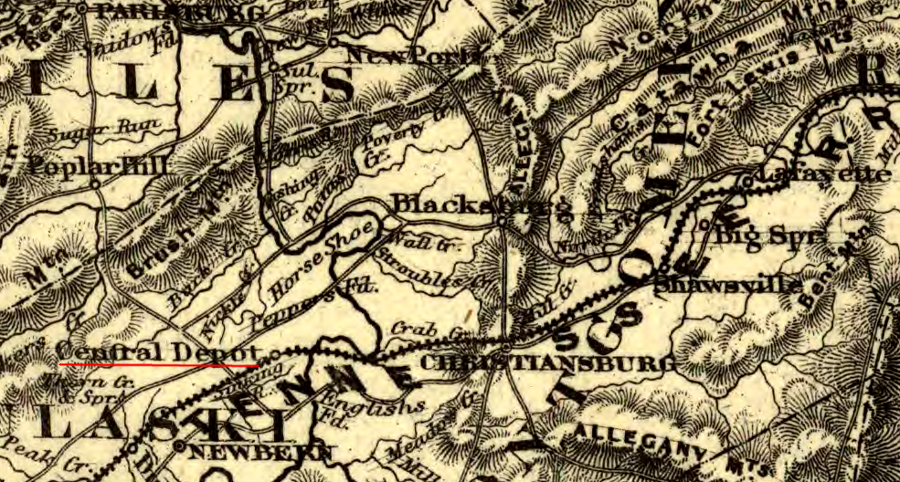
prior to the 1880's, there was no railroad on the New River west of Central Depot (now the City of Radford)
Source: Library of Congress, Map showing the Fredericksburg & Gordonsville Rail Road of Virginia (1869)
Virginia's bituminous coal is used for two major purposes: generating energy and making steel. "Steam coal" is burned at power plants to generate steam that spins turbines and generates electricity, or directly at industrial sites to produce heat and steam. Metallurgical or "met coal" is converted into coke before being used to smelt iron ore or scrap steel.
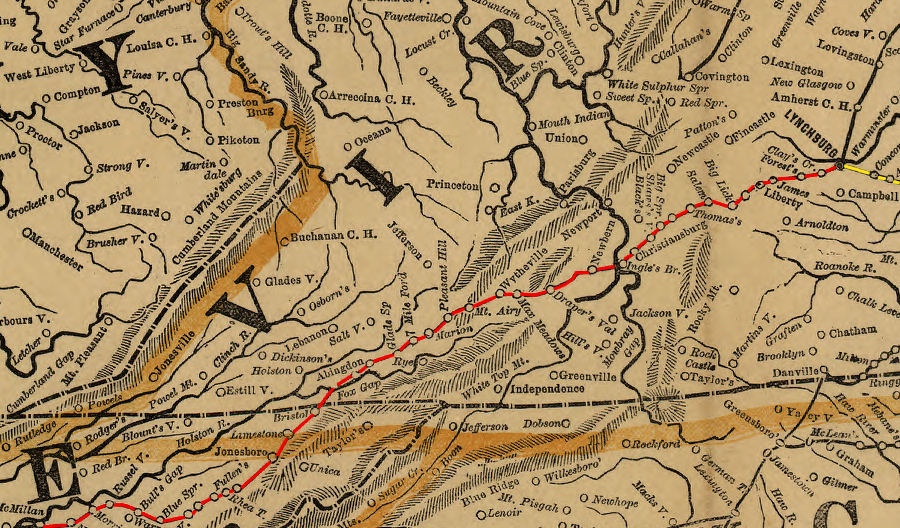
prior to the Civil War the Virginia and Tennessee Railroad carried agricultural products and iron to Lynchburg (and via the South Side Railroad to port cities), and no railroad penetrated the Appalachian Plateau until the 1880's
Source: Library of Congress, Map of the southern states of North America with the forts, harbours & military positions (1862)
Even low-quality steam coal, with a high sulfur content and extracted through expensive underground mining practices, might be worth the high cost of - if transportation costs were low. Transportation costs could be minimized if a power plant was located near the entrance to a coal mine. It is cheaper to transport electrons to customers through high-voltage wires, than to ship bulky coal via trains to power plants and then deliver electricity through the grid.
However, there are few power plants located next to Virginia mines, primarily because there is little water for cooling the boilers in such plants. The Clinch River Power Plant can use the water from the Clinch River, but the Virginia Electric Power Company had to build a new lake up on a ridge for the Mount Storm power plant in Grant County, West Virginia. Using an air-cooled condenser at the Virginia City Hybrid Energy Center in Wise County reduced its demand for cooling water by 90%, compared to a traditional coal-fired power plant.2
Hauling coal by mule-drawn cart is ancient history now. Modern railroads have made it possible to ship bulk coal long distances at relatively low cost. Virginia coal has to compete with other sources based on the quality of the coal as well as geography.
Most Virginia coal is shipped by rail to power plants on the Ohio river or to three major ports - Charleston (in South Carolina), Norfolk (by the Norfolk Southern Railroad), and Newport News (by CSX Railroad). Short trips are less expensive - and for the mines in far southwestern Virginia near Cumberland Gap, Charleston is closer than the two Virginia ports.
The business of hauling coal creates about two-thirds of the freight rail traffic for the two Class 1 railroads in Virginia, CSX and Norfolk Southern (nationwide, coal hauling is only 40% of rail tonnage). Almost all of the coal carried by rail to Norfolk and Newport News and loaded onto ships is low sulfur, high energy coal used for making steel.3
Low-cost transport, by rail and ship, has made it possible for Virginia to export coal since development of the original mines in Midlothian. Coal mines in Wise and Lee County have lower transportation costs to reach power plants in the southeastern United States compared to competing mines in West Virginia and Kentucky. However, Southwestern Virginia coal mines that sell much of their product to power plants along the Ohio River have to compete with mines in Kentucky, Ohio, Indiana, Illinois - even Wyoming, where low-sulfur coal can be strip mined and shipped by unit trains to power plants in the Midwest.
The Norfolk Southern coal processing terminal in Hampton Roads, Pier 6, was opened in 1962 and today is the largest in the United States. Shipping coal by rail to domestic power plants is cost-effective today, but the rail traffic from the mountains to the Virginia ports on the Chesapeake Bay has diminished substantially as bigger gondola cars carry more tonnage and more-powerful locomotives pull more cars.
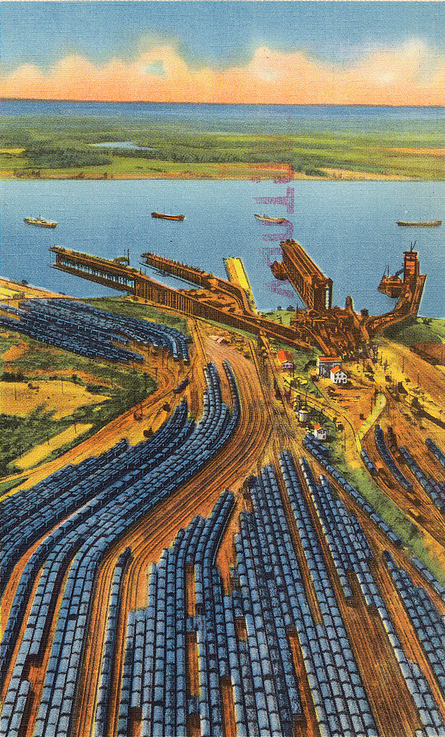
Lambert's Point, destination in Hampton Roads of Norfolk Southern coal, shown on postcard issued 1930-1945
Source: Boston Public Library
In 2012, that facility in Norfolk moved 38% of all coal mined domestically and shipped to foreign customers. In 2013, Norfolk Southern railroad unloaded 200,000 coal cars at Pier 6 in Norfolk. With the typical train hauling 180 cars (carrying 100 tons of coal per car), that required hauling just 3 coal "drags" per day downhill between Roanoke and Norfolk.4
In the past, 80% of the coal exported from Hampton Roads was metallurgical ("met") coal used to make steel. In 2011, Virginia exported 33.5 million short tons of met coal and 7.5 million short tons of steam coal. That coal was delivered by rail from West Virginia/Virginia mines, and shipped primarily to Europe and Brazil. In contrast, Louisiana ports receive primarily steam coal via barges floating on the Mississippi River, and export it to power plants in Europe and Latin America.5
By 2016, the total amount of coal exported from Virginia dropped to roughly 20 million tons, and 90% was metallurgical coal. Few CSX trains running through Richmond to Kinder Morgan's Pier IX and Dominion Terminal Associates in Newport News, or Norfolk Southern coal cars going to Pier 6 terminal at Lambert's Point, carried steam coal.6
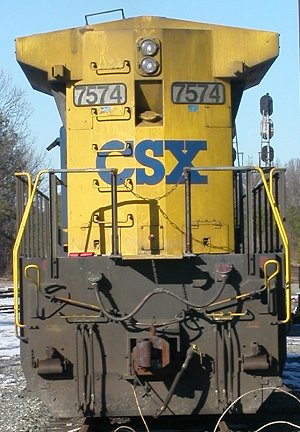
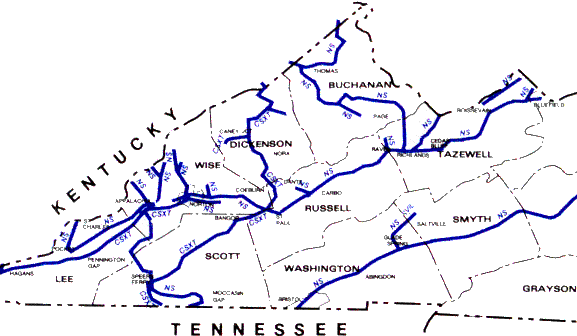
there is competition for coal traffic in Southwestern Virginia: CSX hauls coal to Newport News for export, while Norfolk Southern hauls to Pier 6 at Norfolk
Source: Virginia Department of Rail and Public Transportation, Railroad Map of Virginia
Natural gas supply in the United States has increased through recovery from unconventional means (hydraulic fracturing). In response to the lower cost of natural gas, utilities and industries are expected to buy less steam coal.
The demand for low-sulfur coal from the Central Appalachian basin (Virginia, southern West Virginia, Kentucky, and Tennessee) is also expected to drop in the next 30 years as old coal-fired power plants are retired.
New power plants have scrubbers installed. That allows burning of Powder River basin coal, which has more sulfur but is less expensive. Coal trains will continue to arrive at coal-fired power plants, but more and more coal cars traveling to Ohio River facilities may originate at Wyoming strip mines rather than from geographically-closer underground mines in the Central Appalachian basin.
In contrast, metallurgical coal will not be displaced by lower natural gas prices or lower-cost steam coal from the strip mines in the Powder River Basin. The coal hauled by rail through Williamsburg to Newport News, and through Roanoke to Norfolk, will continue to originate at mines in the Central Appalachian basin, but the long-term trend is for the percentage of steam coal on those trains to decline. One observer noted in 2017:7
- We are seeing the relentless conversion of (Central Appalachian coal production) from a highly productive, extremely influential thermal coalfield to a met-heavy region that serves niche thermal markets
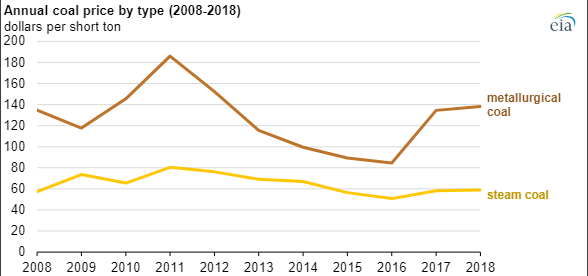
metallurgical coal used for making steel has higher value than steam coal burned just to generate energy
Source: Energy Information Administration, Today in Energy: In 2018, U.S. coal exports were the highest in five years (March 27, 2019)
The economic impacts of being a coal export port are substantial in Norfolk, but the envionmental impacts are also significant. Coal dust particulates, fine particles of powdered carbon, blow off the rail cars and conveyor belts, polluting back yards and potentially affected human health all the way to the Ghent neighborhood. Norfolk Southern relies upon chemicals to suppress the movement of "fugitive" dust. Rail cars loaded with coal are not required to have covers or tarps comparable to what is required of loaded trucks traveling on Virginia highways.8
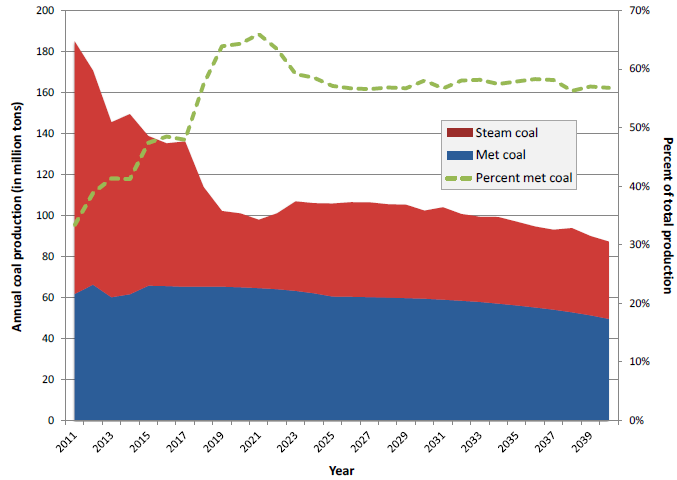
in the next 30 years, met coal hauled to Hampton Roads will continue to originate at Appalachian mines, but steam coal may be imported to Virginia power plants by rail from Wyoming
Source: The Continuing Decline in Demand for Central Appalachian Coal: Market and Regulatory Influences, Projections for Central Appalachian met and steam coal production, 2011-2040 (Figure 36)
Norfolk Southern's Pier 6 loading facility was built in 1962, and predates the Clean Air Act by eight years. Flipping 200,000 coal cars each year to dump out the ground-up coal generates dust, as does the transport of the coal via conveyor belt into the holds of ships, but most operations at the facility are a "pre-existing use" and not regulated by the Virginia Department of Environmental Quality (DEQ).
In contrast, the coal loading terminal at Newport News, loading coal brought by CSX trains, was built in the 1980's. To meet Clean Air Act limits on particulates established by DEQ, the rail car dumper at Newport News is enclosed and water is sprayed on the coal piles to reduce wind-blown dust.9
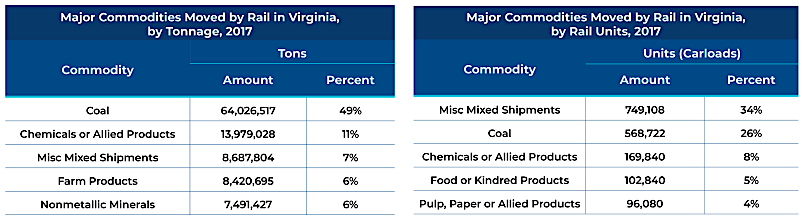
in 2017, nearly 50% of the tonnage shipped by rail in Virginia was coal - though almost 75% of rail cars carried other freight
Source: Virginia Department of Rail and Public Transportation (DRPT), Draft 2022 State Rail Plan (Chapter 1)
In 2018, the Port of Virginia terminals in Hampton Roads were the largest coal export center in the United States, processing 36% of the nation's coal exports.10
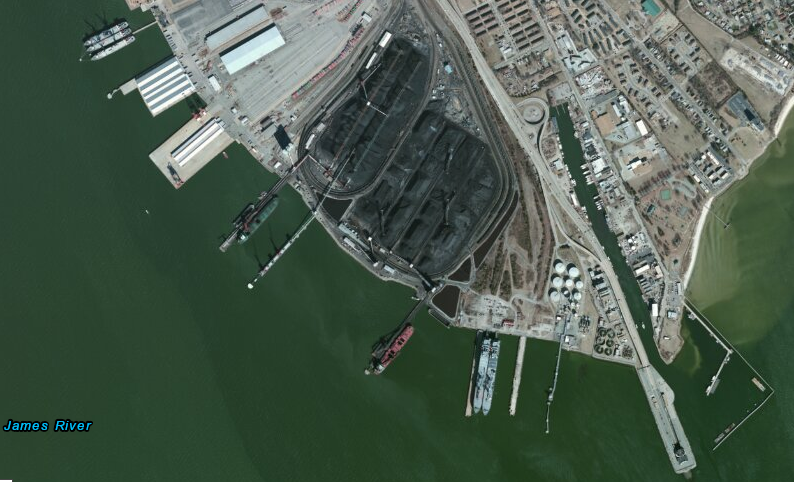
the Dominion Terminal Associates coal-loading facility in Newport News must comply with more Clean Air Act regulations than Norfolk Southern's Pier 6 facility in Norfolk
Source: ESRI, ArcGIS Online
By 2021, as coal-fired power plants closed, the decline in demand affected railroad shipments. CSX Transportation calculated that in 2021 it was handling an average of 2,000 carloads of coal per day, just 50% of the coal traffic in 2011. CSXT concluded that the drop would be permanent, though demand for metallurgical coal would always continue. The railroad started to tear up sidings and surplus yard tracks, selling the material for scrap. Removing infrastructure also reduced maintenance costs and taxes.11
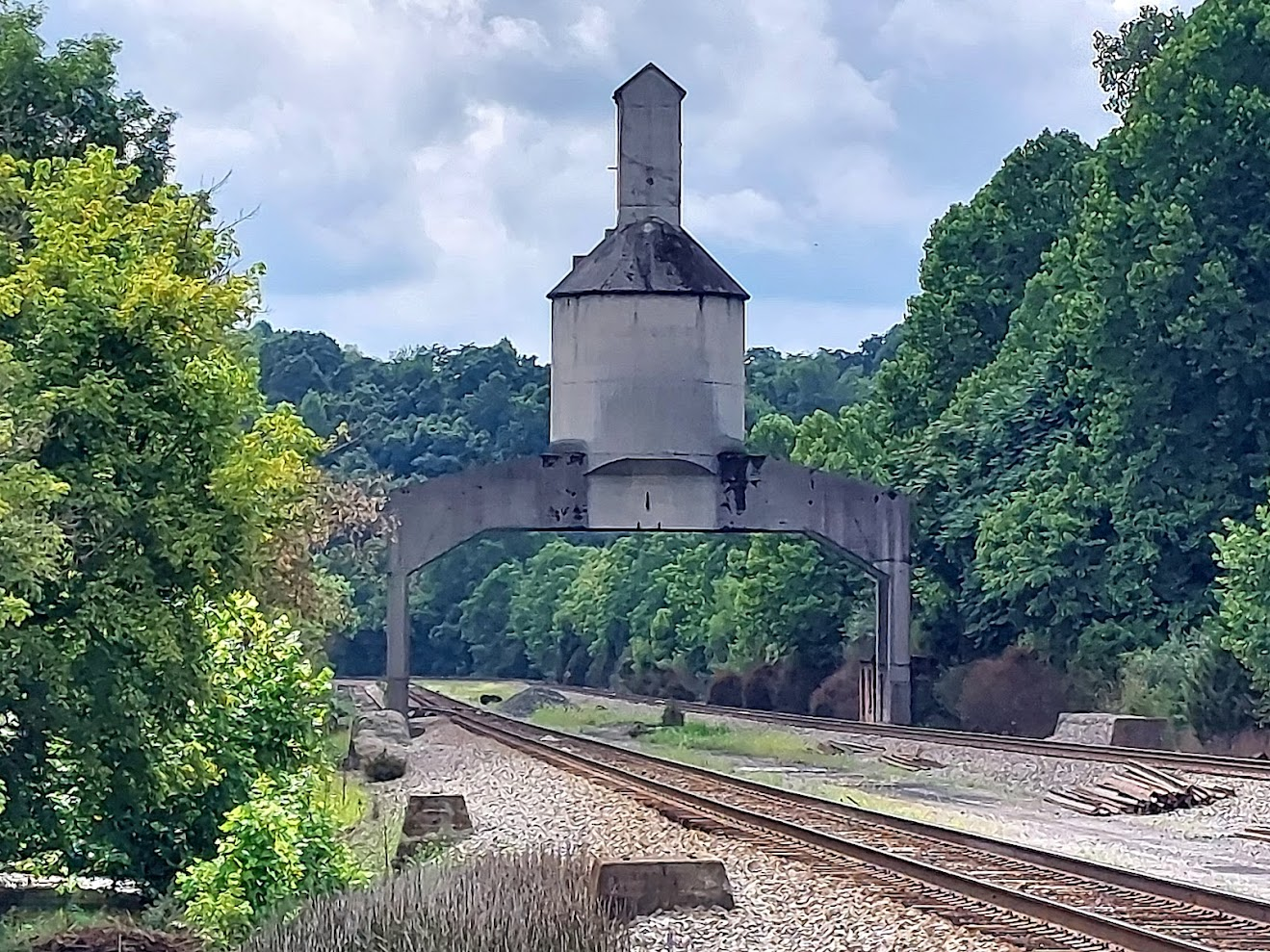
remnant of coaling tower of former Norfolk and Western Railway at Vickers Switch (Montgomery County)
Links
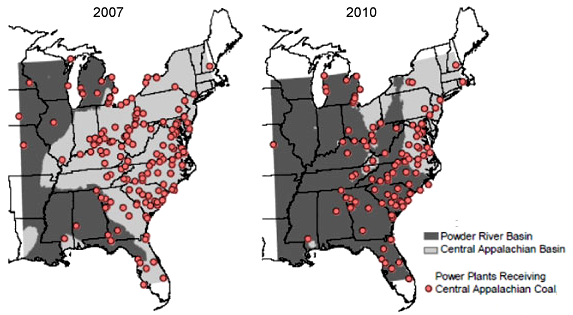
relative cost of coal from Powder River Basin vs. Central Appalachian basin could result in trains carrying coal from west of the Mississippi River to Virginia power plants as far east as Halifax County
Source: Energy Information Administration, "Coal Transportation Rates to the Electric Power Sector," Lowest Delivered Cost Per Coal Basin (Figure 8)
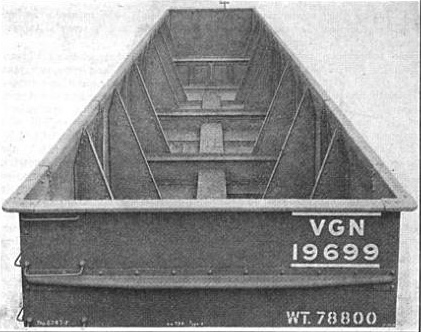
on the Virginian in the 1920's, 75% of the coal car weight was a revenue-earning 90 tons of coal and 25% of the weight was the car itself
Source: Railway and Locomotive Engineering, The 120-Ton Coal Cars of the Virginian Railway (April, 1921)
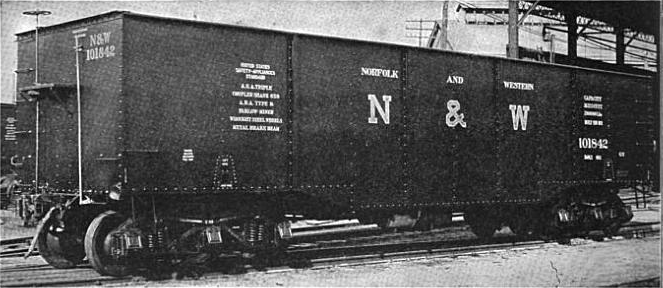
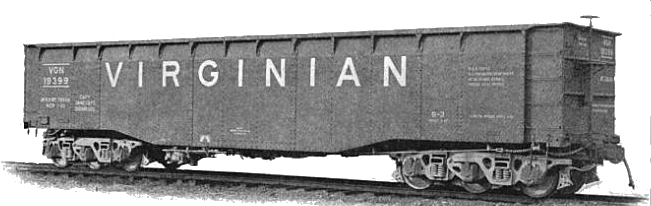
in contrast to the Norfolk and Western 100-ton coal hopper, there were no hopper doors on the bottom of the Virginian's 120-ton coal cars because they were tilted sideways when unloaded at Sewells Point
Source: Railway and Locomotive Engineering, Successful Test of the Automatic Straight Air Brake on the Norfolk and Western Railway (April, 1921) and Railway and Locomotive Engineering, The 120-Ton Coal Cars of the Virginian Railway (April, 1921)
References
1. Martha W. McCartney, "Historical Overview Of The Midlothian Coal Mining Company Tract - Chesterfield County, Virginia," December, 1989, https://www.midlomines.org/historic-overview.html (last checked April 26, 2020)
2. "Virginia City Hybrid Energy Center St. Paul, Va.," Mid-Atlantic Construction, Summer 2009, (last checked May 12, 2014)
3. Association of American Railroads, "Railroad Service in Virginia - 2000," http://www.tomorrowsrailroads.com/pdf/VA.pdf; "Coal," Virginia Department of Mines, Minerals, and Energy, http://www.dmme.virginia.gov/dgmr/coal.shtml (last checked April 25, 2004)
4. "Coal Fuels The World," BizNS, Norfolk Southern, September/October 2010, p.5; http://www.nscorp.com/content/dam/nscorp/bizns/archive/BizNS_Vol2_Issue5.pdf; "Uncovered: The coal dust in our wind," The Virginian-Pilot, May 11, 2014, http://hamptonroads.com/node/716095 (last checked May 12, 2014)
5. "U.S. Coal Exports: National and State Economic Contributions," National Mining Association, May 2013, pp.3-4, http://www.nma.org/pdf/coal_export_report.pdf (last checked May 12, 2014)
6. "Coal exports from Virginia keep sliding, though pace has slowed," The Virginian-Pilot, October 25, 2016, http://pilotonline.com/business/ports-rail/coal-exports-from-virginia-keep-sliding-though-pace-has-slowed/article_fcd03a1f-138f-5a88-b91b-0075ebac11c1.html (last checked October 26, 22016
7. "Coal revival? Hampton Roads' coal exports are up big in 2017," The Virginian-Pilot, July 21, 2017, https://pilotonline.com/business/ports-rail/coal-revival-hampton-roads-coal-exports-are-up-big-in/article_70932757-9ace-5179-bf38-5863dcb51747.html (last checked July 25, 2017)
8. "Virginia - State Profile and Energy Estimates," US Energy Information Administration (EIA), http://www.eia.gov/state/?sid=VA; "'Fugitive dust' from Norfolk coal cars stirs health fears," The Virginian-Pilot, April 22, 2014, http://hamptonroads.com/2014/04/fugitive-dust-norfolk-coal-cars-stirs-health-fears (last checked April 23, 2014)
9. "Uncovered: The coal dust in our wind," The Virginian-Pilot, May 11, 2014, http://hamptonroads.com/node/716095 (last checked May 11, 2014)
10. "Virginia Profile Overview," US Energy Information Administration, September 19, 2019, https://www.eia.gov/state/?sid=VA (last checked September 25, 2019)
11. "Analysis: Infrastructure gets scaled back in coal country," Trains, December 8, 2021, https://www.trains.com/trn/news-reviews/news-wire/analysis-infrastructure-gets-scaled-back-in-coal-Trains (last checked December 9, 2021)
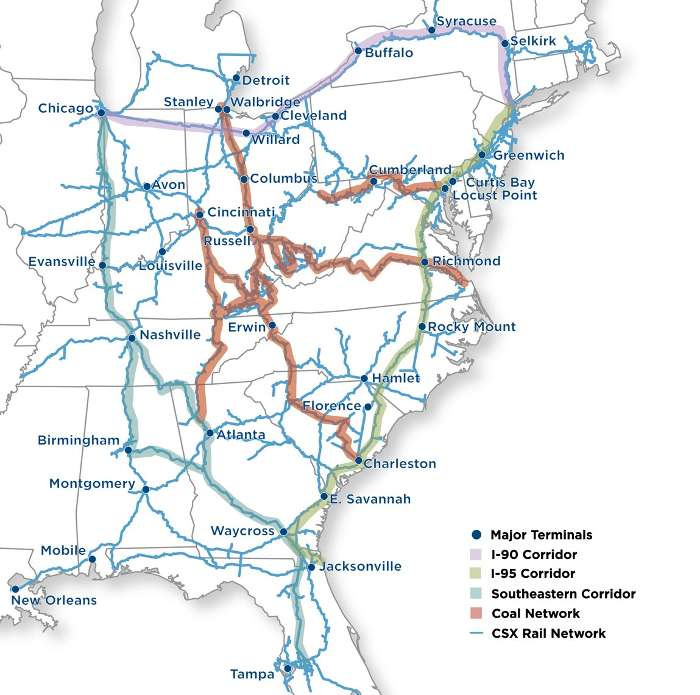
coal transportation is concentrated in the central core of the CSX rail network
Source: Securities and Exchange Commission, Form 10-K for CSX Corporation for the fiscal year ended December 28, 2012
Railroads of Virginia
Virginia Places
