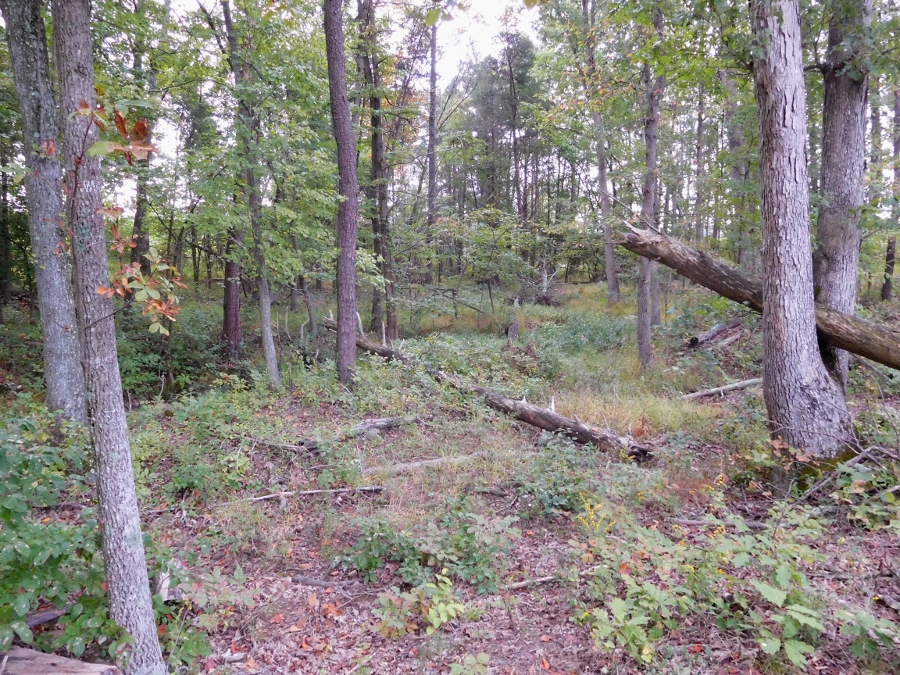
the first Virginians survived by hunting and gathering for over 10,000 years, and were traveling campers constantly seeking new places in the woods to spend the night
the first Virginians survived by hunting and gathering for over 10,000 years, and were traveling campers constantly seeking new places in the woods to spend the night
The initial settlers in Virginia, 15,000 or so years ago, did not stay at a Holiday Inn Express or build houses. The earliest Virginians traveled constantly, establishing transitory family campsites while hunting and gathering food.
Modern travelers constantly on the move carry little luggage, and the earliest Virginians were equally savvy. They made stone and bone tools, but left behind just a few archeological artifacts. Archeologists look for rock flakes (debitage) created when stones were sharpened into "points" at places such as Cactus Hill.
Campsites were temporary, so little debitage would accumulate at any single location. After a short period of hunting, perhaps several days or weeks, the game in an area would be either harvested or wary. Easy-to-gather fruits and berries would have been picked as well. Then it was time to move on to another site, over a ridge into another valley where the hunting was easier and the natural resources could be harvested with less effort.
Hunting bands concentrating briefly in short-term communities, presumably at places with sufficient game to support a larger number of people. The annual rendezvous of beaver-trapping "mountain men" in the Rocky Mountains during the 1840's might serve as a model for how the first Virginians chose to gather.
A more-modern equivalent could be the homecoming events sponsored by high schools and colleges during the Fall. There have been temporary gatherings with games, athletic contests, and feasting for 15,000 years in Virginia, long before there was a National Collegiate Athletic Association with Division I, Division II, and Division III bowl games.
The original gathering spots in Tidewater were places rich in oysters, mussels, crabs, and fish. The brief surge of people in one location during the in the Paleo-Indian and Archaic periods required easy access to extra food, which had to be freshly caught in the days before refrigeration.
In the mountains, modern archeologists focus their hunt for ancient gathering sites at locations that would have been easy to recognize. The water gaps through the Blue Ridge carved by the Roanoke, James, and Potomac rivers were distinctive, identifiable by different groups after traveling around for a year. Gathering sites needed to offer sufficient food resources to meet the short-term demand. A topographic feature such Burke's Garden could have been recognizable but not suitable, because it lacked water and the number of game animals was limited.
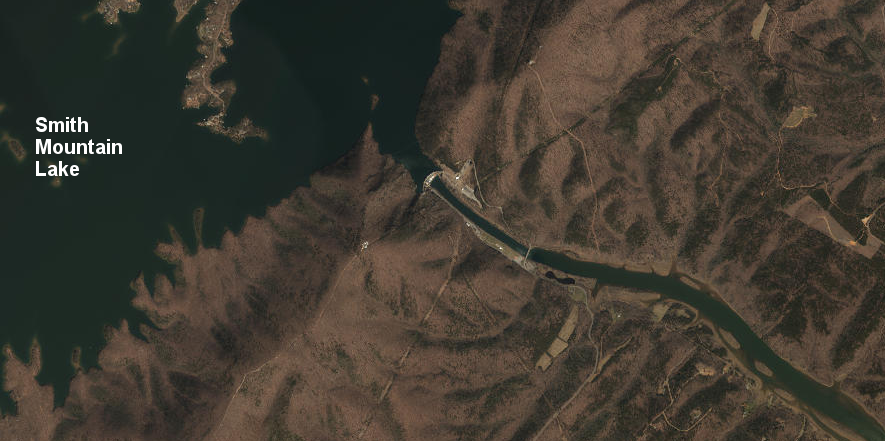
Smith Mountain Lake, created by a dam at a distinctive mountain gap in the Blue Ridge, may cover the fields where short-term communities were created seasonally as early Native Americans gathered to trade and socialize
Source: ESRI, ArcGIS Online
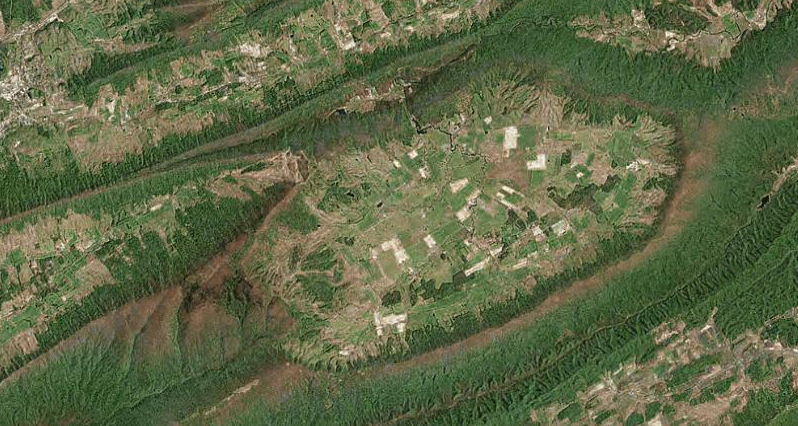
Burke's Garden is an easy-to-recognize topographic feature, but lacked enough water and game to be a suitable gathering spot for bands of hunters and gatherers in the Paleo-Indian and Archaic periods
Source: ESRI, ArcGIS Online
In the Woodland Period, Native Americans continued to hunt and gather foods, but also settled down in one place for 9-10 months of the year. One key step in the transition between the Archaic and Woodland periods is the development of the first settlements in Virginia.
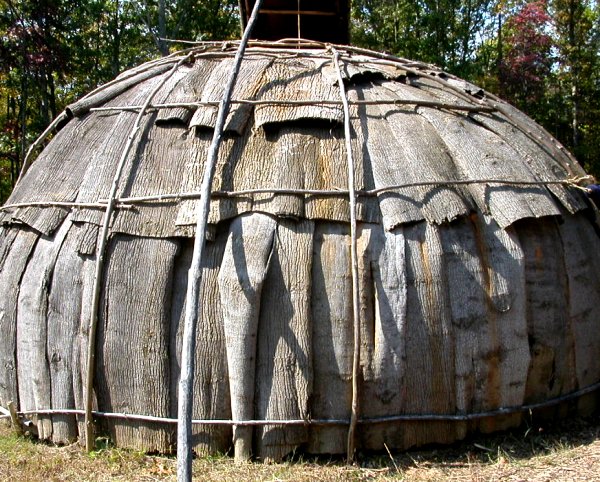
Recreation of Totero (Tutelo) dwelling, at Explore Park near Roanoke
Why would a traveling band build a long-term community in one location, rather than continue to cross nearby watershed divides to hunt/gather in new places after exhausting the local food sources?
Some hunting camps and plant gathering sites were revisited regularly, because the resources were relatively abundant in that area. When camping, the natives would eat plants harvested from the area, or brought from the last camp. Even hungry hikers inevitably miss a few seeds when eating. Discarded seeds were concentrated at Archaic Period campsites.
Some of those discarded seeds would grow the following year, and the seeds that grew at old campsites had not been chosen randomly.
The seeds from the species of plants that were most attractive to humans were collected in the wild. The clusters of plants that began to grow wild at campsites matched the species preferred by the Native Americans. Those seeds had been specifically selected from plants that were tasty, from plants with larger-than-average seeds, and from plants with bunches of seeds that clung to the stalk and ripened together rather than shattered and scattered individually.
Traveling bands of Native Americans discovered that some of their hunting camps evolved into good plant collecting sites. Picking food from plant clusters at those sites would be easier than wandering through the nearby territory.
A campsite that offered "easy pickings" for harvested the seeds or other desirable plant parts would be worth revisiting. Gradually some bands learned to invest some effort in helping the plants grow, and the fruits/seeds from that investment justified the humans living longer in the same place. Genes selected by humans were concentrated at the camps that were revisited, and humans invented agriculture.
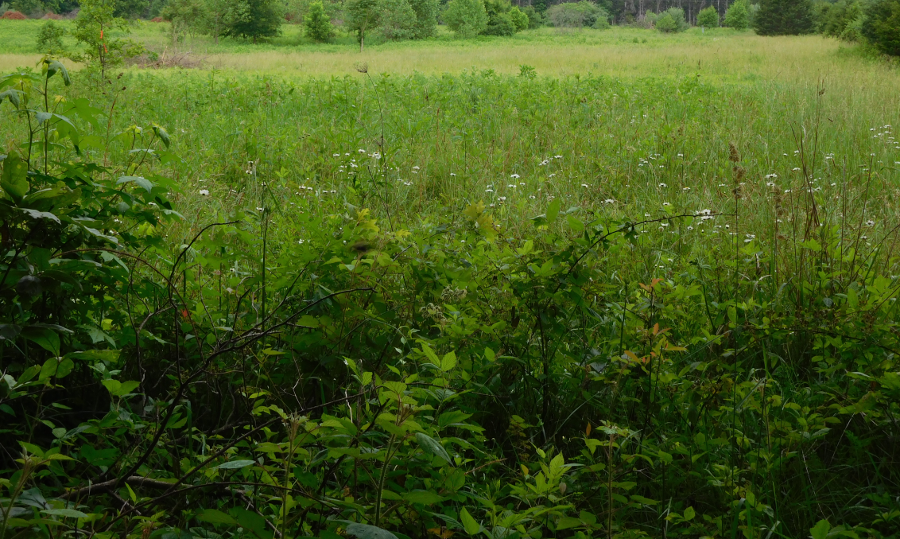
the first communities in Virginia developed near water and open fields, and Native Americans became more sedentary as they discovered the advantages of agriculture
The Eastern Agricultural Complex developed 4,000-5,000 years ago in the Mississippi Valley. Agriculture there started with the domestication of gourds, sunflowers, marshelder, and Chenopodium (a relative of the quinoa plant that was domesticated in South America). Some wolves saw the advantages of being near reliable food sources, and ended up as domesticated dogs.
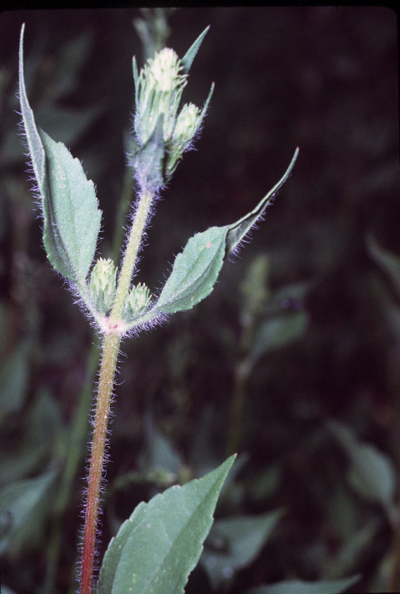
marshelder (Iva annua) was one of the first crops domesticated in the Eastern Agricultural Complex, and its seeds were planted by early Native Americans long before corn
Source: US Department of Agriculture, Plants Database, Iva annua L. - annual marsh elder
The first Virginia communities did not grow beans or edible species of squash. Those species were introduced later, as Native Americans living further south developed versions that could grow in more-northern latitudes.
The last major domesticated plant to arrive was corn. It took thousands of years for different Native American groups to alter the genes of a grass native to Mexico with a small seedhead. Through selective breeding, the first agriculturalists gradually created a version that would completely ripen during the shorter growing seasons in the north.
The English who arrived in 1607 found Native Americans growing the "three sisters" of corn, beans, and squash, but the first permanent communities in Virginia did not grow those plants. Corn was the last species to be added to the agricultural mix in Virginia. It may have become a common crop of the Native Americans in Tidewater only 600 years before the English arrived.
Agriculture helped communities to become established and to grow. As food supplies increased at specific locations, individual bands based on just one family united to form tribes that included multiple families.
Virginia was at the periphery of the Eastern Agricultural Complex, and no large (10,000-person) population centers emerged in Virginia to rival those in the Mississippi Valley or Mexico. John Smith and others did record towns with up to several hundred people. He found one leader (Powhatan) establishing a paramount chiefdom incorporating multiple tribes, though that process may have been underway in other areas he did not document well.
When John Smith arrived, the towns he found were always in the process of moving. Slash-and-burn agriculture required creating new fields for crops every 3-5 years, so Virginia's agriculture-based settlements were not rigidly located in a particular spot.
Native American towns "oozed" across the landscape as families moved their simple reed-covered or bark-covered huts to stay close to the particular spot of land where they grew crops such as corn, beans, and squash.
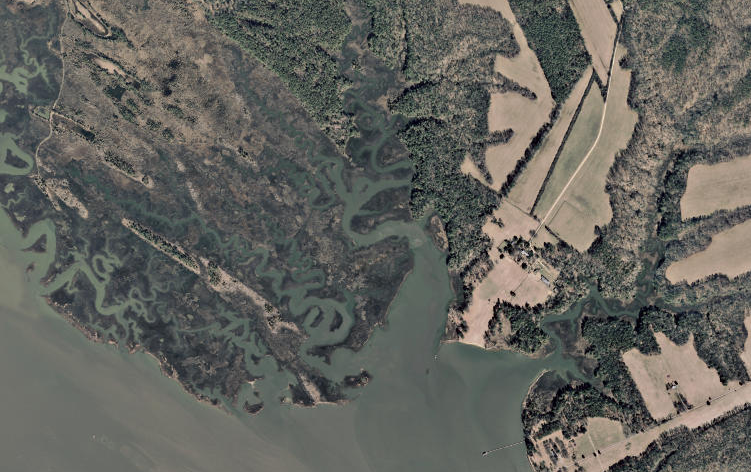
Werowocomoco, Powhatan's capital when the English arrived in 1607, was a good place for settlement because it offered access to a river filled with oysters and fish, a marsh with tuckahoe tubers and other edible plants, and fertile lands suitable for agriculture
Source: ESRI, ArcGIS Online