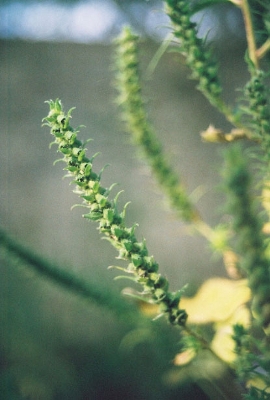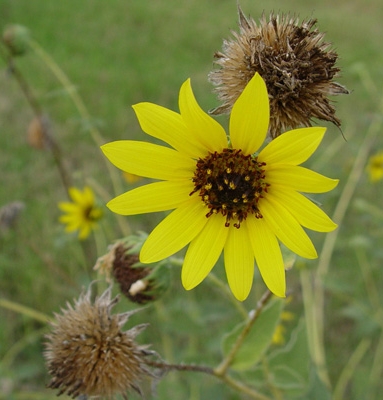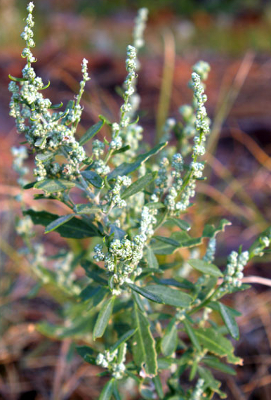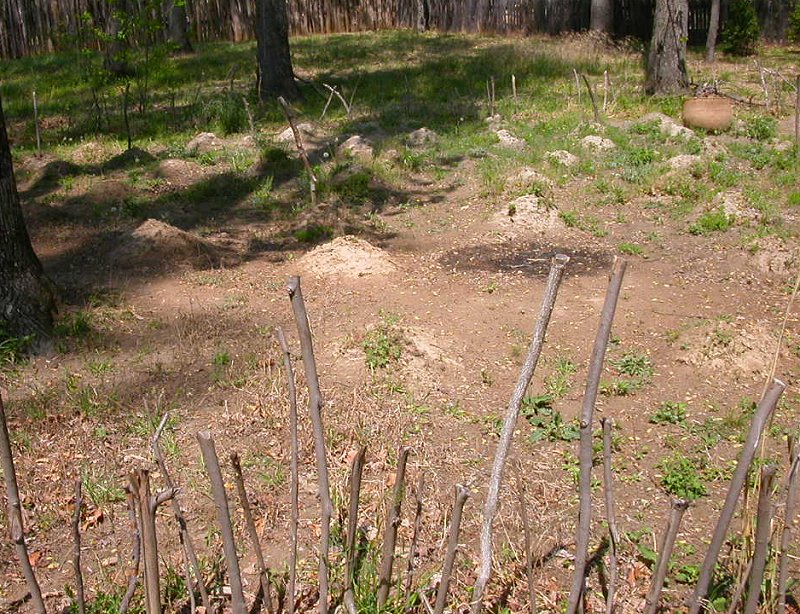
exhibit of just-planted Native American corn field, at Henricus Historical Park
Source: Historical Society of Western Virginia, Towards an understanding of a Native American Legacy: Pre-contact origins and development of domesticated crops in Virginia
The first humans to visit what is now Virginia were hunter-gatherers. They could hunt animals, gather fruits from trees/vines, and pull handfuls of seeds from wild plants to obtain protein, carbohydrates, and lipids.
Selective gathering of plants led to farming. Native Americans domesticated plants and "invented" agriculture in North America. They were the second species to do so. Ants started farming around 66 million years ago. Since then, different species of ants have been bringing parts of leaves back to their nest to feed fungi. The ants then eat the fungus which they grow on the leaves.
Through human intervention, several species of wild plants were domesticated in Eastern North America. Agriculture began not in Virginia, but to the west in the Mississippi River watershed. Evidence of early domestication of plants is found at archaeological sites in Missouri, Illinois, Indiana, Ohio, Arkansas, Tennessee, and Kentucky starting about 4,000 years ago (around 2000 BCE).
One of the earliest plants to be grown on purpose in North America may have been tobacco. It has no food value, but the power of nicotine could have been valued for rituals and creating social communities. A pipe dated to 1,685 BCE, found in Alabama, was analyzed in 2018. It had traces of nicotine.
About 1,000 years ago (around 1000 CE), additional domesticated species - corn, beans, and a new form of squash - were introduced from Mexico/southwestern United States. Fields were located on river floodplains and also in upland areas, where trees were killed in order to create open fields where plants could obtain essential sunlight.
When the first Spanish sailors met Virginia natives in the 1500's, and when the English colonists established Jamestown in 1607, Virginia tribes depended upon home-grown food for a significant percentage of their annual diet.
exhibit of just-planted Native American corn field, at Henricus Historical Park
Development of agriculture in Eastern North America was not a swift process. Domesticating plants was a major cultural change that required centuries of discovery, adaptation, and adoption.
In modern times, dramatic revisions of technology can be implemented in just a year or according to the product cycle of Apple and other technology companies. Genetic modifications can be achieved in laboratories far faster than by traditional crossbreeding. In contrast, the evolution of agriculture in Virginia should be measured over centuries and millennia.
The very first humans to arrive in Virginia, perhaps as much as 15,000 years ago, are called Paleo-Indians by archeologists. The Paleo-Indian lifestyle during the Pleistocene epoch was based on nomadic hunting and gathering wild foods. About 10,000 years ago, after perhaps as much as 5,000 years of initial human occupation in North America, the large megafauna (such as mastodons and caribou) had been exterminated by climate change and hunting pressure. Animal species changed, as the Ice Age of the Pleistocene ended and the chestnut-oak-hickory and southern pine forests developed in Virginia.
Perhaps in response to the loss of the megafauna and the increase of deer and smaller game, nomadic groups changed the technology for their projectile points, their hunting patterns, and their food gathering/settlement patterns. As the climate and the forest changed, people in the Archaic Period began to visit the same places repeatedly to hunt and gather wild foods.
The first Virginians shifted from roving around to hunt/gather in distant locations, and became more-sedentary foragers utilizing the same places on a regular basis. There was a greater and greater understanding of how and where to gather food from wild plants, thousands of years before Native Americans in Virginia intentionally planted crops and depending upon a human-generated harvest.
The sedentary foragers established camps in specific places. Repeated occupation of the same location, with repeated collection of firewood and concentrated deposition of human waste, would create openings where soil was disturbed and enriched by organic wastes. The hunters/gatherers would have re-visited those camps regularly, and middens (mounds of discarded materials) mark some of those locations.
The Native Americans during the Archaic Period probably defended some specific territories, those with valued natural resources, against food collection by rival groups. Archeologists use these major changes in behavior/technology to distinguish the Paleo-Indian from the Archaic Period, when people settled down more and hunted smaller game with differently-shaped stone projectile points.
As part of that repeated gathering of food from the same places, Native Americans focused on gravel bars, mud flats, and floodplain terraces along river bottoms and along the edges of swamps. Generation after generation of hungry people would have looked for plants with the biggest fruits/seeds, and especially for plants whose seeds hung on after ripening.
As one author, Bruce D. Smith, has noted, the intermittently-overflowing rivers:1
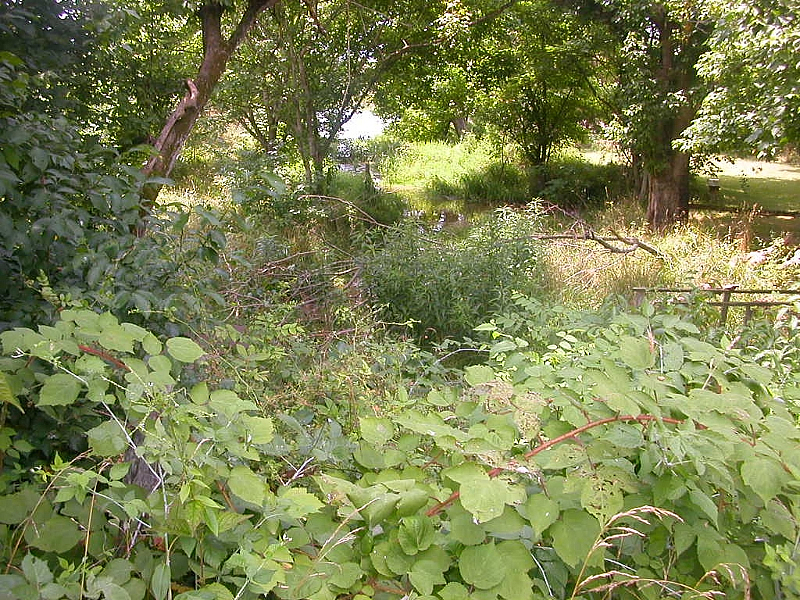
weedy edge next to natural spring... where wild plants might have been harvested (Rockbridge County)
In North America, people started farming with local wild plants, altering their growth patterns and "domesticating" the plants over perhaps 1,000 years. Humans shaped the genetics of a few wild plant species through selective collection practices. In particular, humans altered the natural genetic pattern of a few floodplain annuals that produced edible seeds.
For example, seed pods on most native plants shatter as soon as seeds are ripe, dispersing seeds quickly and throughout the season. However, some individual plants have a genetic quirk, and their seeds do not scatter immediately.
Each visit, Native Americans would have collected seeds from the plants with that genetic quirk, pulling seeds from plants where food was just waiting to be plucked rather than trying to collect the tiny seeds already scattered on the ground. The Native Americans concentrated in their hands, year after year, seeds with the genetic instructions to hang onto the plant after ripening.
Some seeds would have been eaten on the spot along the riverbanks. Other seeds were carried back to the human camps, for sharing with others or for eating later. In the course of preparing/eating the food, some of those seeds would have been accidentally scattered.
The habitat at the human camps would have resembled the open river bottoms and the edges of swamps, with heaps ("middens") of disposed bones/shells/inedible plant materials, disturbed soil, and plenty of light. Discarded organic material and even human waste would have fertilized the soil around the camp, providing a rich opportunity for some seeds to grow at those locations during the next season.
Over several thousand years, selective collection and seed deposition on middens by sedentary foragers would have had the same impact as selective breeding done by scientists today: genetic modification of the plant community. In patches of disturbed soil at the Archaic Period campsites, the seeds deposited by humans would not have been from "average" plants. Those plants would have had larger-than-average seeds, more-than-the-average-quantity of seeds on each plant, more-than-average percentage of seeds that would ripen at the same time, and more-than-average percentage of seeds that would cling to the plant after ripening.
Humans independently established agriculture in nine separate places, including the Middle East, Ethiopia, and China. In the Western Hemisphere, plants were domesticated in Eastern North America separately from the development of agriculture in Central and in South America. There also may have been some dispersal of males from Mexico and Central America into North America, bringing knowledge of agriculture.
Adopting agriculture provided a more-reliable food supply compared to hunting and gathering. It also allowed a group to remain in one place. If a place had special meaning, perhaps because ancestors were buried there or a spiritual event such as a total solar eclipse had been experienced there, then the desire to stay in one spot may have led to adoption of agriculture.
Domestication of three species occurred in the Mississippi Valley - squash (Cucurbita pepo ssp. ovifera), marshelder (Iva annua), and lambsquarters (Chenopodium berlandieri) - while sunflowers (Helianthus annuus) may have been domesticated west of the Mississippi River. Domestication could have occurred in Virginia as well, though the archaeological evidence is documented primarily from sites in the Ohio/Tennessee/Mississippi River valleys.
In addition, tobacco was grown as one of the earliest plants. A species native to North America may have been domesticated first, or the South American species Nicotiana rustica and Nicotiana tabacum may have been introduced at the time farming began.2
Various species of squash have grown naturally in North America since before humans arrived. Squash seeds have been identified in 30,000-year-old mastodon dung found in Florida.
About 4,000 years ago, Native Americans in the Mississippi River Valley first domesticated a species of squash, Cucurbita pepo ssp. ovifera. Modern forms of crookneck, acorn and scallop squash developed from Cucurbita pepo ssp. ovifera. Pumpkins come from a different form of Cucurbita, introduced later from Mexico.

a gourd may have been the first plant domesticated in the Mississippi River Valley
Source: Wikipedia, Cucurbita pepo var ovifera.jpg (by Forest and Kim Starr)
The gourds, the fruits of the squash plants, may have served initially as carrying vessels; domestication of squashes for food may have occurred later. Wild squashes in Mesoamerica had thin rinds and a bitter taste, but over time new varieties were created by human-driven selection.
It is even possible that another species, the bottle gourd (Lagenaria siceraria) was domesticated in Africa and seeds floated to North America, or was domesticated in Asia and brought to North America across the Bering land bridge. The immigrants also brought domesticated dogs. Humans living in Asia domesticated the wolf before the Laurentide and Cordilleran ice sheets melted enough to open a migration corridor into what today is Montana.3
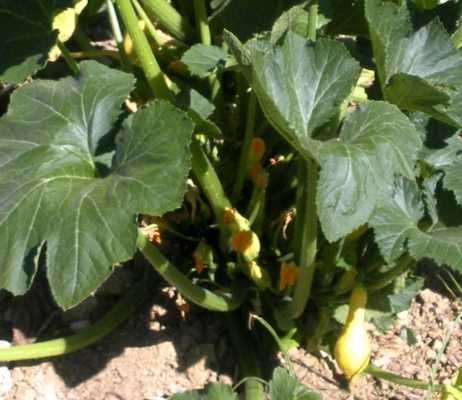
modern crookneck squash - descendant of first domesticated plant in North America
The traditional interpretation is that after domesticating the Cucurbita pepo ssp. ovifera variety of squash, Native Americans transformed two other wild species - marsh elder or sumpweed (Iva annua) and goosefoot or "lambsquarters" (Chenopodium berlandieri).A relative of Chenopodium berlandieri was domesticated in South America, and is still sold today as quinoa.4
These three species of floodplain weeds grew wild in river valleys, where floods regularly exposed bare soil and removed competing vegetation. The end of the Ice Age 10-15,000 years ago created new river and swamp habitats, as the ice sheets melted.
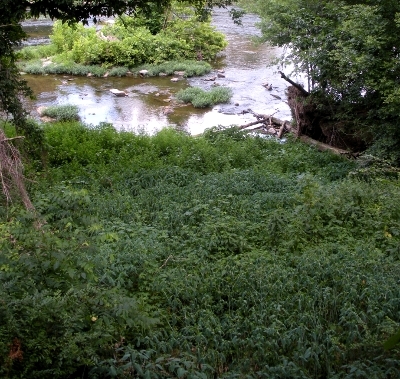
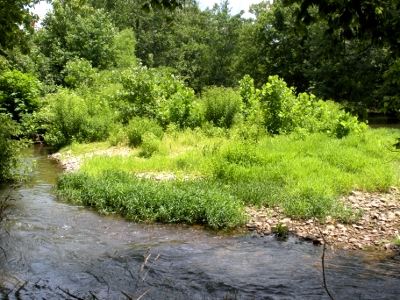
modern "weedy floodplain" on North River and gravel bar on South River at Port Republic (Rockingham County)
Regularly-occupied human camps in the new riparian areas created unplanned experimental plots for genetic modification of plants. By selectively collecting the larger marsh elder/sumpweed seeds, and choosing more of the goosefoot or "lambsquarters" with thinner seed coats, humans altered the physical characteristics of the plant species as domestication progressed. At some point, humans became purposeful in their management of the modified plants, by collecting seeds in the fall and replanting them at the start of the next growing season.
Sunflower (Helianthus annuus) may have a slightly different history. The sunflowers may have been an upland plant species that was originally a native plant west of the Mississippi River, and then introduced to the east via bison or humans. Domestication appears to occurred in the eastern region, where other species were also altered by Native American horticultural practices that selected for plants with preferred characteristics.5
In addition, wild crops of knotweed (Polygonum erectum), maygrass (Phalaris caroliniana), and "little barley" (Hordeum pusillum) were harvested... but those species may not have been fully transformed into domesticated versions before Europeans arrived. Archeologists and botanists can tell the difference between wild and domesticated plants because the domesticated variety has extra-large seeds, thinner-than-average seed coats, and increased requirements for human assistance in order to spread the seeds.
About 1,500 years after the initial start of the development of the Eastern Agricultural Complex, corn arrived. Corn is a relative late-comer to the garden in Eastern North America. The first agricultural fields in the Mississippi Valley, Ohio River Valley, and Tennessee River Valley did not include corn. It took 500+ years for corn to go from a marginal new food source and become the dominant food crop in the Mississippi River Valley.
Corn is not the only latecomer to gardens in Eastern North America. Beans and some variants of squash (more similar to modern pumpkins, rather than the already-domesticated variety similar to modern crookneck squash) were introduced from Mexico.
Beans, corn, and the pumpkin variety of squash arrived in the Eastern United States long after those crops had been domesticated initially in Central and South America, and long after Native Americans in the east had already developed agriculture using native species. However, some major crops domesticated in Central/South America in pre-colonial times (such as potatoes, tomatoes, chili peppers, peanuts, and cotton) never made it to Virginia until Europeans brought them to Virginia.
The domesticated turkey also was imported to Virginia from the Southwestern US and Mexico, through an unusual path. In the 1500's, Europeans sailing home across the Atlantic Ocean brought the domesticated turkey from Mexico and/or the southwestern United States to Spain. Farmers in Turkey obtained birds from Spain, and were very successful in raising the domesticated fowl. Traders introduced the domesticated fowl to other European nations - who named the bird after the source they knew, Turkey.
The "turkey" is native to Virginia, but the domesticated variety with extra breast meat arrived via the Colorado Plateau/Central America, Turkey, and then England before crossing back across the Atlantic Ocean to be raised in large quantities in the Shenandoah Valley today.6
Agriculture in Eastern North America was the result of initial domestication of wild plants in the eastern half of North America, followed by the diffusion of additional crops from Mexico.. When European colonists arrived in 1607, the Native Americans defined five seasons of the year based upon their food production patterns:7
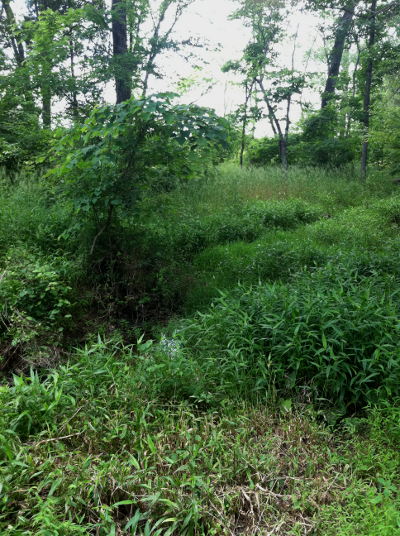
early agriculture developed from harvesting wild plants in floodplains and creek valleys
(Manassas Battlefield, Prince William County)
The English colonists saw Algonquians tribes in the Chesapeake Bay planting corns, beans, and squash, but all three were probably imported into Virginia after 1,000 A.D. It is reasonable to assume that the Native Americans in Virginia were exposed to corn, beans, and a different variety of squash AFTER the occupants of the Mississippi River watershed incorporated those new plants into their agricultural practices. The Appalachian Mountains may have been a barrier to cultural diffusion from the west, just as they slowed European settlement from moving from the Piedmont to the Ohio River valley.
Corn cultivation was introduced into Virginia from what today we call the Midwestern United States. Seeds may have been provided by trade, or new cultivation techniques may have come through intermarriage with residents in the Ohio or Tennessee river valleys. There is no evidence to suggest any quick introduction of corn cultivation into Virginia through direct migration of corn-growing people coming all the way from Mexico. The seeds and the expertise migrated from Central America to Virginia, but not the corn-growing Mexican farmers.
The corn that was grown in Virginia when John Smith arrived in 1607 was different from the original domesticated variety. The primary grain of the Virginia natives - corn - had been domesticated for several thousand years before a variety was developed that was productive in Virginia's climate. Corn was *not* domesticated originally in eastern North America, especially not in Virginia. Converting a wild species of grass into corn occurred in southwestern Mexico, when the wild grass teosinte was domesticated perhaps 9,000 years ago (at roughly the same time wheat and barley were domesticated from other wild grasses in what is now Iraq).8
Wild teosinte is dramatically different from modern corn. Human intervention is required to release modern corn kernels from the husk, so modern corn is clearly the result of human-based artificial selection. Scientists continue to argue about what species/subspecies was the original source. Genetic evidence suggests the debate may be coming to a close, with the ancestor of modern corn coming from a form of teosinte that was domesticated in the Balsas River drainage north of Acapulco, Mexico.9
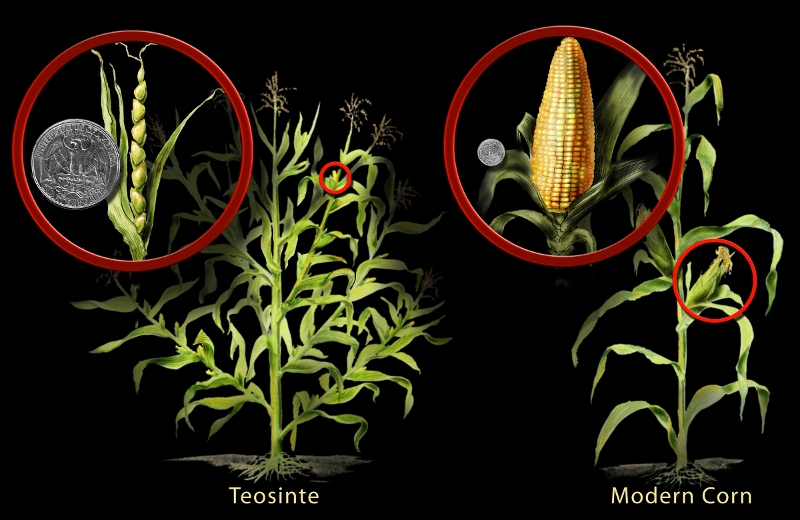
teosinte vs. corn after 9,000 years of human selection
Source: National Science Foundation, Scientists Trace Corn Ancestry from Ancient Grass to Modern Crop
The corn grown originally in Mexico was adapted to the climate there at about 15° latitude north of the Equator. Seeds carried directly from Mexico to Virginia 9,000 years ago would not have thrived in a northern latitude where daylight was longer in the summer, and the growing season between frosts was shorter. The long delay between the arrival of domesticated corn in the Mississippi River Valley, until corn became the dominant food crop centuries later, may reflect the time required for genetic variation to occur.
Fortunately for the early farmers, the corn genome has a high percentage of transposable elements (transposons, or "jumping genes") that permit rapid genetic change. About 1,200 of the 59,000 total genes in the corn genome were altered by Native American selection. In addition to expanding the size of the teosinte "ear" and increasing the number of kernels on each ear, the breeding process reduced the hard coating on each kernel. That coating allowed seeds to pass through the digestive system of herbivores and sprout among the scat deposited by animals, but humans selected for plants with less of the tooth-cracking coating.
Full domestication of corn occurred around 4,500 BCE (Before Common Era, or 6,500 years ago). Farmers in what is now Peru and Bolivia, around 20° latitude south of the Equator, created the corn plant that could supply a high percentage of the calories needed by humans. Migrants brought the knowledge of corn farming north and merged with the indigenous population in Central America, leading to the Maya population and its dependence on corn around 2,000 BCE.
Ultimately, Native American farmers and natural selection created a form of corn that was adapted to the shorter growing season in higher latitudes. Linguistic evidence also suggests that many centuries of farming were required before a strain of corn emerged that was adapted to the climate, and farming corn became common in what is now the American Mid-West and Eastern United States.10
The variety of corn adapted Virginia stimulated a population explosion in the Mississippi Valley about 1,100 years ago (900 A.D.). One impact of the change in lifestyle is that trade of stone tools/shell between Middle Atlantic and Ohio River Valley groups declined. It is possible that as agriculture made groups more self-sufficient in food, there was a reduced need for specialty items imported from outside the region to provide elevated status to key individuals. Perhaps control over stockpiles of corn became sufficient to define leadership roles...11
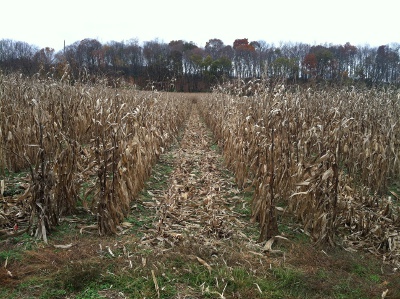
corn is planted in straight rows on modern farms to facilitate mechanical harvesting of large fields - unlike the Native American pattern of scattered plantings in small patches
Even after adopting the Mexican food crops, however, many Virginian tribes still lived as semi-nomadic bands rather than settled full-time into towns. Hunting and fishing in the summer and winter, but returning in the fall to harvest bottomlands planted in the spring, was an effective lifestyle for several thousand years until the arrival of Europeans disrupted the pattern.
Adoption of agriculture led to hunting and gathering bands adopting a more-sedentary lifestyle, living in in one spot for at least the growing season. Curiously, agriculture could have also triggered an increase in interaction between Native American groups who settled down.
Scholars studying the occupation of Australia 50,000 years ago propose that the initial wave of humans swiftly occupied the suitable places for humans to live, but then those hunting and gathering bands became isolated from each other. In Europe and Asia, intermittent migrations were spurred by crop failures, forcing farmers to move in other to seize food or territory from adjacent groups. Each migration caused a mixing of cultures and genes, plus an exchange of technologies.
Agriculture was not invented in Australia, so there were no crop failures to force migrations and mixing of populations. If that model is correct, the Paleo-Indian occupation of North America could also have led to isolated development in different locations until the adoption of agriculture.
There is at least one serious challenge for the "agriculture triggers occasional famines and migrations, preventing isolation of different populations" model. The Clovis culture spread quickly across all of North America long before the domestication of different plants. Perhaps famines did spur North American farmers to move at times, but there were also other mechanisms long before agriculture that transmitted technological innovations across the continent.12
In Tidewater, where the available protein from the Chesapeake Bay estuary was particularly accessible, a town site might be occupied for several seasons while the natives harvested nearby beds of oysters, caught crabs and fish, and hunted deer. Once the easy pickings were gone, however, the structures that identified a site as a town might be moved, and the site not reoccupied for a period of time. Intermittent migrations, rather than living in permanent settlements with concentrations of human and animal waste, also reduced the risks of disease.
By the arrival of John Smith, the original Virginians had evolved through several separate cultures. There were perhaps 50,000 Native Americans in the state when the Europeans arrived.13
As population grew in the Archaic and then Woodland periods, Native American societies had developed increasing social complexity. Religious and political rulers obtained more power, and were able to affect larger numbers of tribes.
Different sections of Virginia evolved culturally at different rates. The Southwestern part of Virginia had adopted ceramics much later than the coastal Virginians. That evidence suggests migration and trade through the seafood-rich Tidewater may have introduced new ideas into Virginia via the Coastal Plain initially.14
Much later, the mound building culture emerged on the southwestern and western edges of Virginia. That culture required a labor force to invest time hauling baskets of dirt uphill to create a mound. Feeding such a labor force required production of an annual food surplus. Absence of mounds in Tidewater can be explained by many hypotheses, but might be a clue that agriculture was adopted first in the watersheds draining into the Ohio River.
Cultivation of beans occurred after Mexican squash and corn agriculture had been adopted. Based on what the Europeans saw in the 16th and 17th Century, the earliest Virginia farmers planted the three crops together. The squash covers the ground, shading out weeds. The corn grows high, and the beans grow up the cornstalk. One benefit of the beans is their ability to add nitrogen to the soil. Clearing patches of woods was not a simple task for a society with just stone points and bone tools, though fire was also available to the natives as well.
Adoption of agriculture was not complete in Virginia, with a commitment to rely upon farmed food for all calories, when Europeans started to sail across the Atlantic Ocean. When the English colonists arrived in 1607, hunting and gathering remained essential to the Powhatan tribes as well as farming.
Native Americans were growing sunflowers, corn, and other crops, but agriculture provided only a portion of the food required each year. Hunting and gathering continued, as it had for 10,000-years. Native Americans farmed various species at the time of contact with Europeans, but:15
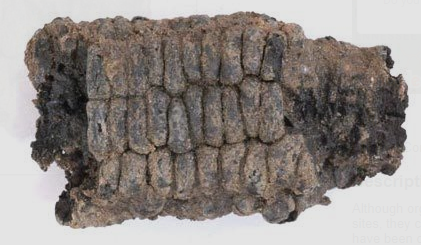
rarely, corn cobs have been preserved at Woodland sites
Source: Virginia Humanities, Virginia Indian Archive, Charred Corncob Artifact
The Native Americans that greeted the English were thin in part because food supply was still unreliable. Perhaps life in Virginia 400 years ago was not as "nasty, brutish, and short" as in the Paleo-Indian period - but famine was a real possibility. William Strachey, an early colonist, commented on how the Native Americans fed themselves - and how their bodies responded to the annual food supply, by growing thin when food was scarce:16
Native American fields for individual families were small, typically 10'x10' squares up to twice that size. An entire town tended larger fields dedicated to the weroance; those may have been 100 acres. In Tsenecommoco, Powhatan required a tribute of corn be paid annually. Much of a community's investment of labor in the weroance field would end up being stored in Powhatan's granaries, as a tax paid for his protection.
A farm plot could be started by clearing shrubs and trees from the land so the crop would be in the full sun. Large trees killed by girdling and fire could be left standing. The labor required to cut down a tree with stone and bone tools was high, as was the challenge of dragging trees away. The Native Americans in Virginia had no domesticated animals other than the dog, so horses or mules could not be used to move tree trunks or till the soil.
It made more sense to clear plots in an area where the forest was young, so only small trees had to be removed. Branches could be used to leverage the roots out of the ground, exposing fresh soil for planting. Henry Fleet, who lived with Chief Powhatan and the Patawomeke between 1609-1611, wrote:17
Plants were scattered in the soil about four feet apart, not arranged in neat rows as done by English colonists. Two types of beans grew up the corn stalks. Squash plants, including passionflower plants (Passiflora incarnata), sent runners across the ground between the corn:18

passionflower and squash vines growing between corn/bean plants made Native American farm plots appear "messy" to English colonists
Source: Wikipedia, Passion Flower
Corn provided 40-75% of the food eaten by Native Americans; hunting and gathering provided a major percentage of the calories required. The weroances had greater access to agricultural food. Chief Powhatan could have lived the entire year on corn provided to him by subordinate tribes.19
Outside the territory of Tsenacomoco controlled by Powhatan, other tribes in what eventually became Virginia farmed similar crops in a similar pattern. The Siouan-speaking and Iroquoian-speaking groups used the same approaches to growing food as the Algonquian-speaking groups.
After about two years, nutrients were exhausted in the soil because no fertilizer was used. Unlike in Massachusetts, no fish were buried next to the plants in Virginia. When productivity was declining, there was an easy solution - families would clear enough space for sunlight to reach another small plot nearby. Plots were always on level bottomland soils. The Pamunkey soil on the Coastal Plain, now Virginia's "state soil," was especially productive.
Moving the farmed plots every two years eventually led to houses being a long walk from the fields. An individual family would dismantle their house and move it a short distance to be closer to the land being farmed. The process created a dispersed settlement pattern that slowly crept across the landscape. Towns with a palisade required more coordinated effort to move, but that was done typically at least every 20 years.20
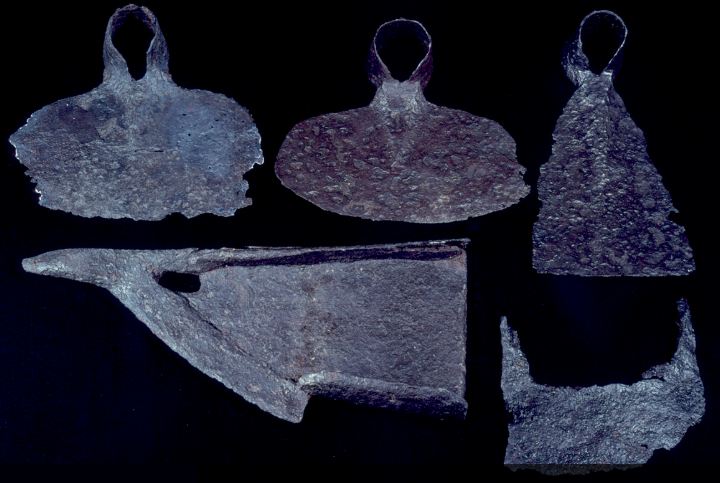
Native Americans quickly acquired iron tools for farming, replacing fragile hoes made from animal bones and wood
Source: Virginia Humanities, Virginia Indian Archive, Iron Agricultural Tools