The Water War Between Fairfax County and the City of Falls Church
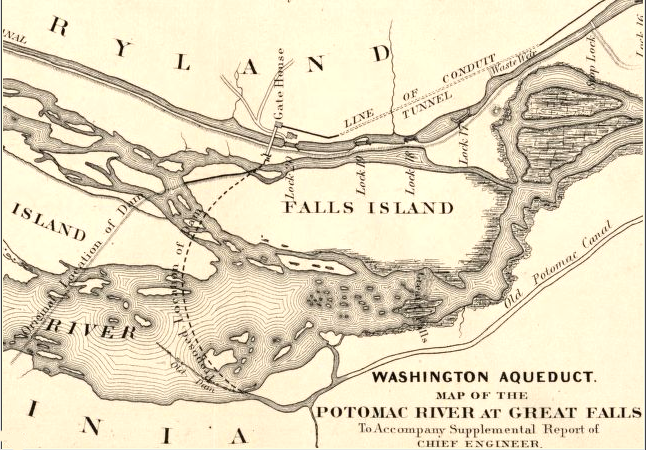
Potomac River water diversion above Great Falls into Washington Aqueduct system, which was completed during the Civil War and today supplies the Pentagon and other parts of Northern Virginia
Source: Library of Congress, Maps of the Washington Aqueduct, Md. and Washington D.C (1864)
The US Army Corps of Engineers expanded the capacity of the Washington Aqueduct after World War I, to increase the supply of water to Washington DC. The Corps started to provide drinking water to Arlington County and Falls Church in the late 1920's, when those communities were urbanizing and the economy of Fairfax County was still based on farming. Falls Church agreed to provide drinking water to nearby parcels located in Fairfax County.1
Fairfax County had 26 fragmented water systems in 1957, rather than the centralized county-run Fairfax Water system of today. Twenty were private, and six were publicly owned. Most landowners relied upon wells, but groundwater supplies were limited.1
One of the separate water systems meeting the needs of Fairfax residents was the municipal utility of the City of Falls Church, which was supplied from the Potomac River via the District of Columbia. The Town of Falls Church had become an independent "city" in 1948. Separating from Fairfax County meant local taxes could be directed to improve the local schools, rather than used to finance new facilities in other areas of Fairfax County far from Falls Church.
The independent city attempted to grow beyond its old town boundaries by annexing territory of Fairfax County, expanding the tax base of Falls Church while shrinking the county's revenue as well as the county's land. The county resisted changes in the boundaries of Falls Church, since annexation would transfer voters and tax-generating properties out of the county's jurisdiction.
Virginia judges ruled in favor of Fairfax County, rejected the city's annexation proposals. Their decision froze the size of Falls Church, but did not limit the ability of the city to expand its network of pipes further into Fairfax County to supply more customers with water.2
In 1957, the county supervisors created the Fairfax County Water Authority (now Fairfax Water). The goal was to improve the availability of water and to standardize rates. Centralizing control over the water supply also gave county officials more ability to shape the pattern and timing of new suburban subdivisions.
State court decisions limited Fairfax County's ability to downzone private land on the western side of the county, in order to steer growth to areas where public services could be provided at lower cost. Control over the water supply was another tool that could be used in the county's negotiations with developers.
From the beginning, all members of the water utility's board have been appointed by the elected supervisors of Fairfax County. Operations of the Fairfax Water utility may be technically independent of the operations of Fairfax County government, but the plans/policies of the utility have been closely aligned with the plans/policies of Fairfax County government.
In 1957 Fairfax County lacked a reliable water supply, and it lacked a system to distribute drinking water throughout the county. The Fairfax County Water Authority began operations by purchasing the private system that supplied Annandale. When the Federal government decided to build Dulles International Airport on the western edge of Fairfax County, the county and the City of Falls Church negotiated a deal that was beneficial to both political jurisdictions.
The best source of water for Dulles was the Potomac River, and the District of Columbia had a drinking water plant just across the river which could supply the airport. The cost of building a pipe underneath the river was high, but Falls Church was constructing one which would have excess capacity for the next decade. The county agreed to pay for use of the pipe and to purchase water from Falls Church.
In 1959, to address the county's concerns that Falls Church would expand its water system too far and compete with the Fairfax County Water Authority, the city signed a 30-year agreement that defined a smaller area of the county to which it would supply water. The county's water authority agreed that it would not provide service to customers within that area, ensuring that the City of Falls Church water utility would gain all the customers there.3
The US Army Corps of Engineers, operating the system that supplied the District of Columbia, could meet the projected demand. Under the service agreement between Fairfax and Falls Church, county residents and businesses near Falls Church were supplied with water that had been diverted from the Potomac River above Great Falls, piped to the Dalecarlia Reservoir on the edge of the District of Columbia, and then piped across the Potomac River to Falls Church.
In 1959, exporting water across the city/county boundary was a good arrangement for both jurisdictions. New development on vacant land near Falls Church increased property tax revenues for Fairfax County, while the City of Falls Church got new customers willing to pay a premium price for its water. From an engineering perspective, it was easy for Falls Church to expand its existing distribution system to supply water to the new developments - though the judges responsible for boundary adjustments would not allow the city to annex that land.
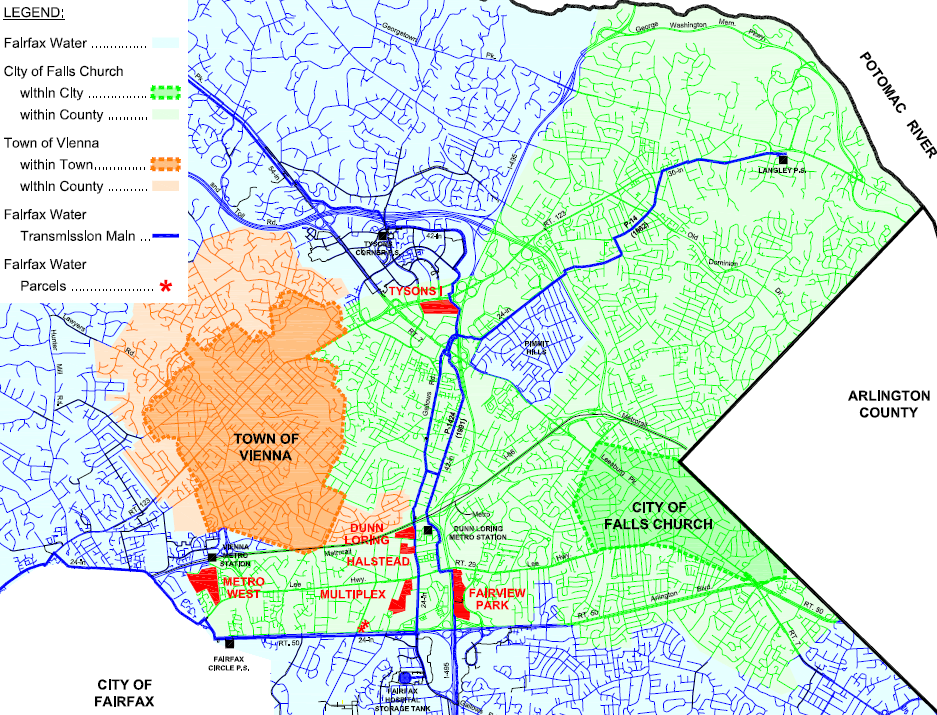
area of dispute between Fairfax Water and Falls Church - in light green, outside boundaries of Falls Church
(Town of Vienna has similar service area, in light brown. Dark blue lines are Fairfax Water water mains.)
Source: First Amended Complaint, Fairfax County Water Authority vs. City of Falls Church (January 9, 2009)
Individual homeowners might drill a well and rely upon groundwater, but developers of large subdivisions and commercial properties in the 1950's and 1960's needed a more-reliable supply. Property owners outside the service area of the Falls Church utility, and equivalent areas in Fairfax County serviced by Vienna and the City of Fairfax, had to wait until the Fairfax County Water Authority built a new set of pipes to that particular undeveloped section of the county.
By 2012, the City of Falls Church system covered 33 square miles and provided five billion gallons of water each year for 120,000 people. Statistics for the city's system included:4
- 34,500 customer accounts for 140,000 residents and another 130,000 workers within the service area
- 17 million gallons per day
- 500 miles of water mains
- 10,000 valves
- 3,200 fire hydrants
- 10 storage tanks
- 8 pumping stations
City residents benefitted from the excess revenues generated by the city's water sales outside the city's boundaries. Monthly water fees paid by Fairfax (and Falls Church) customers created a significant profit after accounting for the costs of purchasing water, maintaining the pipes/pumps/tanks, and billing customers. Since 92% of the city's customers were located in Fairfax County, the annual profit was generated from customers who could not vote for officials that might change the utility's policies or water rates.
Each year, the city's utility profits were transferred to the city's General Fund, allowing the City Council to set lower tax rates. The subsidy from the city's water utility reduced the property taxes that city residents otherwise would have had to pay, in order to operate the city's school system and provide other services inside Falls Church.
As Fairfax County grew rapidly after 1960, the county utility's infrastructure began to overlap the area being serviced by the Falls Church water utility. The 30-year agreement expired in 1989, without generating any action. Falls Church officials apparently assumed the city would maintain exclusive rights to provide water to developing parcels in its traditional service area within Fairfax County, and no one proposed to define specific boundaries for the city's authorized service area outside the city's boundaries.
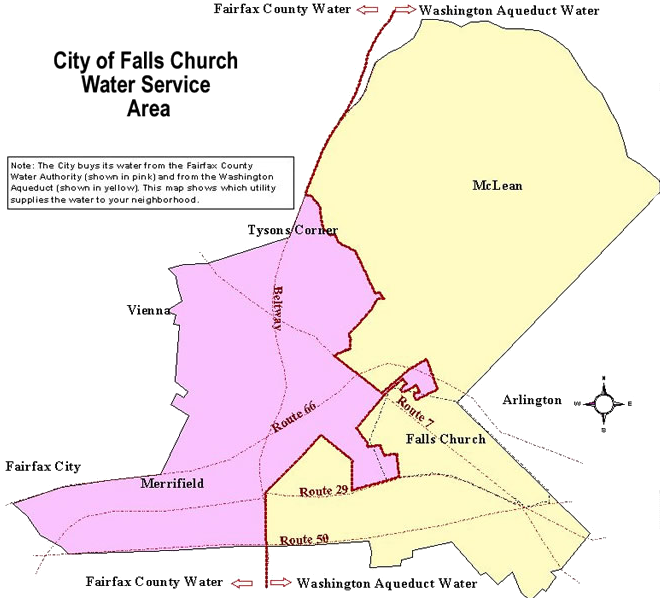
Falls Church water service area (re-selling water from separate suppliers)
Source: Metropolitan Washington Council of Governments
Developers did not complain about the city's water charges, even though the Falls Church rates were higher than the rates charged by Fairfax Water. In late 2009, the city charged $3.03/1,000 gallons, while Fairfax Water charged only $1.83/1,000 gallons. Different utilities increased rates at separate times after 2009, but the difference in cost between jurisdictions remained significant.5

cost of water from different suppliers in Fairfax County in 2010
Source: Fairfax County Consumer Protection Commission, Report on Rates Charged by Water Systems Serving Fairfax County Residents (April 20, 2010)
Why were developers satisfied with the relatively high cost of water from Falls Church? First, for many years the city system was the only source of supply in that portion of eastern Fairfax County. Developers financing projects on borrowed money could eliminate delay by purchasing water directly from the city. Speculating that the county water system might someday expand to the parcel being developed could involve many years of waiting...
Also, developers recognized that Falls Church charged a low initial cost for hookups to its water system. The low hookup fee reduced the construction costs of new buildings. Developers benefitted from the low up-front costs. The people saddled with the higher monthly fees charged by the city were the renters/buyers of the buildings after construction was completed, and the developers had moved on to new projects.
In 2005, Fairfax County decided to break the pattern. Fairfax Water offered to provide drinking water to developers in Merrifield, and near the Dunn Loring Metro station. That area was in the county, but also in the traditional water service district for Falls Church.
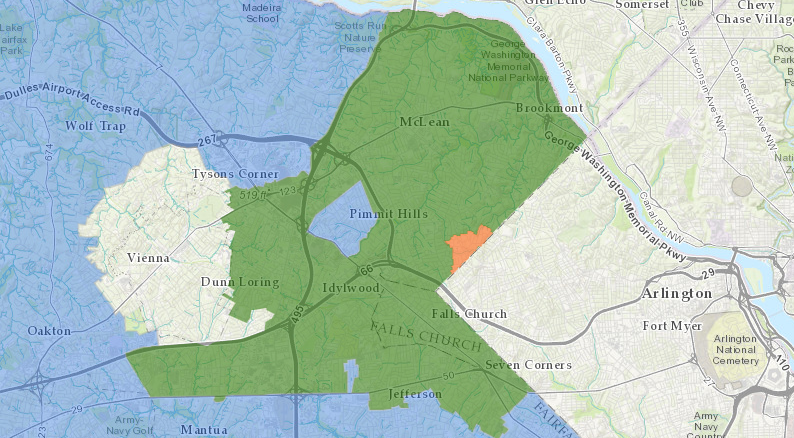
Falls Church provided water to the area in green
Source: Fairfax Water, Water Quality
County officials apparently negotiated for proffers for new projects, and tried to commit developers to connect to the Fairfax Water system. In proffer negotiations in advance of a rezoning approval, Fairfax County officials had many opportunities to make concessions on transportation requirements, impact fees for new schools, or other elements that would offset the higher hookup costs to the Fairfax Water system. (Had Fairfax Water been a regional rather than a county-controlled utility, such tradeoffs would have been harder to arrange.)
The city objected to the county's efforts to "steal" potential customers and reduce the future profits of the city's water utility. In February, 2007, Falls Church filed a Federal lawsuit. It claimed that arrangements with the US Army Corps of Engineers to purchase Washington Aqueduct water provided the city with an exclusive right to sell water within a portion of Fairfax County.
In May, 2007, a Federal judge rejected the city's various claims to exclusive utility service rights. In April 2008, an appeals court affirmed that decision. Then the water war escalated.
Falls Church refused to allow the developer of the Halstead Project in Merrifield to move city water lines, in order to connect to Fairfax Water. In response, Fairfax Water sued Falls Church in December 2008, filing in state court. The county accused the city of violating the Virginia Antitrust Act, by blocking legitimate competition between two possible suppliers for water at the Halstead Project. Fairfax Water not only asked for damages totally $21 million, but also asked the state judge to end the transfer of excess funds from the city's water budget to its General Fund.
On January 6, 2010, Fairfax Water won a clear victory. A state judge ruled that Falls Church's transfer of water utility profits to the General Fund was an unconstitutional tax on people who lived outside the boundaries of the city. The decision blocked all future transfers, and called into question the legality of the October 2009 transfer. The city quickly capitulated, agreeing to pay Fairfax Water $750,000 for legal costs in exchange for release of the county's $21 million claim. Both parties agreed to allow competition for customers in Fairfax County; Falls Church would no longer object to its pipes being moved by customers seeking to connect to Fairfax Water.6
Falls Church appealed the ruling that blocked transfer of utility profits to its General Fund - and on September 1, 2010 the Virginia Supreme Court ruled against the city. By choosing to pick a legal fight over who could service customers in Fairfax County, in hopes of increasing future revenues, Falls Church lost its existing ability to impose an extra-territorial tax on Fairfax County customers. The city was blocked from generating excess revenues from 92% of its customers in Fairfax County, in order to keep tax rates low in the City of Falls Church. The state court saw the dispute as Fairfax Water described the situation, in its objections to the city's appeal:7
- This is a dispute about whether a city-run water system can inflate its water rates in order to divert surplus revenues to the general fund so as to reduce local property taxes.
The answer was provided by the court system: such inflated rates were not legal. Falls Church lost the water war with Fairfax. To comply with the judge's ruling, city residents would have to pay a price: raise local taxes to make up for the lost profits from the water system, or lower services in order to reduce costs of city government.
Falls Church officials resisted making that hard choice - no politician wants to raise taxes or reduce services. After contracting with a water rate consultant, the city claimed it had to establish new reserve funds and expand the water system infrastructure to service new customers at Tysons Corner. The city raised rates 8% for the fiscal year starting October 1, 2011, with plans to increase costs a total of 30% by 2016. Since most of the city's water customers lived in Fairfax County, most of the increased revenues would come from county residents who could not vote in Falls Church elections.
In December, 2011, the Fairfax County Board of Supervisors reacted. Fairfax County decided to set water rates for all county residents, no matter who supplied the water, and to prohibit utilities other than Fairfax Water from servicing new customers in the county. The utility rate control ordinance said:8
- Effective at 12:01 a.m. on December 7, 2011, the Fairfax County Water Authority shall be the exclusive provider of retail public water service within Fairfax County, Virginia, for any new construction or redevelopment of any dwelling unit and any residential or non-residential structure, unless the Fairfax County Water Authority determines that it cannot make water service available due to a utility-related reason.
- Effective at 12:01 a.m. on July 1, 2012, except as provided in this subsection, no provider of retail public water service within Fairfax County, Virginia, shall set, establish, bill, charge, or collect from any user in Fairfax County any rate, fee, or charge for water service that is greater than the corresponding rate, fee, or charge imposed by the Fairfax County Water Authority...
- This subsection does not apply to any rate, fee or charge by any city or town for public water service within the territorial limits of that city or town located within the boundaries of Fairfax County, Virginia. This subsection also does not apply to any public water service provider whose rates, fees, and charges to users within Fairfax County are regulated by the State Corporation Commission.
Opposition to the county monopoly came from Falls Church, of course. The city feared it would be unable to recover the investment to upgrade water facilities in anticipation of new demand as Tysons Corner redevelops, creating "stranded costs." The town of Vienna and the City of Fairfax also challenged the county's monopoly. In addition, the developer of Tysons 2 Center noted that the existing water pipes for that development had been sized for future connections with Falls Church, and the new policy could require the developer to fund costs for duplicative infrastructure.9
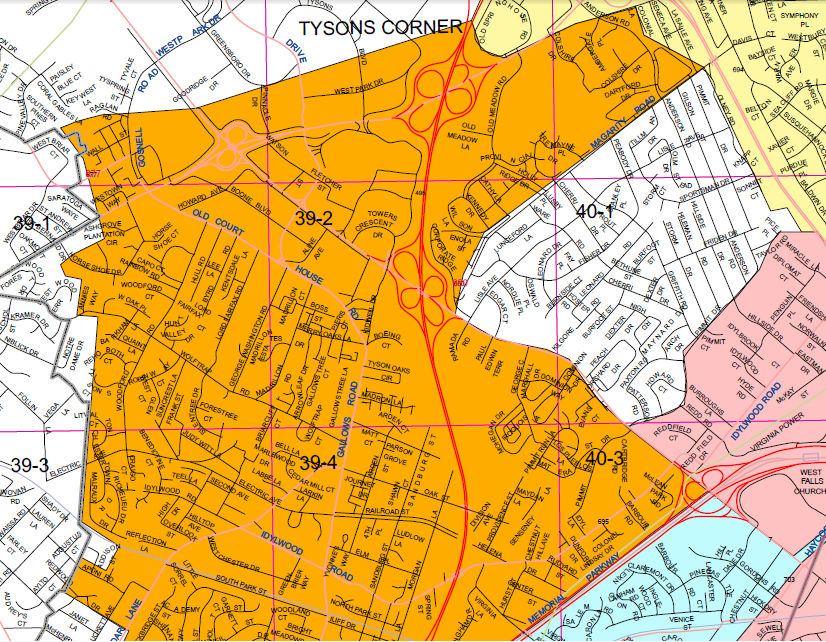
Tysons Corner area serviced by Falls Church water system
Source: City of Falls Church, Water Service Areas
In early 2012, Falls Church decided to escape the legal fight with Fairfax County by auctioning the city's water distribution and sewer system to the highest bidder. The city obtained an appraisal that valued the water distribution system at $40-$53 million, assuming new owners would be able to maintain the income levels based on current water rates, and set a minimum sale price of $44 million.10
Negotiations failed to arrange a direct sale to the Fairfax County Water Authority (Fairfax Water), because the county would not commit to paying anything for the infrastructure. According to Fairfax County, the 92% of utility customers living in the county had already paid 92% of the cost to construct the city's system. The county would assume responsibility for the utility, but would not give Falls Church a $44 million cash payment - or any cash, for that matter.
Just 24 hours before the auction to privatize the utility, after nine potential bidders had responded to the city's Expression of Interest (including Fairfax Water), the Army Corps of Engineers changed the legal interpretation of its contract. The Corps decided that it would be unable to provide water to an investor-owned utility, and could only service a government-owned water distribution system. By June, 2012, Falls Church had spent over $1 million in legal fees on the water war with Fairfax County.11
In July, negotiations for a transfer/merger/sale between Fairfax Water and Falls Church failed to resolve the dispute.12
The water distribution system, and the rate for water sold in the county by utilities other than Fairfax Water, could be resolved only after a court ruled on the county's utility rate control ordinance - or Plan B. The attempt at Plan B - resolution of the city/county differences through mediation led by a Federal judge - was announced on October, 2012.13
Mediation was successful. An agreement for Falls Church to sell its water system to Fairfax County was announced on November 20, 2012. Falls Church voters ratified the deal in the November, 2013 election with 88% voting in favor. The county water system paid $40 million for the city water system in January, 2014, but did not assume the city's debt and pension obligations (approximately $30 million). The deal required that the high city water rates be lowered to county levels within two years, benefitting the 90% customers of the city water system who lived in the county as well as the 10% who are residents of Falls Church.14
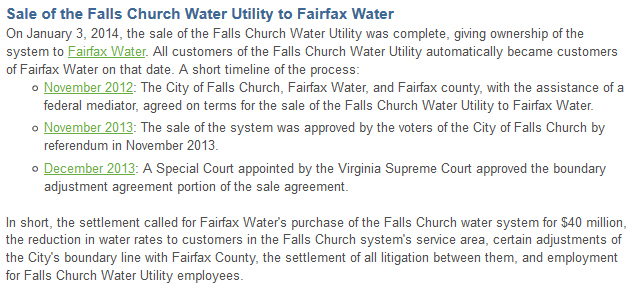
how Falls Church described the sale of its water system
Source: City of Falls Church, Water
As part of the bargain, the City of Falls Church got to annex 38.4 acres of land near the West Falls Church Metro station currently occupied by George Mason High School and Mary Ellen Henderson Middle School. The agreement required that 70% of that annexed land stay dedicated to school uses for the next 50 years, limiting the economic competition with nearby properties in Fairfax County.
The city was allowed to develop immediately a 12-acre parcel next to the Metro station. Though Falls Church lost the annual subsidy from its water system, in the Plan B mediation the city obtained a great opportunity to generate revenue from property incorporated into the city limits.15
- The acres that the City will annex include the property on which George Mason High School and Henderson Middle School now sit, and a 2.4 acre parcel at the Shreve Road and Gordon s Road intersection that would complete a "Gordon's Road Triangle" where the City's property yard now sits. The City has long coveted that area for highly-dense commercial redevelopment.
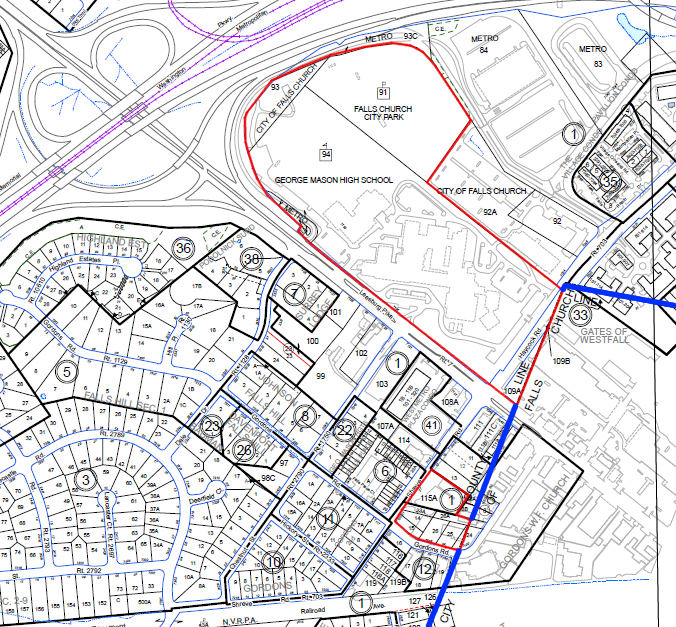
area annexed into Falls Church, as part of 2012 deal to sell water system (blue line indicates "old" boundary between city/county)
Source: Fairfax County Digital Map Viewer, Property Map (Grid 40-3)
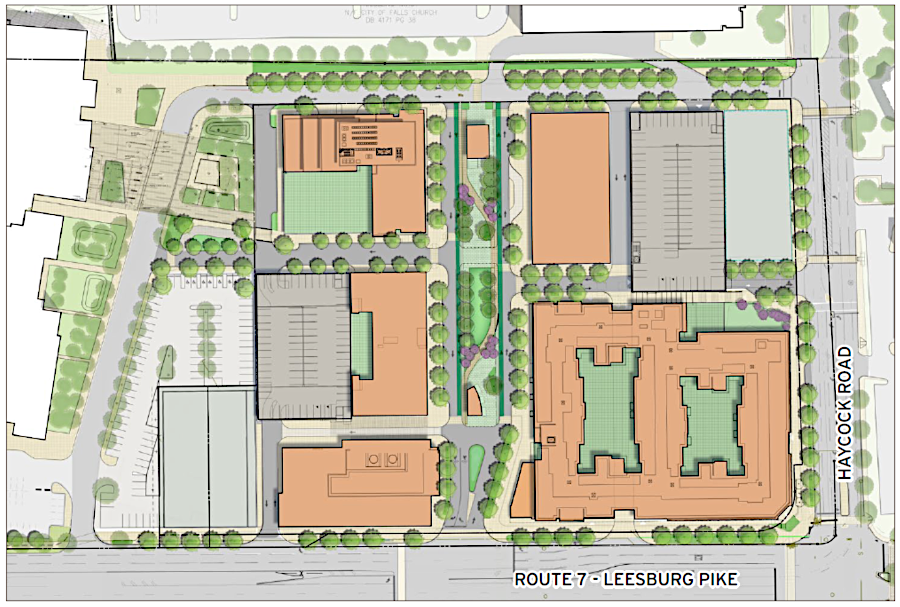
the City of Falls Church approved the West Falls Development Project in 2021
Source: City of Falls Church, West Falls Development Project
In 2015-16, Falls Church considered using the undeveloped land next to the West Falls Church Metro as part of a public-private partnership that would construct a new high school. Two bidders made confidential "campus redevelopment" proposals, but the School Board ultimately decided not to approve either one.16
In 2017, voters in Falls Church approved spending up to $120 million to build a new George Mason High School. The city then arranged to sell 10 acres at the old George Mason High School campus to a public-private partnership that would create a new walkable community that would serve as a gateway into Falls Church.
In 2021, the City Council approved the West Falls Development Project with over 850 housing units, a hotel, 326,100 square feet of Class A commercial office space, and civic space music/entertainment. To build public infrastructure, the West Falls Community Development Authority was created and authorized to issue $13 million in bonds. Repayment was to be funded by a special assessments on the parcels within the West Falls District.
Virginia Tech sold its Northern Virginia Center property so HITT Contracting could begin construction of its new headquarters building in January, 2025. The new headquarters included a 100,000 square foot set of solar panels on the roof and space on the ground floor for Virginia Tech's new Coalition for Smart Construction, a partnership with HITT and other private corporations intended to drive innovation in the construction sector.17
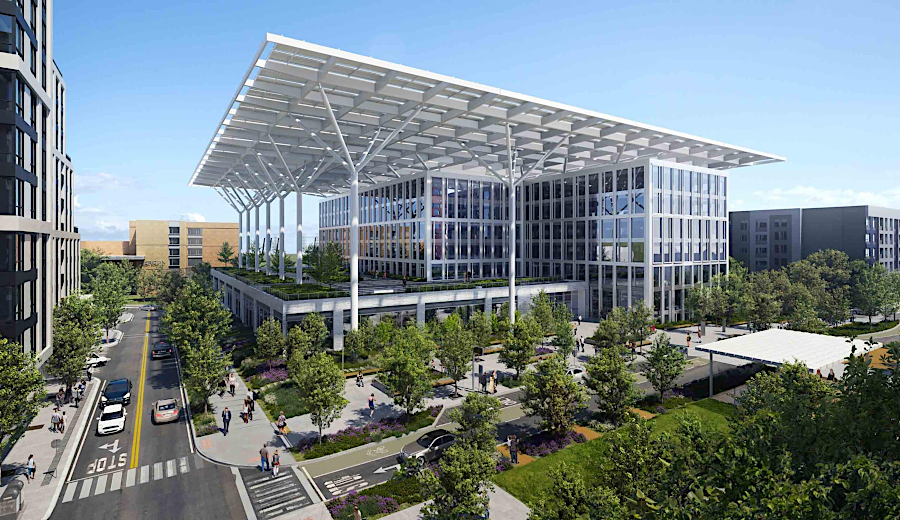
the HITT headquarters replaced Virginia Tech's Northern Virginia Center
Source: HITT, HITT Unveils Visionary Headquarters in Falls Church, Virginia, Sets Stage for a Sustainable Future
Fairfax Water became responsible for maintaining and upgrading the former Falls Church water system. To support the new development, it needed to replace and expand the Poplar Heights tank in the Idlywood community. That tank, built in 1952, was no longer adequate to provide sufficient storage and water pressure for fire fighting.
The Poplar Heights site was centrally located and at the highest elevation, 525 feet above sea level. Alternative sites lacked the existing underground pipes, so building a new tank elsewhere would have been more expensive.
The utility purchased four houses adjacent to the Poplar Heights tank, valued between $640,000-$700,000 each, but remaining neighbors objected to a bigger tank looming above their houses. Fairfax Water was controlled by Fairfax County, not the City of Falls Church, and it had to go through the public facility review process and get approval by the Fairfax County Planning Commission.18
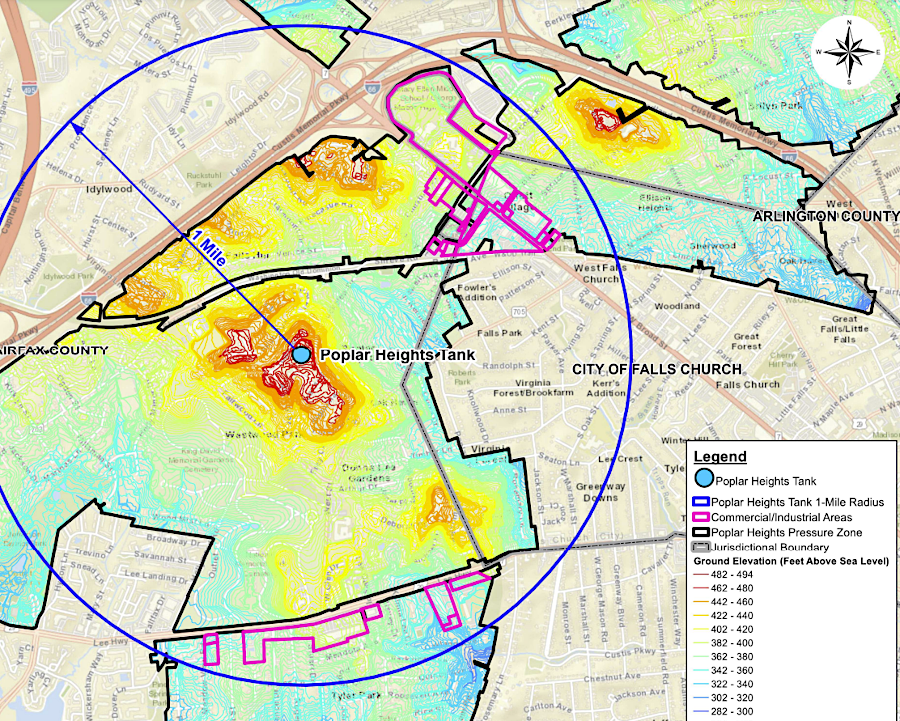
Fairfax Water had to obtain Fairfax County approval for the replacement of the Poplar Heights water tank, built by Falls Church in 1952
Source: Fairfax Water, Poplar Heights Water Tank Replacement - 2232 Public Facility Review
Links
- Fairfax County
- Fairfax Times
- Truce called off in Fairfax County s water war (August 10, 2012)
- Falls Church water system sale dammed (June 1, 2012)
- Times Obtains Copy of Final Water Ruling (May 30, 2012)
- Should Fairfax City spend $45M on its aging water system? (December 23, 2011)
- Water wars between county, Falls Church continuing to rage (October 20, 2011)
- County explores more control over water rates (September 28, 2011)
- Fairfax County leaves 110,000 water users out to dry (July 22, 2011)
- Falls Church delays water rate increase (July 15, 2011)
- Falls Church takes first step toward 8 percent hike in water service rates (July 1, 2011)
- Fairfax Water, Falls Church may settle over turf war (February 16, 2010)
- Falls Church sues for Fairfax water (March 15, 2007)
- Fairfax Water
- Falls Church
- Falls Church News-Press
- Shields Credits Mediator With Big Role Making Water Deal Happen (November 28, 2012)
- Fairfax Co. Supervisors Clear Away Competition for New Water Service (December 7, 2011)
- Fairfax Supervisors Mull 'Knock Out Punch' Water Legislation Tuesday (November 30, 2011)
- Fairfax Plans Water Rate Hike, F.C. Braces for More Legal Offensives (September 28, 2011)
- Fairfax Pols Turn Up Heat, Pressure F.C. To Cough Up Its Water System (July 13, 2011)
- New Court Filing Demands F.C. Refund All Fairfax Water Customers (December 29, 2010)
- 2 Fairfax Apartment Complexes Sue F.C. for Water Refund, Ask $96,558 (December 22, 2010)
- Fairfax Judge Orders F.C. to Halt Water Transfers (January 6, 2010)
- Falls Church News-Press
- Falls Church Times
- Washington Post
- Fairfax County, Falls Church halt water war with tentative $40 million sale of utility (November 20, 2012)
- Talks break down between Fairfax County, Falls Church over water utility merger (August 8, 2012)
- Falls Church, Fairfax County call truce in water war to discuss merger (June 14, 2012)
- Falls Church officials want to tap $1 million from water fees to pay legal bills in water war (June 11, 2012)
- Legal finding forces Falls Church to cancel water utility auction (May 26, 2012)
- Water war in Fairfax County roiled by legal opinion from federal agency (May 24, 2012)
- Falls Church opens bidding on water system at $44 million (April 11, 2012)
- Possible sale of Falls Church water system attracts strong interest from several suitors, city says (March 6, 2012)
- Fairfax County board votes to set water rates for all residents (December 6, 2011)
- Petersen could derail Fairfax move toward greater control over water service (December 2, 2011)
- Fairfax supervisors wade into water wars with possible new law just in time for election, Republican says (November 1, 2011)
- Fairfax County, Falls Church at odds over water service (October 3, 2011)
- Fairfax County pondering buying Falls Church Water, again (July 11, 2011)
- Northern Virginia's water war heats up again as some see anticompetitive bill (February 23, 2011)
- US Army Corps of Engineers
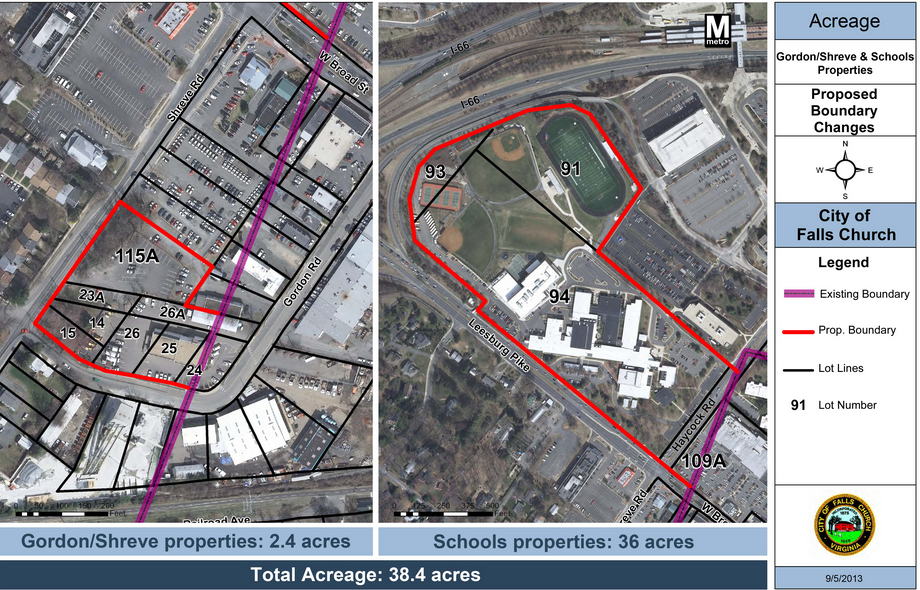
area annexed into Falls Church, as part of 2012 deal to sell water system
Source: City of Falls Church, Falls Church Water Utility to Merge with Fairfax Water
References
1. Pamela Scott, Capital Engineers: The U.S. Army Corps of Engineers in the Development of Washington, D.C., 1790-2004, US Army Corps on Engineers, Publication Number: EP 870-1-67, 2011, p.255, http://www.publications.usace.army.mil/Portals/76/Publications/EngineerPamphlets/EP_870-1-67_2011.pdf; James J. Corbalis Jr., "Recent Developments in the Fairfax County Water Authority," American Water Works Association Journal, Volume 56, Number 4 (April 1964), p.411, https://www.awwa.org/publications/journal-awwa/abstract/articleid/29324449.aspx (last checked April 17, 2018)
2. City of Falls Church vs. Board of Supervisors, 68 S.E.2d 96 (1951), Supreme Court of Appeals of Virginia, December 3, 1951, http://www.leagle.com/xmlResult.aspx?page=2&xmldoc=195116468SE2d96_1163.xml&docbase=CSLWAR1-1950-1985&SizeDisp=7 (last checked November 20, 2012)
3. James J. Corbalis Jr, "Organization and Problems of the Fairfax County Water Authority," American Water Works Association Journal, Volume 52, Number 7 (July 1960), pp.824-826, https://www.awwa.org/publications/journal-awwa/abstract/articleid/29323749.aspx (last checked April 17, 2018)
4. "Appraisal of the City of Falls Church Water System," SAIC, p.2-1, p.2-2, May, 2012 http://www.fallschurchva.gov/Content/Government/Departments/PublicUtilities/Future/2012Docs/SAISAppraisal.pdf (last checked June 13, 2012)
5. First Amended Complaint, Fairfax County Water Authority vs. City of Falls Church, January 9, 2009, http://www.fairfaxwater.org/current/First%20Amended%20Complaint.PDF, (last checked June 13, 2012)
6. "Fairfax Water, Falls Church suit settled," Fairfax Times, March 2, 2010, http://ww2.fairfaxtimes.com/cms/story.php?id=1148 (last checked June 13, 2012)
7. Fairfax Water's Brief in Opposition to City's Petition for Appeal to the Supreme Court of Virginia, April 26, 2010, http://www.fairfaxwater.org/current/falls_church_lit.htm (last checked September 11, 2010)
8. Final Agenda and Board Package, Fairfax County Board of Supervisors, December 6, 2011, p.619-21 http://www.fairfaxcounty.gov/government/board/bdagenda/2011/board-package-dec6.pdf (last checked December 7, 2011)
9. "Fairfax Co. Supervisors Clear Away Competition for New Water Service," Falls Church News-Press, December 7, 2011, http://www.fcnp.com/news/10682-fairfax-co-supervisors-clear-away-competition-for-new-water-service.html (last checked December 7, 2011)
10. "Appraisal of the City of Falls Church Water System, SAIC, May, 2012, p.3-6, http://www.fallschurchva.gov/Content/Government/Departments/PublicUtilities/Future/2012Docs/SAISAppraisal.pdf; "Times Obtains Copy of Final Water Ruling," Fairfax Times, May 30, 2012, http://fallschurchtimes.com/35380/times-obtains-copy-of-final-water-ruling/ (last checked June 13, 2012)
11. "Falls Church officials want to tap $1 million from water fees to pay legal bills in water war," Washington Post, June 11, 2012, http://www.washingtonpost.com/blogs/virginia-politics/post/falls-church-officials-want-to-tap-1-million-from-water-fees-to-pay-legal-bills-in-water-war/2012/06/11/gJQAIU0rVV_blog.html (last checked June 13, 2012)
12. "Truce called off in Fairfax County s water war," Fairfax Times, August 10, 2012, http://www.fairfaxtimes.com/article/20120810/NEWS/708109884/1076/Fairfax-County-news-briefs/Truce-called-off-in-Fairfax-County (last checked August 13, 2012)
13. "Falls Church City and Fairfax Water to Enter Mediation," Falls Church Times, October 24, 2012, http://fallschurchtimes.com/37169/falls-church-city-and-fairfax-water-to-enter-mediation/ (last checked October 29, 2012)
14. "Agreement Terms for Sale of the Falls Church Water Utility to Fairfax Water," Water Settlement Potential Terms and Boundary Adjustment, Capital Improvements Program (CIP) and Facilities Master Plan,
City of Falls Church Planning Commission Presentation: CIP Updates (February 4, 2013), January 23, 2013; "Fairfax County board votes to set water rates for all residents," Washington Post, December 6, 2011, http://www.washingtonpost.com/local/dc-politics/fairfax-county-board-votes-to-set-water-rates-for-all-residents/2011/12/06/gIQAA2utaO_story.html (last checked February 27, 2013)
15. "Blockbuster Water-for-Land Swap Agreed to by Fairfax, Falls Church," Falls Church News-Press, November 20, 2012, http://fcnp.com/2012/11/20/mediation-leads-to-three-way-settlement-of-water-disputes-and-win-win-for-water-customers/ (last checked November 20, 2012)
16. "F.C. School Board Kills Public-Private Plan for Campus Development, 4-2," Falls Church News-Press, June 15, 2016, https://fcnp.com/2016/06/15/f-c-school-board-kills-public-private-plan-campus-development-4-2/ (last checked June 15, 2016)
17. "Project History and Milestones, West Falls Project," City of Falls Church, https://www.fallschurchva.gov/1993/Project-History-and-Milestones; "Resolution Approving the Issuance by the West Falls Community Development Authority of Its Revenue Bonds Series 2022," City of Falls Church, August 2022, https://www.fallschurchva.gov/DocumentCenter/View/16094/CDA-Bond-Resolution; "West Falls Development Project," City of Falls Church, https://www.fallschurchva.gov/1599/West-Falls-Project; "Coalition for Smart Construction aims to redefine industry's future," Virginia Tech, November 20, 2023, https://news.vt.edu/articles/2023/11/csc-engineering-dcmetro.html; "Construction to begin next year on Virginia Tech's West Falls Church campus redevelopment," FFX NOW, December 18, 2024, https://www.ffxnow.com/2024/12/18/construction-to-begin-next-year-on-virginia-techs-west-falls-church-campus-redevelopment/ (last checked December 20, 2024)
18. "Poplar Heights Tank Replacement," Fairfax Water, https://www.fairfaxwater.org/poplar-heights-tank-replacement; "Idylwood neighborhood objects to plans for new Fairfax Water tank," FFX NOW, July 30, 2024, https://www.ffxnow.com/2024/07/30/idylwood-neighborhood-objects-to-plans-for-new-fairfax-water-tank/ (last checked August 1, 2024)
Rivers and Watersheds of Virginia
Virginia Places
