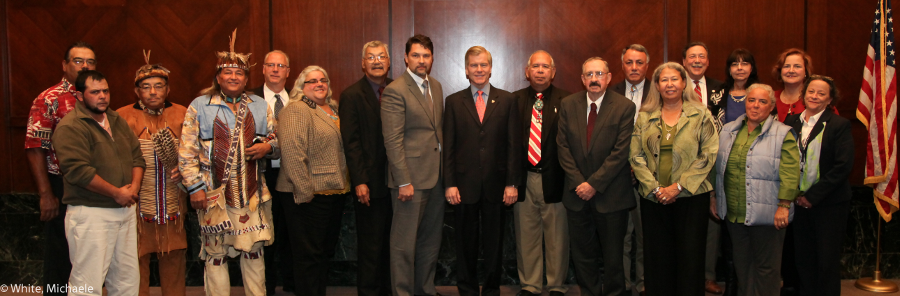
each year, the governor of Virginia announces November is Virginia Indian Heritage Month
Source: Commonwealth of Virginia, Governor McDonnell Signs Proclamation Designating November as Virginia Indian Heritage Month (November 8, 2013)
each year, the governor of Virginia announces November is Virginia Indian Heritage Month
Source: Commonwealth of Virginia, Governor McDonnell Signs Proclamation Designating November as Virginia Indian Heritage Month (November 8, 2013)
The first human residents of Virginia left virtually no written materials about their culture. We don't have the diaries, reports, or other records of a "literate" society as source material for understanding a different culture, in a different time. We have to evaluate other evidence to determine - or guess - at their religious beliefs, political boundaries, population levels, family life, and other social patterns. The physical evidence still available for study - shards of pottery, animal bones, postholes of houses, etc.- are subject to interpretation.
English listeners recorded the words spoken by Powhatan. (He was also called Wahunsenacawh or Wahunsunacock, as recorded by the English immigrants in the early 1600's - spelling of the original Virginia names by the English is not 100% consistent.) His words are not first-hand records; they were not written directly by Powhatan himself. In addition to the inevitable errors in translation, the written records of the Europeans must be viewed in the context of the 1500's and 1600's rather than the first decade of the 21st Century. The early English were not necessarily "New Age, sensitive kinds of guys" who made anthropologically-neutral observations. The first Europeans to explore Virginia filtered what they saw through their world view.
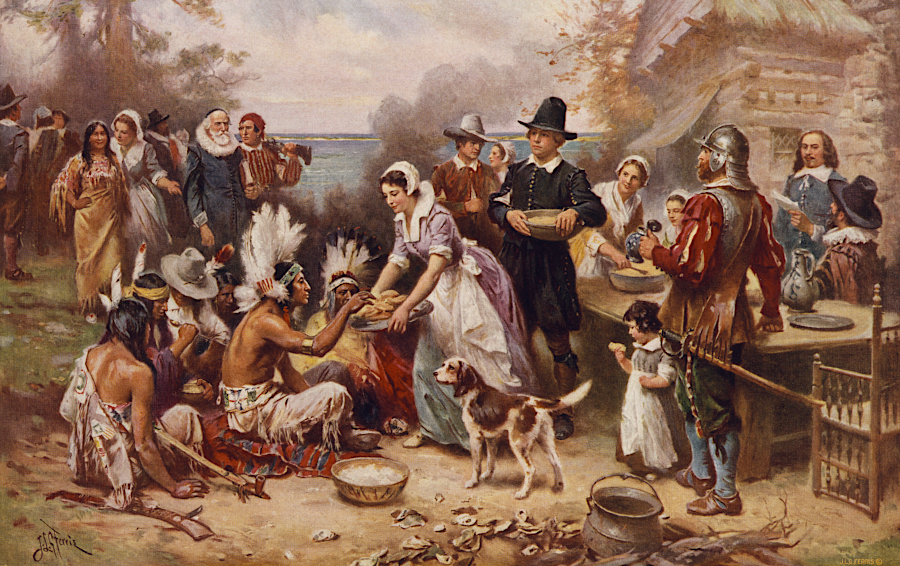
myths and cultural biases shape how many people imagine the colonists and Native Americans first interacted with each other
Source: Library of Congress, The first Thanksgiving 1621 (J.L.G. Ferris, c.1932)
The vast majority of English explorers/colonists who came to Virginia were Protestants and nationalists. The idea that there should be a separation between church and state, that government should be secular and individuals left free to choose their own personal faith, was far in the future. The Europeans who arrived in Virginia considered it a natural way of life that the English would displace the Native Americans, as well as prevent settlement in Virginia by French and Spanish Catholics.
The "pagan" culture of the Natives was described by those educated enough to read and write in the early 1600's. Those recorders were not 100% neutral; they had been thoroughly exposed to the religious and political bias of their time. The descriptions of the early explorers include overt and hidden value judgments that shade our current understanding of the lifestyles of the First Virginians. When you read the original documents, try to anticipate the source material that was omitted as well as the way the recorded material was morphed by the biases of the colonial times.
Modern historians, scientists, and students are affected by cultural biases as well. For example, do you assume the ability to read and write (literacy) is fundamental to intelligence? Do you notice spelling errors in documents, and discount the quality of the thinking because the writing was flawed? If so, then you may be consciously or unconsciously assuming that the Native Americans were not intelligent. If so, be consistent and assume Shakespeare was not intelligent - because his spelling was inconsistent.
If you visit one of the colonial Virginia mansions, tour guides will talk about the Carter, Lee, Randolph, Bolling, and occasionally even the Grymes family as "First Families of Virginia" (FFV's) The FFV's were the gentry - the white, Anglo-Saxon, Protestant gentry - who governed the economic, social, and political life of colonial Virginia between 1607-1776. "Colonial" is the time between when Jamestown was settled in 1607 and 1776, when a special convention of colonial leaders declared Virginia to be an independent state.
In the 1600's and 1700's, members of the gentry families established plantations, purchased slaves, grew tobacco, and built brick mansions such as Gunston Hall, Stratford Hall and Berkeley Plantation. There was even a "Grymesby on the Piankatank" - what a mixture of Native and English names...
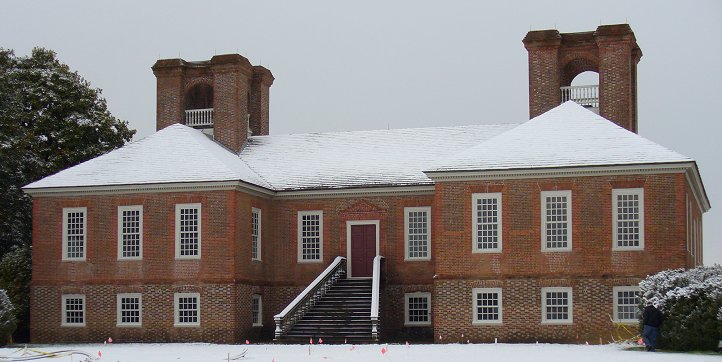
Stratford Hall, ancestral home of the Lee family
Men controlled the Virginia General Assembly and local county courts in colonial times. No women and no slaves (male or female) could vote. Political and economic power was not shared or spread around any more than necessary.
The sons and daughters of FFV families married sons and daughters of other FFV's, and inherited wealth - primarily land and slaves, both considered necessary property for growing tobacco that was shipped to Europe - stayed in the family. The oldest male son inherited the majority of the family wealth, a pattern known as primogeniture. Inherited land was kept within family control for generations, entailed by the wills of long-dead ancestors.
In modern Virginia, especially in rural areas of Tidewater and Southside and in the West End suburbs of Richmond, being related to one of the early colonial families is a badge of honor. These FFV's think "To be a Virginian either by Birth, Marriage, Adoption, or even on one's Mother's side is an Introduction to any State in the Union, a Passport to any Foreign Country, and a Benediction from Above."
Despite such traditional Virginia gentry myths, the very first FFV's did not speak with a British accent. The earliest human residents in Virginia probably walked here from Asia through Alaska, after crossing a land bridge hundreds of miles wide known as Beringea.
Those immigrants may have come directly from Siberia, following the game through fields and marshes exposed as the sea level dropped. The early arrivals may have been trapped on the edge of Siberia/Alaska for thousands of years, isolated from others and interbreeding until the genetic diversity was limited. There is even a theory that the first Virginians paddled here from Europe about 15,000 years ago, bringing stone manufacturing traditions from the Burgundy region of France near the rock of Solutre.
Most likely, the first people who migrated into Virginia originated in Asia, and before that in Africa. Evidence at Cactus Hill along the Nottoway River in modern Sussex County shows people had reached Virginia 18,400-17,100 years ago.1
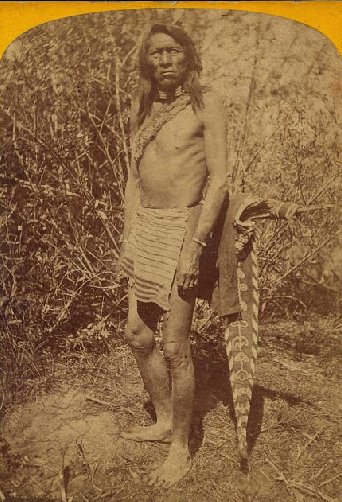
the first Virginian would not have resembled this individual, because the climate 15,000 years ago was colder.
Source: Library of Congress
When the English immigrants got to Virginia, they were greeted by the real "first" Virginians. The next time someone argues about the discovery of America by the Vikings from Scandinavia, or suggests the English had a legitimate claim on the area by Right of Discovery because it was unoccupied by any Christian prince, or challenges the presence of immigrants from foreign nations - remember that Virginia was discovered and occupied first by people who did not speak English.
Our knowledge about the earliest Virginians is unclear. The traveling band whose descendants ultimately occupied North and South America may have been just 70 people. It is possible that just one single family group may have been the source for all the Indians who were "discovered" by the Europeans.2
More likely, multiple hunting/gathering bands brought genetic diversity to the Western Hemisphere, and the different groups arrived at different times before the end of the last Ice Age. Some may have arrived as much as 20,000 years ago. There were at least three waves of immigration from Asia, with the Inuit arriving last about 4,000 years ago.3
We do not have enough evidence to prove beyond a reasonable doubt when humans first came to Virginia, or how they got here. The traditional view, that Asians walked across the Bering Land Bridge, may be expanded to include arrivals from other directions. We can be positive about one thing, however: the first Virginians did not arrive in the Susan Constant, Godspeed, and Discovery in 1607.
About 25,000 years ago, so much water was captured in the ice blanketing the continents that sea level was as much as 400' lower. Lower sea levels exposed the land now under the Bering Sea. Until 14,000 years ago, there was still wet-but-walkable ground that connected modern-day Alaska with modern-day Russia.
Asians who crossed the Bering Land Bridge walked east and south, following new territory for hunting game. The hunting and gathering efforts may have led bands to move 10 miles in a day as they explored the virgin lands. At night, they may have told tall tales to each other and occasionally to other bands of hunters, anticipating what food, forests, rivers, and ice barriers would be found over the next ridge. They could have followed the "kelp highway," walking on rocky coastlines where food was available from both sea and land.4
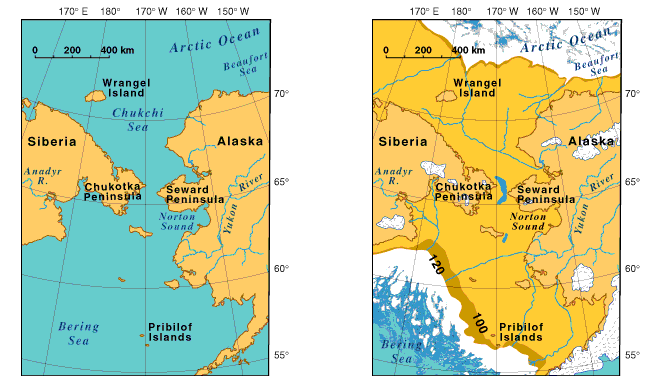
Bering Straight, now and then
Source: USGS Ecosystem and Climate History of Alaska
For over 50 years, scholars thought the first artifacts documenting human settlement in North America were stone tools crafted in the style of the Clovis culture. The tools were first discovered in the 1930's near Clovis, New Mexico and dated to be about 13,000 years old. Recent studies in the last 30 years show clear evidence that there was a pre-Clovis culture, one that arrived in North America as early as 15,000-20,000 or so years ago.
At Cactus Hill (site 44SX202) and Blueberry Hill in Sussex County (site 44SX327), stone artifacts have been excavated carefully a few inches below Clovis-style artifacts. Older materials are buried below younger materials, so the discovery of artifacts beneath Clovis artifacts suggests that the first Virginians were here:5
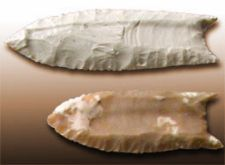
Clovis point and (below) a later Folsom point, showing distinctive notches from the base up through center of point
Source: Bureau of Land Management, Wilson Butte Cave
Some archaeologists still question if Virginia was occupied by humans before the development of the distinctive stone tools of the Clovis culture. Critical thinking skills are required when someone states anything related to Virginia before 1600 as "true." What we know today may not be what we believe tomorrow, as new evidence surfaces and new interpretations are based on new evidence.
In 1996, a skeleton was discovered on the Columbia River in the Pacific Northwest. "Kennewick Man" was radiocarbon dated at roughly 9,000 years old. The Federal government planned to turn over the bones to a local Native American tribe for burial, following the 1990 Native American Graves Protection and Repatriation Act. That law mandates that ancient human bones must be turned over to the most closely-allied tribe for reburial.
However, anthropologists sought access to the bones for scientific research and sued to block the reburial. The scientists challenged the assumption that all bones older than 1492 (when Columbus "sailed the ocean blue") must be connected with a modern Native American tribe.6
One speculation was that the bones indicated Polynesian or even European immigrants may have reached North America nearly 10,000 years ago, separately from those hunting bands that crossed the Bering land bridge. The lawsuit generated extensive discussion on the definition of race and who were the earliest settlers in North America, thousands of years before Columbus. The courts ultimately ruled that the bones are not associated closely enough with any current tribe to require repatriation to a modern tribe under the provisions of the Native American Graves Protection and Repatriation Act, and scientists got 16 days to examine the remains.7
That study led scientists to conclude that Kennewick Man was a traveler from Alaska, someone who drank water from glaciers and ate marine animals such as seals, sea lions and fish. Though the bones were found inland from the Pacific Ocean shoreline, he was a maritime hunter-gatherer who originated with the same group of people that later populated Polynesian islands and Japan. Members of that group may have paddled along the shoreline of Beringea 9,000 years ago to reach different hunting grounds on the coastline of North America, and some may have gone inland for brief visits to trade for different types of stone tools and food.
The unusual physical characteristics of the skeleton may demonstrate just the naturally wide range of skull sizes and shapes within the Native American population living in the Pacific Northwest 9,000 years ago. On the other hand, it may indicate the Ainu people of Japan or Polynesians managed to migrate to North America in a fourth wave of immigration across the Bering land bridge before rising sea levels drowned that path.8
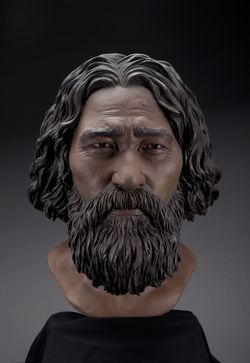
Kennewick Man may have looked like this
Source: Smithsonian Institution, The 9,000 year-old Kennewick Man
Our perspectives on the past are changing fast. For example, the old assumption that corn imported from Mexico was key to the development of agriculture in Virginia is now outdated. Native Americans in the Mississippi River Valley domesticated different plant species long before tobacco and corn were imported from the south. The Native Americans in Virginian added corn as a major food source plant only around 1,000 years ago:9
Even assumptions about Native American origins for Virginia place names are changing. Maybe Shenandoah really does mean Daughter of the Stars, but evidence for that claim is thin. Layers and layers of Virginia tradition may be repeated often by tourism officials, but still lack primary sources.
Chesapeake, name of the largest bay in Virginia, is of Native American origin. Roanoke, Meherrin, and Nottoway are Native American names for Virginia rivers, but they were not the original names used by the first Virginians. Place names used by Native Americans in the early 1600's (before the Europeans arrived) had little or no relationship to the first names assigned to those places by the first settlers who arrived as much as 15,000 years earlier. Paleo-Indians did not speak Iroquoian, Siouan, or Algonquian languages.
The English changed the name of Powhatan's River to James River to honor a ruler in London, but a name change for that natural feature was not new. The Native Americans under Powhatan's control would have used the name Powhatan's River for just the last 30 or so years. Perhaps the name of the previous paramount chief who ruled prior to Powhatan had been assigned to that river, or perhaps it had been called something as mundane as "Big River."
on John Smith's map, the James River was labeled Powhatan's flu (flu=river)
Source: Library of Congress, Virginia / discovered and discribed by Captayn John Smith, 1606
The English referred to Virginia rather than Tsenacomoco, the term used by Powhatan's Algonquians to describe the region where they lived. What was the first name for the place we now call Virginia? No one knows; the Paleoindians left no records providing any clues to their languages.
What we do know is that the first Virginians, maybe 15-20,000 years ago, did not speak the Algonquian language or have a chief called Powhatan. The original names of the Virginia rivers recorded by John Smith on his map of Virginia were not the first names ever used, so efforts to "restore" the place names of Virginia must deal with the fact that we do not know the first names that were used.
The first Europeans to engage with the indigenous people in Virginia were sailors on ships that sailed primarily from Spain or its colonies in the Caribbean. Those sailors in the 1500's traded highly-prized iron tools (which remained a sharp edge far longer than stone tools) for food, furs/deerskins, and sex. Shiny objects were scarce in Tsenacomoco, so copper and glass that was cheap to the Europeans was also highly valued.
Shipwrecks provided other European items, some of which probably ended up as prestige goods controlled by the weroances and other tribal elites. Horses from a shipwreck ended up populating Assateague Island on the Eastern Shore.10
The Spanish seized Native Americans along the South Carolina coastline and enslaved them. They also captured a handful in Virginia. Paquiquineo, a teenage boy enticed onto a ship near the mouth of the York of James rivers in 1561, was taken to Spain and Mexico. The Spanish thought he converted to Christianity, renamed Don Luis, and brought him back in 1570 when Father Juan Baptista de Segura and about nine other Spanish Jesuits tried to establish the Ajacan colony near modern-day Yorktown.
Paquiquineo/Don Luis abandoned the Jesuits and rejoined his Native American community. He soon led an attack that killed all but one of the Spaniards. A ship in 1572 rescued the survivor, the young boy who had been spared. In retaliation, the Spanish captain hung seven Native Americans from the rigging of his ship.
That experience, together with stories from the south of the cruelties of the Spanish led by Hernando de Soto 30 years earlier must have shaped the perspective of the Europeans. The need for protection may have facilitated the creation of paramount chiefdoms where tribes were aligned and more warriors could be mobilized. Over 30 tribes were led by Wahasunacock/Powhatan in a paramount chiefdom in Tidewater when the English colonists arrived in 1607.11
The first interaction in 1607 between the English and the Native Americans was hostile. Two colonists were wounded by arrows when a group landed at Cape Henry on April 26, 1607. Powhatan allowed the settlement at Jamestown, taking advantage of the opportunity to acquire iron, prestige goods, and weapons. He gained essential information about the new culture with new technology such as sailing ships. The colony struggled to survive, and Powhatan's primary source of control was his ability to limit access to food.
After extracting the items he valued, Powhatan saw the English sail away and abandon Jamestown after the "Starving Time" winter of 1609-1610. However, a relief convoy arrived with new leadership from the Virginia Company in 1610. Powhatan sought to prevent the English from expanding their settlements, but lacked the military capacity. He agreed to let his daughter Pocahontas marry John Rolfe and ended the first Anglo-Powhatan war in 1614.
Further expansion displaced Powhatan's people from their townsites along the James and York rivers. The Virginia Company did not seek to enslave the Native Americans, but instead sought to acculturate them. Plans for an Indian school were initiated, and Native Americans commonly interacted with colonists at their farns and within their houses. The apparent peace may have been an intentional prelude, designed to put the English at ease before a coordinated attack.
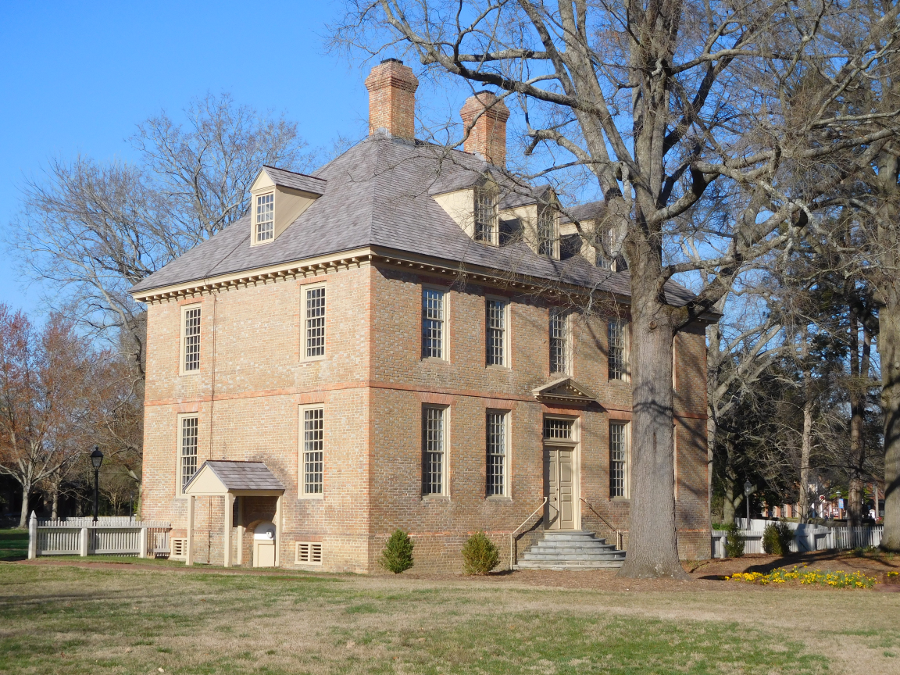
William and Mary built the Brafferton building in 1723 to educate Native Americans
Four years after Powhatan died, Opechacanough led an uprising in 1622 and then another in 1644. Neither were successful in forcing the English to stay constrained within a boundary; population growth led to continued expansion throughout Tidewater. When Necotowance signed the 1646 treaty ending the third Anglo-Powhatan war, the terms established that all of the Peninsula between the York and James rivers would be exclusively English.12
Continued English colonization displaced the Algonquian-speaking tribes north of the York River. William Claiborne and others traded for furs/deerskins with the Susquehannocks on the upper Potomac River, but then Maryland colonists began to occupy the lands of that nation. The English maneuvered in various ways to gain control of land where tobacco could be planted. When cattle and hogs destroyed Native American cornfields, towns were rebuilt further inland. Coastal tribes like the Moyumpse/Dogue lost access to the rich food resources in the Chesapeake Bay and river estuaries.
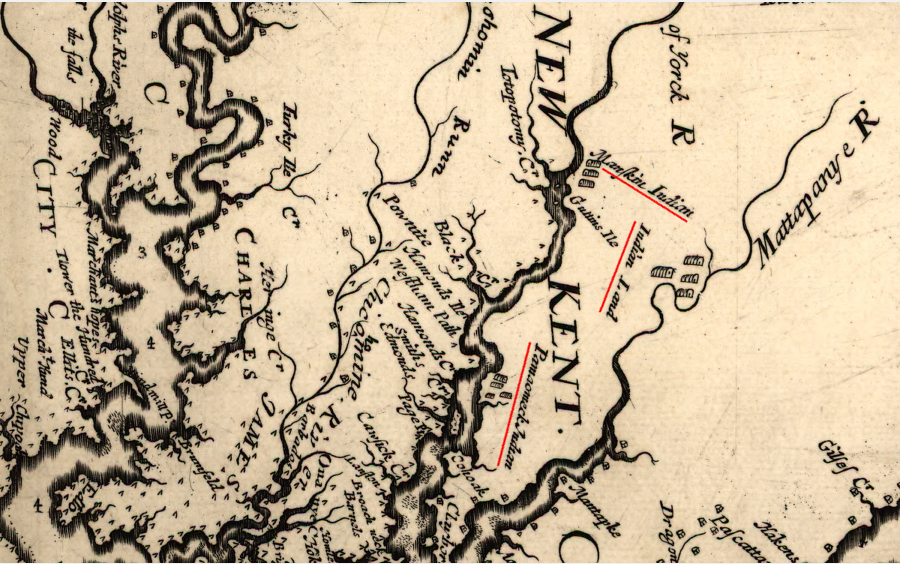
when Augustine Herrman produced his map sixty years after the English landed at Jamestown, Native Americans had been forced off the Peninsula to towns north of the York and Pamunkey rivers (NOTE: map is oriented with North to the right)
Source: Library of Congress, Virginia and Maryland as it is planted and inhabited this present year 1670
During Bacon's Rebellion in 1676, the rebels treated all the Native Americans as enemies that could be killed on sight. The Pamunkey fled into Dragon's Swamp at the headwaters of the Piankatank River to escape being murdered. The rebels marched south to the Roanoke River and destroyed the Occaneechi town near modern-day Clarksville.
In the second half of the 1600's, the Monacans and Manahoacs in the Piedmont evidently moved their towns westward and retreated into the Blue Ridge to avoid the colonists. Siouan-speaking tribes living along the Roanoke River, and others living in the Valley and Ridge physiographic province, were disrupted by Iroquois raiders going south to attack the Catawba and Cherokee and vice versa. When colonists began to settle in the Shenandoah Valley in the 1720's, the land was still used as a hunting territory but there were few remaining Native Americans living in the region.13
After the third Anglo-Powhatan war and into the 1700's, Native Americans still living in organized groups east of the Blue Ridge were assigned small reservation areas where their land ownership was acknowledged. No Federal reservations were ever established in Virginia; by the time a national government was created in 1776, Virginia's Native Americans were already assigned to state-defined areas. All the land within those state reservations was eventually lost to encroachment by land hungry neighbors, except for the land within the reservation assigned to the Pamunkey and Mattaponi.
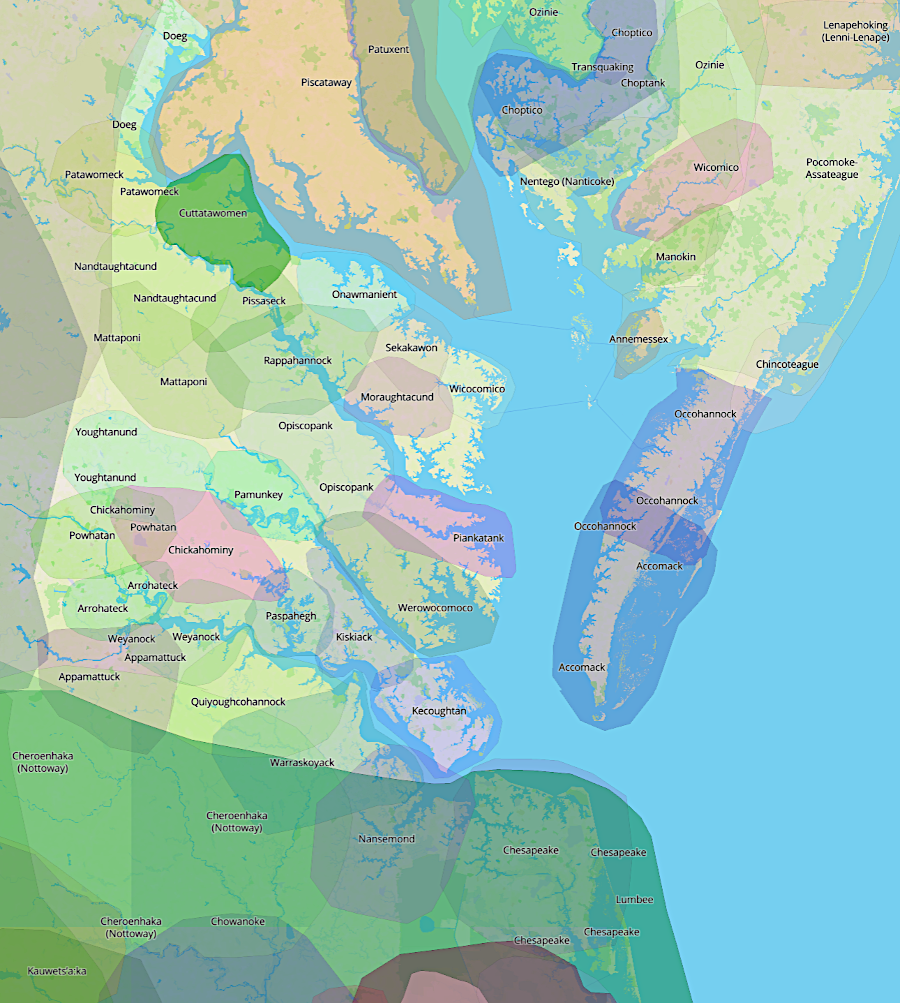
the English documented where Native American groups lived at the start of colonization
Source: Native Land Digital
In the early 1900's, anthropologists studying different cultures published research on the remaining Native American groups in Virginia. Official segregation laws designed to ensure white supremacy also triggered a reaction from Native American groups that resisted being categorized as "colored" and wanted to affirm their distinct identity.
Official state recognition of tribes began in 1983. The Commonwealth of Virginia has recognized 11 tribes. The Federal government has officially recognized seven Native American tribes. The tribe with the largest number of residents in Virginia is the Monacan Indian Nation, with over 2,600 people.15
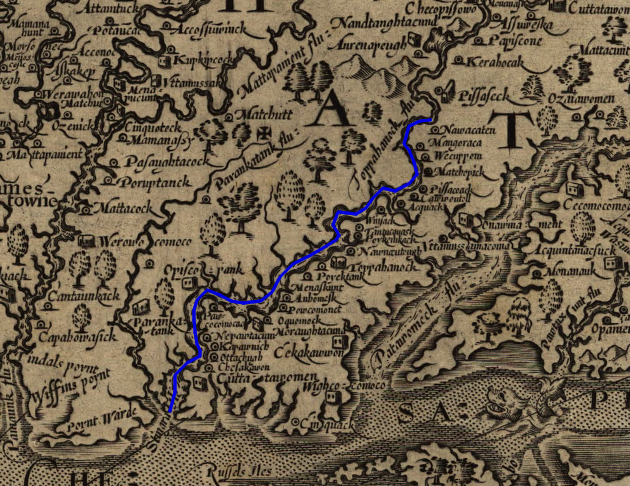
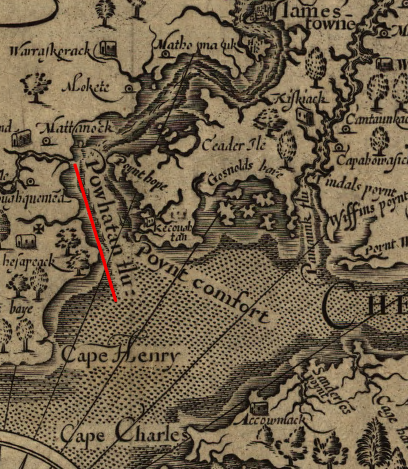
Powhatan's control over Tsenacomoco may have been greater on the southern bank of the Rappahannock River, which is one explanation for the concentration of Algonquian settlements north of that river (marked by blue line - and on John Smith's map, "north" is to the right, not at the top)
Source: Library of Congress, Virginia / discovered and discribed by Captayn John Smith, 1606
Source: Fairfax County Public Schools, Virginia's First People
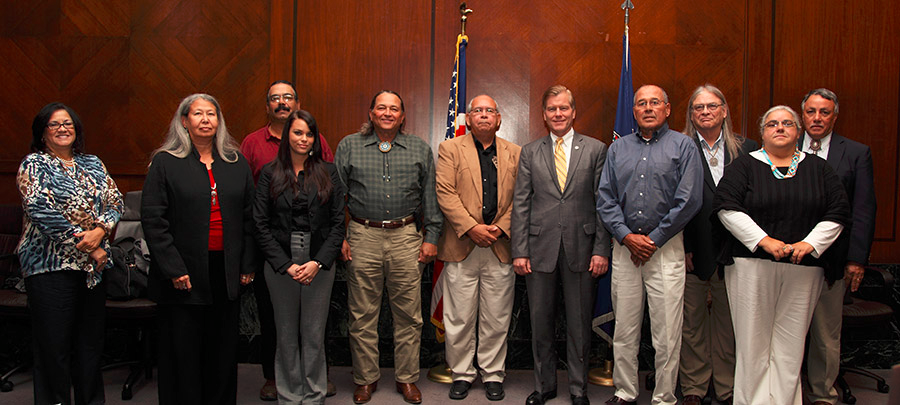
chiefs of Virginia's state-recognized tribes with Gov. McDonnell (November 2012)
from L to R: Rappahannock Chief Anne Richardson, Nottoway Chief Lynette Lewis Allston, Upper Mattaponi Assistant Chief Frank Adams, Pamunkey Tribal Member Ashley Atkins, Cheroenhaka (Nottoway) Chief Walt Brown, Upper Mattaponi Chief Kenneth Adams, Governor McDonnell, Mattaponi Chief Carl Custalow, Patawomeck Chief Robert Green, Monacan Chief Sharon Bryant, Chickahominy Assistant Chief Wayne Adkins
Source: Commonwealth of Virginia
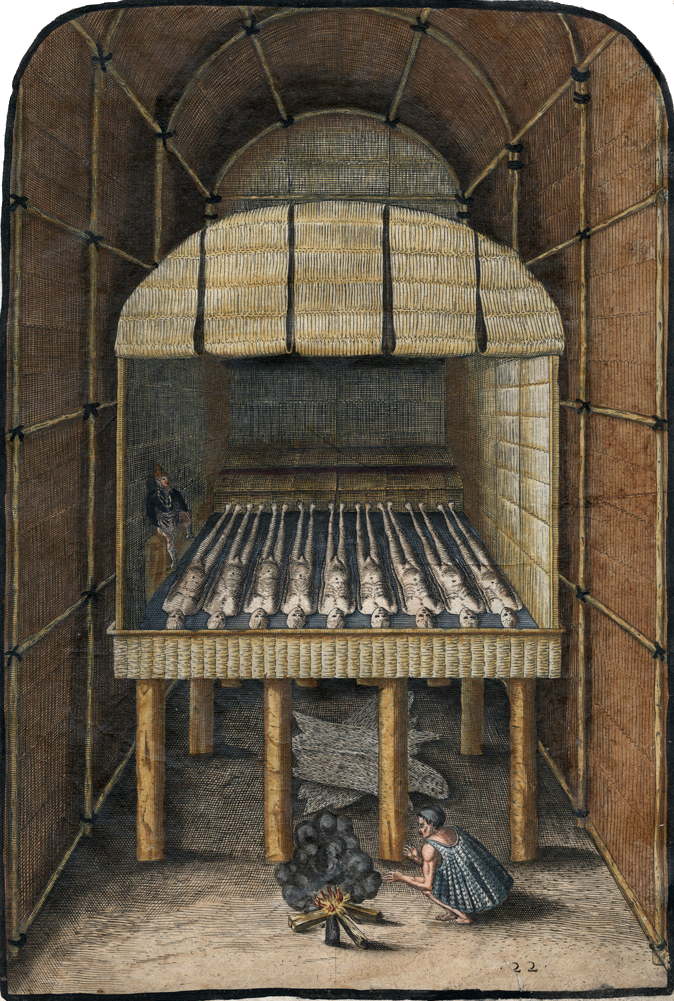
in Powhatan's paramount chiefdom, after weroances died and their flesh decayed the bones were wrapped and retained in temples
Source: LearnNC, Theodor de Brys engraving Indian Charnel House (from Thomas Hariot's 1588 book A Briefe and True Report of the New Found Land of Virginia)
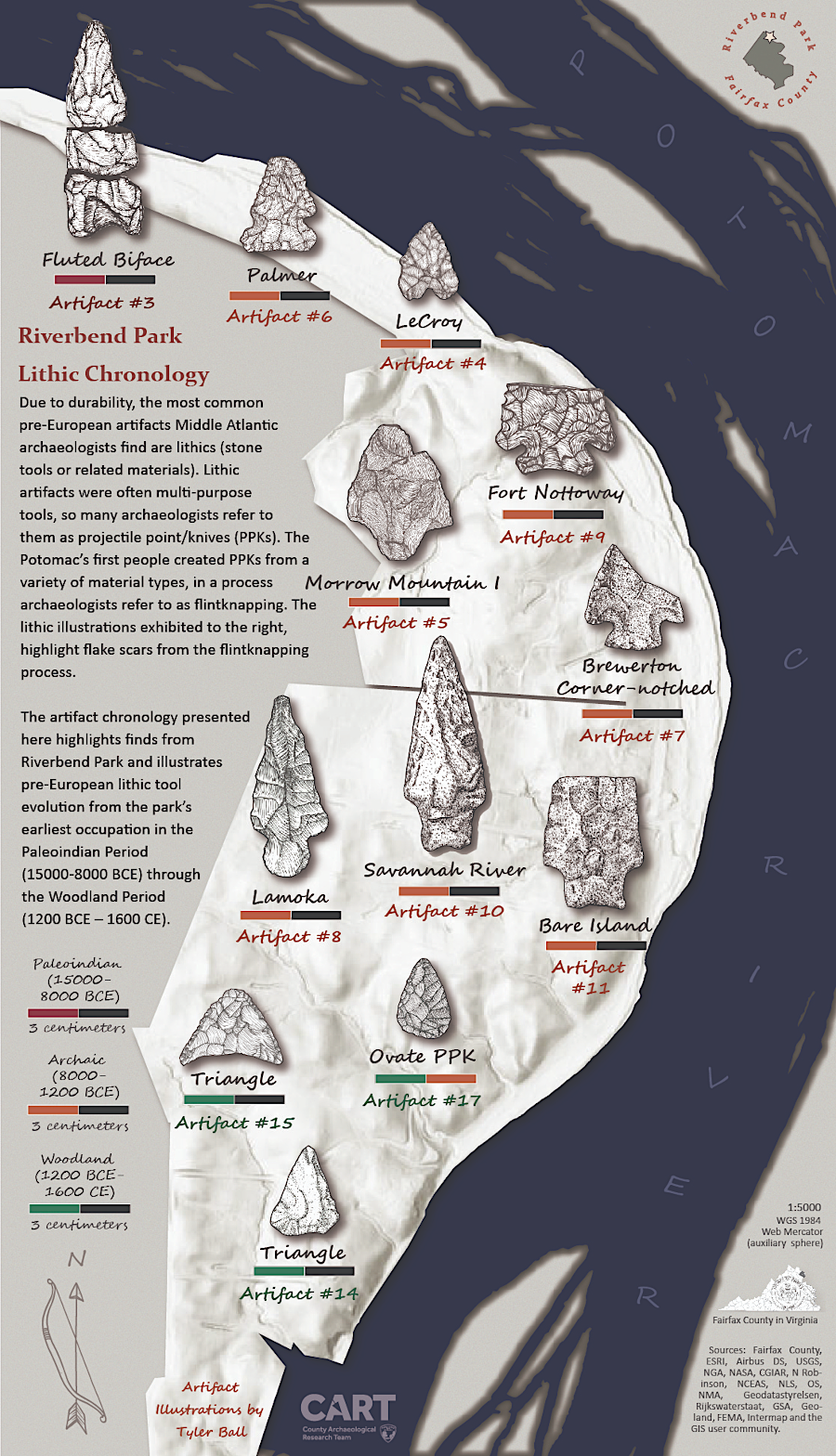
archaeology of Riverbend Park was highlighted on GIS Day 2023 in Fairfax County
Source: Fairfax County Archaeological Research Team (CART), People of the Potomac