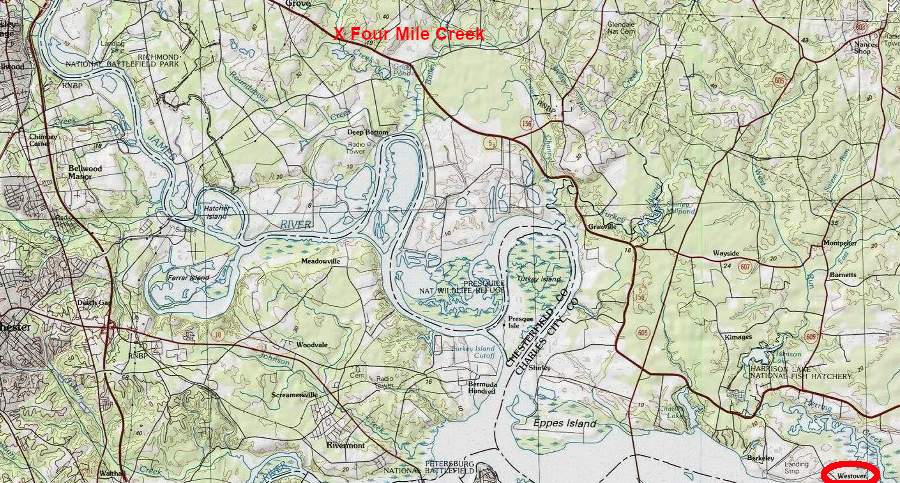
Benedict Arnold marched from Westover to Four Mile Creek, where the British camped on the night of January 4, 1781
Source: ESRI, ArcGIS Online
Benedict Arnold marched from Westover to Four Mile Creek, where the British camped on the night of January 4, 1781
Source: ESRI, ArcGIS Online
Benedict Arnold's treason was exposed in September, 1780, and he fled to New York City. The British made him a Brigadier General. For his first assignment, he was given command of 1,600 troops and directed to invade Virginia.
That attack was part of the "southern strategy" adopted by the British after General Burgoyne surrendered his army at Saratoga and France entered the war. There were not enough ships and troops available for General Henry Clinton to break through the cordon of Continental Army troops surrounding New York City, but there were enough to conquer the southern colonies.
General Alexander Leslie had been sent to Virginia in October 1780 to interrupt the flow of troops and military supplies. Leslie was supposed to raid as far upstream as Richmond. His ships were unable to navigate the shallow channels, so the British focused on destroying military assets in the Hampton Roads area. Leslie was directed to go to Charles Town in mid-November after the loyalists led by Major Patrick Ferguson were defeated at Kings Mountain.
Arnold was sent to Virginia to renew the effort to disrupt the supply chain. He was not directed to seize and hold territory in Virginia. He was given enough troops to conduct a major raid that would destroy supplies and divert troops which otherwise would be headed to the Carolinas.
The British ships sailed from Sandy Hook in New York on December 21, 1780. They arrived in the Chesapeake Bay at the end of December. The troops were moved into smaller vessels seized from the Americans that could sail up the James River.
When Americans fired on the invaders from the shoreline of Warwick County (now the city of Newport News), General Benedict Arnold ordered the Hessians to land and capture a few prisoners to gain intelligence on the location of the Virginia forces. Captain Johann Ewald, the officer in charge of the Hessian in charge of the Jaeger Corps under General Arnold, was reluctant because his troops were not equipped with bayonets. American militia could slaughter the Germans as they climbed up the riverbank.
Nonetheless, he ordered the attack. His men waded through shallow water on the evening of December 31, drew their swords, and raced to the fence line from which the Virginia militia had been firing. The soldiers fled, but Ewald made clear to Arnold that he questioned the British general's military judgment.
British and "Hessian" troops started to disembark at Jamestown, but Arnold countermanded his order once he learned a large group of militia were preparing to resist him there. Arnold was looking for glory and willing to fight, but his orders were to minimize the risk of a defeat.
The flotilla sailed further upstream on the James River, and at Hood's Point the Virginians tried to block his advance. A small fort on the south bank there, located opposite Weyanoke Point, had cannon which could reach all ships maneuvering through the shipping channel narrowed by sandbars.
Arnold quickly captured the fort. Cannon on the British ships raked the fortification while troops landed downstream for a land assault. The Virginians were outnumbered and outgunned. They withdrew, abandoning five artillery pieces at Hoods Fort.
On January 4, 1781, Benedict Arnold then landed his troops on the north bank of the James River at Westover. He had 1,500-1,800 men, including Hessians led by Captain Johann Ewald, mounted dragoons of the Queens Rangers (loyalists) led by Col. John Simcoe, and additional loyalists in the Royal American Regiment (Robinson's Corps).1
Instead of raiding south to Petersburg as Baron von Steuben anticipated, Arnold marched quickly to Richmond. Richmond was the new capital of the rebellious colony of Virginia, so its capture would provide both political symbolism as well as military benefits.
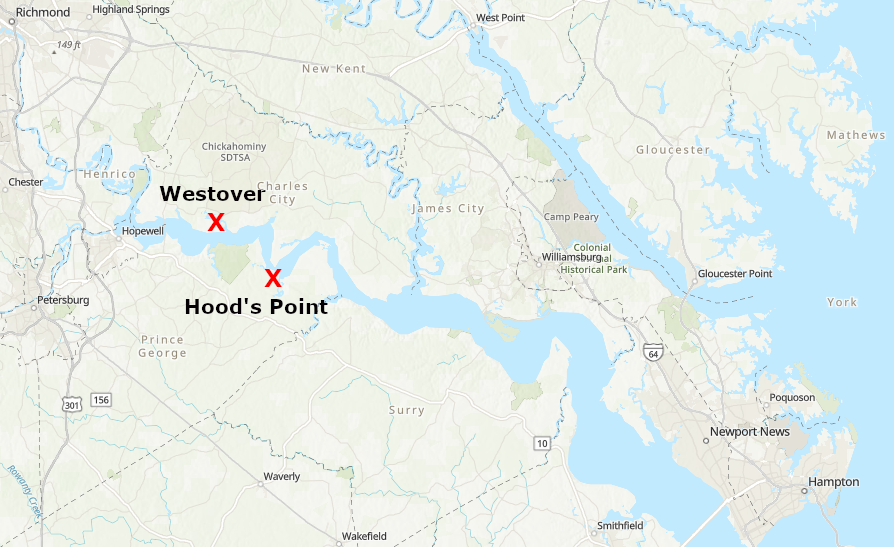
Benedict Arnold sailed past the Virginia fort at Hood's Point and landed at Westover on January 4, 1781
Source: ESRI, ArcGIS Online
The local militia sought to harass Arnold's force, but the invaders had no difficulty rebuilding bridges that had been destroyed to slow the march and allow time for more units in the Virginia militia to arrive. The British reached Richmond on the afternoon of January 5, a day after their landing at Westover.
On the eastern edge of Richmond, General Arnold had the Hessians disperse the 200 Virginia militia who had assembled on Church Hill. Lieutenant Colonel John Graves Simcoe led the Queens Rangers six miles upstream to Westham, where there was a foundry and a stockpile of military supplies. The Queens Rangers, accompanied by the 80th Regiment and some Hessians, destroyed cannon by breaking off the trunnions. They also dumped 700 barrels of gunpowder into the river, and burned the two powder mills and other buildings.
Arnold himself set up a base at what is now the northwest corner of 19th and East Main streets; his men camped at the Henrico Parish Church (later renamed Saint John's Church). He offered to spare the new capital from destruction if the Virginians would gather tobacco and other valuables, which the British would then claim as prize goods. Governor Thomas Jefferson refused.
Virginia militia in Manchester did deter the British from crossing to the southern bank of the James River and destroying the supplies there, but the river barrier also meant that those troops were not a threat to Arnold's forces.
The British stayed in Richmond just two days, January 5-6, 1781. During that time they loaded tobacco from the warehouses into 42 ships seized at the waterfront, then destroyed the shipbuilding workshops, unfinished vessels, and public buildings.
The ships loaded with plunder sailed downstream on January 6. British officers would later receive a portion of the value of the seized tobacco and other goods; there was a strong incentive to capture material as well as to destroy supplies within Virginia.2
Captain Johann Ewald described the raid as equivalent to freebooting pirates marauding through settlements near the shoreline. Resistance by the Virginia militia on the march to Richmond and the return to Westover was negligible, and:3
As the British approached Richmond, Governor Thomas Jefferson fled with other state officials to Charlottesville. He was later criticized for the weak military response to Arnold's raid, but he did not receive the military information needed to identify how to use the militia to interfere with Arnold's march.
Initial reports suggested Petersburg or Williamsburg could be the primary target. Once it was clear that Arnold would march to Richmond, there was little time for Governor Jefferson to gather the scattered militia and block the British advance. The governor's letter to George Washington on January 10, 1781 reveals how quickly General Arnold moved:4
After Arnold brought his force back to Westover, Thomas Nelson assembled militia at Charles City Courthouse. British forces surprised them and routed the militia, and Arnold was never attacked during his stay at Westover.
He sailed downstream to Flowerdew Hundred on January 10, where Arnold's forces skirmished with militia forces that night. The British dismantled the remains of Hoods Fort, then sailed downstream again to Smithfield. They landed, dispersed the militia there, and marched overland to arrive in Portsmouth on January 19.
They built fortifications at Portsmouth, plus a new star fort at Great Bridge. For the first time since Governor Dunmore fled, the British had a base in the Chesapeake Bay. No fortfifications had been created during the two-week Collier-Mathew Raid in 1779.
Three French ships arrived in the Chesapeake Bay in mid-February, 1781, but they landed no troops and left without a fight. The Virginia militia re-assembled at Hampton, and the British sent a force across the James River to attack them. The troops crossed the river at night to Newport News, then marched towards Hampton on March 7.
The British recorded that the fight that day started when 26 mounted British raced towards a line of 200 Virginia militia. The militia fired twice before the horsemen reached them. The British infantry 100 yards behind their horsemen forced the militia to withdraw, and the British returned to Portsmouth that evening.
George Washington sent Major General Marquis de Lafayette to Virginia with a detachment of Continental Army troops, along with orders to capture and execute Benedict Arnold. Lafayette reached Virginia on March 14, 1781. He lacked enough men to confront the British directly; he ended up spending six months seeking opportunities to harass the British without risking his army.5
General William Phillips arrived on March 27 and superseded Arnold in command. On April 24, after the fort was completed at Portsmouth, Phillips led his forces upriver. He feinted coming ashore at Burwell's Landing, then landed nearby. His troops destroyed facilities and supplies at Yorktown and Williamsburg, then got back on the ships to land at City Point and march to Petersburg.
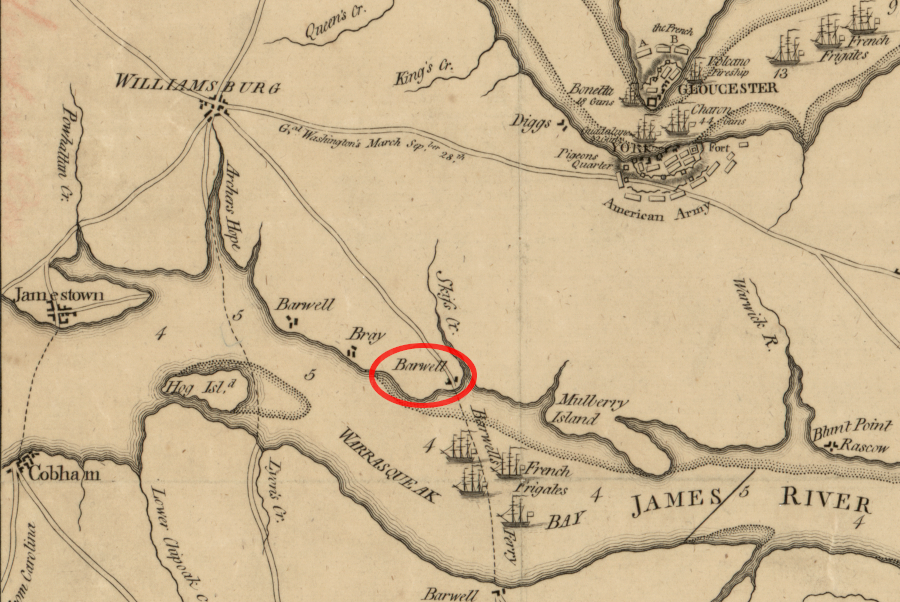
General William Phillips feinted a landing at Burwell's Ferry before sending troops ashore at an undefended site just downstream
Source: Library of Congress, A Plan of the entrance of Chesapeak Bay, with James and York rivers (by William Faden, 1781)
After capturing Petersburg, General Phillips sent Benedict Arnold to capture the ships at Osbourne's Landing while marched to the militia barracks at Chesterfield Courthouse.
Hoping to capture more booty which would result in rewards for the officers, General Arnold sent a note to the ships saying the Virginians could keep half of their cargoes if they surrendered without a fight. They declined, and when Arnold attacked they burned, scuttled, and destroyed several ships. Arnold and Phillips reunited their forces in Manchester, while the Marquis de Lafayette brought his troops to the north bank of the James River in Richmond. The situation in May, 1781 was the opposite from January, when Arnold had occupied Richmond and the militia had occupied Manchester.
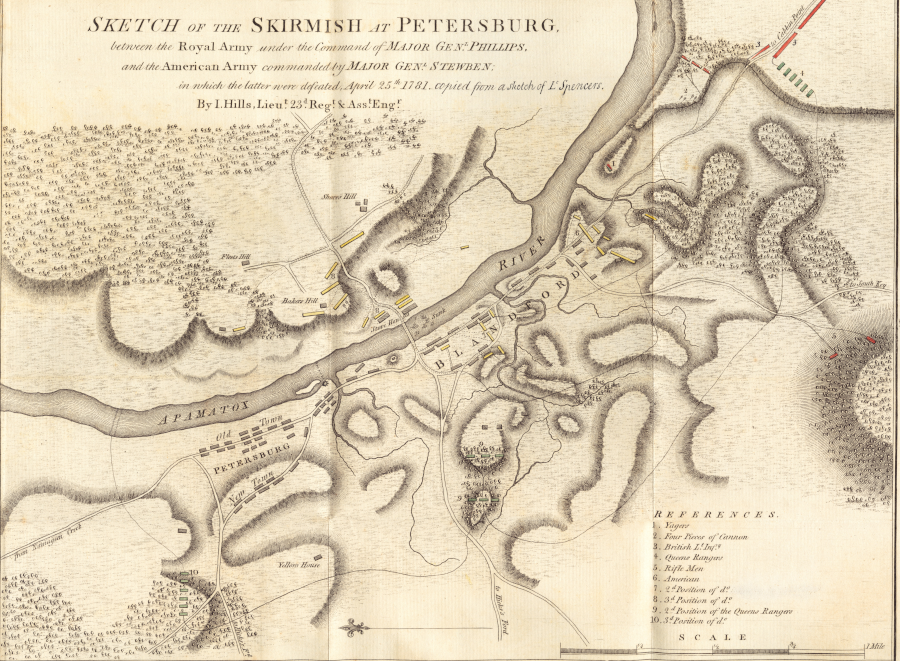
the British captured Petersburg on April 25, 1781
Source: Norman B. Leventhal Map Center at the Boston Public Library, Sketch of the skirmish at Petersburg (by John Simcoe, 1787)
After burning flour mills and supplies in Manchester, the British marched to Bermuda Hundred. They loaded onto ships there, where the river was wide enough to ensure Virginia forces on the shoreline could not block passage back to Portsmouth. However, the troops disembarked and marched back to Petersburg, in hopes of uniting with the army of Lord Cornwallis as it moved north. Petersburg was midway between Portsmouth and Halifax in North Carolina, where Cornwallis was thought to be at the time.
Major John Simcoe and some of his mounted Queens Rangers were sent south to discover the status of Cornwallis's march. They crossed the Meherrin River at Hicks Ford (now Emporia) and found General Cornwallis at the Roanoke River. His forces reached Petersburg on May 24.6
By that time, General William Phillips was dead. He died from disease in Petersburg on May 13, 1781. Cornwallis reached Petersburg on May 20 and never met Phillips personally in Virginia. General Phillips was buried at Blandford Church, in a grave whose specific location can no longer be identified. In 1914, the local chapter of the Daughters of the American Revolution erected a monument honoring the British general.7
Arnold was a bold commander, but fearful of capture. Captain Johann Ewald, in charge of the Hessians serving under Arnold, noted that the general displayed:8
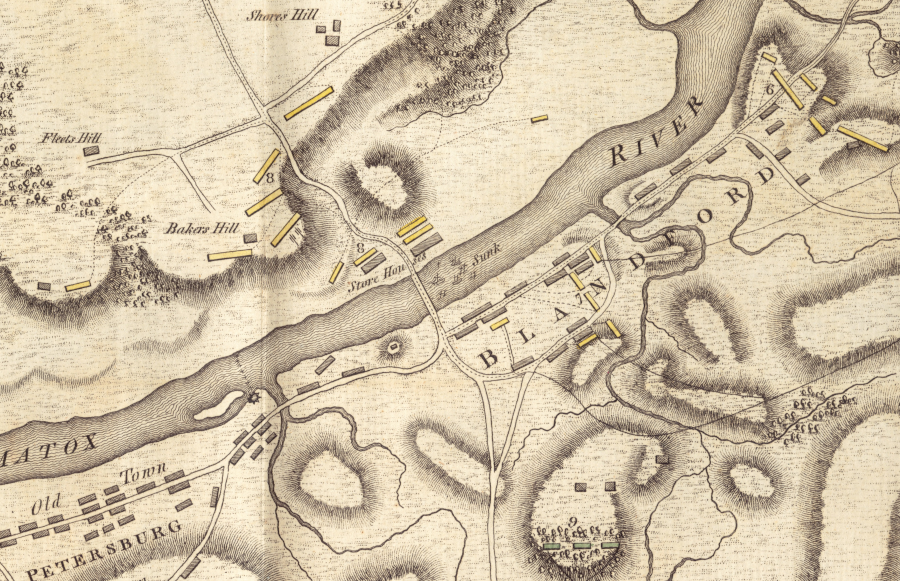
General Friedrich Wilhelm von Steuben placed troops and cannon on the heights north of the bridge across the Appomattox River, to protect the retreat from Petersburg
Source: Norman B. Leventhal Map Center at the Boston Public Library, Sketch of the skirmish at Petersburg (by John Simcoe, 1787)