Collier-Mathew Raid of 1779
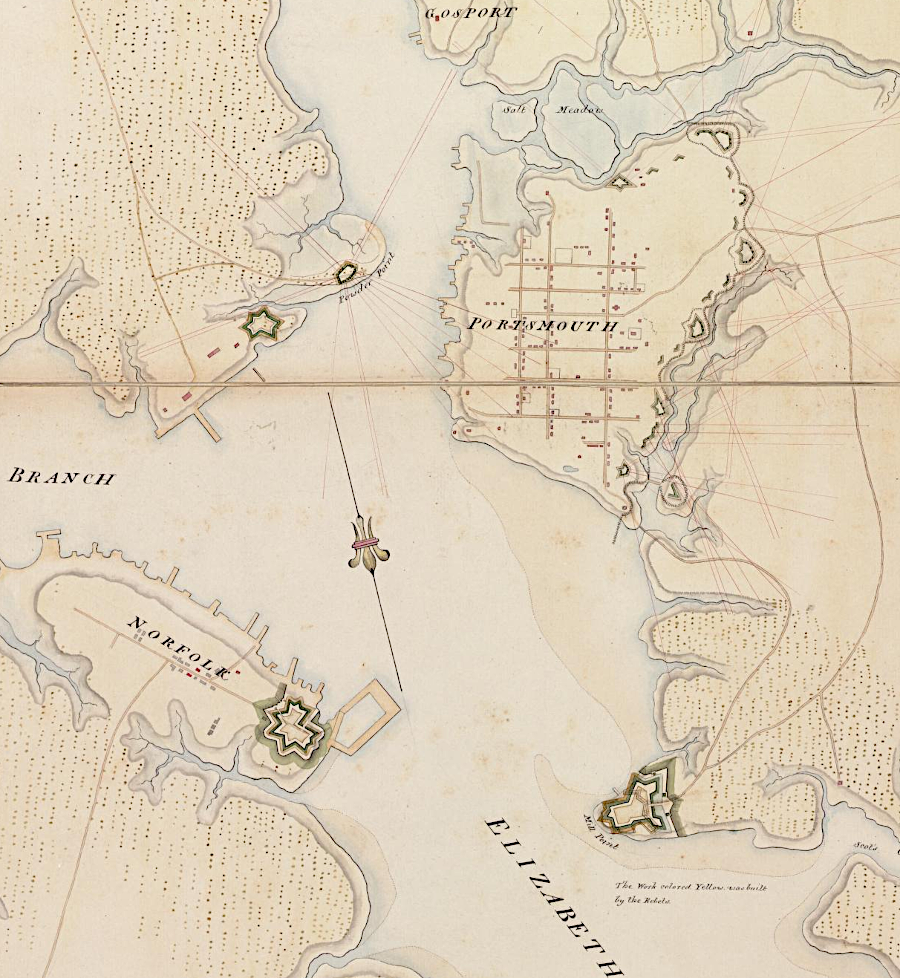
during the Collier-Mathew Raid of 1779, the British captured Fort Nelson without a fight
Source: Library of Congress, A plan of Portsmouth Harbour in the province of Virginia shewing the works erected by the British forces for its defence, 1781 (by James Stratton, 172)
Lord Dunmore and his British troops evacuated Gwynn's Island in June, 1776. In August, 1776, the fleet sailed out of the Chesapeake Bay. For almost three years, Virginia was not invaded by British forces. The British sailed up the Chesapeake Bay in 1777 and landed troops that captured Philadelphia, but ignored Virginia during that expedition.
That changed in May, 1779. General Henry Clinton in New York launched a raid on Virginia to destroy supplies that Virginia was sending to support George Washington's army.
Commodore George Collier led the fleet of six men-of-war and twenty-eight other ships carrying troops. Major Gen. Edward Mathew commanded the 2,000 soldiers loaded on board, including some German mercenaries and American Loyalists.
It took five days for the British to sail from New York City to the Chesapeake Bay. They sailed past unfortified Craney Island and captured Fort Nelson at Portsmouth on May 10, 1779. The 100-man Virginia militia abandoned the fort rather than fight against overwhelming odds. Some of the functional vessels at the Gosport shipyard were destroyed to prevent them from being seized and used by the British.
The British force burned the remaining supplies and ships under construction at the Gosport shipyard. The Virginia militia offered only minimal resistance at Suffolk. The British seized tobacco and burned more military supplies there - including 9,000 barrels of salted pork intended to feed Continental Army troops and 8,000 barrels of pitch, tar, and turpentine needed for sailing ships. Over 250 enslaved workers fled to Collier's ships.
When loyalist privateers burned Suffolk homes against orders of Commodore George Collier, he sought to mitigate the impact. He delivered a shipload of salt for the affected Virginians, demonstrating that in 1779 the rules of war were still being applied.
The Virginia Navy sailed up the James River to shallow water which prevented the British ships from reaching them.
After two weeks, the expedition sailed back to New York City. The raid had accomplished its mission to destroy military supplies. The raiders seized or burned tobacco that could have been carried past the blockade to France, where it might generate credit that could be used to acquire more supplies for the rebels.
Governor Patrick Henry was unable to get the Virginia militia organized in time to challenge General Mathew's troops. The British could have stayed and occupied whatever part of Virginia they desired.
However, those troops were needed back in New York. General Henry Clinton sent 2,000 men with Collier and Mathew just to raid Virginia and destroy supplies. There was no intention to occupy the colony and restore royal rule. After the troops returned to New York, they were sent up the Hudson River to capture Stony Point and Verplanck's Point.1
The Collier-Mathews raid in May 1779 spurred Virginia to raise four more regiments for service within the state. Two regiments were dedicated to the west.2
Despite the easy success of the Collier-Mathew Raid of 1779, it was not until the end of 1780 that the British repeated it. For most of 1780, British troops were sent to capture the Continental Army at Charles Town and conquer South Carolina. The next time the British sent an invading force to Virginia at the end of 1780, it was led by Benedict Arnold.
Links
- Black Loyalist
- Portsmouth, Virginia
References
1. Edward G. Lengel, ed., The Papers of George Washington: Revolutionary War Series, Volume 20, 8 April 31 May 1779, University of Virginia Press, 2010, http://gwpapers.virginia.edu/editions/letterpress/revolutionary-war-series/volume-20-8-april-31-may-1779/; Edwards Park, "Virginia's Very Own Navy," Colonial Williamsburg Journal, Spring 2002, https://www.history.org/foundation/journal/spring02/navy.cfm; "Collier-Mathew Raids," American Revolution Podcast, October 10, 2021, https://blog.amrevpodcast.com/2021/10/arp221-collier-mathew-raids.html; "1779 Campaign," Mount Vernon, https://www.mountvernon.org/library/digitalhistory/digital-encyclopedia/article/1779-campaign (last checked March 10, 2026)
2. Michael Cecere, Great Things Are Expected From the Virginians, Heritage Books, 2008, p.152, https://www.google.com/books/edition/Great_Things_are_Expected_from_the_Virgi/P9DCwAEACAAJ (last checked March 10, 2026)
The Military in Virginia
Virginia Places