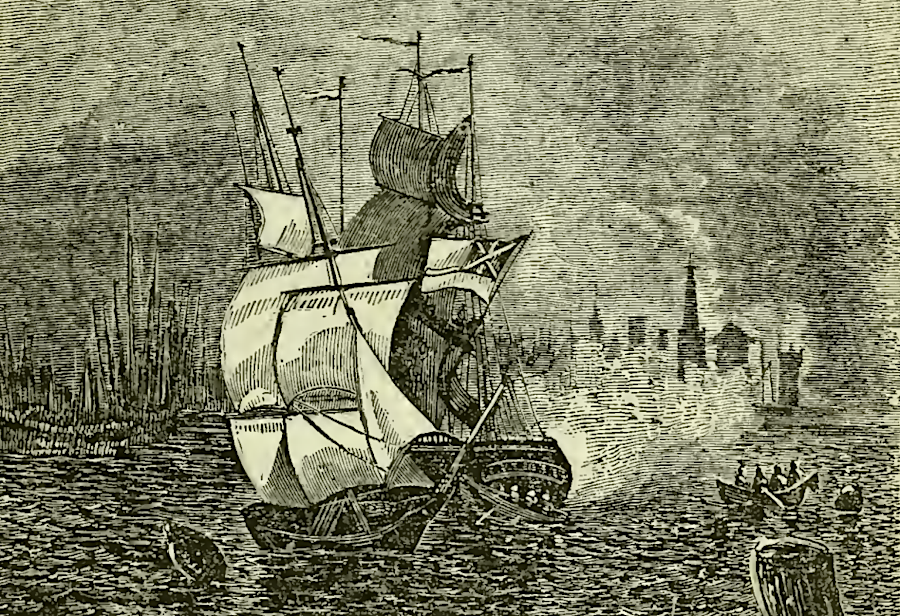
British warships cannonaded and burned part of Norfolk on January 1, 1776 - then rebellious Virginians burned the rest of the city
Source: Mary Tucker Magill, History of Virginia for the Use of Schools (1873, p.179)
British warships cannonaded and burned part of Norfolk on January 1, 1776 - then rebellious Virginians burned the rest of the city
Source: Mary Tucker Magill, History of Virginia for the Use of Schools (1873, p.179)
Governor Dunmore fled Williamsburg in June, 1775 and took refuge on a British warship anchored off Yorktown. Five weeks later, after determining that Virginia forces had the potential to place cannon on the high ridge along the waterfront, the British ships sailed from Yorktown to the Elizabeth River.
Members of the General Assembly and other leaders in the colony gradually assumed responsibility for governing Virginia without a royal governor. Voters chose delegates to Virginia Conventions rather than to the General Assembly.
A Committee of Safety assumed a leadership role comparable to the former Governor's Council, with Edmund Pendleton as chair. The committee made decisions between sessions of the conventions. In fits and starts, while still declaring allegiance to royal authority, the conventions created an army with two regiments.1
By the end of 1775, open warfare had erupted. Hampton was attacked in October by British ships seeking retaliation for the destruction of a tender, the Liberty, which had been stranded in Back Creek.
British officials decided to attack the southern colonies in late 1775, while Boston was surrounded. From a military perspective, regaining control in the south was more feasible because the winter weather was better for fighting. After recovering control in Georgia and the Carolinas, British troops were planning to go north in 1776 to break the siege of Boston.
The Continental Congress meeting in Philadelphia pressed for the Virginians to expel the British forces in Hampton Roads before reinforcements could arrive from England. In October 1775, the Fourth Virginia Convention gave Colonel William Woodford and the Second Virginia Regiment that responsibility.2
Lord Dunmore, reinforced with men from the 14th Regiment in St. Augustine, prepared a defense line at Great Bridge. That was a chokepoint where passage across the South Branch of the Elizabeth River could be blocked. Men from the Ethiopian Regiment, loyalists enlisted in the Queen's Own Loyal Regiment, and British Regulars built Fort Murray and initially kept the Virginia rebels on the southern bank of the river.
After receiving reports that North Carolina forces were coming to Great Bridge with cannon, the British launched a preemptive attack against the fortifications which the Virginians had built on the south bank. In a brief firefight on December 9, the attackers were slaughtered. That evening, Dunmore's forces evacuated Fort Murray. On December 10, all the British forces on land in Norfolk (including those in the Ethiopian Regiment) were ferried to warships in the harbor.
Scottish merchants and other loyalists who had resources/connections also fled, getting aboard private ships that formed a floating town. Those unable to get offshore, plus those who had no strong political preference and a few "patriots," remained in the town. Perhaps half of the 6,250 Norfolk residents managed to squeeze aboard a ship.
Norfolk's town officials met Colonel Woodford on December 11. After Colonel Robert Howe arrived with North Carolina militia, he took charge of the rebel force. Howe was an officer in Continental Army and outranked Woodford.
Almost 1,300 rebels from Virginia and North Carolina occupied Norfolk on December 14. Suspected loyalists were arrested for interrogation in Williamsburg. The soldiers shouted taunts and paraded visibly with hats hoisted on the bayonets, so those on ships saw who was in control on the land. Rifle shots were fired intermittently at the British warships anchored off the waterfront.
Both Howe and Woodford considered it impossible to defend the town. Dunmore had made the same decision. There were many places for an enemy to land troops from ships sailing in the Chesapeake Bay and the Elizabeth River. Too many troops would be required to man the long stretch of fortifications to protect the town.3
For three weeks, there was a standoff between the British forces on the ships and the rebels in the town. Efforts of the British to acquire fresh water and to purchase supplies were blocked. The occupying rebels destroyed the bakeries in Norfolk in an effort to interrupt the food supply. Supplies in the ships holds, plus livestock and other food obtained by aiding parties going into Princess Anne and Norfolk counties, were sufficient from the troops. Civilian refugees struggled to survive on the merchant ships they occupied.
The warships pointed 100 cannon at the waterfront. The potential for a cannonade was high; those ships placed springs on the cables to the anchors. People in the town knew the springs were designed to prevent anchor cables from snapping from the backlash when cannons were fired.
On December 31, Dunmore warned Howe that he was planning to destroy several waterfront warehouses located on the southwest corner of town (near the modern Waterside District) being used by snipers. At 3:00pm on January 1, 1776, cannon started to fire at those buildings. After an hour, Regulars, white loyalists, and members of the Ethiopian Regiment members came ashore to burn the warehouses that had provided shelter to riflemen.
After setting fire to the structures, the men returned to the ships. The cannonade was renewed and continued into the night. The ships fired cannonballs that had not been heated and were not filled with explosives; they were intended to knock buildings down. Some shots were poorly aimed; one cannonball stuck in the brick wall of the Borough Church (now known as St. Paul's) behind the waterfront.
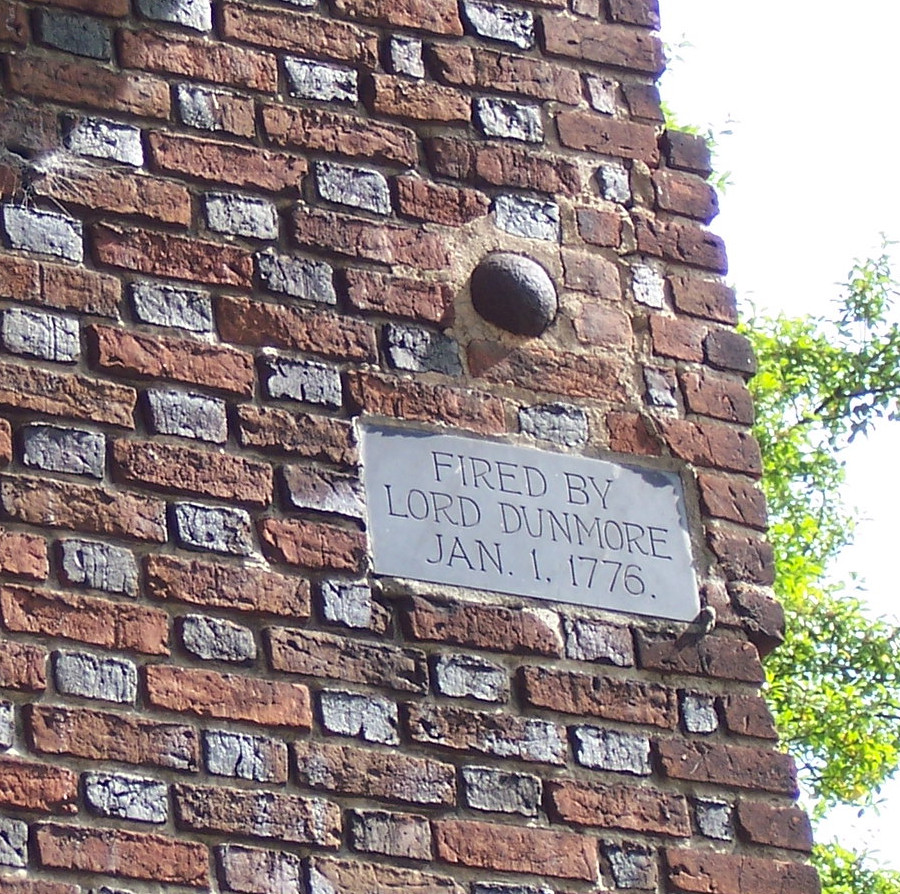
a cannonball was re-installed in the church wall, allocating blame to Lord Dunmore
Source: lori05871, Flikr
A later survey, completed by the Virginia General Assembly in September 1777, determined that the British destroyed 19 buildings on January 1. A breeze blew south that day, carrying embers towards the water and the British ships rather than back into town north of the waterfront>
The Virginia and North Carolina troops did far more damage that day. They were ordered to set fire to the rest of buildings on waterfront, because Howe and Woodford were determined to destroy the town.
There was no Virginia Navy, and the Continental Congress had no ships ready to establish a base at Norfolk. Since only the British could take advantage of the port, Howe and Woodford chose to destroy the town completely in order eliminate its potential use as a British base. The fires initially set by Dunmore gave them the opportunity to burn all of Norfolk and blame it on the British.
When local residents tried to stop the Virginia and North Carolina troops from burning their private houses and businesses, the response was that the troops had been ordered to "keep up the jig." Looting was common and the rebels made no effort to extinguish any fires, which raged for three more days. Woodford estimated on January 4 that 90% of the buildings in town had been burned, but a large number still remained intact away from the waterfront.
Source: WAVY, History Through the Lens | Burning of Norfolk 1776
On January 4 the rebels burned the buildings at Gosport. Andrew Sprowle and his new wife watched from a ship as their wealth went up in smoke. On January 8, the windmills and other structures at Tucker's Mill Point were burned in order to stop anyone from baking bread there for Dunmore's fleet.
On January 21, the British landed at Town Point in order to snatch some supplies. They burned three more structures that day, and overall were responsible for the destruction of 54 buildings in Norfolk. Of that total, 32 had been destroyed before January 1.
On January 15, those responsible for the evolving independent government ordered the troops to withdraw to Great Bridge. Colonel Howe directed his troops on February 5 to destroy all remaining structures. After the January 1 fires, an additional 863 more structures were burned. On February 6, rebels torched the last 416 buildings. Even outhouses were destroyed.
The Fourth Virginia Convention concurred with the decision of Howe and Woodford to obliterate Norfolk. The Committee of Safety recognized the impact that would cause, but had little sympathy for residents of the town or of Princess Anne and Norfolk counties. Many of those residents had promised in November 1775 to support Governor Dunmore, so disrupting a nest of loyalists and allies of Dunmore would be good public policy.
Thomas Jefferson even quoted the ancient Roman demand by Cato the Elder to utterly demolish the rival city of Carthage. At the bottom of an October 31, 1775, letter written while attending the Continental Congress in Philadelphia, Jefferson put in capital letters "DELENDA EST NORFOLK" (Norfolk Must Be Destroyed).
In August 1774, Thomas Jefferson had objected in "A Summary View of the Rights of British America" to the closure of the port of Boston after the destruction of tea there in December 1773. He argued that collective punishment of all the residents, rather than targeting those who had tossed tea into the harbor, was not justice. By January 1776, however, Virginia's rebelling leaders were willing to destroy every building in Norfolk, the colony's largest town. Norfolk residents who supported the rebellion suffered a total loss, just like the loyalists.
The men seizing control from Governor Dunmore were tobacco planters who depended upon an agricultural economy based on unpaid enslaved labor; 75% of Virginia's exports were hogsheads loaded with 100 million pounds of tobacco each year. The cosmopolitan benefits of Norfolk, dominated by Scottish merchants, was not appreciated. Key planters were deeply in debt to companies in Glasgow and England. Economic tensions translated into ethnic resentment against the Scots.
Colonial leaders were willing to destroy a cosmopolitan port dominated by Scottish merchants trading with Britain in part because so many of the residents were loyalists, and in part because the economy and culture was inconsistent with the rural character of the rest of Virginia. In Maryland, the Carolinas, and Georgia, the wealthy elite lived in coastal towns. In Virginia, those leaders lived on isolated plantations scattered across the Coastal Plain and Piedmont. They gathered only intermittently in the second-largest town, Williamsburg, where half of the 2,000 white residents were enslaved.4
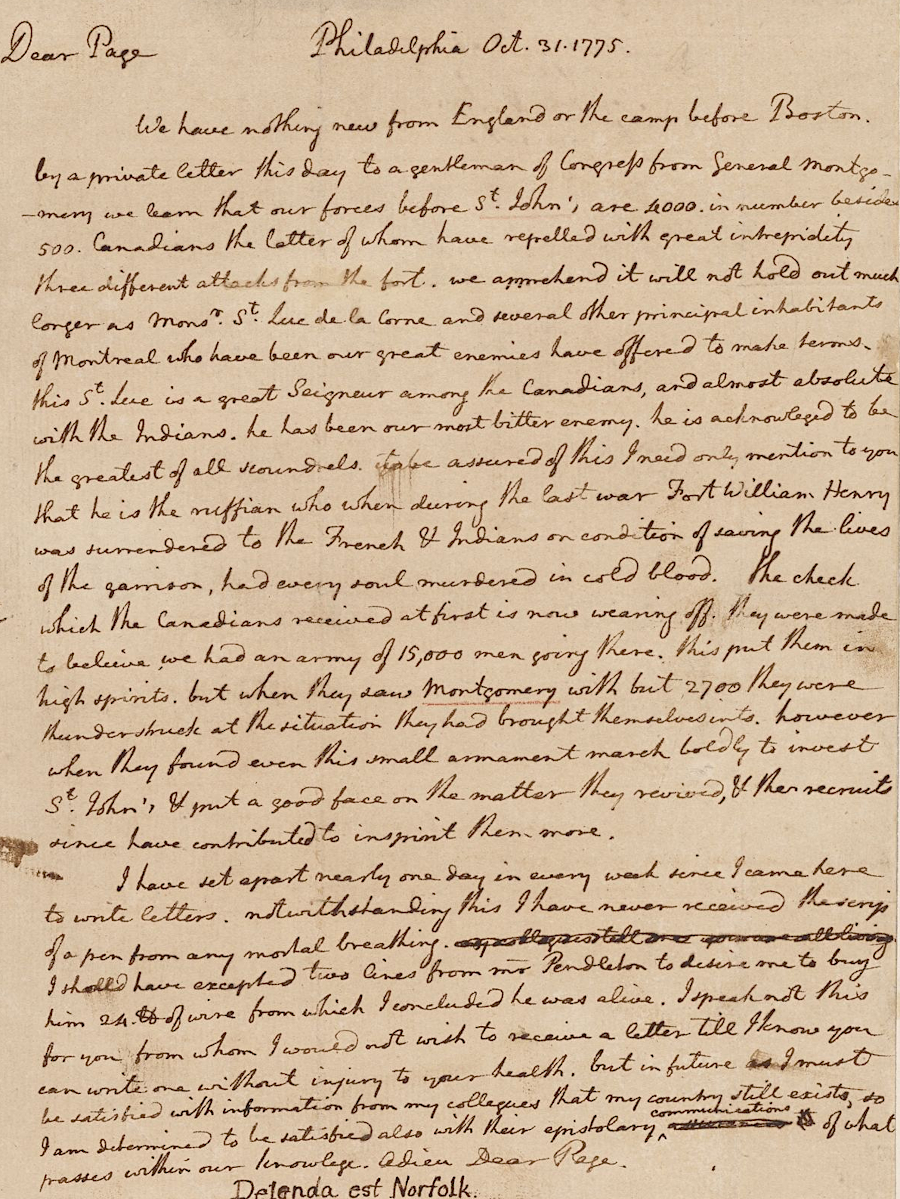
two months before the burning of Norfolk started, Thomas Jefferson called for the total destruction of the town
Source: New York Public Library, https://digitalcollections.nypl.org/items/77b31010-2e5b-0133-dbec-58d385a7b928
A major concern of Virginia's leaders in 1775 was that Dunmore's Proclamation would spur a colony-wide slave uprising. If he was able to establish a permanent base in Hampton Roads, he could be resupplied by the Royal Navy. Though most new British troops might be sent across the Atlantic Ocean to Boston, his Ethiopian Regiment could grow and become an effective fighting force.
Lord Dunmore had "raised the royal standard" in his proclamation and was recruiting white loyalists at Norfolk. If enough joined the Queen's Own Loyal Regiment, his military capacity could become unstoppable.
Virginians feared that enslaved population would lose fear of whites if Dunmore demonstrated they could flee and become free without reprisal. A successful march of armed black men up the Peninsula from Hampton to capture Williamsburg could spur the 40% of Virginia's population that were enslaved to seek their own freedom.
Even the threat of slave uprisings would cause men needed for the two Virginia Regiments to stay at home to protect their families and property. If enslaved workers managed to seize some plantations, wealthy planters would be tempted to negotiate peace with the British rather than support a rebellion.
George Washington saw the danger clearly, and considered the British base at Norfolk to be an existential threat. He also recognized that Governor Dunmore had sent John Connolly to encourage the Shawnee, Delaware, Mingos, and other Native American groups living on the western edge of Virginia to attack down the Potomac River valley. An invasion from the west, together with Lord Dunmore's force in the east, could force Virginia to surrender before Washington could capture Boston.
Washington ended up reversing his initial policy to expel blacks from the Continental Army. He needed as many soldiers as he could recruit. By the time George Washington wrote from Massachusetts on December 15, 1775, Connolly was in a Philadelphia jail but Lord Dunmore was still gathering strength:5
Propaganda declaring the Lord Dunmore was responsible for the burning of Norfolk was quickly circulated by the Virginians. That version of the story reached London before official reports from British officials arrived. King George III had already declared the colonies to be in rebellion, but members of Parliament were stunned that the leading city in Virginia had been flattened and 6,000 civilians forced to flee as part of a military response.
Burning Norfolk appeared to be part of British war policy. Warships in Boston harbor had already torched Charlestown intentionally during the battle at Bunker Hill on June 17, 1775. After Martha Washington arrived to spend the winter of 1775-1776 with her husband, she reported "Charlestown has only a few chimneys standing in it."
On October 18, warships had shelled Falmouth (now Portland), Maine. Sailors came ashore and intentionally burned nearly all the public buildings and 2/3 of the private houses in the town. What George Wahington called "an Outrage exceeding in Barbarity & Cruelty every hostile Act practised among civilized Nations" made clear to wavering colonists that they needed to fight in order to protect their property.6
Politicians on both sides recognized that colonists would be angered by the dramatic elimination of all the structures needed by 6,500 people in Norfolk. Virginians spread their misrepresentation of the event quickly, knowing that blaming Lord Dunmore for burning Norfolk to the ground would radicalize opinion towards a complete break with royal government and mobilize support for military resistance. Town destruction united colonists to resist, rather than intimidated them into surrender.
The news of the burning of the Borough of Norfolk spread across the colonies at the same time that Common Sense was published, enhancing the political shift towards declaring independence rather than seeking reconciliation. It took another six months to get a consensus at the Continental Congress. In the list of 27 grievances finally included in the Declaration of Independence, Thomas Jefferson claimed King George III had "burnt our towns."

Thomas Jefferson, when drafting the Declaration of Independence in Philadelphia, may have believed initial reports that the British were responsible for torching Norfolk
Source: National Archives, Declaration of Independence (William J. Stone engraving)
The General Assembly researched the actual events after citizens sought compensation for the burning of their houses by Virginia and North Carolina forces. The reports from three commissions to evaluate losses in Norfolk, in Portsmouth, Suffolk, Great Bridge and Norfolk County. The first commission, appointed in May 1777:7
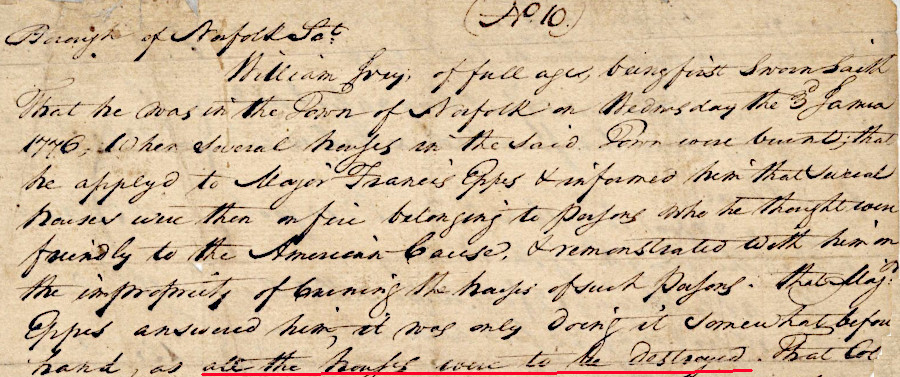
William Ivey's deposition in 1777 recorded instructions that "all the houses were to be destroyed," even those of patriots
Source: Library of Virginia, Norfolk Burning
The report of the high percentage of damage done by Virginia and North Carolina troops was suppressed by the state government for 60 years. It became standard history that the British were fully responsible for the "single biggest war crime of the American Revolution." When St,. Paul's Church was rebuilt, a cannonball was inserted into the new brick wall with a plaque underneath saying "Fired by Lord Dunmore, Jan. 1, 1776" to perpetuate the widely-accepted myth.8
After the remaining houses were burned in early February, perhaps 3,000 loyalists with whatever possessions they had saved were crowded onto 200 ships floating off ruins of Norfolk, Gosport, and Portsmouth. A British officer called it a “floating town.” The mixture of people, black and white, was the largest population center in Virginia and "a place of remarkable intercultural engagement."
After the Virginia and North Carolina troops withdrew to Great Bridge and their supporters in the now-displaced local population moved to Portsmouth and Suffolk, it was easier for the British anmd loyalists to get water. However, little food was available. The justification for remaining in the Elizabeth River was thin.9
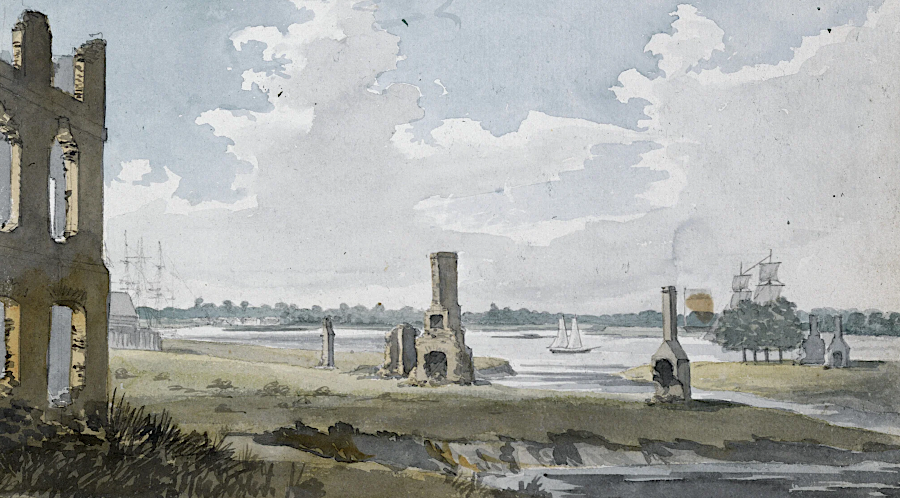
burned ruins at Norfolk were still visible 20 years later
Source: Maryland Center for History and Culture, View of Part of the Ruins of Norfolk (by Pierre Benjamin Henry Latrobe, ca. 1796-1798)