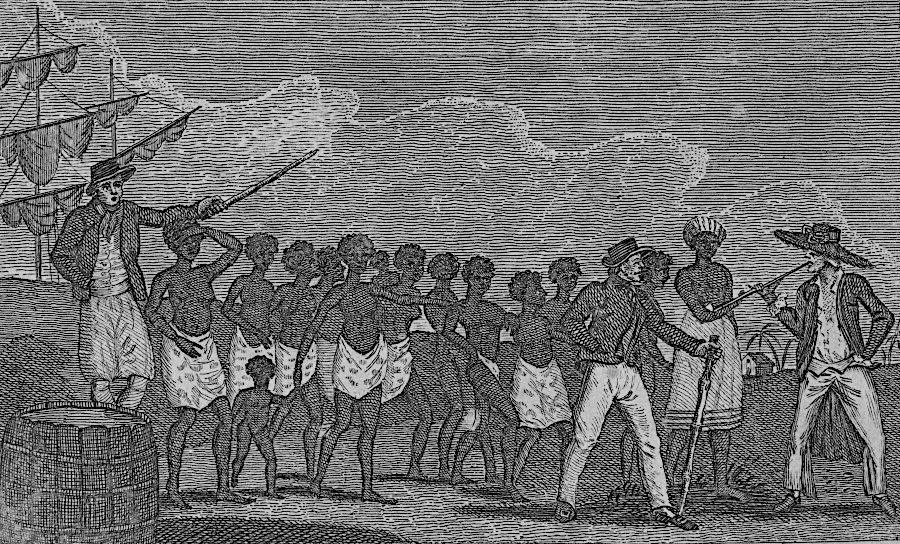
landowners purchased slaves imported from Africa primarily in the 1600's
Source: Schomburg Center, New York Public Library, Negroes just landed from a Slave Ship
landowners purchased slaves imported from Africa primarily in the 1600's
Source: Schomburg Center, New York Public Library, Negroes just landed from a Slave Ship
The English did not immediately enslave the Native Americans when they arrived at Jamestown, nor did they bring slaves from Africa in the first years. Various forms of slavery were familiar to the English and other Europeans, as well as to Africans and Native Americans, but in the 1600's nearly all labor in England was provided by workers with significantly greater levels of freedom compared to chattel slavery.
The Portuguese were the first European country to sail south and explore the African coast, and ultimately to get around the Cape of Good Hope and travel by water to India. Portuguese ship captains had been importing slaves from Africa for over a century.
The Spanish enslaved the Indians in Central and South America to work the mines and to grow crops, but needed even more workers. For almost a century, Caribbean islands and New Spain had provided a reliable market for someone willing to acquire a cargo of human beings in Africa and sail across the Atlantic Ocean.
The British developed their concepts of chattel slavery first on Barbados, to raise sugar with unpaid labor. Around 1660, there were 20,000 enslaved people in Barbados and 1,000 in Virginia.
White landowners who acquired large parcels in South Carolina brought that approach to the North American continent, and Virginia landowners adapted it to tobacco-based agriculture. One scholar assessed the historical dispute over the development of race-base slavery in North America, and reached his particular conclusion:1
John Smith had been a slave himself, after being captured by the Turks. He claimed that a beautiful woman helped him escape, a story that matched his later tale of rescue by Pocahontas. He and the earliest settlers at Jamestown traded with the Native Americans for food, but did not seek to create an enslaved labor force until the discovery that tobacco would be a profitable export.2
Agricultural operations required importing a labor force or enslaving the existing residents. As the English colonists developed an economy based on tobacco after 1614, Opechancanough became the paramount chief with control over Native Americans in Tsenacommacah. He and the weroance/weroansqua leaders of individual towns were unable to block expansion of the English farming operations, but did avoid large-scale enslavement.
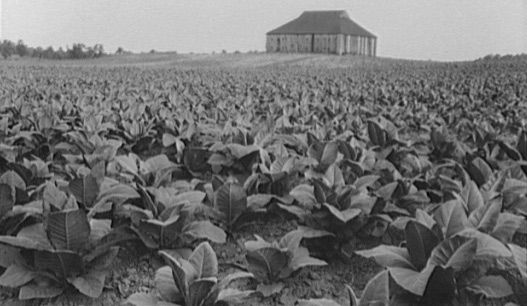
slavery was developed in Virginia so planters could acquire a cheap labor force to grow tobacco
Source: Library of Congress, Tyler, His Family and His Allegiance to the South
The Virginia Company sought to encourage emigration on indentured servants from England to Virginia. The company's greatest asset, land, was offered as the incentive. The wealthy who were willing to arrange groups of people willing to travel across the Atlantic Ocean were offered acreage and the right to create a "particular plantation." Individuals willing to travel to America saw potential in becoming landowners there without having to rely upon inherited wealth, an option not available to most people in England.
Dependence upon indentured servants to grow tobacco for export continued after the conversion of Virginia to a royal colony in 1624, up to Bacon's Rebellion in 1676. Political shifts and even new government during the English Civil War did not alter the fundamental economics in Virginia. Staple agriculture required a large workforce to clear land, plant/harvest crops, and pack/transport the tobacco to wharves on the river. The less the farm workers were paid, the greater the wealth accumulation for the landowners.
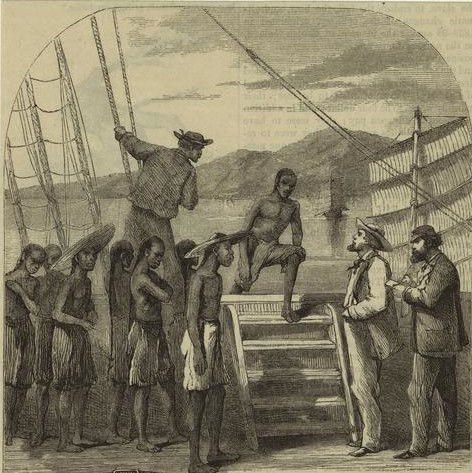
an unpaid labor force, imported from Africa, replaced indentured servants migrating from England
Source: Schomburg Center, New York Public Library, Coolies Embarking
Chattel slavery offered the lowest-cost labor force, but the Virginia Company never intended for the colony to rely upon it. The first enslaved people were introduced to Virginia initially by accident. The General Assembly then created a legal system to authorize chattel slavery through conscious modification of laws in the mid-1600's. For years a Dutch ship was credited with bringing the first slaves to Virginia in 1619 or 1620. Latest scholarship indicates that two English pirate ships intercepted a Portuguese ship in the Gulf of Mexico, then transported slaves to Jamestown. The Portuguese ship had acquired a cargo of slaves in Angola, and was planning to sell them to Spanish settlers in Mexico.
In 1619, the English colony in Virginia was too small and too poor to justify sailing to it as a destination. Ship captains did not expect the settlers there to have sufficient gold or silver to buy slaves.
The first documentation of the arrival of enslaved people starts with the Portuguese ship Sao Joao Bautista loading a cargo of 350 people off the coast of Angola. His intended destination was Vera Cruz, but near there he was intercepted by two pirates. The English captain of the two ships claimed to be privateers, authorized to seize Spanish and Portuguese vessels under letters of marque.
At the time, Phillip III of Spain ruled Portugal, under the Iberian Union which lasted from 1580-1640. The letters of marque had been issued by two European leaders at war with Spain, the Dutch Prince of Orange and the Duke of Savoy (a small territory near modern Switzerland). Because periods of war and peace changed intermittently, the two ship captains were at risk of losing the legal right to attack Spanish and Portuguese ships if those two leaders chose to make peace with Phillip III. Technically, they would become pirates rather than authorized privateers during times of peace, so long as the captains were aware of a peace agreement.
The White Lion and the Treasurer had sailed from a Dutch port in 1619. That summer they captured the Sao Joao Bautista and seized 50 men and women, perhaps all the two ships had room to transport. The Africans were Bantu-speaking people known as Ndongans. They were already experienced in growing tobacco and corn in Africa.
The pirates/privateers immediately sailed to Point Comfort. Virginia was a familiar destination for the Treasurer. Deputy governor Samuel Argall was a part owner, and the Treasurer had transported Pocahontas to England in 1616.
John Rolfe reported to the Virginia Company later that the White Lion arrived first, near the end of August, with about half of the people stolen from the Portuguese ship. The ship captain needed to make a sale in Virginia; taking his stolen cargo to a Spanish settlement was not an easy alternative, and there was no market for a shipload of Africans in England.
The Virginia Company needed more workers in its colony. The company's new management team in London had altered the terms of settlement in 1618, issuing a "Great Charter" to attract more immigrants from England. As part of the new policies, Virginia's first General Assembly had been held earlier that summer.
The arrival of the White Lion loaded with non-English workers was unexpected. Ultimately Governor George Yeardley and Cape Merchant Abraham Peirsey (essentially the quartermaster for the colony) traded supplies for the Angolans. The Treasurer arrived a few days later, but found it harder to sell its half of the stolen cargo. The letter of marque issued by the Duke of Savoy was not valid because he had made peace with Phillip III, so the Treasurer could be defined as a pirate. Any English colonist trading with a pirate could end up in legal difficulty.
The White Lion unloaded 28-30 people, which John Rolfe reported as "20 and odd" people. The Treasurer unloaded only 2-3 before sailing away to Bermuda. The acting governor on the island there was less concerned about the status of the letter of marque and purchased the remainder of the cargo. Apparently all 32 Africans documented in a March 1620 census of the colony's population arrived on the two ships.3
The status of the first Angolans is confusing. Their skin color clearly made them different, but the Virginia colony lacked a legal framework for slavery until 40 years after the 1619 delivery.
The great increase in the slave population did not start until 1700. Tobacco was a labor-intensive crop. Each slave or indentured servant working on a tobacco plantation may have processed 10,000 plants a year. That would require bending over 10,000 times to plant seeds, 10,000 times to dig seedlings from the early planting bed, 10,000 times to plant seedlings in a field...
Transportation of enslaved people across the Atlantic Ocean became the "Middle Passage" leg in a triangular trade between Africa, colonies in the Western Hemisphere, and Europe. Enslave people were sold in the colonies, and ships were reloaded with raw materials such as sugar and tobacco. The raw materials were carried to Europe, where the ships were loaded with manufactured goods. Those were shipped to Africa and sold in exchange for another cargo of people to be carried west across the ocean.
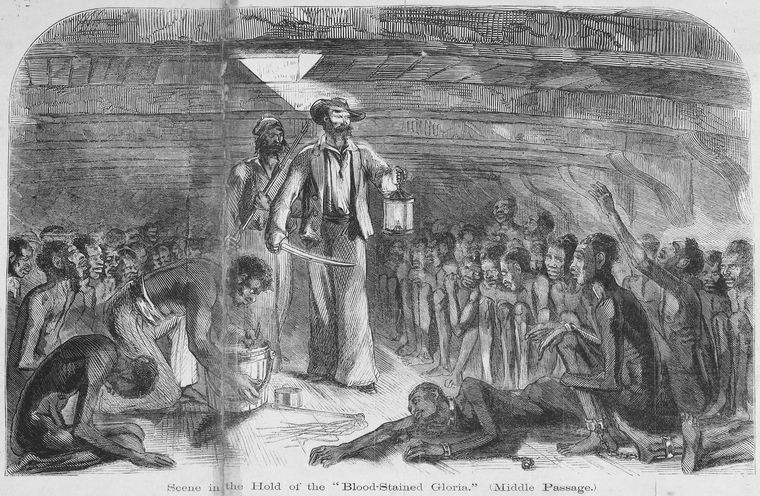
sailors maintained order with threats and actual violence during the Middle Passage
Source: Schomburg Center, New York Public Library, Scene in the hold of the "blood-stained Gloria" (Middle passage)
As plantation agriculture spread up the Potomac River, the demand for field workers exceeded the supply of people in the colonies and England willing to do such work. The economic solution was to obtain laborers from another source - slaves from Africa, imported through the Caribbean islands as well as directly from that continent. In the 1660's, the demand for labor in Virginia exceeded the supply of indentured servants from England after the end of the civil war there.
The Virginia colony revised its laws in that decade to establish that blacks could be kept in slavery permanently, generation after generation. An influx of slaves was spurred at the same time by a drop in the value of sugar grown on Caribbean islands, causing the planters there to sell their "property" to the tobacco farmers in Virginia.4
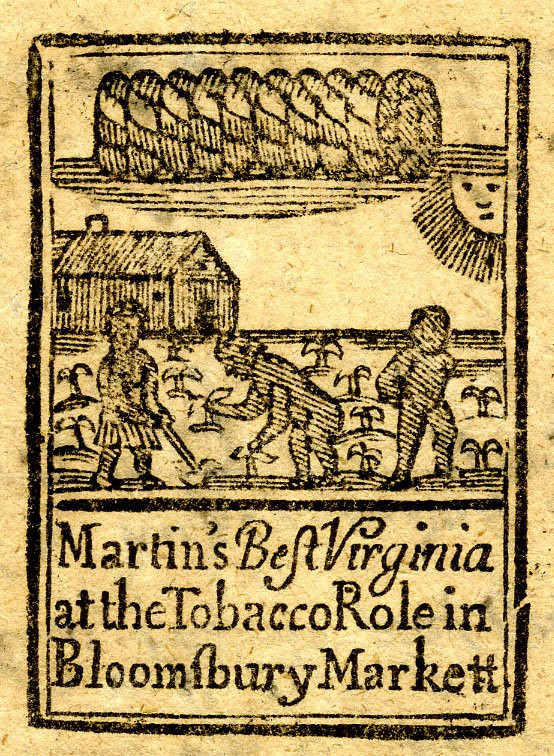
children of enslaved mothers were kept in slavery and forced to work without pay for their entire lives
Source: British Museum, tobacco paper with advertisement for Martin's Best Virginia
There is a continuing debate regarding whether racism against blacks preceded the adoption of a legal system supporting lifetime slavery in Virginia, or whether the practice of slavery triggered the colonists' racist attitudes. Blacks were not automatically slaves in the early colonial days. Some held property, married, and raised families outside the institution of slavery.
In the 1660's, however, the government of the colony (not the officials in London...) established the legal framework for perpetual servitude based on color:5
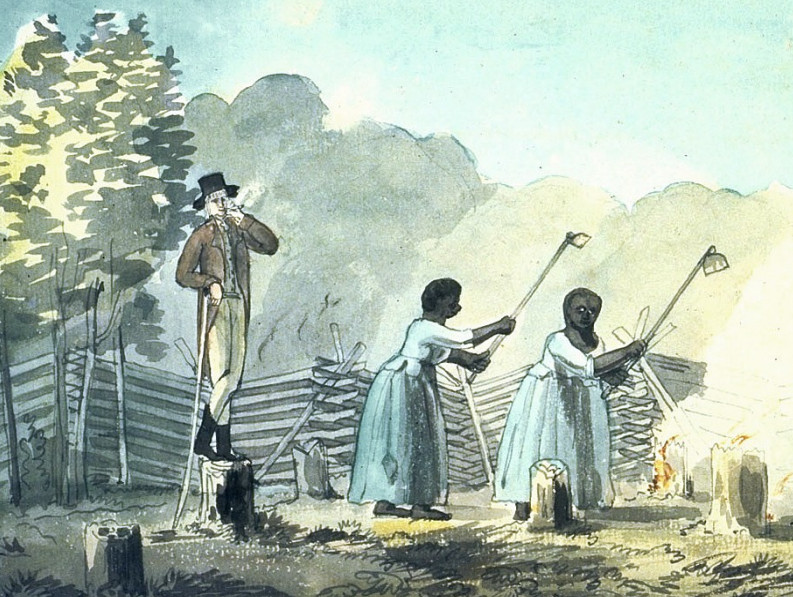
enslaved women were valued for their ability to work, and to produce more children who would be enslaved
Source: Revolution Francaise.net, An Overseer Doing his Duty (by Benjamin Henry Latrobe, 1798)
Until Bacon's Rebellion in 1676, most people brought to Virginia to provide slave labor were imported from the Caribbean islands rather than shipped directly from Africa. According to the acting governor in Virginia in 1680:6
Bacon's Rebellion in 1676 showed the risk to the colonial elite maintaining their status and control of the government, if the population of indentured servants and poor landless farmers kept increasing. The solution was to import more Africans and divide the poor based on skin color. Whites, no matter how small their accumulated wealth, were granted social status and economic opportunities that were denied to black people. Even the small percentage of black people who were not trapped in the status of chattel slavery faced discrimination greater than poor whites. The racial divide was sufficient to prevent an uprising in which poor whites would join poor blacks against the gentry.7
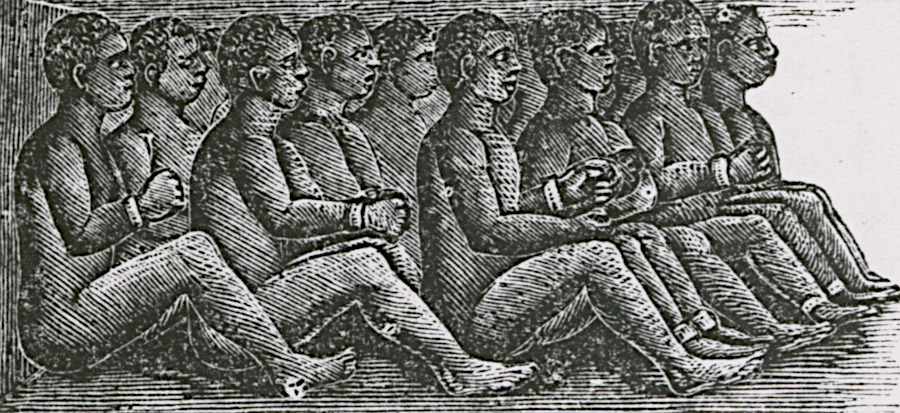
after Bacon's Rebellion people were shipped as cargo from Africa to Virginia, in conditions that were unhealthy and inhumane
Source: Schomburg Center, New York Public Library, View of chained African slaves in cargo hold of slave ship, measuring three feet and three inches high
By the beginning of the 1700's, direct importation from Africa was predominant. Around 1730 the existing enslaved population produced enough children to meet the demand of slaveowners. About 100,000 enslaved Africans were brought to Virginia and Maryland before the slave trade as banned in 1808.8
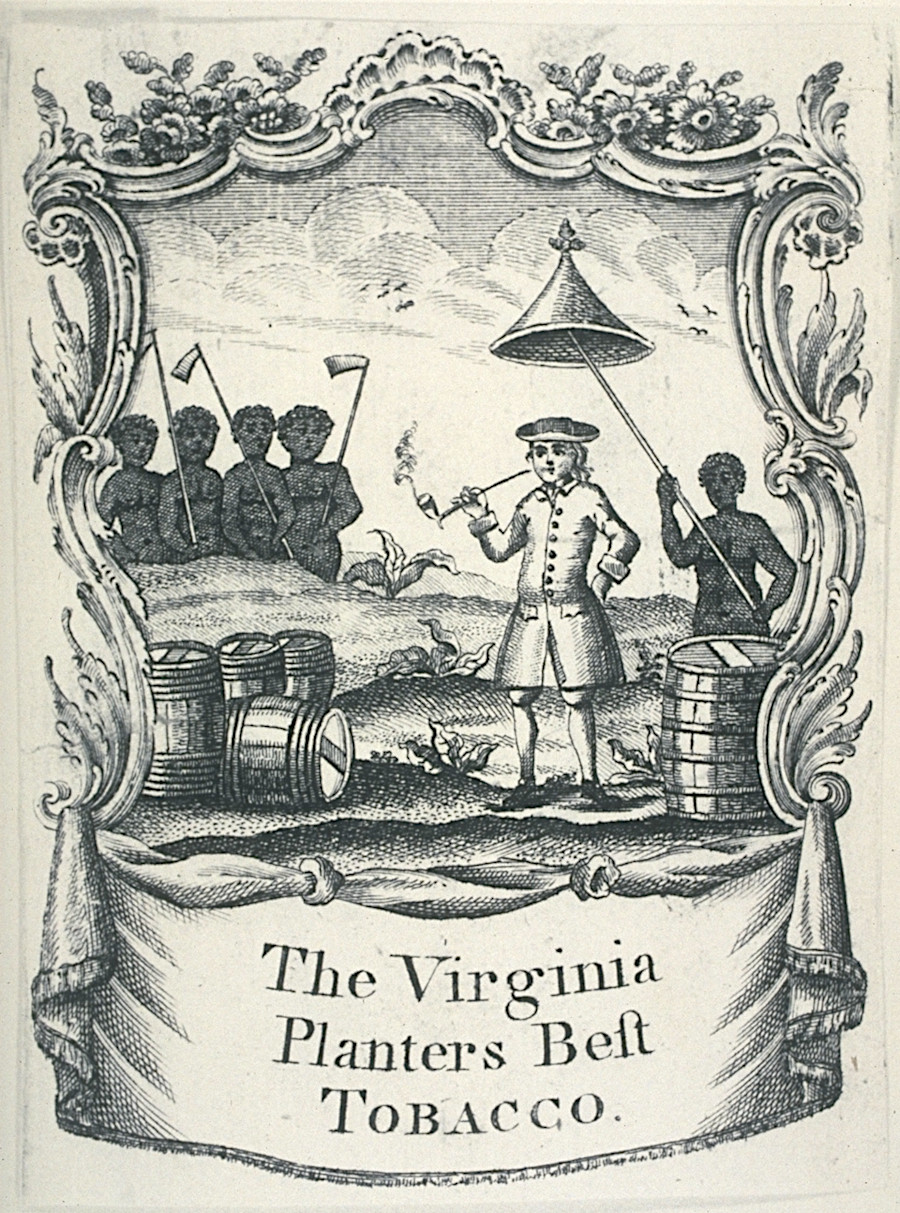
unpaid enslaved workers on forced labor camps (plantations) created wealth for the gentry
Source: Slavery Images: A Visual Record of the African Slave Trade and Slave Life in the Early African Diaspora, Tobacco Production, Virginia, 18th cent.
A 1772 legal decision in England officially blocked the export of anyone from England as a slave, an 1807 act of Parliament blocked English participation in the slave trade from Africa, and all slaves still held in bondage in England were finally freed in 1828.9
The slave trade lasted almost 200 years. During the 1787 Constitutional Convention in Philadelphia, a Federal ban on the slave trade was authorized starting in 1808. That allowed an additional two decades for competition from African and Caribbean imports to keep the price of enslaved people low. A ban was recognized as a mechanism to increase the value of children born in the United States to enslaved mothers, which slaveowners could sell as a "product" from their farms.
The importation of slaves was officially prohibited in 1808 by Article I, Section 9 of the US Constitution:10
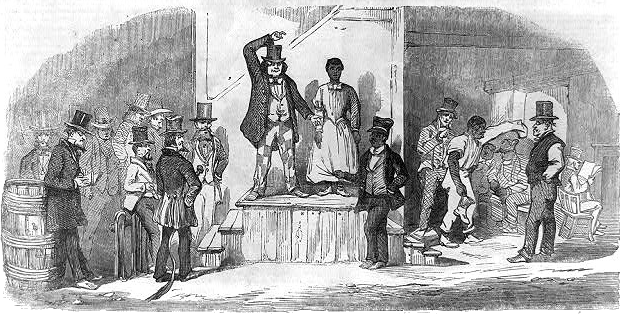
Virginia was a center of the slave trade after the import of slaves was banned in 1808, and shipped Virginia-born slaves to fast-growing states along the Gulf Coast
Source: Library of Congress, Slave Auction
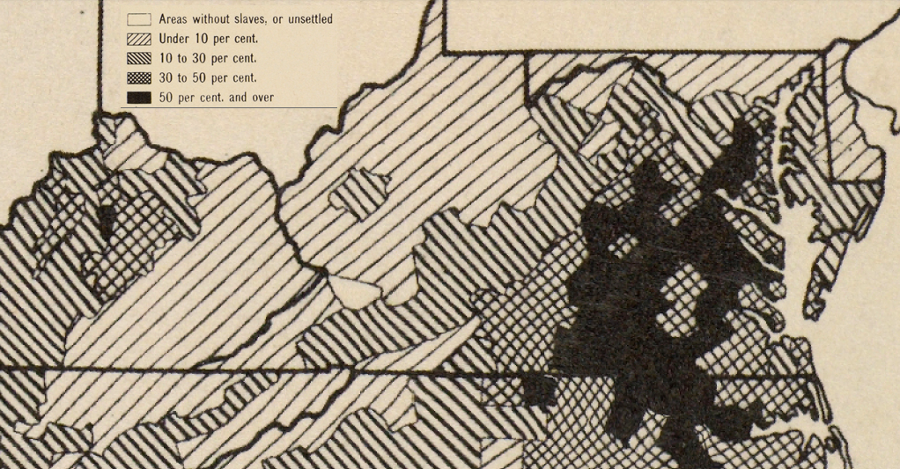
by 1860, slaves were the majority of the population in a substantial portion of Tidewater and Piedmont Virginia
Source: Atlas of the Historical Geography of the United States, Slaves, 1860 (Plate 68b), digitized by University of Richmond