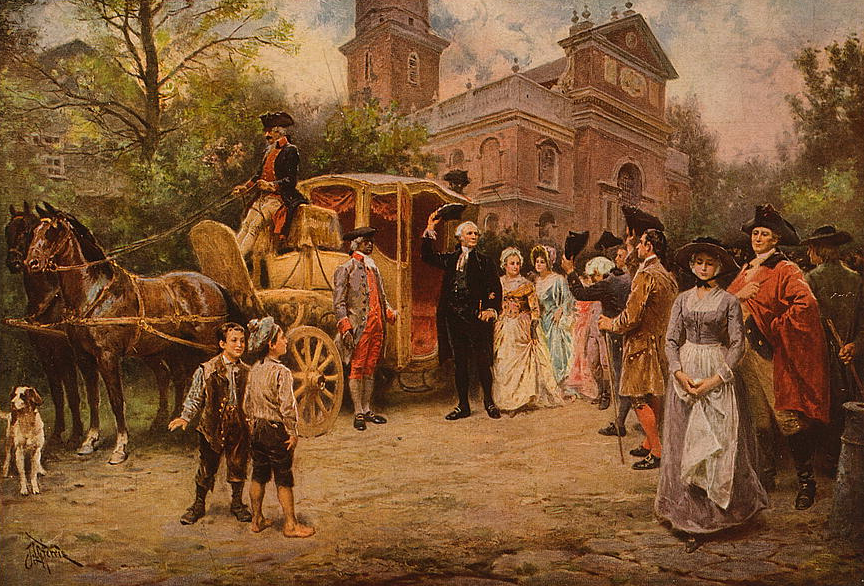
George Washington kept a pew at Christ Church in Alexandria
Source: Library of Congress, General Washington at Christ Church, Easter Sunday, 1795 (by Jean Leon Gerome Ferris, 1908)
George Washington kept a pew at Christ Church in Alexandria
Source: Library of Congress, General Washington at Christ Church, Easter Sunday, 1795 (by Jean Leon Gerome Ferris, 1908)
George Washington grew up in a colony in which the Anglican church was "established," an official part of the government. Salaries of ministers were funded by local taxes, and the vestry of the church was responsible for social services such as caring for orphans.
The Mount Vernon plantation was so large that its land was within the boundaries of both the Fairfax Parish (centered in the town of Alexandria) and the Truro Parish (in Fairfax County). As a wealthy member of the local elite, Washington served on the vestry of both parishes. He helped fund the construction of Pohick Church near Lorton and Christ Church in Alexandria by "buying" pews..1
As an individual, Washington gives us little in his writings to indicate his personal religious beliefs. The letters that Martha Washington burned may have included such insights, but today we have to discern his personality primarily through his actions and official papers.
Though Washington attended many church services, especially when serving as the commander of the Continental Army, he commented on sermons only twice. In his writings, he never referred to "Jesus Christ." He did not take communion - though Martha did, requiring the family carriage to return back to the church to get her later.2
Clear evidence of his personal theology is lacking, even on his deathbed when he died a "death of civility" without expressions of Christian hope. His failure to document beliefs in conventional dogma, such as a life after death, is a clue that he may not qualify as a conventional Christian. Instead, Washington may be closer to a "warm deist" than a standard Anglican in colonial Virginia.
He was complimentary to all groups and attended Quaker, German Reformed, and Roman Catholic services. In a world where religious differences often led to war, Washington was quite conscious of religious prejudice. However, he joked about it rather than exacerbated it. Washington once noted that he was unlikely to be affected by the German Reformed service he attended, because he did not understand a word of what was spoken.
Washington was an inclusive, "big tent" political leader seeking support from the large numbers of Anglicans, Baptists, Presbyterians, and Quakers in Virginia, and even more groups on a national level. He did not enhance his standing in some areas by advocating support for a particular theology or form of worship, and certainly did not campaign on "wedge issues" based on religious differences.
Instead, in late 1775, Washington banned the Protestant celebration of the Pope's Day (a traditional mocking of the Catholic leader) by the Continental Army. He deplored the sectarian strife in Ireland, and in 1785 wished the debate over Patrick Henry's General Assessment bill would "die an easy death." 3
When trying to arrange for workmen in 1784 at Mount Vernon, Washington made clear that he would accept "Mohometans, Jews or Christians of any Sect, or they may be Atheists." Washington wrote Lafayette in 1787:4
Washington was not anti-religion. Washington was not uninterested in religion. He was a military commander who struggled to motivate raw troops in the French and Indian War. He recognized that recruiting the militia in the western part of Virginia required accommodating the Scotch-Irish Presbyterians, Baptists, and Dutch Reformed members in officially-Anglican Virginia. He knew that he would receive more support if he avoided discriminating against specific religious beliefs.
He was aware that religious beliefs were a fundamental part of the lives of his peers and of his soldiers. He knew that a moral basis for the American Revolution and the creation of a new society would motivate the rebelling colonists and then new American citizens to support his initiatives.
In the Revolutionary War, Washington supported troops selecting their own chaplains (such as the Universalist John Murray) while trying to avoid the development of factions within the army. Only 10% of the chaplains serving Continental Army regiments were Anglican, the Protestant faith in which Washington grew up.5
Religion offered Revolutionary War leaders moral leverage to instill discipline, reduce theft, deter desertion, and minimize other rambunctious behaviors that upset local residents. It was logical for Washington to invoke the name of the Divine, but it may have been motivated more by a desire for improving life on earth rather than dealing with life after death.
While never trying to establish an official religion defined by the government, Washington recognized the relationship between religious faith and moral behavior. He said in his 1796 Farewell Address:6
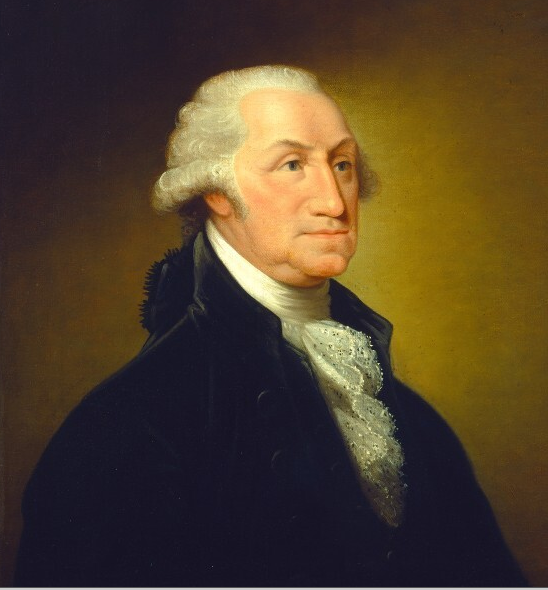
George Washington, at the time he finished his second term as president
Source: National Gallery of Art, George Washington c.1796 (painted by Edward Savage)
George Washington understood the distinction between morality and religion, and between toleration of differences and full religious liberty. His replies to messages from Jews and Swedenborgians showed he was not merely accepting the differences of religion, tolerating those who had not chosen the correct path.
Instead, when in positions of authority he maintained what Jefferson would later define as a "wall of separation between church and state." Though their perspectives on faith and religion varied, neither supported using the power of government to coerce religious behavior or define acceptable/unacceptable theological doctrine.
Washington used generic terms with his public requests for divine assistance, to the extent that his personal denomination must be classified as "unknown." That vagueness has not stopped Episcopalians, Presbyterians, and other faiths from claiming him as a member, and has invited others to identity him as a Deist.
Washington was a man dedicated to creating national unity, not an exclusionist seeking to identify and select those with correct beliefs for reward in this life or the next. It would have been inconsistent for him to seek to blend the westerners and the Tidewater residents, the Yankees from the north and the slave-owning planters from the South, into one national union - while at the same time supporting narrow religious tests for officeholders, or advocating the superiority of one religious sect over another.
Washington had no interest in converting his own workforce at Mount Vernon, including those whom he held in bondage as enslaved workers, to a particular faith. He wrote in 1784, telling an aide to focus on age and character when purchasing indentured servants from a ship recently arrived from what is now Germany:7
The Washington Monument obelisk is clad in white limestone. When illuminated at night, it glows white. It stands out from the dark background because of the artificial light we project on it; there is no natural light corning from the stone.
If we projected a colored light, we would see the tall Washington Monument as an object glowing with color. Similarly, many writers project onto Washington's life a set of religious beliefs - and see a reflection of what they project.
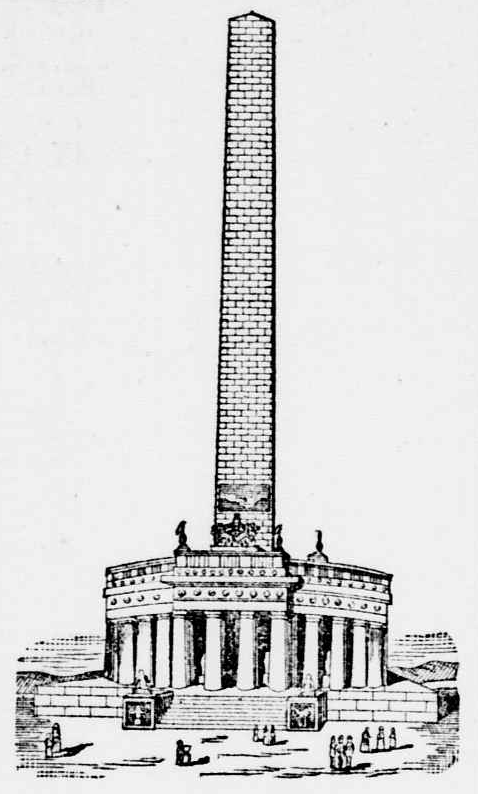
the original design for the Washington Monument included more ornamentation beyond just the marble shaft
Source: Library of Congress - Chronicling America, Historic American Newspapers, Evening Star (February 21, 1885)
Mason Locke Weems manufactured stories to establish Washington as a pious Christian, a man who suceeded in part because he prayed for God's blessing. Weems was a parson, and his inaccuracies (including the moralistic "I can not tell a lie" tale about cutting down a cherry tree) have shaped the perspective of Washington for two centuries now.
Many modern writers still repeat second-hand information of questionable reliability to describe Washington as a traditional Protestant. The individuals who describe Washington's life as one marked by prayer and steady attendance at church are often advocates of a religious perspective, proselytizing the perspective of a particular denomination or at least trying to shape American society so more people attend church regularly.
At times, they cite the generic proclamations issued as a public leader to portray Washington (or even Jefferson!) as a mainstream Christian, and to define the United States as a Christian Nation. Some of those who emphasize the personal faith - or faithlessness - of elected officials use it as a partisan issue. The Moral Majority led by Reverend Jerry Falwell was clearly allied with the Republican Party. Both Jimmy Carter and Pat Robertson used religion as part of their campaigns for the presidency.
In modern America, many religious leaders consider personal salvation to be fundamental to the strength/survival of American society. Linking Christian religious beliefs with political authority is enhanced by highlighting the faiths of the founding fathers.
George Washington was a man of faith, and the Museum of the Bible highlights a 1976 painting of George Washington praying at Valley Forge. Leaders in the second Trump Administration highlighted the image as they advanced the claim that the United States was founded as a Christian Nation, questioned the separation of church and state, and sought to conflate religious authority with military strength and government power.
However, Washigton recognized he governed a pluralistic society in the 1790's with many different perspectives on Christianity, plus a small percentage non-Christian citizens. He carefully avoided entangling the practices of government and religion, avoided referring to Jesus Christ in his public statements, and made clear that the new Federal government would not discriminate against non-Christian faiths.8
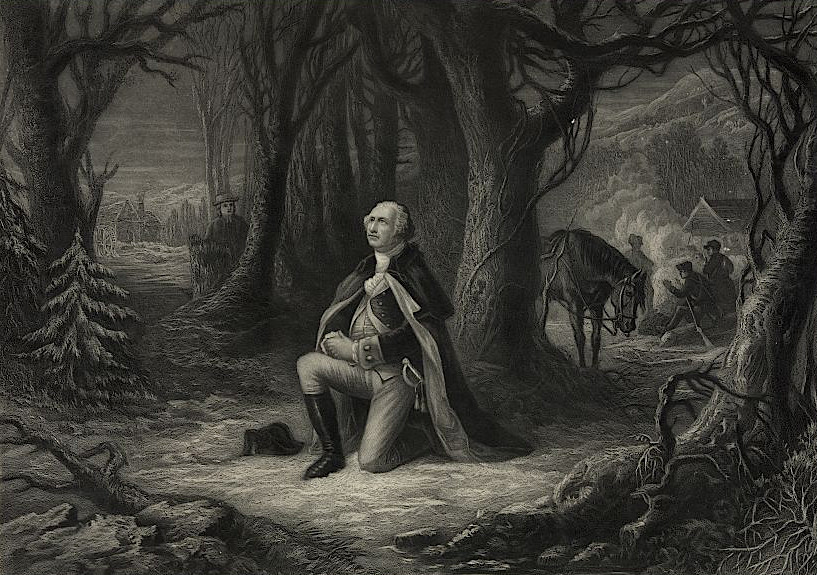
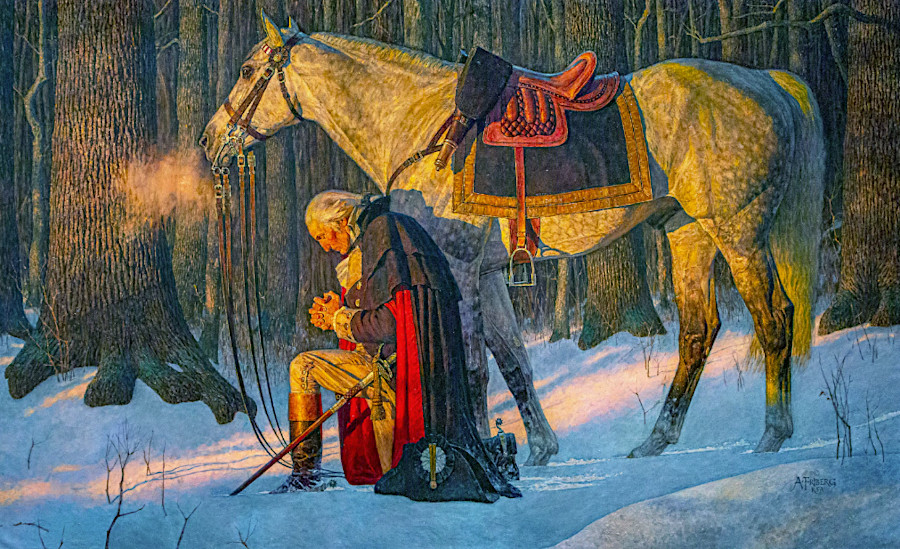
George Washington praying at Valley Forge
Source: The prayer at Valley Forge (engraved by John C. McRae, 1866, from painting by H. Brueckner); Museum of the Bible, Celebrating the 50th Anniversary of the "Prayer at Valley Forge"
The debate about the morality of elected officials has been intense since the realization that Lyndon Johnson lied about the status of war in Vietnam. Jimmy Carter gave an interview to Playboy magazine in the 1976 campaign in which he confessed he had felt lust in his heart, though he had not acted on what he considered to be the sin of adultery. Subsequent presidents have demonstrated publicly their own lapses, particularly Richard Nixon, Bill Clinton, and Donald Trump. They retained public support for remaining in office despite their personal behavior.9
Those who attempt to project a religious theology upon Washington often seek to connect theological beliefs with civic benefits, assuming morality is based on religion. In contrast, Madison and others crafted a government that could succeed even if Americans were not angels, thanks to a balance of powers. Jefferson and other "natural law" theorists assumed that individuals in a mature society would follow a common set of ethical principles, independent of the different religious beliefs held by individuals.
In a letter to the Touro Synagogue, a Jewish congregation in Newport, Rhode Island, Washington made clear that he aligned with James Madison in the perspective that religious freedom was broader than just "toleration" that could be revoked by a government:10
Washington was a man focused throughout his life on gaining honor and respect. He acted in public settings with some personal distance, even coldness, to reduce the likelihood of some informality reducing the respect he sought from others. So it is likely that he would desire political leaders today to also earn respect through moral, virtuous behavior - even at some personal cost to their comfort level.
However, there is little in Washington's life to suggest he would support a political movement based primarily on a moral agenda. To make such a claim requires that we project a light upon the monument of Washington, then look at our own reflected light and claim its source to be Washington. The "myth of Washington" created during his life and shortly thereafter by Parson Weems is not static. Even today, Washington's life can be re-shaped when necessary to fulfill the agenda of a modern mythmaker.