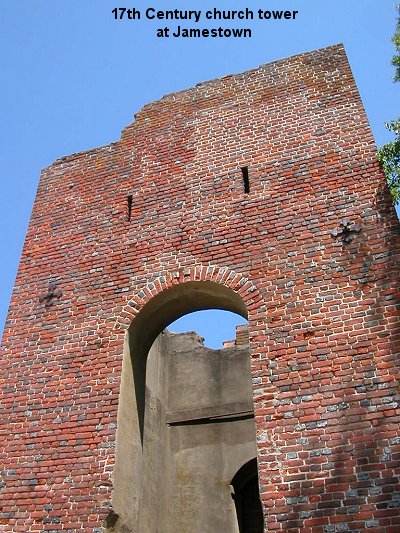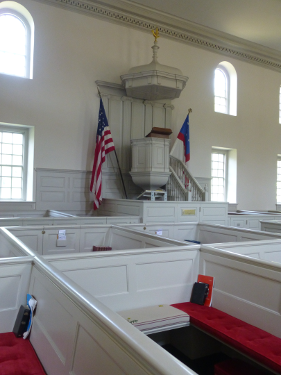
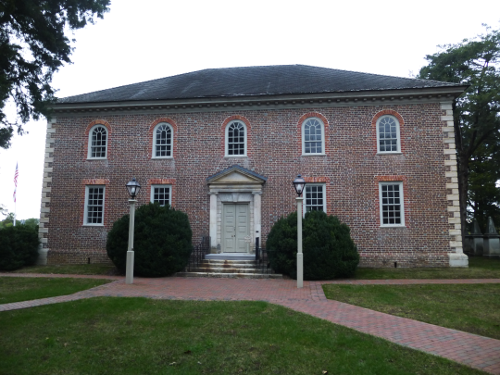
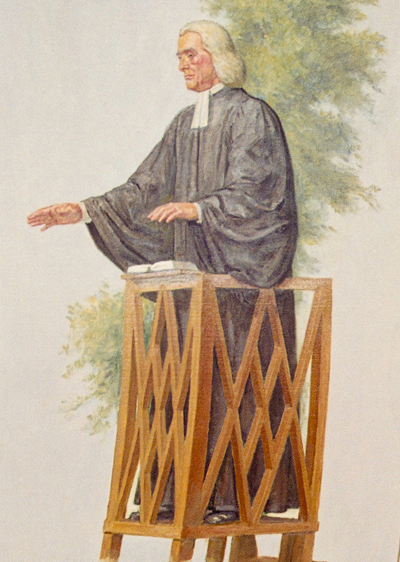
at Pohick Church in Fairfax County, the Anglican minister preached from a position of authority to parishioners sitting in boxed pews within a classic example of Georgian architecture
at Pohick Church in Fairfax County, the Anglican minister preached from a position of authority to parishioners sitting in boxed pews within a classic example of Georgian architecture
The first humans to settle in Virginia, over 20,000 years ago, brought religious and spiritual beliefs. They probably centered on seeking help for physical security (including protection from wild animals and hostile bands, finding shelter, and successfully hunting and gathering food), establishing and maintaining loving relationships, and raising children to adulthood - - elements also found in modern-day prayers for divine intervention.
It is realistic to assume that Paleo-Indians asked the same religious and philosophical questions as modern Virginia residents, such as "Why do bad things happen?" and "What happens after death?"
The oldest evidence of religious practices is from burial sites. The effort required to put bodies into the ground indicates there were some sort of religious beliefs about life and death, and rituals associated with those beliefs. The oldest grave discovered to date in North America is of a two-year old child buried 11,000 years ago at the Anzick site. Archeologists found antlers and stones covered with ed ocher, in addition to the skeleton.
Also about 11,000 years ago, a man and child were carefully buried at the Horn Shelter in Texas. They were aligned to face the settling sun, and numerous artifacts (including shells, claws and canine teeth) were included with the bodies. Large flat slabs of stone were placed on top, up to the heads of the deceased.1
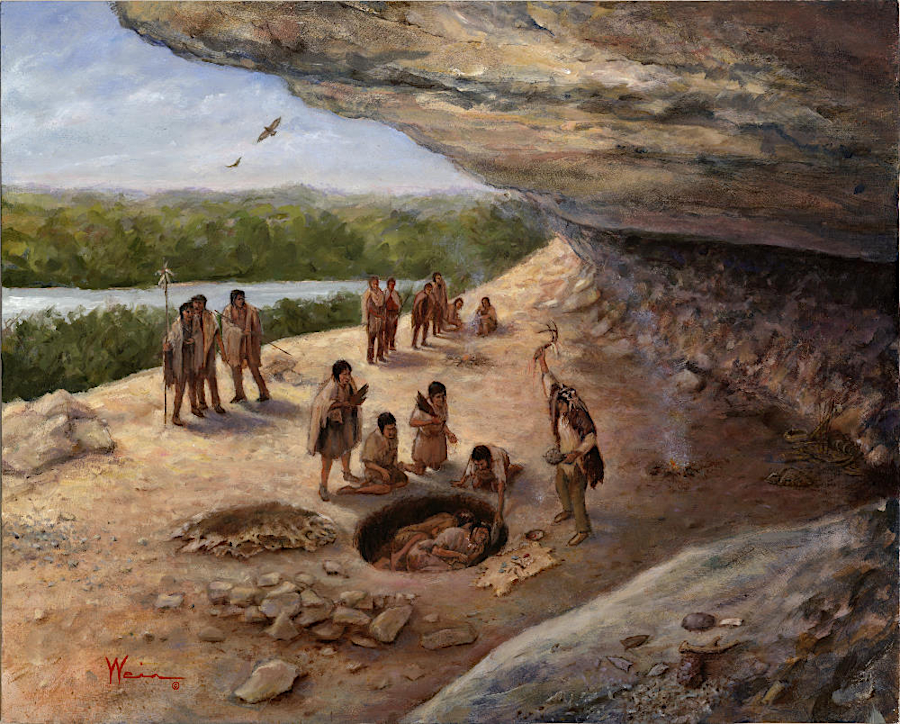
the 11,000 year old grave at Horn Shelter in Texas suggests Paleo-Indians brought their religious beliefs when they migrated into North America
Source: Texas Beyond History, Horn Shelter
The first official religious ceremony conducted in Virginia by European colonists was a Catholic Mass led by Jesuit priests. It was held in 1570 at Ajacan, a site on the Peninsula somewhere between the James and York rivers. Spanish Catholics had started regular religious ceremonies on the North American continent when they settled St. Augustine five years earlier in 1565. Catholics priests from France arrived at Quebec in 1608, the same year Spanish Catholic priests started holding regular worship services in Sante Fe.
Official Anglican ceremonies started when English colonists arrived in 1607. On April 29, 1607, the colonists erected a wooden cross at Cape Henry and Reverend Robert Hunt led prayers.2
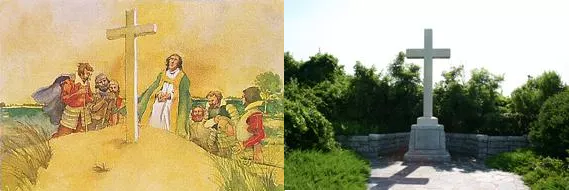
a cross now marks the area where Rev. Hunt held the first official Anglican ceremony in Virginia on April 29, 1607
Source: National Park Service, Cape Henry Memorial
In Massachusetts, the leaders of a different group of English colonists that started arriving in 1620 had a zeal to create a new theocracy. They wanted to build "city on a hill," to become a shining example to others.
The Separatists (Pilgrims) that sailed on the Mayflower and then the Puritans who arrived later wanted to create an environment in which their one majority perspective would dominate the religious and political culture. Many elementary school Thanksgiving pictures show those Massachusetts colonists wearing black hats and carrying a blunderbuss. They were seeking religious freedom for themselves, but not for anyone else with different beliefs.
The settlers who came to Virginia provide a clear contrast to the Puritans. Nearly all of the Virginia immigrants in the 1600's came for economic reasons - to get rich, or get richer. The Europeans who colonized Virginia in the 1600's were not driven primarily by a desire for religious freedom. After Pocahontas married John Rolfe the Virginia Company briefly highlighted the benefits of converting Native Americans to the Protestant faith, but few colonists came to Jamestown for religious reasons. Unlike Massachusetts, Virginia was not settled by a subset of English culture that wanted to create a single acceptable form of public worship and one religious organization to manage church life.
To early Virginians, material wealth was more interesting than freedom or salvation or politics. The first Europeans to land in Virginia were Spanish missionaries willing to die for their beliefs, but the English settlers were motivated by desires for land and wealth more than the chance to proselytize the "heathen" or establish a religious refuge.
The initial Virginia colonists were not anti-religious; they considered religion to be a fundamental part of both life and government. They assumed the Anglican church would be the "established" church, supported by taxes that were imposed by governmental authority.
From 1607 until the American Revolution, the Anglican church determined the official form of worship in Virginia. Anglican leaders in England resolved theological disputes, and church vestries in Virginia provided key social services (such as arranging the care of orphans) in the colony.
Sunday services were a standard public gathering. With Virginia's decentralized settlement pattern, religious events offered a rare opportunity to meet with other people. In contrast, the settlement pattern in New England was more dense. Neighbors who lived closer to each other met more often in town meetings, where they became became accustomed to voting on local policies and priorities.
Government and religious leadership were combined at the top. The King of England was the head of the Anglican Church, and the new translation of the Bible was named in honor of the same king for whom Jamestown was named.3
Protestants from the Netherlands settled on the Hudson River in 1614. Their beliefs and rituals were different from the Anglicans in Virginia. In particular, the Dutch did not consider King James I in England to be the head of their religious faith. Similarly, the Swedish Lutherans who settled along Delaware Bay in 1638 were Protestants - but were clearly were not Anglicans.
Unlike some other colonists, Virginians did not cross the Atlantic Ocean to create a "city on a hill" or a place where different religious faiths would be allowed. In colonial Virginia, there was no expectation that church and state would be separate, or that dissent would be encouraged by government officials.
The official church emphasized tradition and sacraments in worship services. In the 1740's, Virginia and other colonies experienced the "Great Awakening." Methodists, Presbyterians, and Baptists emphasized emotional worship experiences through which people gained a direct connection to the divine. Such an approach reduced the power of ministers and the vestry of each Anglican church to define appropriate behavior. Few Anglican ministers welcomed the competition.
Virginia was often hostile to Catholics, in part because of the local rivalry with Catholic Maryland and the national rivalry with Catholic France and Spain. As early as 1613, Captain Samuel Argall sailed north from Virginia to destroy a French colony of "Papists" in Acadia. Only one Catholic, George Brent, was elected to the House of Burgesses during the colonial era. The first permanent Catholic congregation in Virginia (St. Mary Catholic Church in Alexandria) did not get organized until 1795.4
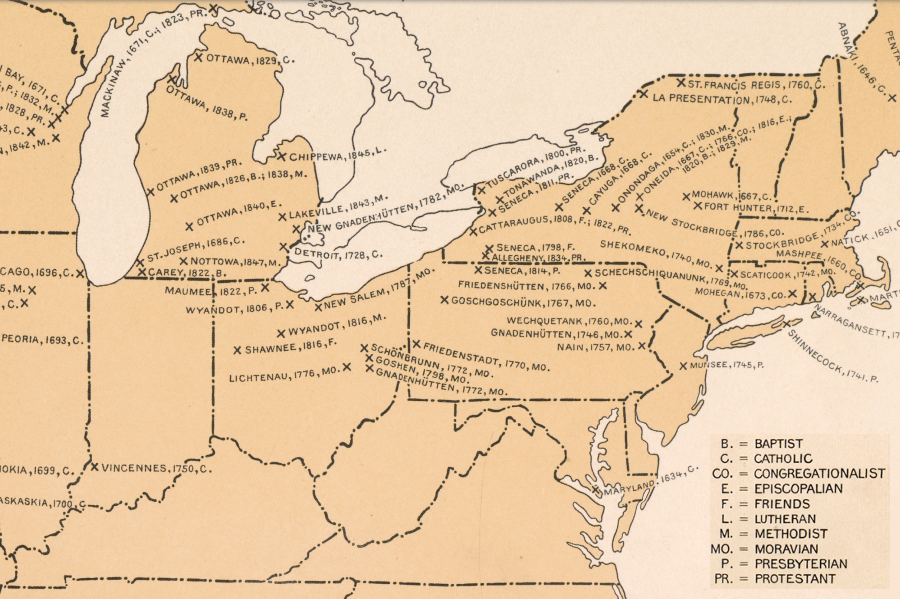
the first Catholic mission to convert Native Americans in Virginia was in 1570-71, when Spanish missionaries tried to start a settlement at Ajacan (red X)
Source: Atlas of the Historical Geography of the United States, Indian Missions, 1567-1861 (Plate 37, digitized by University of Richmond)
Despite the hostility towards other faiths, the Anglicans of Tidewater Virginia showed some flexibility in order to attract settlers. In the early 1700's, Governor Spotswood consciously recruited Presbyterians and other Protestants belonging to various German/Swiss denominations. He wanted them to move south from Pennsylvania to Virginia, and to establish farms and new communities west of the Blue Ridge.
Spotswood's own land claims were east of the Blue Ridge, and he was not shy about using his government influence to enrich himself, but he encouraged dissenters such as the "Pennsylvania Dutch" to buy land in the Shenandoah Valley. That was an area where he would not benefit directly, but getting new colonists to live west of the mountains would create a "tripwire." If Native Americans or the French launched an attack on the colony from their bases in the Ohio River Valley, Spotswood expected the new settlers to respond and to provide an essential warning to the English settlements east of the Blue Ridge.
The Germans and Scotch-Irish were not members of the Anglican Church, but were still reliable Protestants. The presence of non-Anglicans on the western edge of Virginia was a small price to pay to create a buffer against enemies living further west. Immigration by Catholics from Maryland was not encouraged by Governor Spotswood or the General Assembly, since Catholics would have been a less-reliable buffer against possible French incursions.
Religious and cultural differences affected settlement patterns. In contrast to the colonists east of the Blue Ridge, the immigrants west of the mountains did not acquire large groups of slaves and did not grow tobacco for export. Instead, the new settlers developed small farms growing grain and cattle, and sent their agricultural products to Philadelphia for sale.
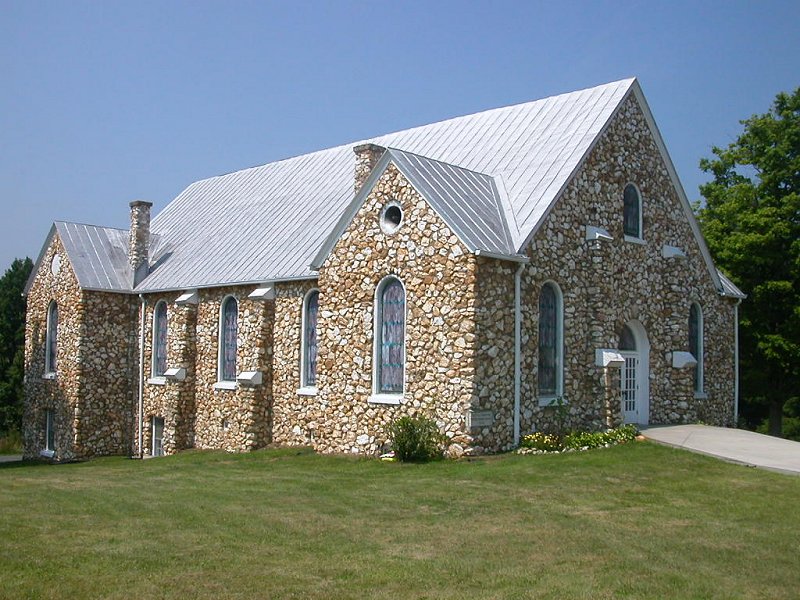
Buffalo Mountain "rock church" built by Rev. Bob Childress (Carroll County)
Today, the German Mennonite heritage is still reflected west of the Blue Ridge in style and transportation. Harrisonburg is home to the large James Madison University, and every style of modern clothing is visible in town. In the same city, it is easy to find women who still dress plainly and wear a white head covering. Some traditionalists still drive horses-and-buggies to Sunday services near Dayton.
During the colonial period, the Anglican Church was intimately connected to the government. County sheriffs collected mandatory taxes that paid the salary of the minister and for maintenance of church buildings.
The vestry, the governing body for each Anglican parish, was responsible for civil tasks such as community awareness of land survey boundaries and care of the indigent and insane. The vestry could "bind out" orphans to a person willing to pay the costs of raising a child in exchange for the work of that child in the household or a business. Children of unmarried mothers and parents deemed too irresponsible could be moved to another home.
For example, in 1764 the Orange County court ordered the vestry to care for a child not receiving adequate religious education. The court records may have not have included other, more substantive issues as well in that family:5
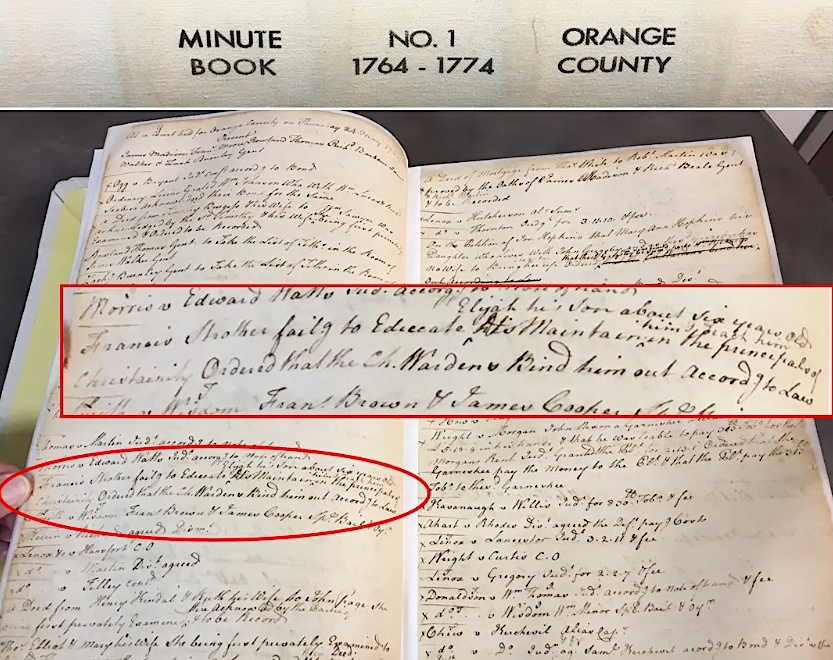
the local vestry was responsible for orphans and could take children from parents judged not responsible for child raising
Source: UnCommonwealth blog, Library of Virginia, CCRP Records Rooms Road Trips: Teaming Up With Virginia Untold
Adoption of the Virginia Statute for Religious Freedom in 1786 ended tax support for the church. Virginia's political leaders officially "disestablished" the church from government, and established a new tradition of maintaining a wall of separation between religious and government organizations.
In Virginia and then in the new United States, government no longer had a role in determining the "correct" faith of citizens. People could select whatever religion they preferred, switch their religious affiliation at any time, or could choose to live a completely secular life and not to associate with any religious group at all.
James Madison and Thomas Jefferson led first Virginia, and then the new United States, to end government involvement in religious-oriented activities with the Virginia Statute for Religious Freedom and the First Amendment to the US Constitution ("Congress shall make no law respecting an establishment of religion, or prohibiting the free exercise thereof").
They moved America past beyond official tolerance, which could be revoked at the whim of a later set of officials such as the Edict of Nantes in France, and into permanent acceptance of various forms of religion. Government-based discrimination against people with the "wrong" faith was no longer acceptable. Choosing a religious belief was defined as a natural right, beyond the power of government.
George Washington made the distinction between toleration and acceptance clear in his "Letter to the Hebrew Congregations of Newport," written in 1790 when he was president of the United States:6
First Baptist Church in Petersburg, founded in 1756, is the oldest continuously-operating African-American religious institution in North America.7
Religion was a core element for most Virginians at the time of the American Revolution. It remained that way through the Cold War, and in 1999 70% of Americans said they were members of a church, synagogue or mosque. In 2021, that percentage dropped below 50% for the first time and over 20% of Americans expressed no religious preference.
Within the "Traditionalists" (those born before 1946), membership dropped from 77% in 1998 to 66% in 1920. Within the Millennial cohort, only 36% were members of a religious institution in 2020.8
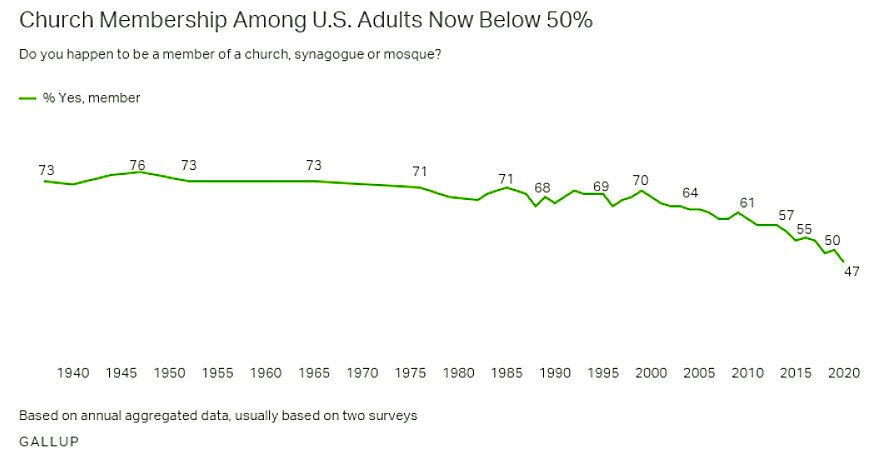
the majority of Americans today do not identify as a member of a religious institution
Source: Gallup, U.S. Church Membership Falls Below Majority for First Time
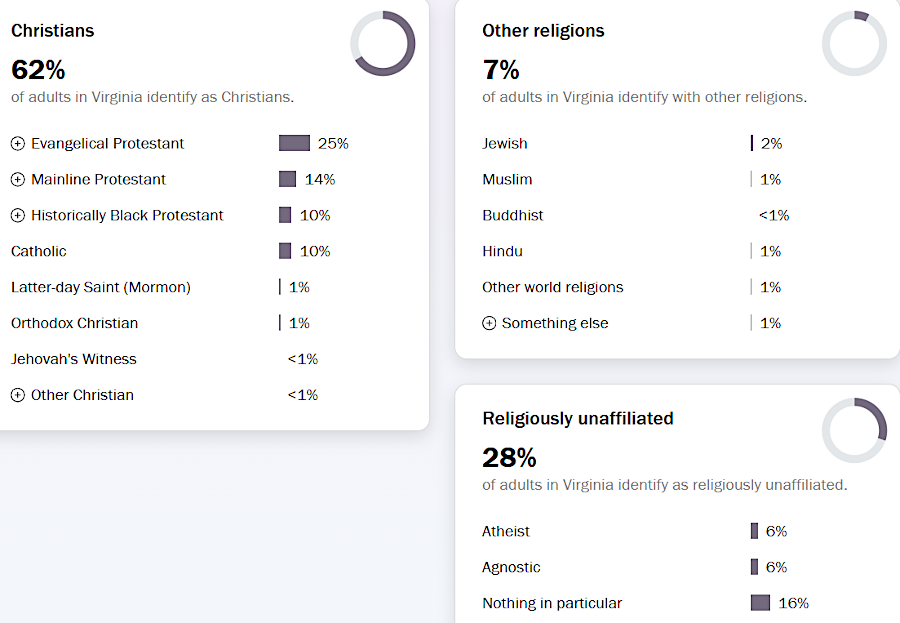
in 2024, more Virginians identified themselves as Evangelical Protestants than any other group
Source: Pew Research Center, Religious Landscape Study
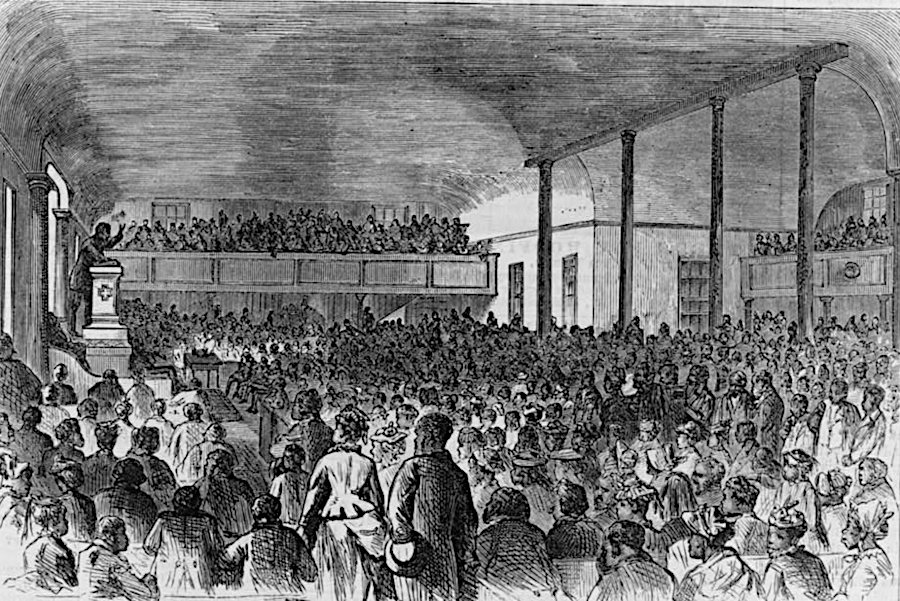
in Richmond, black members of the First Baptist Church split from the whites and founded the First African Baptist Church in 1841
Source: Library of Congress, The first African church, Richmond, Virginia--Interior of the church, from the western wing (by W.L. Sheppard, 1874)

Rev. Joshua Thomas, the "Parson of the Islands," helped make the Methodist faith dominant on the Eastern Shore and Chesapeake Bay islands such as Tangier
Source: The Parson of the Islands (p.93)
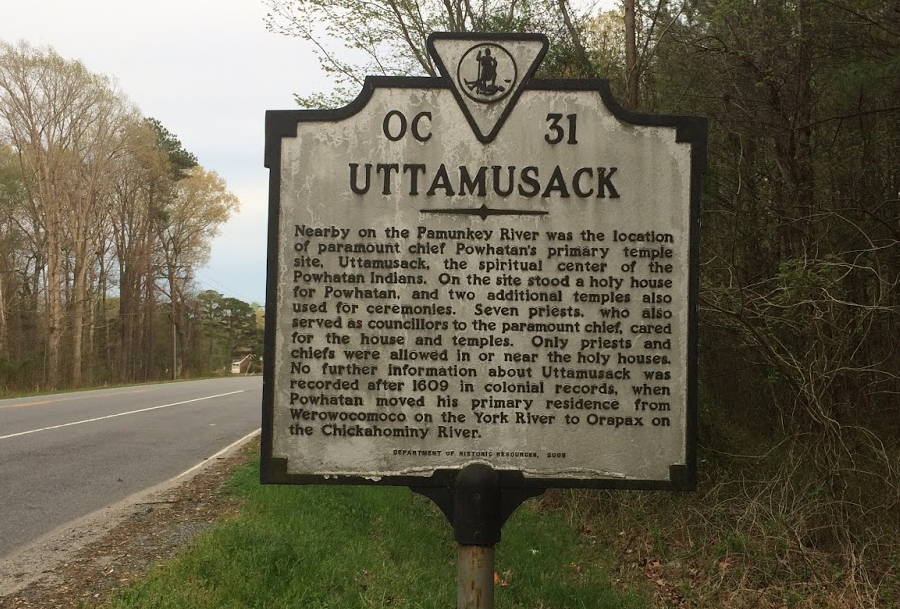
until 1609, the religious temples of Powhatan were at Uttamusack in King William County (near modern Augusta Lumber mill at West Point)
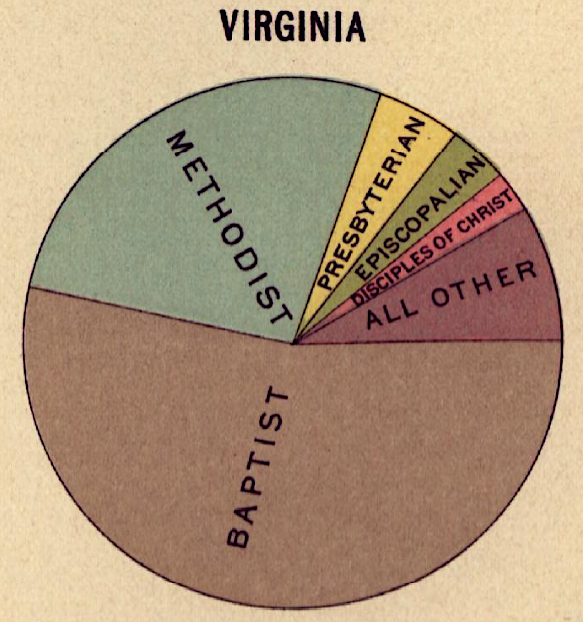
composition of church membership in Virginia, 1890
Source: Library of Congress, Statistical atlas of the United States, based upon the results of the eleventh census (1898)
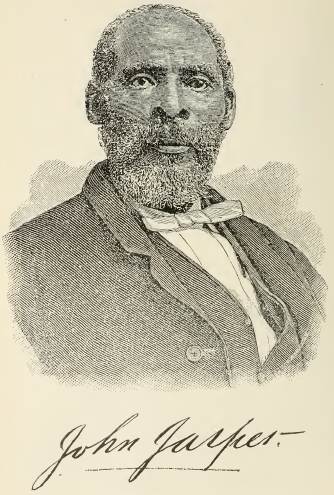
John Jasper was famous for his sermon "The Sun Do Move"
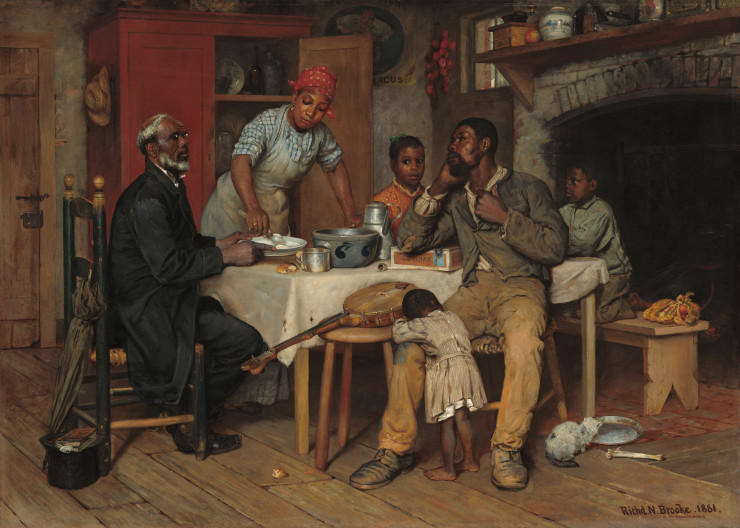
a family welcoming their elderly pastor to Sunday dinner
Source: National Gallery of Art, A Pastoral Visit (painted by Richard Norris Brooke, 1881)