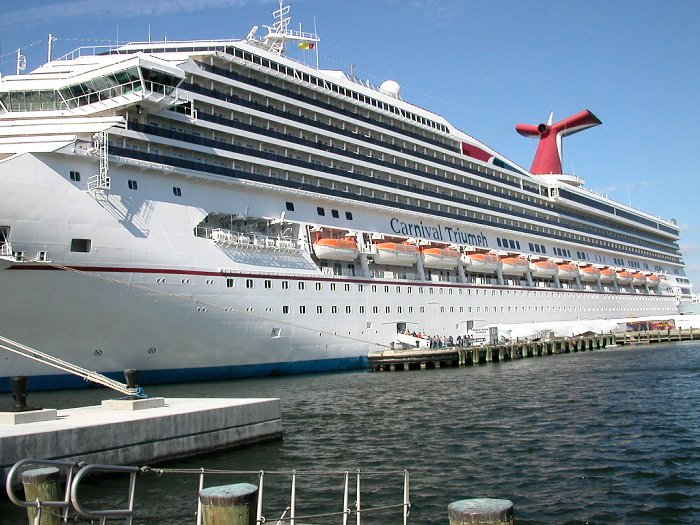
Carnival cruise ship at Nauticus, in Norfolk
Carnival cruise ship at Nauticus, in Norfolk
Cruise ships stop at Alexandria, Tangier Island, and Yorktown, but the main Virginia port for passenger ships is Norfolk.
The first cruise ship visited Norfolk in 1996, two years after the waterfront Nauticus museum was constructed with a small pier. The demand for cruises from smaller port cities peaked after the 9/11 terrorist attacks; passengers were reluctant to fly to New York or Miami, but willing to drive to a closer cruise ship terminal. Cruise lines abandoned Norfolk in 2013, but later renewed visits.
Today the local competitor is primarily Baltimore, and the regional competitor is New York. Florida remains the primary location for cruise ship home ports on the East Coast.
Norfolk attracts customers who drive from North Carolina, West Virginia, and Pennsylvania as well as from within Virginia. Baltimore is a shorter drive for passengers coming from the population centers in the Northeast, but Norfolk highlights that it is closer to Bermuda, the Bahamas, and various other resort destinations.
Norfolk tourism officials argued "what tourist wants to spend an extra six hours sailing through the cold Chesapeake Bay during a winter cruise when they could be sitting in deck chairs, holding drinks with little umbrellas and basking in 80-degree warmth in the sunny Caribbean?" (Answer: tourists from Ohio, Pennsylvania, New Jersey, and Maryland who hate driving on I-95 through DC/Northern Virginia, and then on I-64 through the Hampton Roads Bridge-Tunnel to get to Norfolk.)
Why do Virginia officials want cruise ships to dock at Virginia ports? In addition to the fees and wages paid to port-related employees, there is plenty of spending money in the pockets of passengers. Baltimore receives up to $1 million in economic benefits for each cruise.
When a cruise ship with 500-2,000 passengers docks and the average tourist spends $100 or so in town, Virginia officials are willing to build facilities to stimulate more cruise ships to visit Hampton Roads. Extra business from tourists generates more sales/meals tax revenues for local governments.1
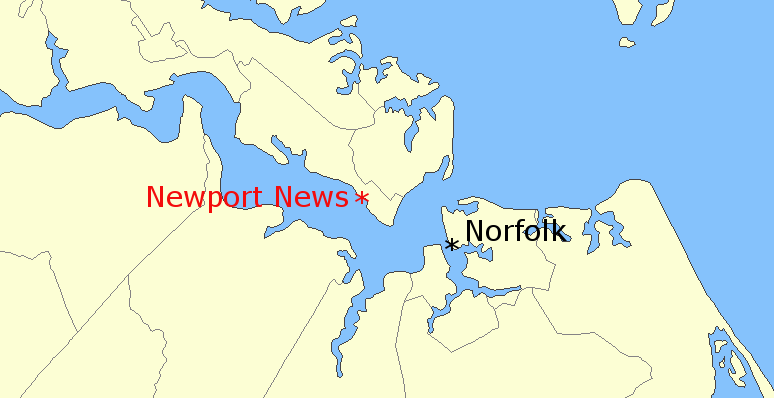
cruise port alternatives in Hampton Roads
Map Source: US Geological Survey, National Atlas
Deciding where cruise ships should dock in Hampton Roads involved competition between Newport News and Norfolk. On December 7, 2000, the USS Wisconsin took up residence next to the Nauticus museum in Norfolk harbor. At that time, the Nauticus dock could handle only afternoon visits from cruise ships. Overnight cruises to the Caribbean used the Newport News Marine Terminal, across Hampton Roads. Newport News officials loved the income associated with the cruise business - after all, the tourists required minimal services but contributed substantial tax revenue to the city. However, the Newport News Marine Terminal was busy handling cargo; it could not accommodate more cruise ships.
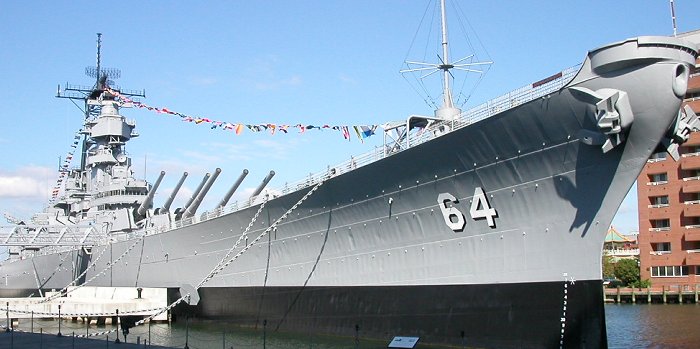
USS Wisconsin, berthed in Norfolk
While the state's Virginia Tourism Corporation studied how to attract more cruise ship visits to the state, the Newport News Industrial/Economic Development Authority studied how to ensure those ships continued to stop in Newport News. However, Norfolk was also angling for a larger slice of the tourism pie as well. By 2002, the cruise ships were docking at a temporary facility at Town Point in Norfolk, on the other side of Nautilus from the USS Wisconsin.
Separate jurisdictions within Hampton Roads area competed with each other for the cruise ship business, but regional cooperation to draw tourism to Hampton Roads is also common. Elected officials in Tidewater agree in public that it is great to have tourists in the area, and officials from Virginia Beach to Williamsburg jointly celebrate the Hampton Roads region as a destination to visit. Community leaders know that the travel and tourism-related businesses in both North Hampton Roads and South Hampton Roads will benefit if the cities/counties combine efforts to convince visitors to come to the Hampton Roads region, rather than go to the North Carolina beaches, Richmond, Atlanta, etc.
For example, the HarborLink ferry connected Nauticus in Norfolk and the Virginia Air and Space Center in Hampton started in 1992. It was sponsored by the Norfolk Convention and Visitors Bureau and the Hampton Convention and Visitors Bureau. Visitors who stay long enough to see *both* communities were likely to spend the night and buy meals at various restaurants in the region. In one effort to attract business, HarborLink advertised "Make total purchases of over $100 in Hampton and return trip to Norfolk is free."2
HarborLink was discontinued in 2002, when it became clear that tourist and commuter traffic would remain insufficient to cover costs.
Cooperation on regional tourism can increase sales tax revenues across the Hampton Roads region. However, Hampton Roads is a collection of competing, as well as cooperating, jurisdictions. At some point, political lines dividing jurisdictions on the regional map become critical.
When the cameras are turned off, it is natural for local elected officials to direct their staff to ensure sales taxes from tourists are returned to a particular local jurisdiction. Newport News tax revenue does not fund Norfolk schools, and Norfolk taxes do not support services in Newport News. If the local sales tax collections are high, then the local property tax rate can be kept low and the local voters can be kept happy.
It matters where tourists actually spend their money. A percentage of the state sales tax goes back to the jurisdiction - not the region - where the tax revenue was collected. Meals taxes and occupancy taxes on hotel rooms are local taxes. Though some of that revenue may be dedicated to the regional tourism organizations, most is used primarily for providing services (especially schools, fire, and police) in one jurisdiction.
Local officials need local (as well as state and Federal) revenue to pay teachers, maintain government buildings, etc. When tax revenue is credited to one particular jurisdiction, then voters in that particular city/county can receive good services from their local government along with a low property tax rate. If the City of Poquoson does not get business from cruise ships docking in the City of Norfolk, then landowners in Poquoson may have to pay higher property taxes than landowners in Norfolk.
Before September 11, 2001, the Virginia Port Authority started to plan a major upgrade of the Newport News Terminal. The Virginia Port Authority is a state agency, so it could not arbitrarily provide state funding for Newport News while ignoring potential other sites. The state agency had to focus on regional cooperation, and could not select a "winner" in a competition for building infrastructure to attract cruise ships without documenting its reasons.
Taking advantage of that delay, Norfolk built temporary facilities and obligated local funds to draw cruise ships to the other side of the harbor in 2002. In 2004, Norfolk committed $36 million in city funds to build the permanent Half Moone Cruise and Celebration Center next to Nauticus. The Virginia Port Authority contributed an additional $5 million for improving the piers and other infrastructure. The city calculated that it would have to almost double the number of people choosing Norfolk as their port of embarkation for a cruise, but decided it was a good risk.3
The $36 million Half Moone Cruise and Celebration Center on Town Point opened in April, 2007. It operated as part of the city-owned Nauticus science and technology center and maritime museum, together with the USS Wisconsin battleship.
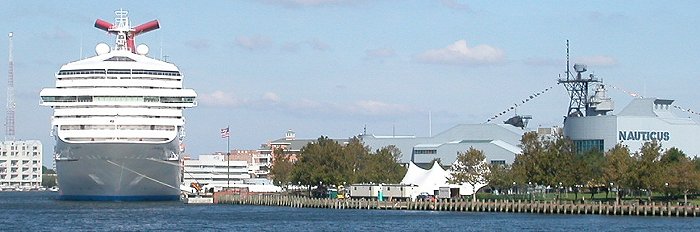
the Half Moone cruise ship terminal was built next to the Nauticus museum facility
After 9/11, cruise ship companies found mid-Atlantic ports to be competitive to the traditional ports in Florida because customers were more willing to drive than fly to catch a cruise ship. Norfolk was not the only mid-Atlantic option, however. Half Moone Cruise and Celebration Center initially attracted business away from Baltimore, a competing port of call for cruise ships - but Baltimore required an extra day of sailing up the Chesapeake Bay, when customers on cruise ships want to travel out into the Atlantic Ocean. In addition, the Norfolk cruise terminal was designed to attract trade shows, parties, exhibitions, and other events that would draw people to the city and its downtown.4
Local officials justified constructing the new cruise ship terminal by claiming taxes generated by more tourists would pay for most of the cost, and the taxpayers of Norfolk would not be stuck with the bill. Cruising was projected to be an economic "driver" for the Norfolk economy, though the business has its ups and downs. Back in 2003, one local official estimated the new terminal would need 150,000 passengers annually to be cost-effective. In 2008, 28 cruise ships "called" at Norfolk and brought over 100,000 passengers, but in 2009 that dropped to 17 ships bringing just 64,000 passengers.5
The Virginian-Pilot newspaper reported in 2008, "while the Half Moone produces enough revenue to offset its operating expenses, it is falling short of covering its annual construction debt payment, according to financial information provided by the city."6
The mathematics of calculating economic benefits from tourism can be confusing, based on various assumptions about business with/without the Half Moone Cruise and Celebration Center. The loss of Royal Caribbean business after 2010 made the business risk of Norfolk's investment even more clear.7
Royal Caribbean stopped splitting its business 50-50 between Baltimore and Norfolk, and moved all sailings to the Maryland port after 2010. However, Norfolk was able to generate more cruise ship visits from the rival Carnival Cruise Line. Carnival scheduled 7 port visits to Norfolk in 2011, 9 visits in 2012, and 11 visits in 2013. Even with port-of-call visits to Norfolk from four other ships in 2012, however, the passenger count was less than 1/3 of the once-anticipated 150,000 cruise passengers annually. In 2011, only 37,000 passengers sailed from Norfolk on a cruise.8
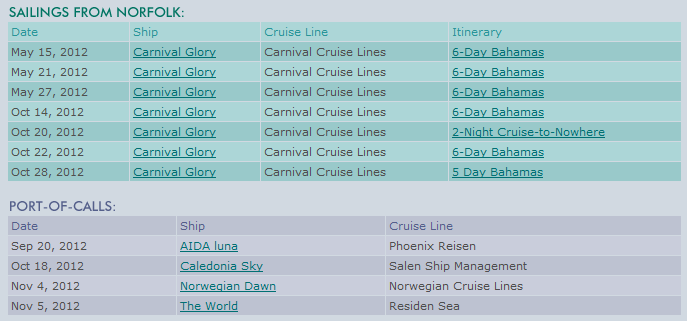
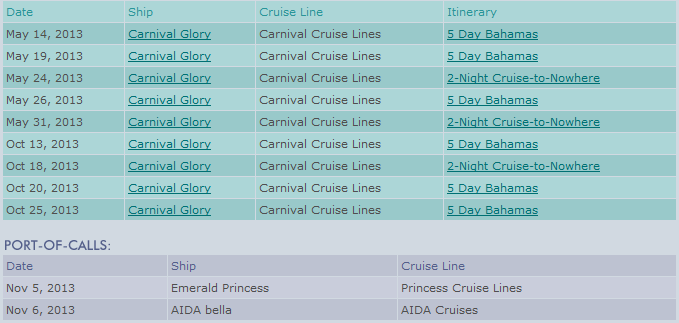
only Carnival Cruise Line scheduled cruises that launched from Norfolk in 2012 and 2013, and the only destination was the Bahamas - though other companies visited with port-of-call stops
Source: CruiseNorfolk
In contrast, Baltimore's cruise terminal was operating at full capacity in 2013. Cruise ships started using Baltimore as a port after the 2001 terrorists attacks in New York City. Customers wanted to drive rather than fly to get on their cruise ship, so suddenly smaller ports on the Atlantic Ocean coastline were able to compete with Florida and New York for cruise ship business. In 2006, Baltimore spent $13 million to convert a paper warehouse into a cruise terminal, moving the passenger travel business away from the cargo business.
Baltimore successfully supported year-round cruising by Carnival Cruise Lines starting in 2009, and considered building a second cruise terminal in 2011. In 2013, there were two trips a week. Each Saturday, a Royal Caribbean ship loaded 2,200 passengers, followed the next day by an equally-large Carnival Cruise Line ship. After reaching maximum capacity for weekend sailings (one ship on Saturday, one on Sunday), Baltimore began exploring whether recruiting a third company to sail sometime between Monday-Friday would expand the overall business, or simply shift customers from the weekend trips and undercut the existing cruise lines.9
The market for cruising is not infinite, and customer preferences change over time. There are limits on demand, no matter how much the supply of cruise terminals might increase.
After Royal Caribbean withdrew its ships that sailed from Norfolk to Bermuda after 2010, Norfolk was handicapped by Carnival's decision to sail primarily to the Bahamas from Norfolk. Customers could cruise to just one destination from Norfolk, but could sail to a variety of interesting locations from competing ports at Miami, Fort Lauderdale, Orlando (Port Canaveral), Jacksonville, Charleston, Baltimore, New York, and Boston.
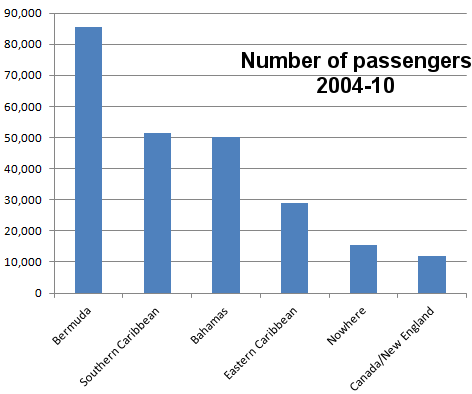
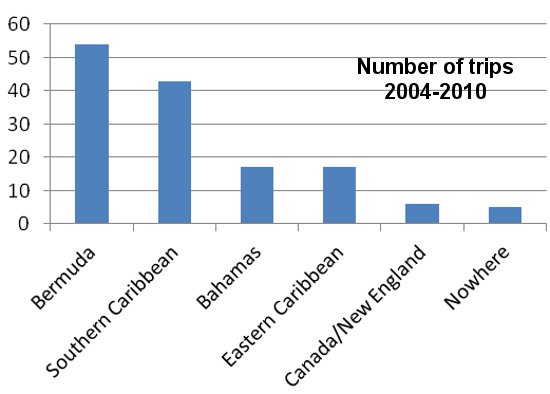
until 2006, more cruise ships sailed from Norfolk to the Southern Caribbean than any other destination, but Bermuda then became the dominant destination
Source: US Maritime Administration - Cruise Detail Table
Norfolk spent $36 million on its Half Moone Cruise and Celebration Center. Other cities proposed to out-compete Norfolk by constructing more expensive facilities.
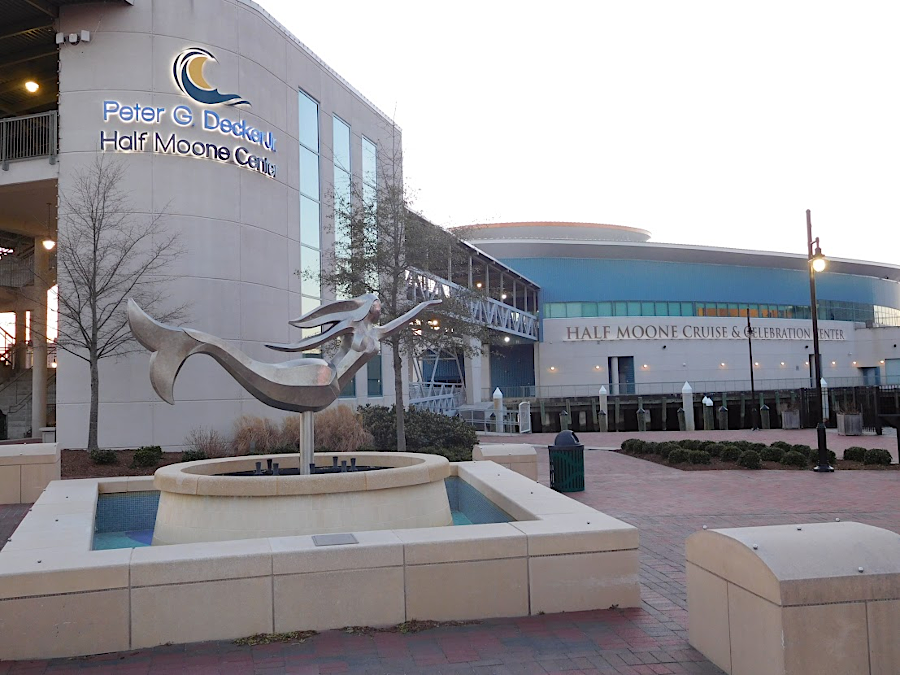
Half Moone Cruise and Celebration Center
To attract cruise-oriented tourists, a group in Savannah, Georgia proposed to build an $88 million cruise ship terminal. A consultant claimed that Savannah could attract over 100 ships with 50,000 passengers by 2015. Unless customer demand climbed by 50,000 people stating to cruise, or 50,000 customers took one more cruise each year, Savannah would meet that "rosy scenario" target only by pulling cruise ship sailings away from existing East Coast ports.
If 2,500-passenger ships used the Savannah terminal, only 20 sailings would be required to handle the projected number of passengers. Increased capacity at Savannah would be a clear threat to Norfolk's ability to generate revenue from the Half Moone terminal, but city officials also recognized that competing ports would threaten Savannah's ability to attract 50,000 passengers. In June 2013, the Savannah City Council unanimously stopped further investment in the project; the investment was judged to be too risky to justify the public investment.10
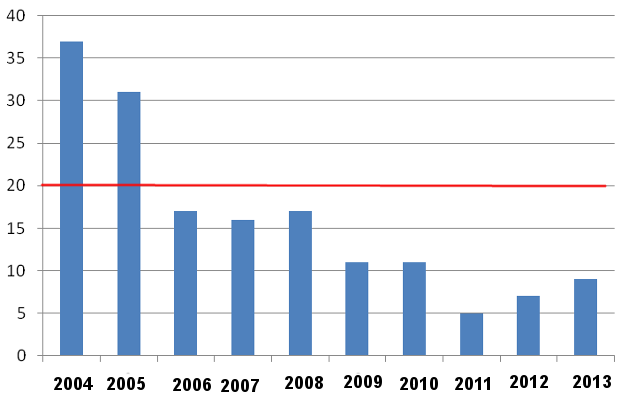
after 2005, less than 20 cruises annually were based in Norfolk
Source: CruiseNorfolk; US Maritime Administration - Cruise Detail Table
Norfolk was not alone in its failure to maintain its initial business levels, after building a cruise terminal. Cruises from Philadelphia started in 1998, expanded as New York cruise ships shifted to new sites after 2001, and peaked in 2006 with 35 sailings. The Delaware River Port Authority invested $21 million to build a cruise terminal (advertised as "CruisePhilly - America's Berthplace") at Philadelphia Navy Yard, but abandoned it in 2010. Just two cruises were scheduled from Philadelphia in 2011, in part because the Delaware Memorial Bridge blocked the 5,000 passenger mega-ships from sailing up the Delaware River.11
Similarly, Mobile built the $20 million Alabama Cruise Terminal in 2004. It made a profit hosting ships from the Carnival Cruise Line, until the company relocated its ships to New Orleans in 2011. Like Norfolk, Mobile sought to rent the cruise terminal for weddings, conferences, and other events unrelated to passenger ship travel, to generate some income and help pay off the bonds sold to finance construction of the facility.12
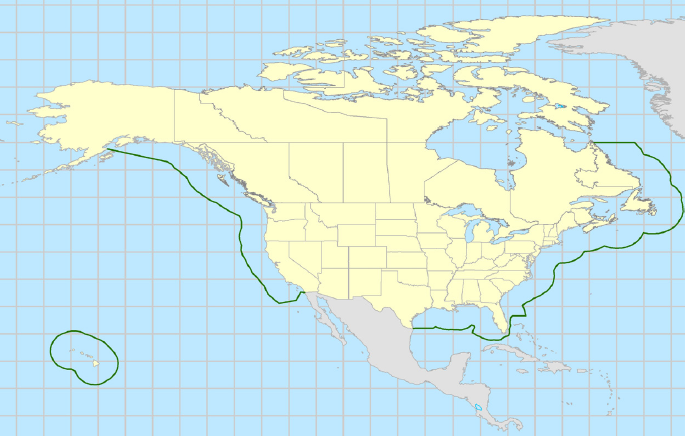
the North American Emission Control Area extends 200 nautical miles off the coast of the United States/Canada,
consistent with the Exclusive Economic Zone (EEZ) boundaries claimed by both countries - except near Florida
Source: Environmental Protection Agency (EPA), Designation of North American Emission Control Area to Reduce Emissions from Ships
Royal Caribbean pulled its business out of Norfolk in 2010, and then Carnival Cruise Line announced it would stop using Norfolk as a home port after October, 2013. In 2014, local officials expected cruise ships would continue to tie up at the terminal on stopover cruise calls, making short visits to Norfolk as a ship cruises between other ports. However, stopover cruise visits do not generate the same level of economic benefits as home port operations, since customers on stopovers will not stay in local hotels before/after cruise sailings.
Carnival announced in 2013 that it would abandon Baltimore and Boston as well, scheduling no new visits to those ports after the 2013 season. Carnival's cruise ship Glory shifted its homeport sailings from Norfolk (and Boston) to Miami. Carnival's Pride moved from Baltimore to Tampa, starting in 2014.13
The cruise line blamed Federal regulations issued by the Environmental Protection Agency (EPA), which required ships to use low-sulfur fuel to reduce sulfur emissions to 1,000 parts per million (0.1% of volume), starting in 2015 within the North American Emission Control Area approved by the International Maritime Organization. That limit was designed to reduce particulate matter (PM) and sulfur oxide (SOx) emissions by more than 85 percent, from ship engines burning traditional high-sulfur (3%) heavy fuel oil. The regulation implemented the "MARPOL" treaty (technically, Annex VI to the International Convention for the Prevention of Pollution from Ships).14
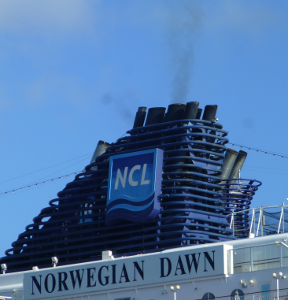
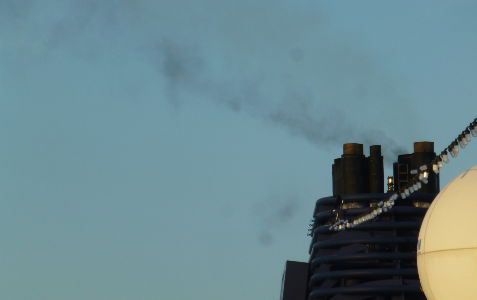
cruise ships use fuel oil to power their engines, and US controls on air quality are applied within the North American Emission Control Area
The boundaries of the North American Emission Control Area are close to the Florida shoreline, since the extent of the US claim to an Exclusive Economic Zone (EEZ) is constrained by the presence of counties such as the Bahamas and Cuba in that part of the Atlantic Ocean. The North American Emission Control Area extends for 200 nautical miles off Virginia, however, so the EPA regulation provided a clear economic advantage to cruise ship ports in Florida.
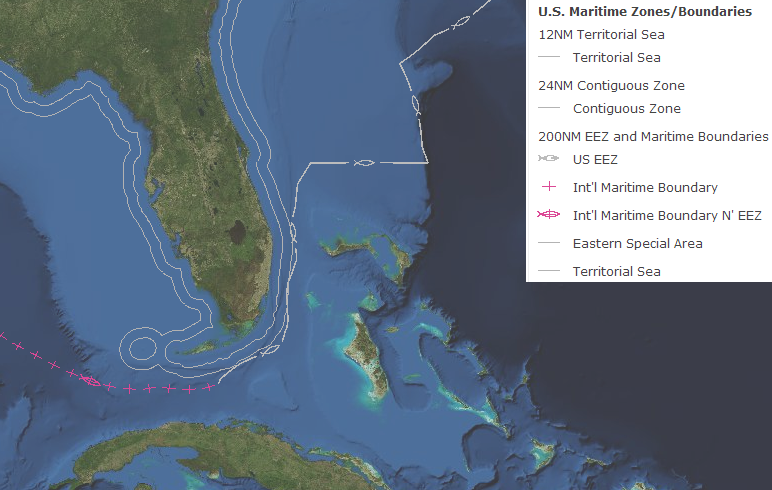
the Exclusive Economic Zone (EEZ) and North American Emission Control Area boundaries are
much closer to Florida's cruise ship ports, compared to the location of the boundaries off the coast of Virginia
Source: National Atmospheric and Oceanic Administration (NOAA) - Office of Coast Survey, U.S. Maritime Limits and Boundaries
Cruise ships sailing out of Florida ports could switch to traditional heavy fuel oil, a cheaper energy source, shortly after leaving port. The United States claim of offshore waters is limited by the nearby presence of Cuba and the Bahamas, so the North American Emission Control Area boundaries are not 200 miles offshore. The extra costs for low-sulfur fuel was calculated to be somewhere between $7/day and $19.50/day. The faster opportunity to switch to lower-cost, high-sulfur heavy fuel oil for most of a voyage could dramatically reduce operating costs for a cruise ship carrying 2,500 passengers.15
Separate from the costs of air quality regulations, there was a fundamental geographic reason to abandon Norfolk - not enough people live within a 6-hour drive, compared to the competition.
As tourists regained their willingness to fly, cruising demand increased at Florida ports and the drive-to-the-cruise-port business declined. Cruise industry officials described Norfolk as a "tweener" port, with nearly all customers driving to the port and minimal traffic flying to Norfolk in order to catch a cruise sailing.
Baltimore intercepted the customers from the north who wanted to drive rather than fly to a cruise ship port, while Charleston attracted the customers out of Atlanta and the southeastern United States, leaving Norfolk in-between with inadequate demand to support sailings. Though Norfolk was judged to have a high-quality terminal, it could not generate higher profits compared to cruises from alternative ports.16
The "build it and they will come" approach used by Norfolk was a business risk, undertaken by a local government that issued 30-year General Obligation bonds guaranteed by revenue from Norfolk's taxpayers. The city could have limited its financial exposure by issuing Revenue Bonds, which would have been repaid through revenue generated by the facility (typically the mechanism used to finance new parking garages). However, purchasers of Revenue Bonds would have assessed the long-term business challenges and required a higher interest rate, to compensate for the risk that the revenue from cruise ships over the next 30 years would be inadequate and the city might default on the bonds.17
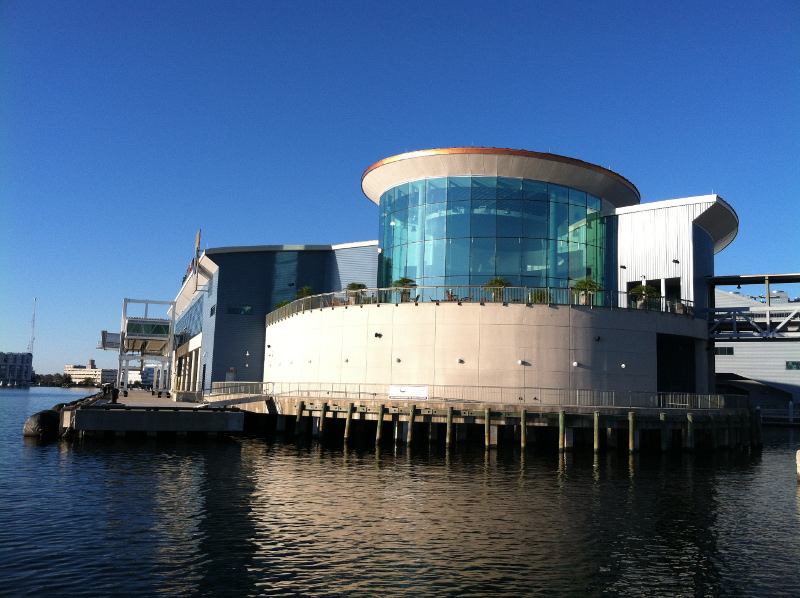
Half Moone cruise ship terminal (October 2012)
By building the Half Moone terminal, Norfolk pulled the cruise business away from Newport News for slightly more than a decade, but will pay the costs for 30 years. Back in 2002, local officials were excessively optimistic, with the director of Nauticus predicting:18
Completing the Half Moone cruise terminal in 2007 was part of a conscious initiative by Norfolk officials to invest in infrastructure to revitalize the downtown area, starting in the 1980's with city funding to build the Waterside Festival Marketplace and Town Point park. A 2007 economic analysis, completed before the opening of Half Moon terminal, estimated that investment of $250 million between 1996 to 2006 (including the Cruise Terminal, Nauticus center, and battleship USS Wisconsin) resulted in an additional $18.5 million per year of annual tax revenues from downtown Norfolk residents and businesses.19
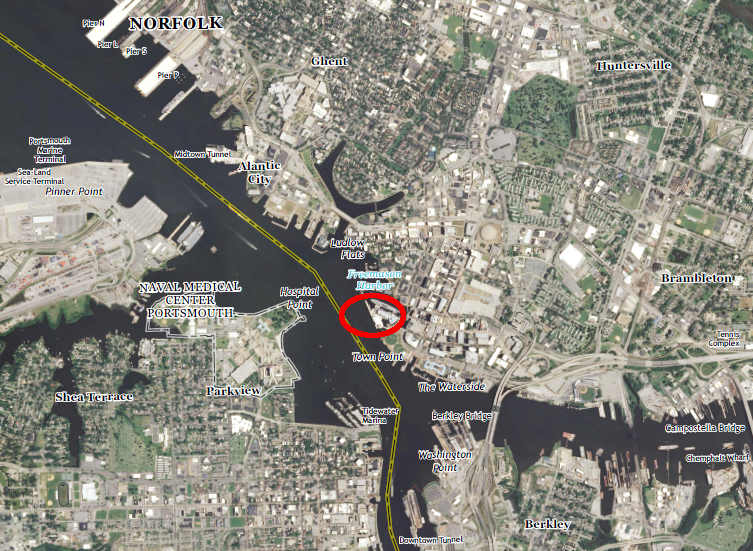
Half Moone cruise ship terminal was built just north of Town Point,
with Nauticus sandwiched between the terminal and the USS Wisconsin
Source: US Geological Survey (USGS), Norfolk South US Topo Revision 1 (2013)
The city never had any long-term guarantee that the cruise lines would use the Half Moone terminal long enough to repay the initial capital costs of building the facility. Even the annual operating costs had to be subsidized - the $7.7 million generated by the terminal was not adequate to cover the $9.2 million in operating costs between 2007-2013. However, indirect economic benefits from customer purchases (estimated at $135.50/customer) may have generated sales taxes and boosted property taxes downtown, offsetting some or all of the $1.5 million subsidy by the city.20
Following the announcement that Carnival Cruise Line would stop scheduling cruises after 2013, the local Virginian-Pilot newspaper editorialized that Norfolk needed to develop a new purpose for the Half Moone facility. The newspaper noted that the claims of $61.7 million in economic activity generated by the cruise ship terminal did not translate directly into tax revenue for the city.
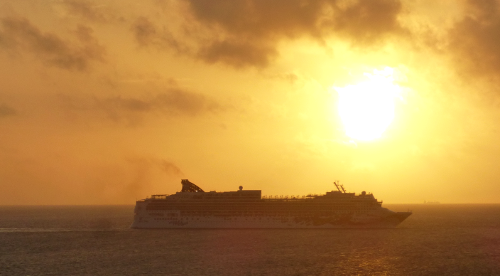
cruise ship lines can sail away from Norfolk... and never return, since they are not obligated to pay for the Half Moone terminal or other infrastructure constructed to attract ship visits
There were clear economic benefits from cruise ship visits, but primary beneficiaries were local businesses rather than the taxpayers who funded the infrastructure. The paper questioned if the city had received a good return on the investment, and called for efforts to make Half Moone into a profitable/sustainable project rather than keeping it dedicated as a cruise terminal - an "extremely expensive anchor for a nonexistent boat."21
In January 2014, Carnival reversed its decision and announced plans to "homeport" cruise ships in Norfolk again starting in 2015. The company had decided to meet air quality standards by installing scrubbers to reduce the sulfur emitted from the cruise ship smokestacks. That investment reduced the marginal cost of sailing from Norfolk through the wide North American Emission Control Area.
The continued marketing efforts by Norfolk/Virginia officials to retain the cruise business were successful. Carnival returned again to Norfolk in 2015, scheduling a total of 5 trips from Norfolk to the Bahamas and Bermuda. The cruise line committed to offer far more trips out of Baltimore on a year-round basis to more destination, but Virginia retained a toehold in the cruise business.22
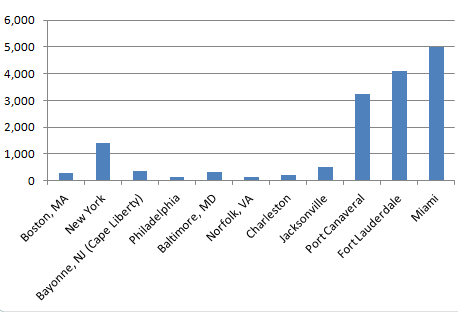
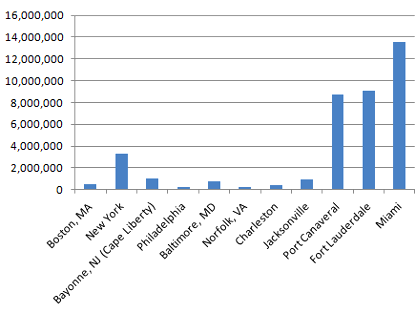
on the East Coast, New York and Florida ports dominated the cruise business between 2004-10 and most cruise passengers used Florida ports, leaving other cities (such as Norfolk) to compete for a tiny share of the market
Source: US Maritime Administration - Cruise Detail Table
In 2016, the city renamed the terminal to honor Peter Decker Jr. He was a lawyer who had been instrumental in redeveloping downtown, in part through creation of the downtown improvement district. He was well known in the area as a generous philanthropist supporting local causes, served on the board of Nauticus, and was a champion of building the Half Moone Cruise and Celebration Center. He was inspired by the Cows on Parade art exhibit in Chicago, and stimulated Norfolk to adopt mermaids as the city mascot and display statues of them across the city.23
Two German cruise lines, Tui and Aida, started to visit the Decker Half Moone Center in 2017. The cruise ships scheduled day trips for passengers to visit the Historic Triangle of Williamsburg, Jamestown and Yorktown, and also to explore Norfolk. The cruise ships themselves did not sail up the York River and dock at Yorktown.
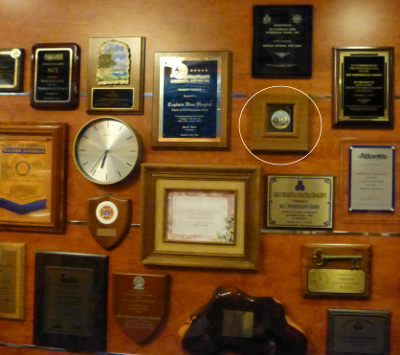
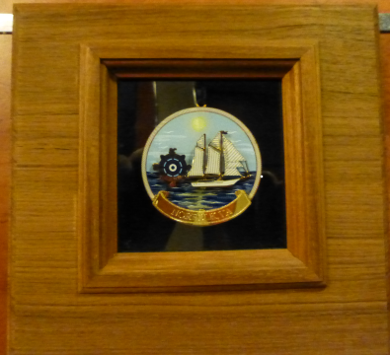
the Norwegian Cruise Line ship Dawn displays plaques recognizing when it first visited a port, including Norfolk
However, Norfolk officials were disappointed to learn in 2017 that Carnival would not start or stop trips at Norfolk in 2018. The cruise line's pattern had been to load passengers at Half Moone Cruise and Celebration Center for cruises to Bermuda as a ship moved in the spring season from winter cruises in Florida to New York, or moved the ship in the fall from New York to Florida.
In 2018, Carnival interrupted that pattern when it added a larger ship to its fleet. The new Horizon did not travel between New York to Florida when it went into service for the winter season, so Norfolk was not a halfway point for a port call. Carnival also determined that the larger Horizon, which could accommodate 4,000-passengers, exceeded the capacity of Norfolk's terminal.
Carnival scheduled a smaller ship for 2019 cruises to the Bahamas. The Triumph, with a capacity of 2,754 passengers, was booked for three trips to Nassau and Freeport in May, 2019 and for two trips in October. The 2020 trip schedule added Cuba as a destination for two trips that start at Norfolk.
After President Obama loosened restrictions on travel to the island, 55% of American tourists went to Cuba by cruise ship. However, plans to spend a week at Havana were interrupted when President Trump prohibited cruise ships from stopping in Cuba. Carnival kept the two trips on its Norfolk schedule. It offered everyone who had booked the cruise a $100 onboard credit for a trip to another destination in the Caribbean, or a full refund.24
Though no cruise ship trips started or stopped in Norfolk in 2018, the Half Moone was still active. There were 22 "port calls" (one-day visits) by different ships in 2017 and 30 in 2018.
Port calls may generate more revenue for local businesses that trips that start or stop at Norfolk, since passengers go shopping and pay for experiences such as historical tours and bike rides around Hampton Roads. One trade organization estimated the average passenger who got off a ship during a port call spent over $100.
When the cruise ship Sunrise re-started home port trips from Norfolk on April 29, 2019, 3,309 passengers got onboard in Norfolk and sailed to the Bahamas About 2,400 of the customers lived in Virginia.25
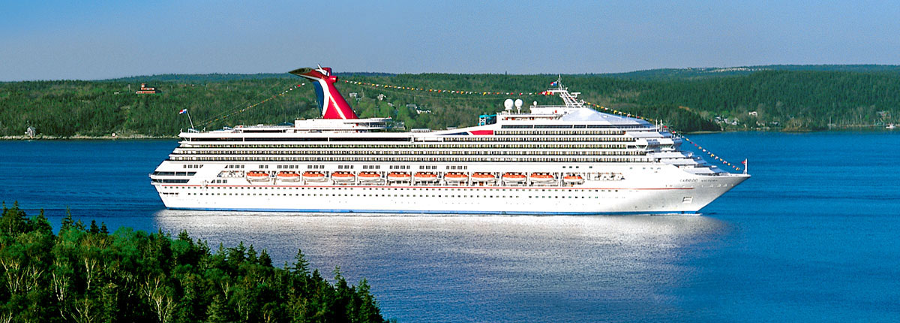
Carnival scheduled the 2,754 passenger ship Triumph to visit Norfolk five times in 2019
Source: Carnival, Carnival Triumph
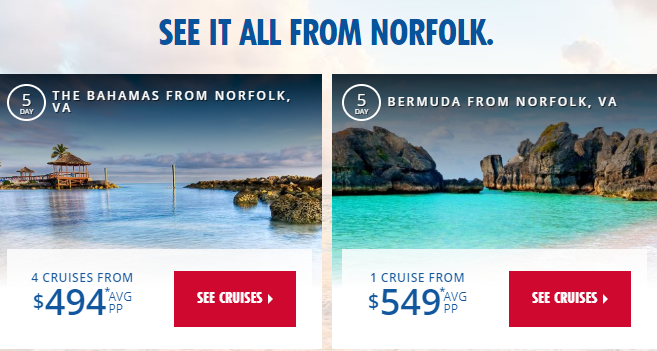
Carnival scheduled eight departures in 2020 from Norfolk
Source: Carnival, Norfolk, VA
In 2020, Carnival Cruise Line announced a five-year deal to use the Decker Half Moone Center as a starting/ending point for cruises to the Bahamas, Bermuda, and the Caribbean, including Cuba. The city committed to expand the gangway at a cost of $4-5 million. The cruise line guaranteed only $350,000/year, but the city projected it might get nearly $1 million/year in revenue from the extra cruise business.26
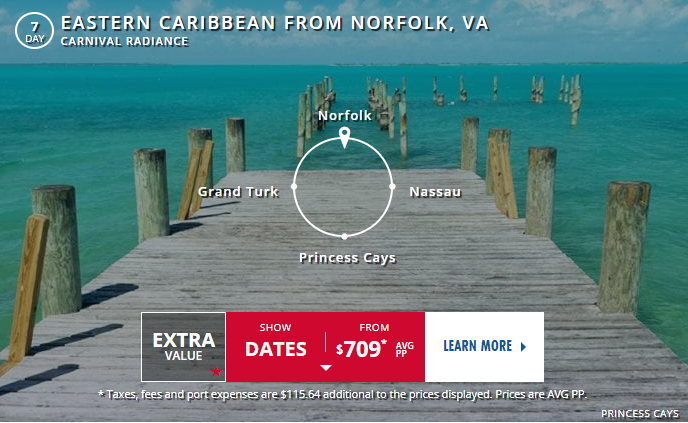
Carnival scheduled 12 departures in 2021 from Norfolk
Source: Carnival
In 2020, Carnival, American Cruise Lines, Norwegian Cruise Line, Blount Small Ship Adventures, Regent Seven Seas Cruises, Princess Cruises, Crystal Cruises, and Scenic scheduled 22 stops at Norfolk.27
Norfolk has built a full-scale terminal for cruise ships, but the city is not the only Virginia port of call. American Cruise Lines operates an 11-day "American Revolution Cruise" out of Baltimore that stops at Alexandria and Yorktown as well as Norfolk. The 7-day "Chesapeake Bay Cruise" visits Tangier Island as well as Yorktown. The 15-day East Coast Inland Passage Cruise stops at Norfolk on the way to Jacksonville.28
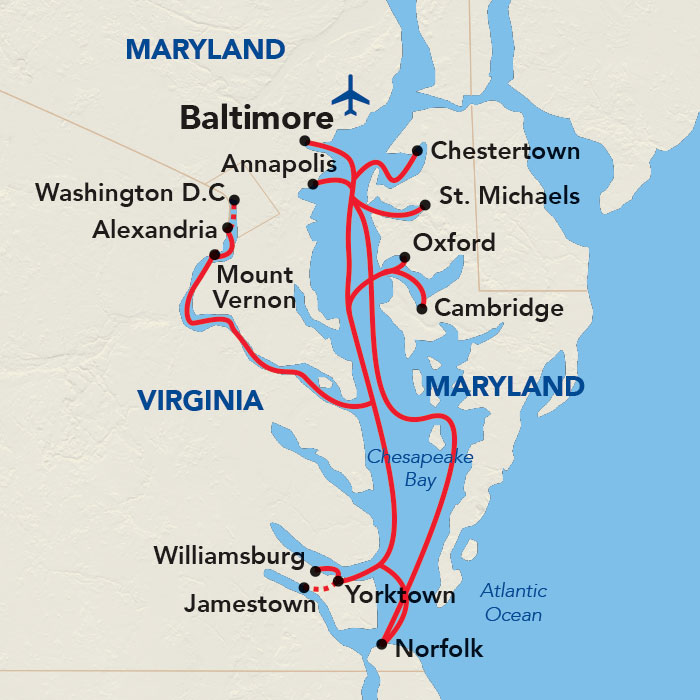
the American Revolution Cruise out of Baltimore stops at Alexandria and Yorktown, as well as Norfolk
Source: American Cruise Lines, American Revolution Cruise
The 2020 coronavirus pandemic ended Norfolk's dreams of a banner year for cruise ship sailings from the Decker Half Moone Center, with two Carnival cruises. Spring and Summer trips were cancelled first, eliminating the expected financial benefits from tourism.
Carnival Cruise Line did not propose any changes to the five-year deal, but the viability of the industry was unclear after early stories about the coronavirus focused on its spread among cruise ship passengers and crews. Dr. Anthony Fauci, director of the National Institute of Allergies and Infectious Diseases (NIAID), advised in March:29
Three cruise ships operate by Norwegian Cruise Lines, the Norwegian Bliss, Norwegian Spirit and Norwegian Encore, rented berth space and docked at the Portsmouth Marine Terminal (PMT) after the start of the pandemic in 2020 forced cancellation of planned trips. The company parked the large ships until business could be restarted. Space was available in part because the Port of Virginia closed the terminal to all container traffic, directing such ships to Norfolk International Terminals and Virginia International Gateway instead.
A passenger on a previous cruise of the Norwegian Bliss tested positive for the virus which caused the Covid-19 disease. Before being allowed to dock, the Centers for Disease Control and the Virginia Department of Health approved the plan of operations for the cruise ships. Just 10% of the 1,700 crew members stayed on board, with no opportunity to get off the ship.30
The three ships sailed away in August, 2020. Norwegian Cruise Lines did not announce their destination at the time.31
In 2021, anticipating a recovery of cruise line operations after COVID-19, Norfolk decided to construct a $2.6 million cruise ship gangway and in 2024 to expand the Peter G. Decker Jr. Half Moone Center. Norfolk had minimal cruise activity in 2021, but a full-scale restart was planned for 2022.
Carnival Cruise Line announced plans for 2022 cruises from Norfolk to Bermuda, the Bahamas, and the eastern Caribbean using the 4,000-passenger ship Carnival Magic. Carnival had planned to bring that ship to the Half Moone Cruise and Celebration Center in 2021 before the COVID-19 pandemic.
Norwegian Cruise Lines was the first major cruise line to return to Norfolk. The Norwegian Getaway arrived on February 20, 2022. The company used Norfolk regularly. The Norwegian Gem arrived on April 10, 2022, and a day later the Norwegian Getaway returned.
The first post-pandemic ship to sail initially from Norfolk was the Carnival Magic in May. It was the largest cruise ship ever to dock at the Half Moone Cruise and Celebration Center, with room for 4,724 passengers. For 2022, Norfolk expected to see 180,000 cruise ship passengers compared to 68,000 passengers prior to COVID-19.32
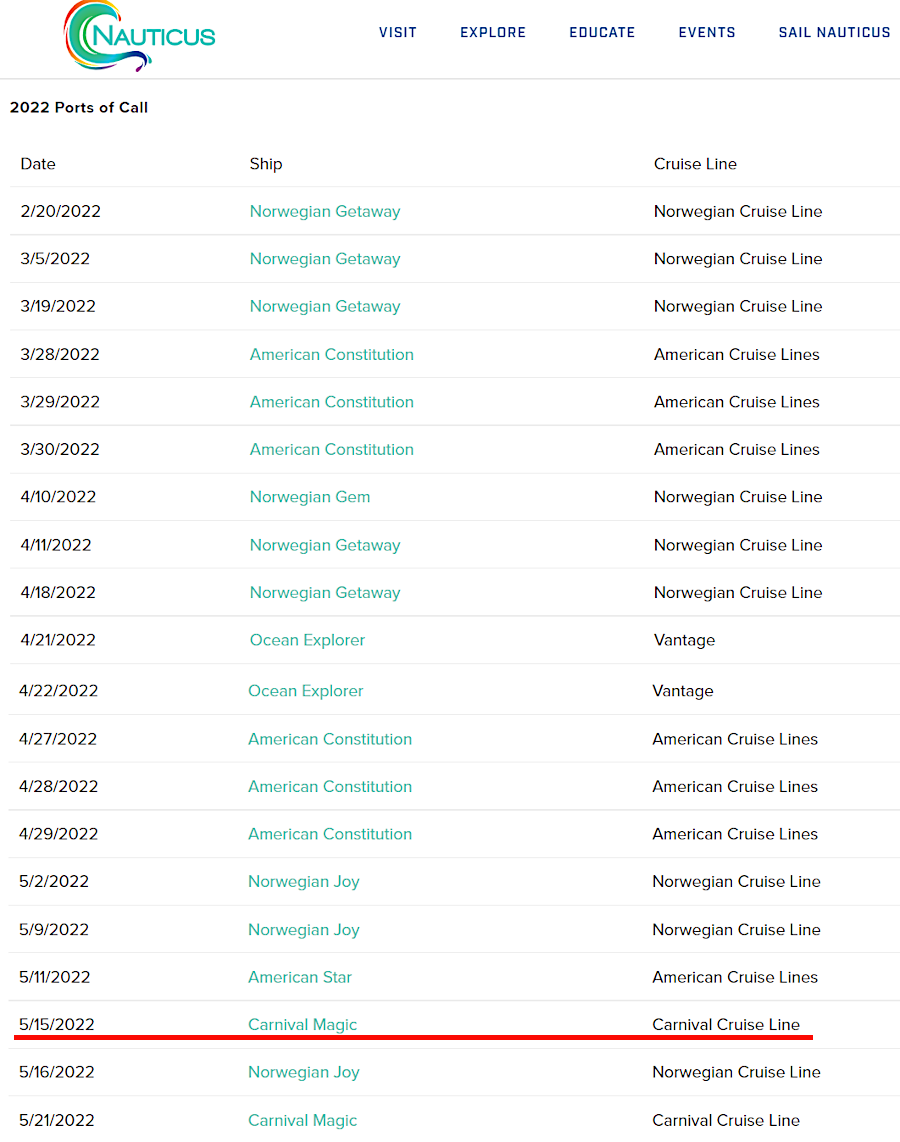
Carnival Magic cruises after COVID-19 restarted on May 15, 2022
Source: Nauticus, Cruise Schedules
The restart was marred in July by break-ins of cars of passengers sailing on a cruise. The cars were parked in a City of Norfolk lot, but both the cruise line and the city said they were not responsible for the damages. A Carnival Cruise Line official commented:33
Carnival Cruise Line operated 11 cruises from Norfolk in 2022, as Carnival Magic sailed from both New York and Norfolk between May and October. For 2023, the company added a new ship to its fleet and committed to sail continuously from Norfolk for six months, offering 4-10 day trips. Available itineraries aboard Carnival Magic include the Eastern Caribbean, the Bahamas, Bermuda, Canada and New England. That expansion of cruises was expected to bring another 100,000 customers through the cruise terminal, enhancing economic development in Norfolk.
Norfolk upgraded security at the Cedar Grove Parking Lot before the cruise season started with the departure of the Carnival Magic on May 14, 2023. New fencing and lighting were added, and sheriff deputies patrolled the lot rather than a private security firm.
Norfolk expected 200,000 visitors in 2023 from cruise trips sailing between May-October. The city had refused to compensate passengers whose cars were burgled in 2022, but recognized the need to address the risk that cruise lines would reduce sailings if security did not meet their expectations. The city's parking director said:34
Overall, the cruise industry was bullish on growth. The old canard dating back to the 1970's television show "Love Boat" was that cruises were for the "newly wed and nearly dead," but by 2022 the average age of cruisers was 46.5 years. Cruises were family vacations, with nearly 75% of passengers traveling together with at least one other generation of their family.
As described by Cruise Lines International Association:35
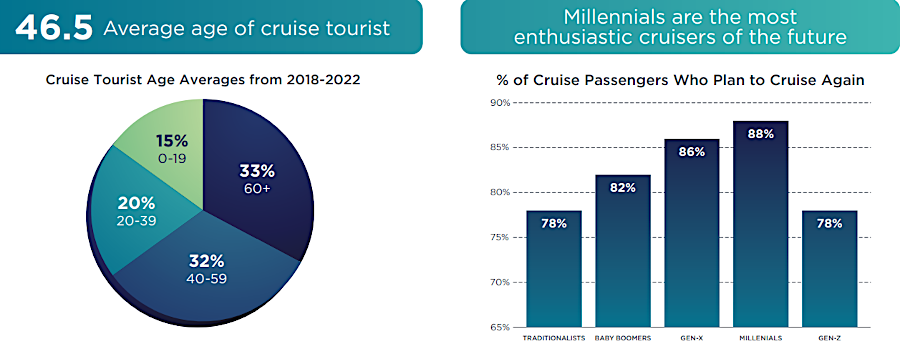
the cruise industry projected steady growth in 2023, based in part upon the young age of cruise passengers
Source: Cruise Lines International Association, The State of the Cruise Industry 2023
In addition to planning 26 sailings in 2023, Carnival Cruise Line also announced plans to offer year-round sailings with weekly departures from Norfolk starting in 2025.
Even more sailings than planned occurred in 2024. The I-695 (Francis Scott Key) bridge over the Patapsco River collapsed in March, after being struck by a container ship which lost power when leaving the Port of Baltimore. Carnival quickly switched cruise sailings going to Nassau in the Bahamas from Baltimore to Norfolk.
The 2,600 passengers on the Legend who had sailed out of Baltimore had to disembark at the Half Moone Cruise and Celebration Center. Carnival arranged for 70 buses to carry them north to where they had started at the Baltimore terminal. Another 2,600 passengers then got on the ship for another cruise.
Royal Caribbean did the same, redirecting the 2,500 passenger Vision of the Seas to land at Norfolk. The company also relocated two April cruises to the Virginia port.
Nauticus Executive Director said that the facility welcomed the unplanned cruises, but:36
Since Norfolk had been successful in recruiting more cruise ship sailings and becoming a year-round home port for Carnival, city officials anticipated that each week a ship would be disembarking 3,000 passengers and loading another 3,000 that same day. Norfolk officials welcomed the cruise ship visits and sought to increase the number.
In contrast, Charleston abandoned its status as a home port for cruise ships. The South Carolina Ports Authority announced in 2022 that it would redevelop Union Pier, and after 2024 only brief port-of-call visits by cruise ships would be accommodated at its terminal. Charleston officials welcomed day visits by cruise ship passengers, but objected to being the starting/ending point for cruises. As a home port, too many cars clogged downtown Charleston traffic. As just a port-of-call destination, passengers would still visit the city and generate revenue, but their cars would not occupy parking spaces for the entire time of the cruise.
Carnival then arranged to use Norfolk as a home port, with the Carnival Sunshine leaving and arriving each week. That ship, formerly the Carnival Destiny, went through a $155 million retrofit at the Chantier Naval de Marseille in France before starting service at Norfolk.
The Carnival Magic, which could accommodate 4,724 guests, had begun using Norfolk as a port stop in May 2022. The cruise line increased the number of its sailings and used Norfolk as a Carnival Magic home port for half of 2023, after adding another ship to service New York customers in the spring/summer season.
To provide better service as a year-round home port, Norfolk appropriated $12 million to upgrade the Half Moone Cruise and Celebration Center. Starting in June 2024, Carnival ships stopped sailing to Norfolk to facilitate the construction. The diversion of cruise ships from Baltimore to Norfolk after collapse of the Francis Scott Key bridge was handled without delaying the project.
An air-conditioned seating space for 600 people waiting to board was scheduled for opening in late 2025. By the time the revamped terminal opened in February 2025, a new sloped walkway from the first to second floor allowed disembarking passengers to move downstairs faster in order to go through customs. The city executive responsible for the Half Moone Cruise and Celebration Center said:37
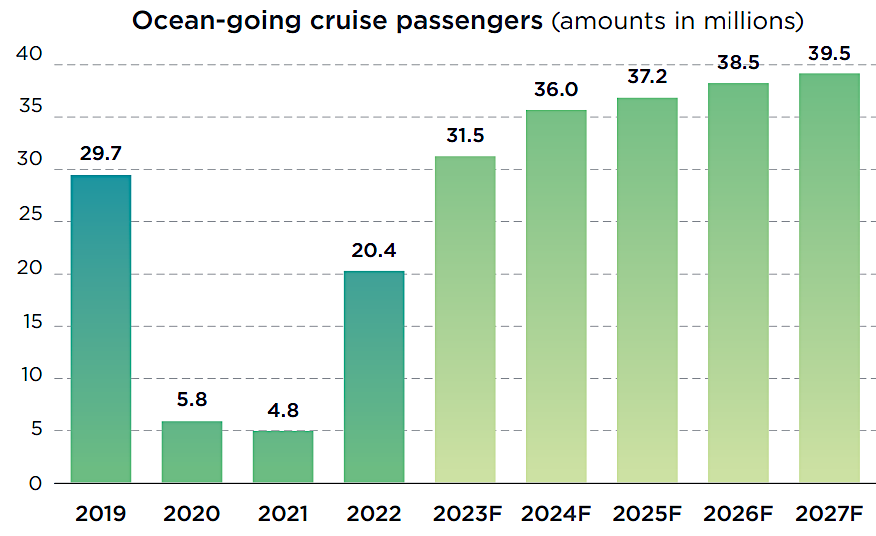
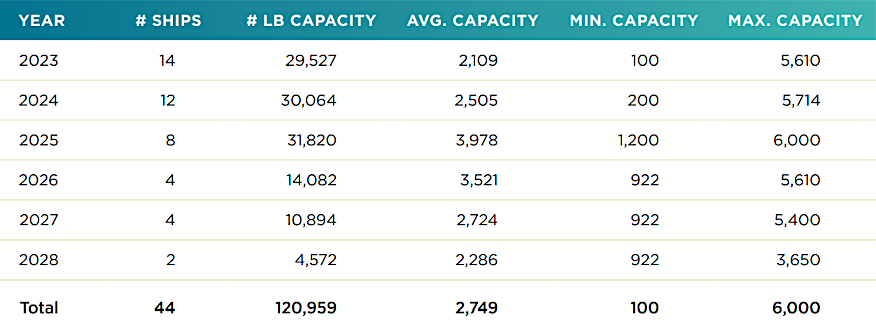
the cruise industry planned for significant growth after the COVID pandemic, with 44 new ships added to the fleet between 2023-2028
Source: Cruise Lines International Association, The State of the Cruise Industry 2023
Weekly cruises from the Half Moone Cruise and Celebration Center started February 11, 2025. The Norfolk business community, particularly hotels, prepared for the increased number of visitors. Tourism officials estimated that each cruise ship passenger would spend $250 in the home port city. With 3,700 people per year getting on and off the Carnival Sunshine and other ships each week, the 2025 economic impact was expected to be significant. Economic development offices anticipate passengers will stay in a hotel at least one night before or after a trip, and even donut shops near where passengers park their cars during the cruise will see a surge of business.
The increased cruise schedule was not impacted by the decision of the second Trump Administration to target cruise ship employees for deportation. In the summer of 2025, 28 Filipino employees with valid C1/D visas for employment on the Carnival Sunshine were seized by Customs and Border Protection agents. They were accused of being involved in child pornography, threatened with a $250,000 fine or jail, and flown back to the Philipines.
Advocates for the workers claimed they had no involvment with any criminal activity, and the deportations were designed to meet arbitrary quotas assigned for political reasons to Customs and Border Protection offices. The cruise ship response was:38

cruise ships bring thousands of tourists to Norfolk, stimulating the tourist economy
Source: Watts, 2016 Norfolk Harborfest Virginia Carnival cruise ship Sunshine line
The executive director of Nauticus told the Norfolk City Council about the benefits of establishing the city as a home port:39
In a separate 2025 interview, he described how to expand the economic impact by attracting additional ships to visit Norfolk in the middle of a cruise that started elsewhere:40
In 2027, the newer ship Carnival Freedom with capacity for 3,000 passengers was scheduled to replace Carnival Sunshine. Norwegian Cruise Line planned for its 2,400 passenger Norwegian Pearl to stop at Norfolk 20 times during 2027, with weekly visits between April-August.41
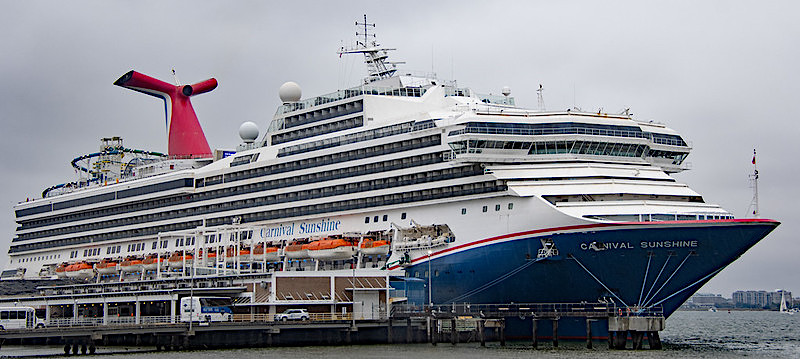
the Carnival Sunshine began weekly sailings from Norfolk on February 11, 2025
Source: David, IMG_1024
In addition to large cruise ships, a number of smaller operations offer cruises on Virginia waterways. The James River Batteau Company offers two-hour floats on the James River at Scottsville, with up to six people in a batteau. Jamestown Discovery Boat Tours, based out of Williamsburg, offers sightseeing tours for up to 28 people on a pontoon boat.
James River Discovery also uses a pontoon boat to offer bald eagle and Civil War tours on the James River downstream of Richmond. Venture Richmond offers 40-minute narrated tours on the James River and Kanawha Canal in downtown Richmond.
Assateague Explorer, based on Chincoteague Island, offers a variety of scenic and wildlife tours on the waters around Assateague and Chincoteague islands. One option is a Pony Express Nature Cruise.42
The Spirit of Norfolk cruise boat caught fire on July 7, 2022 while taking kindergarten students around the Norfolk harbor. The $4 million ship was destroyed; the remnants ended up as an artificial reef in waters near Florida.
CityExperiences had multiple boats in its fleet on the Potomac River, which were used to offer cruises from Alexandria as well as Washington and National Harbor. The company selected one to substitute for Spirit of Norfolk and as a temporary measure, the Spirit of Mount Vernon was brought down from Alexandria. Harbor cruises on the Elizabeth River in a new boat named the Spirit of Norfolk restarted on October 3, 2024.43
Opposition to the cruise industry evolved in Yorktown when Princess Cruise Lines proposed to start making visits at that town. Large cruise ships would anchor offshore and bring thousands of people within one day through Yorktown, with many traveling inland to see Williamsburg and Jamestown. York County residents organized as the "Preserve Yorktown" group and successfully convince local and state officials not to support port-of-call stops at Yorktown by 2,000–3,600 passenger cruise ships. Smaller ships filled with tourists remained welcome, however.
The Preserve Yorktown group then reorganized as Protect Virginia. It advertised:44
In 2024 Protect Virginia petitioned the Virginia Department of Environmental Quality to establish tighter regulations on "ocean-class" passenger cruise ships traveling on state-controlled waters. The Air Pollution Control Board and the State Water Control Board were requested to:45
Preserve Yorktown defined its definition of the "appropriate scale" of cruise ships visiting the town:46
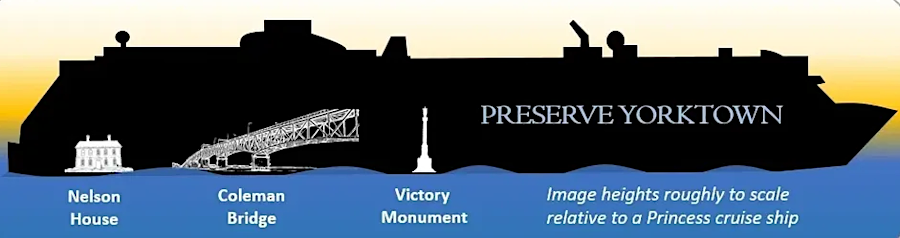
Preserve Yorktown objected to the large cruise ships, while accepting visits from those with ~200 passengers or less
Source: Cruise Lines International Association, About Preserve Yorktown
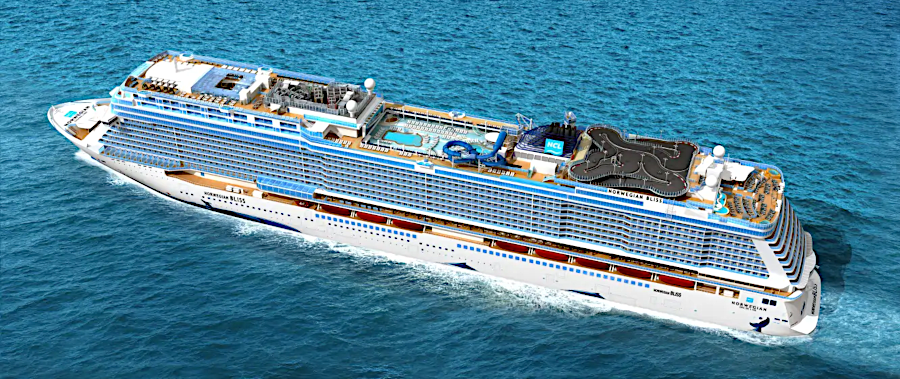
the 1,092-foot-long Bliss and two sister ships were parked at Portsmouth Marine Terminal during the COVID-19 pandemic in 2020
Source: Norwegian Cruise Lines, Norwegian Cruise Line Unveils Features For Norwegian Bliss