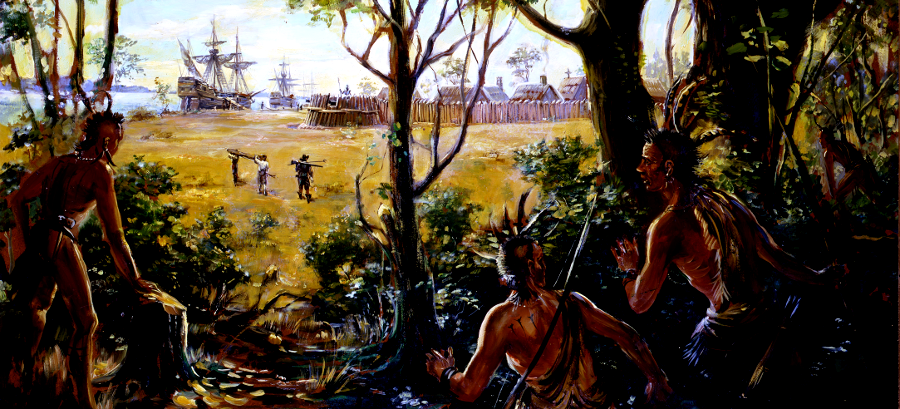
Jamestown started as a fort, placed on an island without permission from the current inhabitants
Source: National Park Service, Jamestown - Sidney King Paintings, Watching the Colonists Construct James Fort
Jamestown started as a fort, placed on an island without permission from the current inhabitants
Source: National Park Service, Jamestown - Sidney King Paintings, Watching the Colonists Construct James Fort
The investors in the Virginia Company named their first town after the king of England, who granted the charter that authorized their business venture. English sea captains were politically-correct as well, and the large tributary known locally as "Powhatan's River" was renamed the James River.
Christopher Newport followed his orders and brought the 104 colonists far upstream from Hampton Roads when selecting the site for Jamestown. The colonists cleared the land, built a fort, and by the end of summer they had started to die.
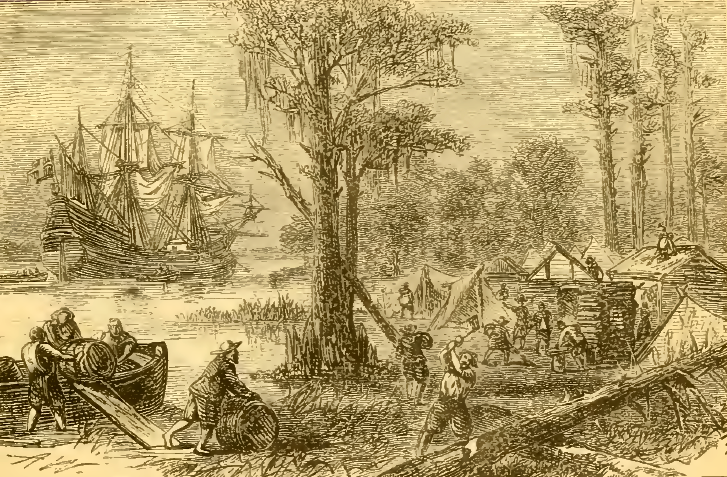
starting at Jamestown required cutting trees and making a palisade for the fort, plus timbers for houses and the church
Source: Internet Archive, A School History of the United States, from the Discovery of America to the Year 1878 (p.33)
The colonial capital struggled through hard times initially. England had experience with settling Ireland, but Virginia was far different.
Powhatan skillfully milked the colonists for ornamental copper and beads, plus the iron tools (hatchets, needles, etc.) that dramatically improved Algonquian agriculture and the manufacture of clothing. He even obtained guns and training to use them. The English were aliens who just appeared without warning in his territory, and Powhatan restricted their expansion outside the settlement for several years.
The English had abandoned Roanoke Island twice in 1584 and again in 1585 before the third colony in 1587 was "lost." Jamestown was abandoned too, in 1610. After the 1609-10 winter known today as the "Starving Time," the English settlers crowded aboard ship and fled Virginia.
They sailed down to the mouth of the James River, headed home in defeat. To their surprise, they met Lord De le Ware's ship, arriving from England with new supplies and new people. The colonists abandoning Virginia had not burned the fort at Jamestown before leaving, and Powhatan had not done so either. The English were able to return to Jamestown and start over again in June, 1610.
The colony struggled along through the first Anglo-Powhatan War in 1609-14, which ended essentially when Powhatan decided to adopt other tactics and signaled peace by allowing his daughter Pocahontas to marry John Rolfe in 1614. Rolfe identified how the colony could make a profit, after he imported sweet-scented tobacco seeds from the West Indies and grew a crop successfully.
Tobacco, an agricultural product which had no value as a food, quickly became a wildly marketable product in Europe. The colony had discovered an economic basis for survival, and all open spaces - even the streets of Jamestown, at one time - were planted in tobacco.
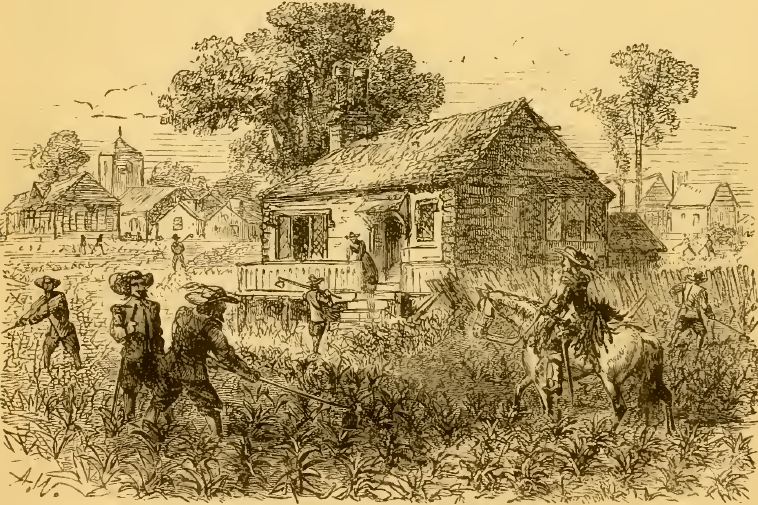
after hearing of the demand for tobacco, residents of Jamestown supposedly grew tobacco in the streets of Jamestown (which were already cleared of trees)
Source: Internet Archive, A School History of the United States, from the Discovery of America to the Year 1878 (p.40)
Jamestown did not grow into a major population center initially, because the whole colony was slow to grow even after the success of tobacco became clear. To attract immigrants, the Virginia Company allowed colonists to establish a form of self-rule via a House of Burgesses. This ended the martial law imposed by Sir Thomas Dale in 1611. The elected representatives first met in July, 1619, and that group continues today as the General Assembly of Virginia.
The original meeting spot was the church in Jamestown, the largest facility in the colony. The General Assembly met in a wooden structure 50' long by 20' wide, slightly longer and twice the width of a modern Greyhound bus. The 1907 Memorial Church on Jamestown Island allows modern visitors to discover that the largest building was tiny and cooled only by breezes.1
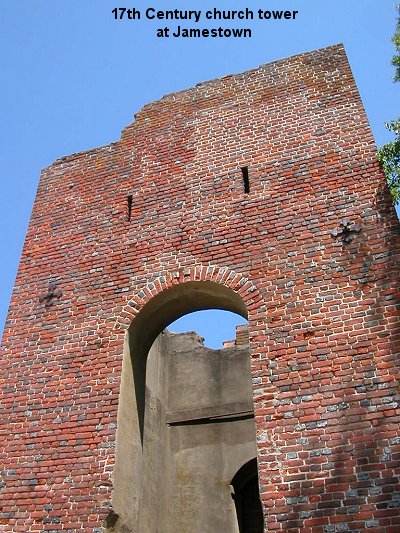
the tower next to the reconstructed church at Jamestown is the oldest remaining structure at Virginia's first capital
In a society without easy access to soap and running water, where men squeezed tightly to fit into a small confined space with no fans or air conditioning in July, it's not hard to imagine why meetings were short and occasionally tempers would flare. Jamestown was a place where conflicts were resolved, but the process was not elegant.
During the General Assembly meetings, Jamestown smelled - literally. Horses contributed increased levels of manure, and humans splashed their equivalent into outhouses where the groundwater near the surface filled the holes.
The decisionmakers who gathered were men (no women could vote), and in the 1600's they were typically working men with callused hands from physical work on their farms. Their talents in making speeches or negotiating deals varied, but their hygiene was consistently different from modern times. The burgesses did not shower, apply ant-perspirant, and splash on some cologne each morning before gathering in a small space with no air conditioning. By the end of the day, that space would have been ripe with odors.
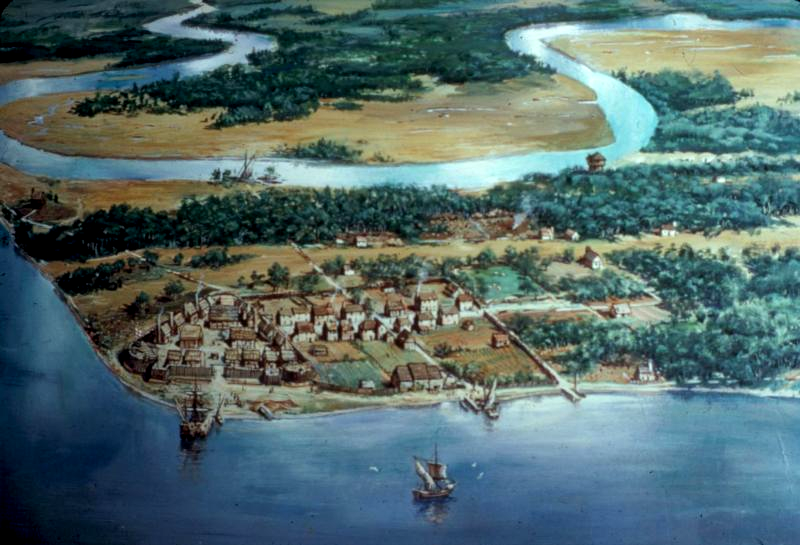
in less than 10 years Jamestown expanded from a fort into a town, with houses aligned along two major streets
Source: National Park Service, Jamestown - Sidney King Paintings, Jamestown About 1614 - Aerial View
Settlement around the fort did increase, slowly. The 1622 uprising led by Opechancanough destroyed plantations away from Jamestown, including the settlement at Henricus that might have replaced Jamestown as the capital. Jamestown remained the central developed site in the colony.
Brick houses were built along two new streets parallel to the shoreline east of the old fort site, surveyed by William Claiborne. Town development was spurred by a combination of government mandates and subsidies, and "James Cittie" evolved. Governor Harvie built a substantial home on a New Towne lot, and it served as the statehouse in the 1630's.2
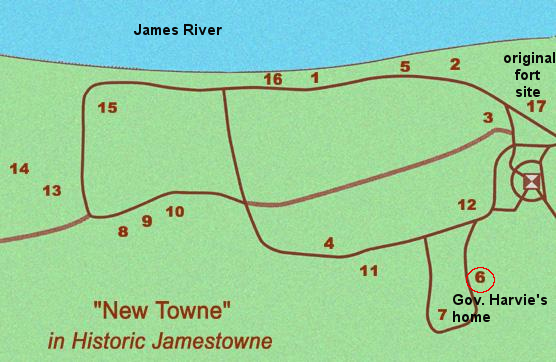
Gov. Harvie's home is #6 on the map of New Towne at Jamestown
Source: National Park Service, More Than a Fort: Historic Jamestowne's New Towne
During Bacon's Rebellion in 1676, the Statehouse and most of the buildings at Jamestown were destroyed. After looking at the ruins of the town:3
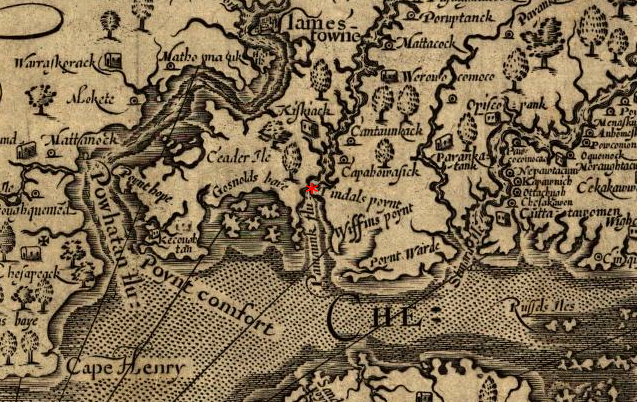
Tyndall's Point (Gloucester Point), considered as alternative to Jamestown after Bacon's Rebellion
Source: Library of Congress, Virginia / discovered and discribed by Captayn John Smith, 1606
The locally-approved move was vetoed by royal authorities in London, however, and the capital stayed at Jamestown. Through the 1690's, Jamestown was still a tiny village with inadequate meeting facilities for the House of Burgesses.
The statehouse in Jamestown burned again on October 20, 1698. The cause may have been arson, a fire caused by a prisoner in jail awaiting execution with nothing left to lose. Destroying the statehouse removed the meeting space for the General Court.4
The General Court was a smaller group than the House of Burgesses, since it consisted of just the governor and his Council of State. The appointed councilors were the wealthy members of the colony, the "upper crust" of the gentry. Despite the greater sophistication and fancier clothing of the people appointed to the Council, the odors in their meeting room would still be considered appalling to modern legislators, lobbyists, and visitors to the General Assembly.
Before the 1698 fire, proposals to move the capital to Middle Plantation nearby had been rejected as requiring too much effort. After the statehouse was destroyed, a team of students at the new College of William and Mary presented a proposal to move the capitol to their site. More significantly, Francis Nicholson was appointed as the new royal governor of the colony.
He had served previously as lieutenant governor in 1690-1692, before being appointed the royal governor for Maryland. Nicholson remained engaged with Virginia as a trustee of the College of William and Mary, so he was familiar with the advantages of Middle Plantation over Jamestown.
As Maryland's first royal governor after the Calvert's lost control over their proprietary colony, Governor Nicholson moved the Maryland capital from St. Mary's City to Annapolis in 1695. He helped design the new capital, and:5
The move occurred for multiple reasons. The colonists understood that the swamps at Jamestown were not healthy places. The road network on the Peninsula followed the faster-drying watershed divide, which passed through Middle Plantation.
As part of the decision to move, Middle Plantation was renamed Williamsburg. That honored the current king in London, just as the first settlement in 1607 was named after the king.
The General Assembly voted the necessary funds to construct a new capitol building in the new capital, the seat of government. In Jamestown, the meeting space of the General Assembly had been called the Statehouse. The new building in Williamsburg that served as the home of the General Assembly was the first building in North America to be called a "capitol."6
The local county seat for James City County remained at Jamestown for nearly 20 more years, but the island first occupied by English colonists gradually reverted to farmland. The town had been authorized to elect one member to the House of Burgesses in 1784. It retained that right after the capital moved until the end of the House of Burgesses in 1776, but with the decline in population as few as 25 voters participated in the elections at Jamestown.7
By the 1750's, the brick church built sometime in the 1600's was abandoned. The tower survived, but the rest of building collapsed along with all other structures from the colonial period.8
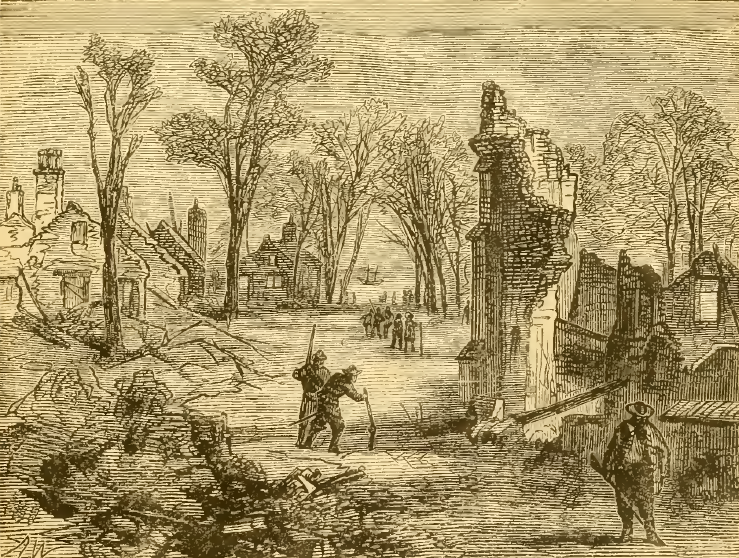
Jamestown rapidly declined after the colonial capital moved to Williamsburg and Yorktown developed as the port serving the new capital
Source: Internet Archive, A School History of the United States, from the Discovery of America to the Year 1878 (p.45)
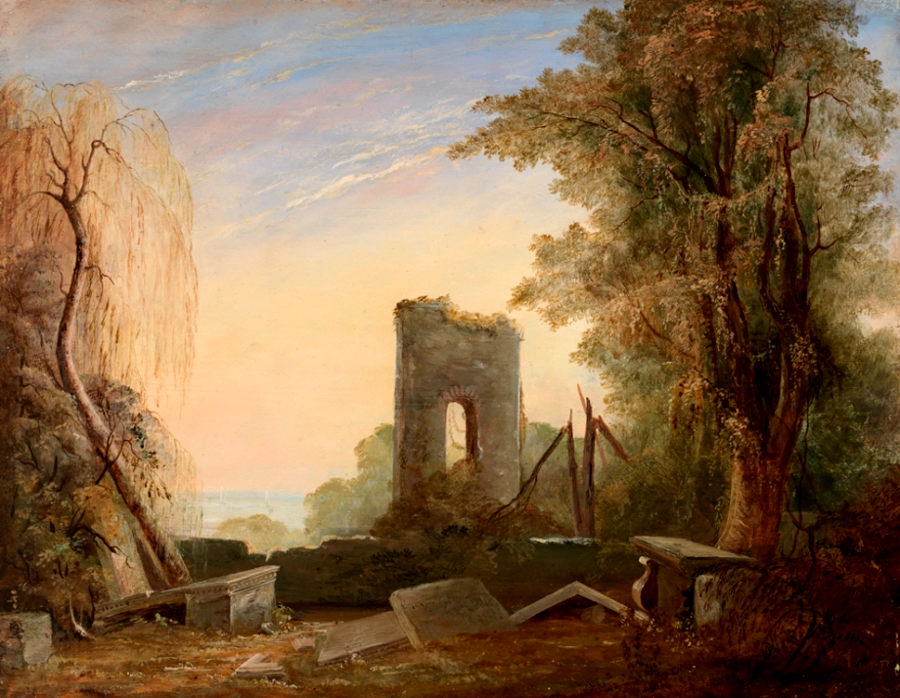
after the capital moved to Williamsburg, the church fell into ruins
Source: Virginia Historical Society, Ruins of Jamestown, Virginia (by John Gadsby Chapman, 1834)
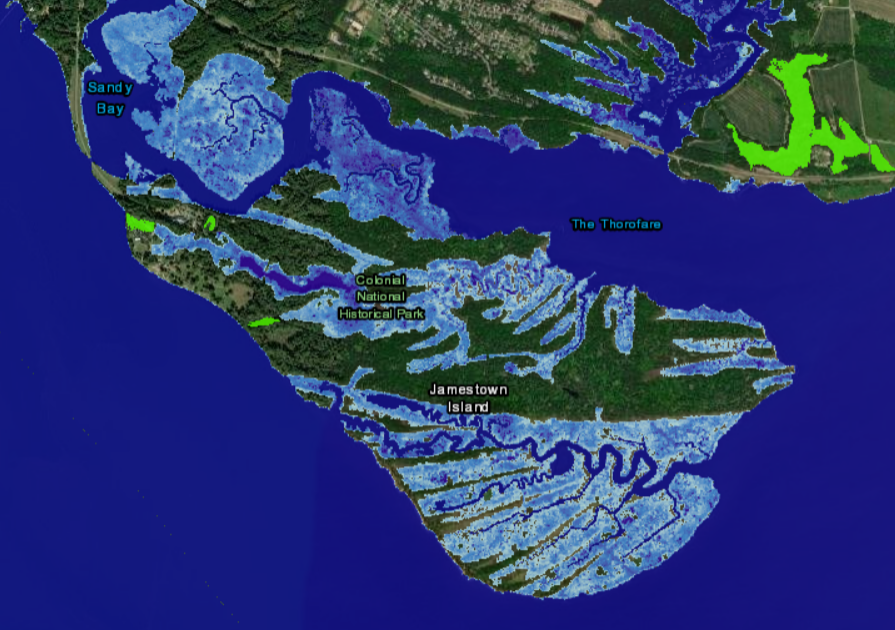
with one more foot of sea level rise, Jamestown will be flooded
Source: National Oceanic and Atmospheric Administration (NOAA), Sea Level Rise Viewer
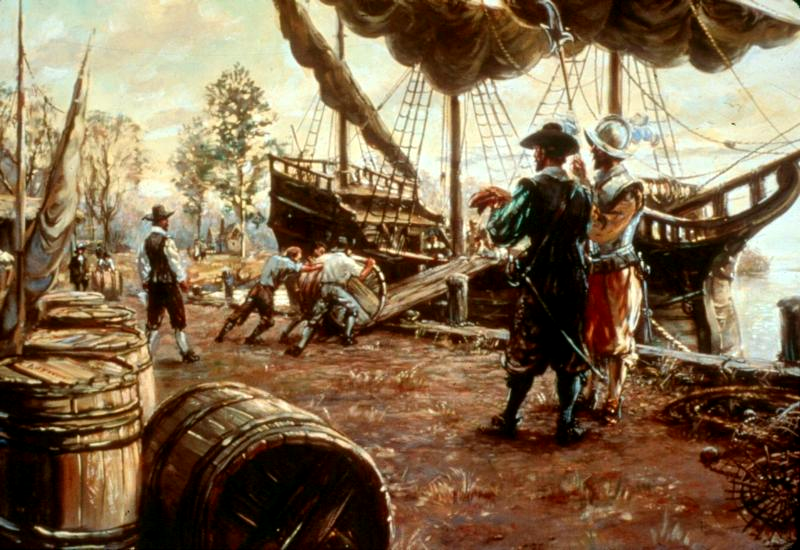
Jamestown was an international port throughout its entire existence, exporting hogsheads of tobacco and importing textiles, metal tools, and other manufactured goods
Source: National Park Service, Jamestown - Sidney King Paintings, A Shipping Scene
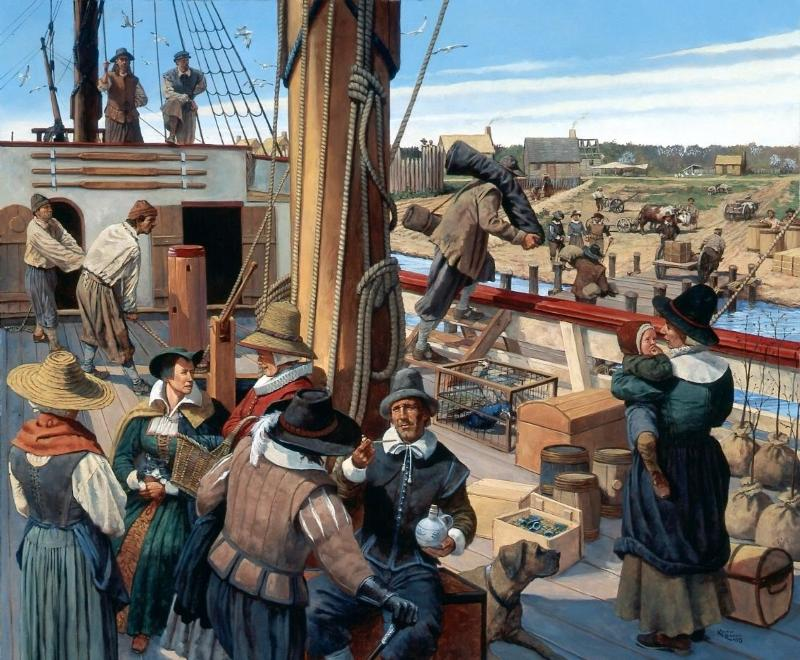
Jamestown was the commercial and shipping center of the colony in the 1600's
Source: From Fort to City - Jamestown in 1621 (Keith Rocco painting)