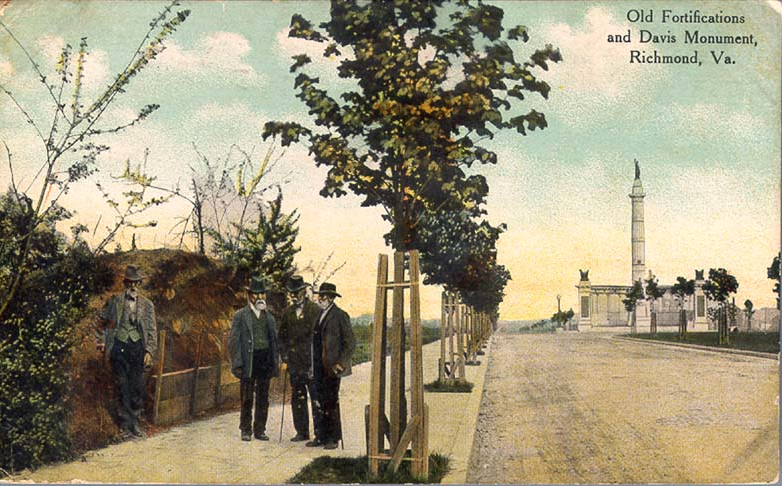
in 1910, a remnant of the original inner defense line's earth works was still visible next to the monument honoring Jefferson Davis
Source: Virginia Commonwealth University (VCU), Old Fortifications and Davis Monument, Richmond, Va.
in 1910, a remnant of the original inner defense line's earth works was still visible next to the monument honoring Jefferson Davis
Source: Virginia Commonwealth University (VCU), Old Fortifications and Davis Monument, Richmond, Va.
The Jefferson Davis statue in Richmond was at the intersection of Monument Avenue and what is now Davis Avenue. The Monument Avenue Commission circulated background material on it for a public forum in August, 2017:1
Date Conceived: December 21, 1889 (10 days after his death)
Date Erected: June 3, 1907
Location: Proposed: Monroe Park, then Broad Street. Final: Intersection of Monument Avenue and Cedar Avenue (later renamed Davis Ave.) at the site of the CW Star Fort.
Sculptor: Statue: Edward V. Valentine; monument design by architect William C. Noland
Organizers: In 1889 The Jefferson Davis Monument Association was created to build a monument and to make plans to have Davis's body reburied in Richmond. City Mayor J. Taylor Ellyson presided over the Association. The monument also was backed by the United Confederate Veterans and the Chamber of Commerce. The group sought $250,000 from former confederates across the south and their descendants. Varina Davis chose Monroe Park as a location and a competition was announced in 1896. The cornerstone for a temple-form design by Percy Griffen of New York was laid in Monroe Park, but the plan was abandoned due to insufficient funds. Around 1902, the United Daughters of the Confederacy (UDC) took up the cause, raising additional funds to add to the $42,000 left from the original association. Louis Gudebrod won another competition in 1902 but his design for a triumphal arch at Broad and 12th Street was disliked by Mrs. Davis; when fundraising issues continued, he quit. The next year the UDC went to Edward V. Valentine and William C. Noland, a Richmond sculptor and young architect respectively, and asked them to design a statue within the existing budget. In 1904 the UDC requested a site on Monument Avenue from city council following announcement of the site for Stuart. The council gave the UDC a site four blocks to the west on Cedar Steet (now Davis Avenue).
Description: The monument's design has a central 60' granite column topped by a female figure cast in bronze; an eight-foot tall bronze statue of Jefferson Davis with his right arm outstretched and his left hand resting on an open book; and a semi-circular exedra with a colonnade of thirteen doric columns. The literature created for the statue dedication in 1907 reads "Symbolized in the Vindicatrix, which crowns the shaft of the monument . . . the emblem of Southern womanhood fitly stands, the immortal spirit of her land, shining unquenched within her eyes, and her hand uplifted in an eternal appeal to the God of justice and truth." Below her are the words DEO VINDICI (by God the protector.) Also on the column are inscriptions reading PRO JURE CIVITATUM (for the rights of states) and PRO ARIS ET FOCIS (for heart and home.) The bottom of the column above Davis's head contains the seal of the Confederacy and the words JEFFERSON DAVIS PRESIDENT OF THE CONFEDERATE STATES OF AMERICA 1861-1865. Davis's pedestal contains the wording JEFFERSON DAVIS / EXPONENT OF / CONSTITUTIONAL PRINCIPLES / DEFENDER OF / THE RIGHTS OF STATES followed by a latin quote from Horace: CRESCIT OCCULTO VELUT / ARBOR AEVO FAMA meaning "The fame from a remote age grows like a tree." The colonnade includes thirteen doric columns decorated with the stars and bars of the Confederate military. The columns represent the eleven seceding states and the two which sent delegates to the Confederate Congress but did not secede (Missouri and Kentucky).
Original plans were to place the monument in Monroe Park in Richmond, before Monument Avenue was envisioned. A new York architect designed a domed structure comparable to a Roman temple. A cornerstone was laid there on July 2, 1896. Jefferson Davis's body had been moved to Hollywood Cemetery three years earlier, but that location was not considered to a large public memorial.
Fundraising then stalled, and the United Daughters of the Confederacy (UDC) took over responsibility for the memorial in 1899. A new design was for construction of a memorial arch on Broad Street at 12th Street, but Varina Davis was not satisfied with the design or the location.
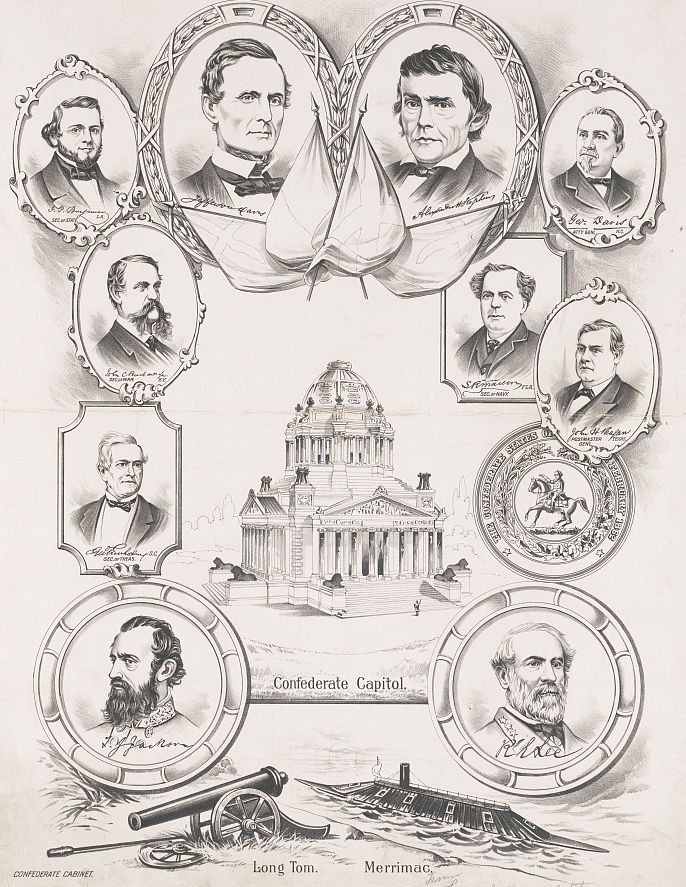
the orginal design of a Jefferson Davis memorial, to be constructed in Monroe Park, was a domed temple
Source: Library of Congress, "Confederate capitol" surrounded by portraits of confederate governing officials (1902)
Moving the arch to Monroe Park was considered, but In 1903, the United Daughters of the Confederacy chose architect William C. Nolan and sculptor Edward V. Valentine to create a structure to be located on Monument Avenue. In 1873 Jefferson Davis had posed for the sculptor, Edward Valentine, in his studio inside the carriage house of what is today the Valentine Museum in Richmond.
The new design included 13 columns in a semi-circular colonnade, intended to represent the 11 states that officially seceded plus the border states of Kentucky and Missouri. Members of the United Daughters of the Confederacy in Maryland tried to get a 14th column added. After the dissention was widely reported in the news, the issue was finessed by declaring that the states would be represented by their coat of arms rather than by the columns.
Valentine said adding a 14th column would:2
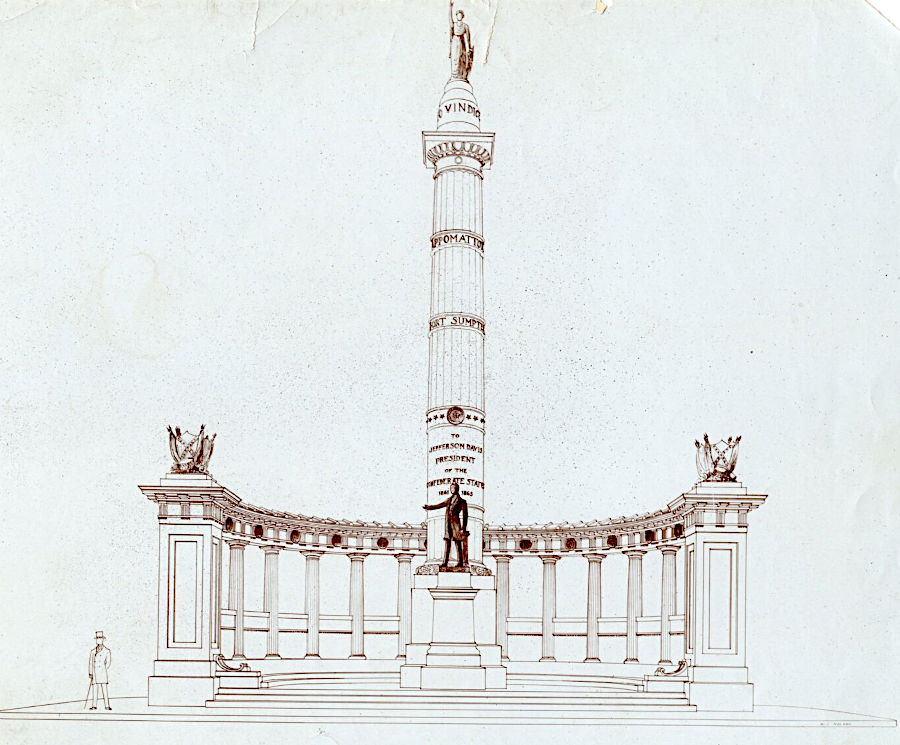
final design of the Davis statue included 13 columns intended to represent 11 states that officially joined the Confederacy, plus Kentucky and Missouri
Source: Valentine Museum, Shaping History: The UDC and Edward Valentine’s Collaboration on the Jefferson Davis Monument
Valentine was a champion of the Lost Cause perspective on the Civil War, representing the creation of the Confederacy as a noble effort to preserve the Southern Way of life. Its soldiers had fought gallantly, its leaders had been honorable, and its armies led by General Robert E. Lee had been defeated only because the Northern states had a greater amount of men and material. Around 1900, he wrote:3
Nearly two decades after the proposal was first launched, the completed statue was dedicated on Jefferson Davis's 99th birthday. The dedicate on June 3, 1807 was the culmination of a weekend that started with the dedication of the statue to Jeb Stuart further east on Monument Avenue. Between 80,00-200,000 people attended the dedication.4
On the night of June 10, 2020, after the murder of George Floyd, protestors ripped the statue of Jefferson Davis from the monument. The statue, on its back with hands pointing at the sky, was hauled away on the bed of a tow truck. On July 8, the rest of the memorial was removed. The first step was to unbolt the statue of Vindicatrix from the top of the pillar and lift it down using a crane. Prying off the metal plaques was difficult; some were bent in the process.
The city of Richmond removed its Confederate monuments in 2020-2022. It stored most remnants at the wastewater treatment plant.
The city donated the statue of Jefferson Davis to the Black History Museum and Cultural Center of Virginia. That organization lacked the space and security required to display it, so the statue was loaned to the Valentine Museum. It put on display, still with pink graffiti, inside the museum several blocks from the Confederate White House. In 2025 in the
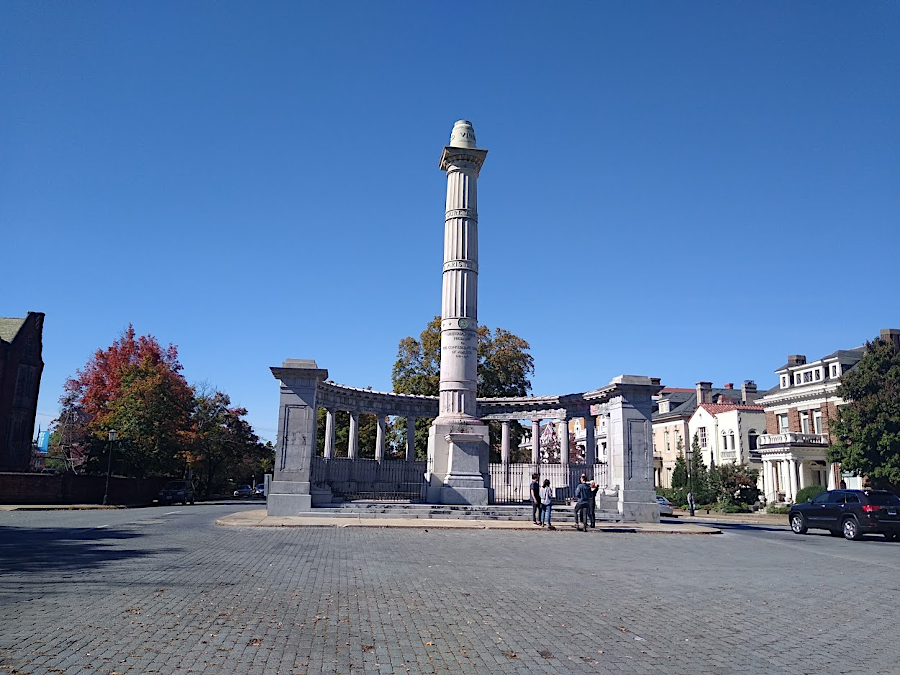
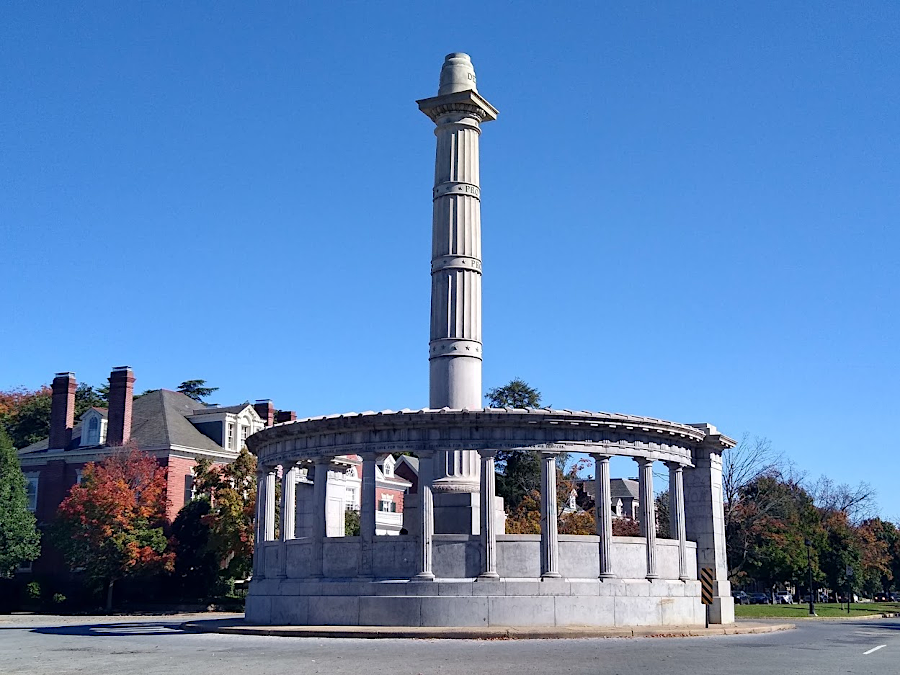
the remnants of the Jefferson Davis monument in October, 2020
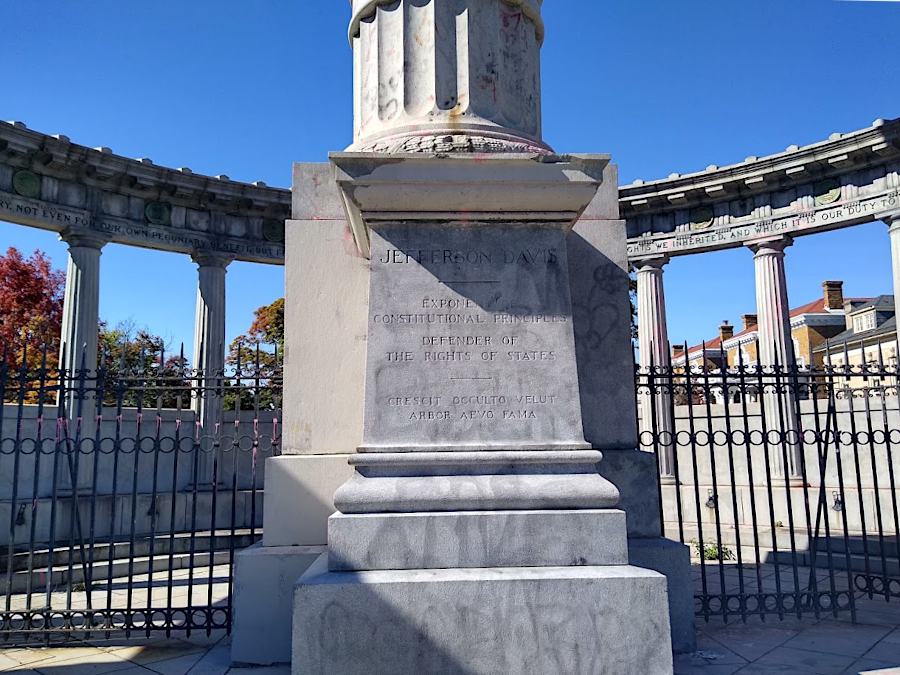
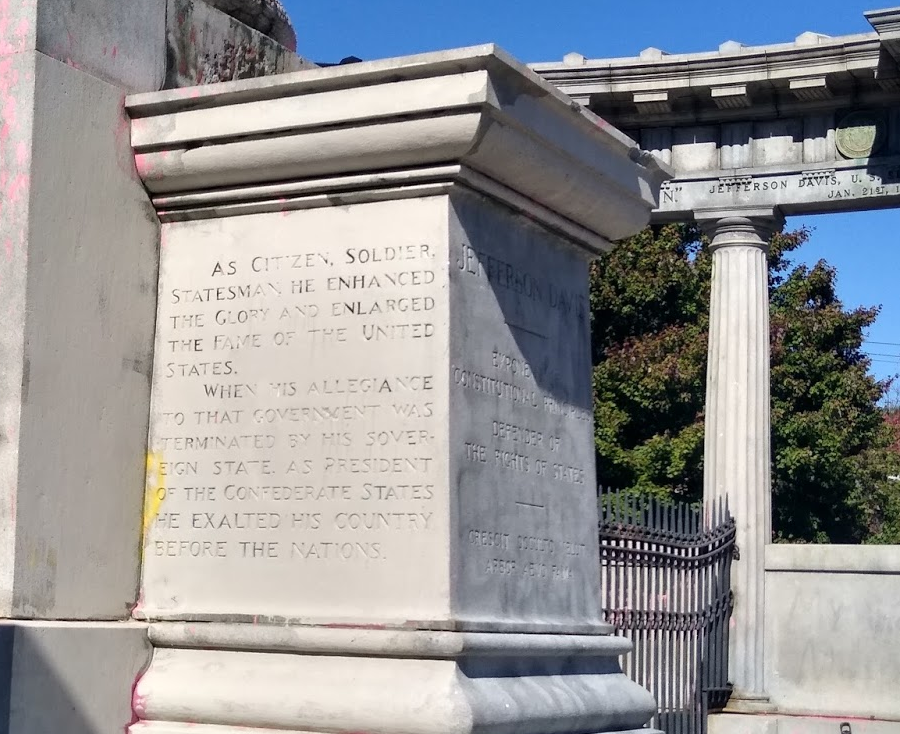
the Jefferson Davis monument claimed he "exalted his country before the nations"
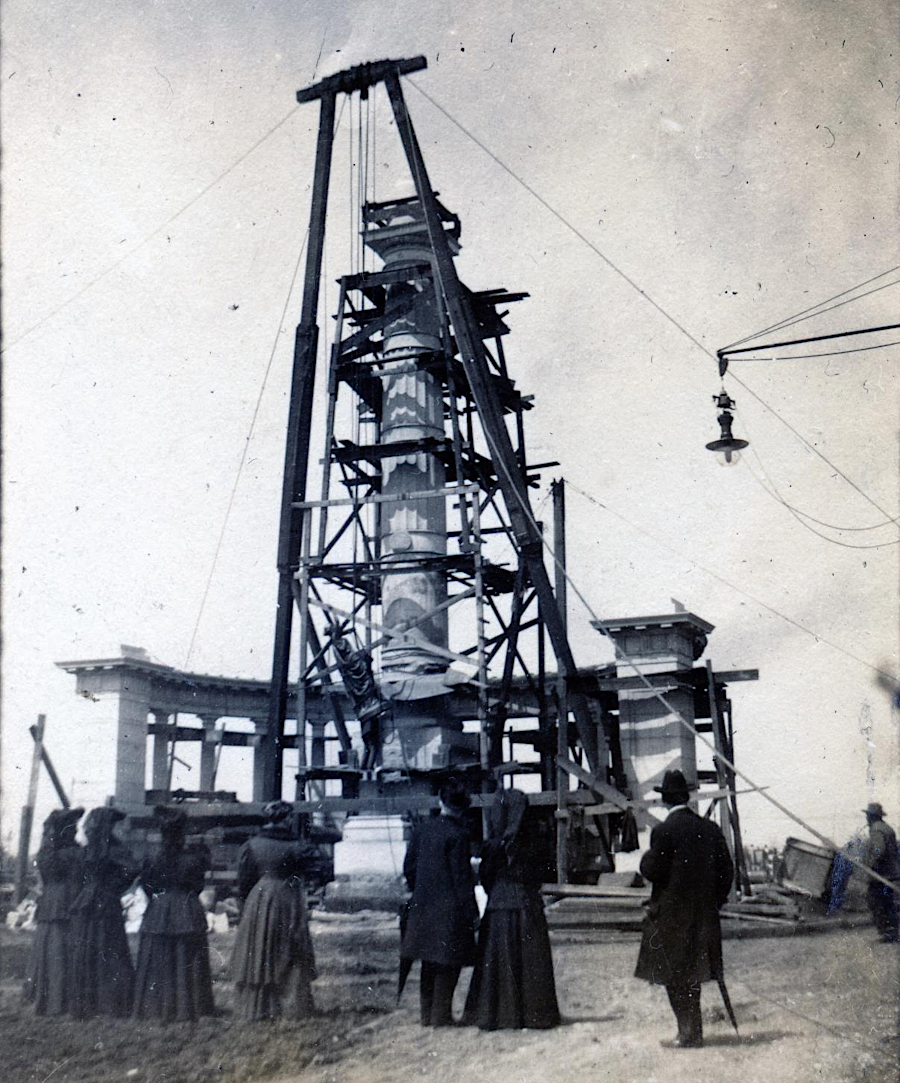
the statue of Jefferson Davis, under construction in 1907
Source: Valentine Museum, Davis, Jefferson