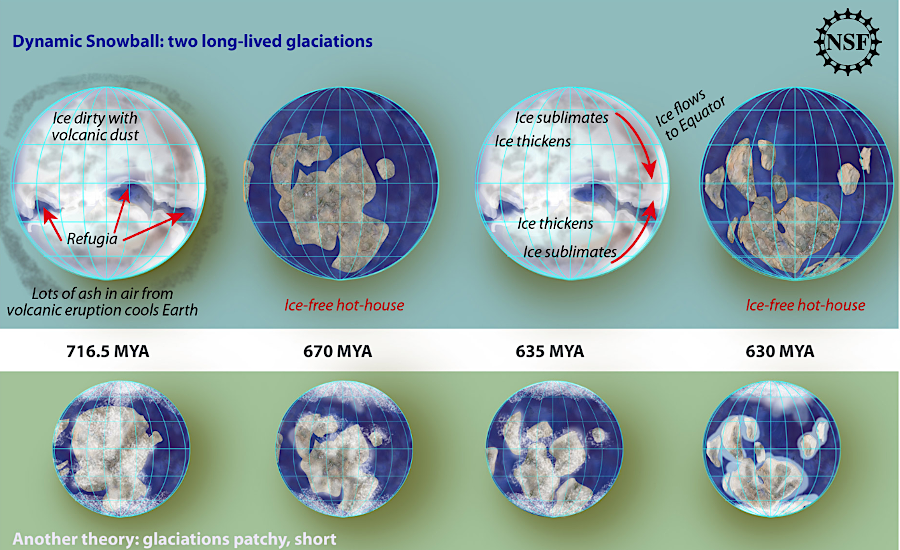
the causes of a Snowball Earth are still being researched
Source: National Science Foundation (NSF), Scientists Find Signs of "Snowball Earth" Amidst Early Animal Evolution
the causes of a Snowball Earth are still being researched
Source: National Science Foundation (NSF), Scientists Find Signs of "Snowball Earth" Amidst Early Animal Evolution
Earth has twice been covered completely/almost completely with ice according to the Snowball Earth theory. The surface of the entire planet was ice, perhaps comparable to the way ice today covers all of Europa (a moon of Jupiter).
How could the earth totally freeze into a snowball during the Neoproterozoic Sturtian global glaciation 716-663 million years ago, and again during the Marinoan glaciation 654–635 million years ago?
The sun's output could have dimmed, and during a Milankovitch cycle the radiation from the sun may have reduced how solar energy strikes the Earth. Volcanic eruptions could have generated an increase of sulfur aerosols in the upper atmosphere that reflected incoming radiation more than the extra carbon dioxide absorbed it. A 2% reduction of incoming sunlight, if it occurred quickly over just 10,000 years, may have been sufficient to trigger a Snowball Earth event.
Most likely there were massive lava flows starting 717 million years ago that created the the Franklin Large Igneous Province, followed by rapid weathering of the newly-exposed rock. Erosion reduced the lava flows into smaller and smaller particles. As those particles weathered, carbon dioxide from the atmosphere (CO2) combined with other elements to create carbonates, silicates, and other minerals. Weathering of the eroded particles pulled CO2 out of the atmosphere and locked it up into minerals
The weathered particles washed into the ocean and dissolved. That created a "nutrient soup" which spurred a massive increase in algae. The waste product from the algae (oxygen) escapred into the atmosphere. A higher percentage of oxygen and a lower percentage of carbon dioxide facilitated evolution of new life forms.
Particularly in the ocean, calcium and silica atoms joined with other elements plus carbon dioxide (CO2) to form molecules of limestone, dolomite, and various types of silicates. When those molecules precipitated and sank to the ocean bottom, together with the remnants of dead algae, the minerals consolidated into underwater sedimentary formations. Continued erosion and weathering of rocks on the continents replenished the minerals dissolved in the ocean, gradually extracting much of the atmosphere's carbon dioxide and trapping in in the sediments on the bottom of the oceans.
Light from the sun continued to enter the earth's atmosphere in short wavelengths that passed through the atmosphere with minimal absorption of the energy. Because carbon dioxide was sequestered rather that returned to the atmosphere, less of the energy radiated away from the earth (in long wavelengths of infrared radiation) was captured by CO2. As CO2 levels dropped, the greenhouse effect was reduced. More energy was radiated back into space without warming the earth's atmosphere.
As a result, the planet cooled. Snow accumulated rather than melted, covering more of the surface. Earth's "albedo" increased and the white snow reflected light (still in short wavelengths) directly back into space. Due to that reflection, less solar energy was absorbed by the ground; less energy then re-emitted in infraded wavelengths which CO2 could trap. Planetary cooling increased in a positive feedback loop, as albedo increased and more snow fell.
Today Antarctica at the South Pole is covered with ice. Erosion and weathering is limited, so the Southern Ocean is depleted in minerals and the sequestration of carbon dioxide is limited. During the two periods of Snowball Earth, however, the continents were clustered near the Equator. Weathered material washing into the ocean extracted more CO2 and sank to the ocean bottom.
The natural weathering and sequestration process may have removed enough CO2 from the atmosphere that, combined with the increased albedo, the average global temperatures dropped to minus 58 degrees Fahrenheit. Within a short time period, perhaps just 10,000 years, ice sheets crept from the poles to the Equator.

in the Sturtian global glaciation 716-663 million years ago, and again during the Marinoan glaciation 654–635 million years ago, all of the surface of the Earth was frozen solid
Source: Environmental Sciences Proceedings, The Snowball Earth Episodes (August 25, 2023)
Key to creating the Snowball Earth was the parallel increase in the albedo:1
As the Earth cooled, volcanoes continued to emit carbon dioxide. Once Earth was covered with ice, CO2 in the atmosphere was blocked from dissolving into the ocean. Carbon dioxide could no longer be incorporated into minerals that ended up sequestered in ocean bottom sediments.
Once the oceans and atmosphere were isolated by an ice sheet, volcanic emissions increased the percentage of carbon dioxide in the atmosphere. High percentages of carbon dioxide created an intense greenhouse effect as more solar energy was absorbed by the atmosphere. With higher levels of CO2, the average temperature on earth skyrocketed in a climate reversal and the ice covering the oceans melted.
The ice may have disappeared within just one million years.2
When the CO2 in the atmosphere could once again dissolve in the ocean, it stimulated a quick precipitation of calcium to the seafloor in limestone and dolomite formations. "Cap carbonates" mark the end of Snowball Earth periods.3
A second cycle of lava flows and ice sheet expansion occurred, but a third is less likely. The expansion of life on earth has created a new pattern of storing and recycling carbon, and that may occur too quickly for another Snowball Earth. However, the causes are still not well understood, so the possibility exists. Paul Hoffman, a pioneer Snowball Earth researcher, has noted:4
Sediments at Sharp Top Mountain appear to be the debris from the base of pre-Cambrian glaciers, 750 million years ago. These Virginia sediments are similar to a contemporary formation in Namibia, indicating what is now Virginia was covered in ice during the Snowball Earth periods.
The Sharp Top sediments are diamictites, a conglomerate rock with stones of different sizes. They were formed by glaciers scraping together a debris pile that later consolidated into rock. The diamictites are exposed today in the Mechums River formation, southwest of Charlottesville near Batesville.5
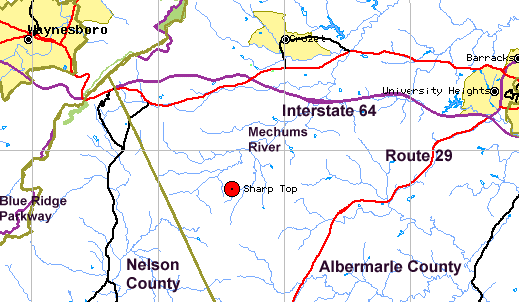
diamictites at Sharptop Mountain record when ice covered the entire earth
Source: ESRI, ArcGIS Online
For roughly 10 million years, life in the oceans was suppressed. The earliest forms of complex life, such as sponges, somehow survived even when the ocean surface was covered with ice. Transfer of oxygen into the ocean may have occurred where meltwater came from the ice sheet during the Snowball Earth period.
Eventually, the greenhouse effect was triggered by the extra carbon dioxide and the earth warmed. The global ice sheets melted, forming the distinctive sedimentary deposits (diamictites) in Albemarle County. The Konnarock Formation at Mount Rogers provides evidence of glacially-influenced sedimentation at tropical latitudes 751 million years ago.
There may have been a series of dramatic extinctions, then re-blossoming of life after several freezing and warming cycles. The Cambrian "explosion" of life 580 million years ago may have brought an end to the cycles, in part due to the evolution of bottom-dwelling worms. These animals have stirred/recycled the carbon in ocean sediments for the last 580 million years, perhaps maintaining the essential percentage of carbon dioxide and preventing another reduction in the ability of the atmosphere to retain heat from the sun.6
Snowball Earth may even be responsible for the Cambrian Explosion, by churning through the bedrock and flushing a wider variety of minerals into the oceans:7
Whether or not the earth was a completely frozen popsicle hundreds of millions of years ago, it is clear that colder climate changed the composition of the vegetation in Virginia in the most recent Ice Age. As shown by analysis of the pollen in the bottom of bogs in the Appalachians, the species we currently consider to be "northern" such as spruce and fir trees were common in Virginia 20,000 years ago.
At Great Falls on the Potomac, the forest was composed of spruce and jack pine trees 16,000 years ago - comparable to forests along the Canadian border today. Pollen from oaks and hemlocks appears in quantity 12,000 years ago, and by 8,000 years ago the forests were similar to the oak-hickory forest of today.8