Leslie's Raid in 1780
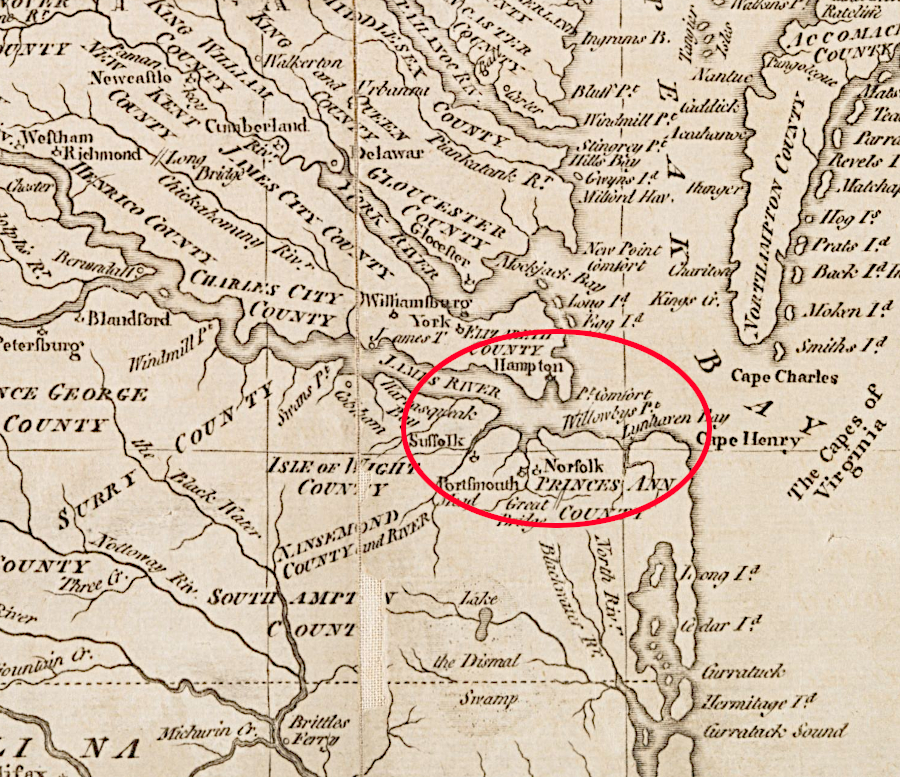
General Alexander Leslie's 1780 raid focused on Hampton Roads because British warships could not go far upstream in the shallow channel of the James River
Source: New Yor Public Library, A New and accurate map of Virginia: and part of Maryland and Pennsylvania (1780)
Loyalists in Virginia and enslaved people seeking to escape to British lines were pleased when Major General Alexander Leslie sailed into the Chesapeake Bay with 2,200 men on October 20, 1780.
The last British forces in the state had both arrived and departed in May 1779. That raid, led by Commodore George Collier and Major General Edward Mathew, destroyed supplies at Suffolk and the Gosport Shipyard at Portsmouth but left after two weeks. Without a permanent British base in Virginia, the rebels dominated the region and suppressed their loyalist opponents.
The purpose of Leslie's raid was similar to that of the Collier-Mathew Raid. Virginia was a source of men and supplies to the Continental Army fighting in New York and in the Carolinas. Around New York City, George Washington and General Henry Clinton were in a stalemate. After the French entered the war, British officials redirected ships and troops. Clinton was not sent enough men to attack and defeat Washington.
Instead, the British adopted a "southern strategy" and hoped to recapture the colonies south of Virginia. Savannah was seized in 1778; Charles Town fell to an invasion force led by General Clinton in 1780. He left General Charles Cornwallis to establish loyalist control in South Carolina, but the rebelling colonists there kept receiving replacement soldiers and supplies from Virginia.
Whenever British soldiers left an area, rebellious South Carolinians regained control over the countryside. Like General Clinton, Lord Cornwallis also lacked the resources to implement the southern strategy to expand royal control beyond Charles Town and scattered outposts.
The British were unable to establish an army large enough to occupy the rural areas in the South Carolina and Georgia "upcountry" in order to maintain British control; too many troops were needed in the Caribbean to defend the sugar islands against the French. The British anticipated that if they defeated the organized military forces in the southern colonies, then the southern loyalists would be emboldened. Once enough loyalists enlisted and were willing to fight, rather than just take an oath of loyalty and sit on the sidelines while the British Regulars fought, then royal government could become effective again in the backcountry outside of Savannah and Charles Town.
British military victories at Charles Town and Waxhaws in May 1780 and at Camden in August 1780 suggested the southern strategy was succeeding. Completing the task of defeating the Continental Army forces and partisans in the southern colonies would require interrupting the delivery of new troops and supplies from the north through Virginia.
General Leslie was ordered to sail up the James River and capture Petersburg and Richmond, destroying the central supply depots and diverting reinforcements headed to General Nathaniel Green in North Carolina. After landing at Portsmouth, Leslie discovered that the loyalist support in Virginia was weaker than expected while the Virginia militia was stronger than expected.
He also realized that sailing up the James River required a local pilot, and could not get one. Leslie decided to ignore the plans developed in New York City and to use the mobility provided by his warships to raid just coastal areas.
Governor Thomas Jefferson still feared a raid deep into the interior of Virginia to free 800 British soldiers who had been captured at the Battle of Saratoga in 1777. They were imprisoned in the Albemarle Barracks near Charlottesville, so Jefferson shipped them further away from the coastline to Maryland. He left the Hessian prisoners in their Albemarle Barracks, assuming General Leslie would not risk a long-distance raid to free the hired Germans.1
Governor Jefferson also moved supplies inland, though Leslie was able to seize and destroy significant amounts of material at Suffolk, Newport News, and Hampton. He was constrained in his ability to send militia from the Piedmont counties to Portsmouth because loyalists were threatening to rebel against the rebelling Virginians. He wrote to the Virgina delegates in the Continental Congress:2
- A very dangerous Insurrection in Pittsylvania was prevented a few days ago by being discovered three days before it was to take place. The Ring-leaders were seized in their Beds. This dangerous fire is only smothered: when it will break out seems to depend altogether on events. It extends from Montgomery County along our Southern boundary to Pittsylvania and Eastward as far as James River: Indeed some suspicions have been raised of it’s having crept as far as Culpepper.
Major Gen. John Peter Gabriel Muhlenberg was responsible for the Virginia troops in 1780 when Leslie arrived. He collected 800 untrained, inexperienced troops to confront the British. That was sufficient to force Leslie back into his fortifications at Portsmouth.
George Washington sent General Nathanael Green to command the Southern Department after the ignominious flight of General Horatio Gates after defeat at the Battle of Camden. When Greene passed through Virginia in November 1780, he designated Prince Edward Court House to be the primary depot for military supplies and assigned Baron von Steuben to command the District of Virginia with responsibility for ensuring the deklivery of gunpowder and lead. Colonel Edward Carrington was tasked wih the job of quartermaster.3
General Henry Clinton could have chosen to reinforce Leslie and enable him to move inland, but his plans were shaped by the march of the Overmountain Men to Kings Mountain. The British invasion on Virginia in October 30-November 22, 1780 ended because Colonel William Campbell and his volunteers from southwestern Virginia, united with volunteers from Tennessee, won a battle at Kings Mountain on October 7, 1780.
After they defeated Major Patrick Ferguson and his loyalists, Clinton directed Leslie to leave Virginia and go to Charlestown, South Carolina. The Virginians who succeeded in forcing General Leslie to abandon his raid after less than a month were not the Tidewater militia.
After the defeat at King's Mountain, General Charles Cornwallis decided not to go into winter camp. He chose instead to march into North Carolina. After spending only a month in Hampton Roads conducting raids, Leslie started leaving for Charles Town on November 18, 1780 to reinforce Cornwallis.
Thomas Jefferson had anticipated Leslie's withdrawal when he wrote to George Washington on November 3, 1780:4
- ...they give out themselves that after drawing the force of the State to Suffolk they mean to go to Baltimore. Their movements here had induced me to think they came in expectation of meeting with Lord Cornwallis in this country, that his precipitate retreat has left them without a concerted object, and that they were waiting further orders.
Leslie's troops arrived in South Carolina too late to participate in the battle at Cowpens on January 16, 1781. They did join in the "race to the Dan" afterwards, as Cornwallis sought to engage General Nathanael Greene's Continental Army fleeing north. Leslie was in command of the right wing when the British won a Pyrrhic victory over Greene's army at Guilford Courthouse on March 15, 1781.5
General Clinton in New York quickly arranged for another invasion of Virginia. He sent General Benedict Arnold south from New York in December, 1780. There was a British army marching through Virginia for the next 10 months commanded first by Arnold, then by General William Phillips, and finally by General Cornwallis.
Links
- National Archives "Founders Online"
References
1. Spencer C. Tucker, American Revolution: The Definitive Encyclopedia and Document Collection, ABC-CLIO, 2018, p.865, https://books.google.com/books?id=CyJrDwAAQBAJ; Edward G. Lengel, ed., The Papers of George Washington: Revolutionary War Series, Volume 20, 8 April - 31 May 1779, University of Virginia Press, 2010, http://gwpapers.virginia.edu/editions/letterpress/revolutionary-war-series/volume-20-8-april-31-may-1779/; Edwards Park, "Virginia's Very Own Navy," Colonial Williamsburg Journal, Spring 2002, https://www.history.org/foundation/journal/spring02/navy.cfm; Michael Cecere, The Invasion of Virginia 1781, Westholme Publishing, 2017, p.10, https://books.google.com/books/about/The_Invasion_of_Virginia_1781.html?id=SgJLvgAACAAJ; "The winners write history. What happens to the losers?" The Historical Dilettante, http://historicaldilettante.blogspot.com/2012/07/the-winners-write-history-what-happens.html; "Marquis de Lafayette to Benjamin Franklin, 19 November 1780," Founders Online, https://founders.archives.gov/documents/Franklin/01-34-02-0014 (last checked March 10, 2026)
2. "Letter from Thomas Jefferson to the Virginia Delegates in Congress (October 27, 1780)," Encyclopedia Virginia, https://encyclopediavirginia.org/primary-documents/letter-from-thomas-jefferson-to-the-virginia-delegates-in-congress-october-27-1780/ (last checked March 10, 2026)
3. Joshua Horn, "Peter Muhlenberg: The Pastor Turned Soldier," Journal of the American Revolution, November 9, 2015, https://allthingsliberty.com/2015/11/peter-muhlenberg-the-pastor-turned-soldier/; Henry Beebee Carrington, Battles of the American revolution, 1775-1781, 1888, p.530, https://lccn.loc.gov/04017792 (last checked July 10, 2026)
4. J. Britt McCarley, The War in Virginia, 1781, The U.S. Army Campaigns of the Revolutionary War, United States Army Center of Military History, 2025 pp.14-15, https://history.army.mil/portals/143/Images/Publications/catalog/71-53.pdf; "To George Washington from Thomas Jefferson, 3 November 1780," Founders Online, National Archives, https://founders.archives.gov/documents/Washington/03-29-02-0052 (last checked April 26, 2025)
5. "Alexander Leslie," National Park Service, https://www.nps.gov/people/alexander-leslie.htm (last checked March 10, 2026)
The Military in Virginia
Virginia Places