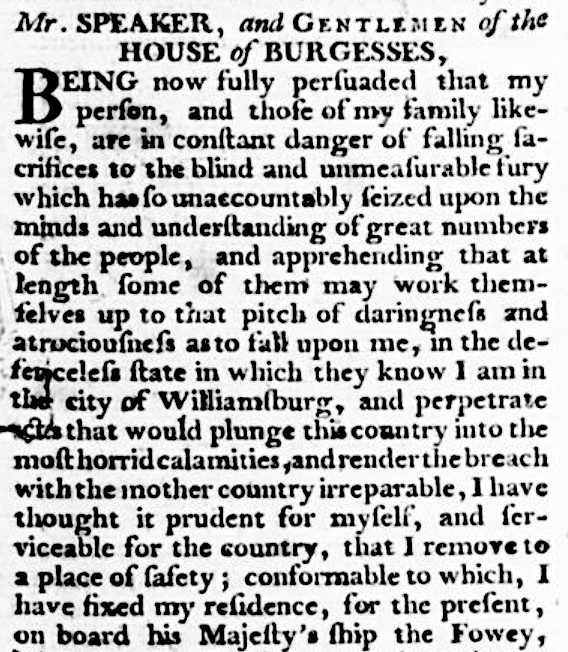
Lord Dunmore left a letter behind explaining why he fled Williamsburg on June 8, 1775
Source: Colonial Williamsburg, Supplement to the Virginia Gazette (Purdie) (June 9, 1775)
Lord Dunmore left a letter behind explaining why he fled Williamsburg on June 8, 1775
Source: Colonial Williamsburg, Supplement to the Virginia Gazette (Purdie) (June 9, 1775)
Dunmore claimed he was still ruling as King George III's appointed governor in the colony, but fear of insurrection required that he had to be surrounded by British soldiers and sailors away from the Governor's Palace. While on the British warship, he assumed responsibility as the military commander over the Royal Navy warships and troops on them.
The governor's ability to command was established after the captain of the HMS Mercury, head of the naval squadron at the time, ignored his advice and went ashore to meet with a member of the Governor's Council. Dunmore complained to Admiral Graves in Boston and the captain was sent back to England. Subsequent naval commanders allowed Dunmore to determine where to station the ships, though at times they made arrangements without alerting him.1
"Supplement to the Virginia Gazette (Purdie)," Colonial Williamsburg, June 9, 1775, https://digitalcollections.colonialwilliamsburg.org/asset-management/2RERYDT0I6QJ?_gl=1*ux3po7*_ga*MTI1MjY0Mjc1Ni4xNzMyNjU2NzM1*_ga_85G4WZQQQG*czE3NDcyMjE0OTckbzIxJGcwJHQxNzQ3MjIxNDk3JGowJGwwJGgw*_gcl_au*MTQyNjAwMDY1LjE3NDEzNjYxMDQ.*_ga_DL4M8SY7PH*czE3NDcyMjE0OTkkbzIwJGcwJHQxNzQ3MjIxNDk5JGo2MCRsMCRoMA..&FR_=1&W=1536&H=791; W. Hugh Moomaw, "The British Leave Colonial Virginia," The Virginia Magazine of History and Biography, Volume 66, Number 2 (April, 1958), pp.156-158, https://www.jstor.org/stable/4246423; "Porto Bello, Queens Creek, Camp Peary Military Reservation, Williamsburg, Independent City, VA," Library of Congress, https://www.loc.gov/pictures/item/va1916/ (last checked August 30, 2025>
Dunmore had planned to make a life in Virginia. He brought his family from England to Virginia in 1774, and had fought Dunmore's War to ingratiate himself with fellow land speculators in the gentry. Leaving Williamsburg must have forced him to confront the potential that his personal plans, as well as his official role, had failed.
On June 30, 1775 the Virginia Gazette reported that Lady Dunmore and the governor's children had sailed back to England on the HMS Magdalen.10
Virginia Gazette - Supplement (Purdie), June 30, 1775, https://research.colonialwilliamsburg.org/DigitalLibrary/va-gazettes/VGSinglePage.cfm?issueIDNo=75.P.43 (last checked June 18, 2025)
The newspaper was mistaken when it also reported that Dunmore himself had sailed to New York. He stayed on the warship, watching the Virginia militia parade on the shoreline around Yorktown, until July 15. The British warships then sailed to the Elizabeth River and anchored next to Portsmouth.11
Michael Cecere, A Universal Appearance of War: The Revolutionary War in Virginia, 1775-1781, Heritage Books, 2014, pp.4-5, p.10, https://www.google.com/books/edition/A_Universal_Appearance_of_War/Cy6UrgEACAAJ (last checked June 18, 2025)
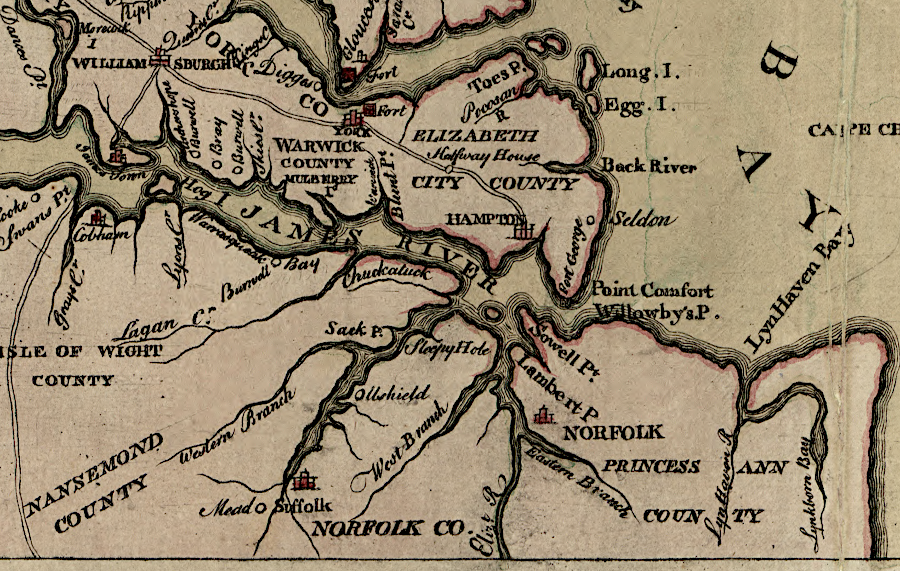
Dunmore fled Williamsburg to a ship at Yorktown, then sailed to Norfolk
Source: Library of Congress, Map of the maritime parts of Virginia exhibiting the seat of war and of Ld. Dunmore's depredations in that colony (by Pierre Eugène Du Simitière, 1776)
Virginia's last royal governor never saw Williamsburg again. He came ashore to stay in Portsmounthb, and led at least one raid in Princess Anne County. The success of the November 15 raid against militia assembled at Kemp's Landing led him to issue a proclamation inviting the enslaved workers of the rebels to join the British and become part of the Ethiopian Regiment.
The last time the royal governor touched Virginia soil was to set up a new base on Gwynn's Island. Along with Dunmore, all the British abandoned that island on July 9, 1776.
The Governor's Palace in Williamsburg was unguarded after Lord Dunmore fled. A mob broke in again on June 24, 1775 and removed the remaining 300 swords and 200 muskets stored in the building. Those weapons were distributed to the militia. The armed men walking the streets at night asserted that they were protecting Williamsburg against attack, but the greatest threats to public safety probably occurred after many of those men visited the taverns.
Governor Dunmore received reports from allies in Williamsburg. On July 12 he wrote to Lord Dartmouth, Secretary of State for the Colonies in London:11
"Lord Dunmore to Lord Dartmouth, July 12, 1775," Naval Documents of the American Revolution, https://navydocs.org/node/1611; "Dispatch from 1775: Exiled to a British ship in the James River, royal governor says 'every part' of Virginia is 'resisting' him," Cardinal News, July 15, 2025, https://cardinalnews.org/2025/07/15/dispatch-from-1775-exiled-to-a-british-ship-in-the-james-river-royal-governor-says-every-part-of-virginia-is-resisting-him/; "Dunmore's Flight and the Seizure of the Governor's Palace," Colonial Williamsburg, April 18, 2024, https://www.colonialwilliamsburg.org/discover/moments-in-history/road-to-independence/dunmores-flight-and-the-seizure-of-the-governors-palace/; Patrick H. Hannum, "Recognizing the Skirmish at Kemp’s Landing," Journal of the American Revolution, December 17, 2018, https://allthingsliberty.com/2018/12/recognizing-the-skirmish-at-kemps-landing/ (last checked August 30, 2025)
In anticipation that Governor Dunmore would have to leave Virginia, on July 29, 1775 King George III issued a commission for Richard Corbin to serve as the Lieutenant Governor. Corbin was trusted in London, though he was a member of the Virginia gentry. He had been a Crown appointee since 1762, serving as the deputy receiver general responsible for collecting taxes due to King George III.
Corbin did not become Virgina's last royally-appointed governor, because Lord Dunmore stayed on British warships in the Chesapeake Bay. He may have shown Corbin the commission, but kept the formal paperwork with him on the ship. By the time Dunmore sailed to New York City in August 1776, Virginia had declared independence. The position of royal governor had evaporated, and Corbin lived through the revolution quietly on his plantation.11 "Richard Corbin," Dictionary of Virginia Biography, https://old.lva.virginia.gov/public/dvb/bio.asp?b=Corbin_Richard; Jeffrey Lynn, "The Richard Corbin letterbook 1758-1760," Dissertations, Theses, and Masters Projects Paper 1539625163, College of William and Mary, 1982, p.3, https://dx.doi.org/doi:10.21220/s2-en8z-z871
The Third Virginia Convention met in July 1775. George Washington was not there; he had taken command of the Continental Army outside Boston on July 3. Washington was appointed as a political general, in large part because he wasfrom Virginia. There were other military officers with more experience, but the Continental Congress desired to establish a national army and ensure the southern colonies would support the uprising which had erupted in Massachusetts on April 19, 1775.11
"Washington takes command of Continental Army in 1775," US Army Center of Military History, April 15, 2016, https://www.army.mil/article/40819/washington_takes_command_of_continental_army_in_1775; David Price, "Washington's Ten Best Military Decisions," Journal of the American Revolution, October 28, 2025, https://allthingsliberty.com/2025/10/washingtons-ten-best-military-decisions/ (last checked October 28, 2025)
Like the First Virginia Convention that met in Williamsburg on August 1-6, 1775 and the Second Virginia Convention that met on March 20-27, 1776 in Richmond, the Third Virginia Convention was unauthorized by the British government. The Third Virginia Convention filled the vacuum of colony-wide authority after Dunmore fled; the political revolution reached closure years ahead of the military revolution.
The House of Burgesses had stopped meeting a month before Lord Dunmore fled to the HMS Fowey>. A few members assembled in the Capitol in October 1775 and March 1776 but there were not enough burgesses to make a quorum. Even if there had been a quorum, since the Governor's Council did not meet and the governor was absent there was no "General" Assembly that could conduct business. The burgesses who did gather simply adjourned, in ancticipation of holding a later meeting.
The final attempt for the House of Burgesses to meet was on May 6, 1776. Recognizing that colonial government had ended, someone wrote "Finis" boldly at the very end of the official journal. The burgesses never met again, though there was an abortive effort to get the house called into session in February 1776. The Committee of Safety proposed that meeting in order to provide an official response to Governor Dunmore's offer to pardon the rebellious Virginia leaders, which was part of a reconciliation proposal floated by King George III.11
"Final Meeting of the House of Burgesses ('Finis' Document), May 6, 1776," Library of Virginia, https://edu.lva.virginia.gov/oc/stc/entries/final-meeting-of-the-house-of-burgesses-(%22finis%22-document)-may-6-1776 (last checked August 29, 2025)
Members of the Third Virginia Convention chose to assemble in Richmond, too far upstream to be threated by marines on British warships. As desired by Patrick Henry when he made his famous "Give Me Libery or Give Me Death" in the Second Virginia Convention, the Third Virginia Convention voted to put the colony in a state of defense. A three-level military structure was created. It was based on the county militia, 8,000 designated "minutemen" who could respond quickly to a threat, and 1,000 members of a regular army organized into two regiments. <
Government decisions were made by two more Virginia conventions until 1776; there were five conventions in total as colonists started in 1774 to create a parallel government outside royal authority. After a state constitution was adopted in June 1776, a new General Assembly was organized with a House of Delegates to replace the House of Burgesses and a State Senate to replace the Governor's Council.
Instead of a king appointed the governor, the state constitution gave that authority to the General Assembly. To prevent a governor from becoming too powerful, he served a one-year term and could be elected a maximum of three years in a row. The Third Virginia Convention appointed an 11-man Committee of Safety who would manage affairs after the convention adjourned. The chair of that committee, Edmund Pendleton, exercised executive authority in place of Lord Dunmore.
After Lord Dunmore fled from Williamsburg on June 8, 1775 the Third Virginia Convention delegates authorized recruiting two regiments of soldiers. That established a full-time regular army in Virginia, in addition to the independent militia companies. Patrick Henry was made colonel of the First Regiment, which had eight companies totaling 544 men. William Woodford was given command of the Second Reginent, composed on seven companies with 476 men.
The Third Virginia Convention divided the colony into 16 districts, of which 15 districts were directed to raise a company of men and send it to Williamsburg. The Eastern Shore district was told to keep its company there for defense from raids by the Royal Navy.In addition, the Third Virginia Convention created 16 battalions of minutemen, with 500 men in each battalion, to create a second tier of defense. The minutement were to be selected by local officials from the standard county militia and given extra supplies (including gunpowder, lead for bullets, and a hunting shirt). Minutemen were supposed to train more regularly. With their personal cache of supplies, they could be directed to march to respond wherever the British might attack.
Mount Vernon was thought to be a target, with the potential of seizing Martha Washington as a hostage. Lund Washington, taking care of the mansion after George Washington was given commsand of the Continental Army, considered an attack to be unlikely. If a British ship sailed up the Potomac River, everyone would be aware; Mrs. Washington could be spirited away long before troops reached the mansion house.
At the local level, the justices of the peace who formed the county courts cooperated with the local Committees of Safety. Loyalists objecting to the rejection of royal authority were suppressed, and were unable to organize local resistance to the usurpation of authority. No county court in Virginia proclaimed that its community was choosing to remain loyal to King George III or willing to accept direction from Lord Dunmore. No loyalist group created a replacement county court in opposition to the revoutionaries who seized control.12
Michael Cecere, Great Things Are Expected From the Virginians, Heritage Books, 2008, pp.15-16, p.35, pp.46-49,https://www.google.com/books/edition/Great_Things_are_Expected_from_the_Virgi/P9DCwAEACAAJ; https://www.google.com/books/edition/A_Universal_Appearance_of_War/Cy6UrgEACAAJ; "The Revolution Takes Shape,"
Despite the absence of the royal governor, the Virginia House of Burgesses adopted its reply to the Conciliatory Proposal passed by Parliament in February, 1775. On June 10, 1775, the House of Burgesses repeated that only colonial legislatures had the right of taxation.
The reply did not reject Lord North's proposal outright. It also included a statement that the Virginians sought "perpetual continuance of that brotherly love which we bear to our fellow subjects of Great Britain." The House of Burgesses said that a formal response must come from all the colonies together through the Continental Congress; Parliament's divide-and-conquer tactic seeking individual responses from 13 colonies failed.
The formal reply by the House of Burgesses to the Conciliatory Resolution was delivered to Lord Dunmore on the British warship, since he was no longer in residence at the Governor's Palace. He had abandoned Williamsburg because he feared for his safety, but no military action had occurred yet in Virginia.
Communications between royal and colonial leaders was all done in writing. Leaders in the House of Burgesses would not go onto a British warship, fearing they would be taken captive. Dunmore would not go back to Williamsburg or even go ashore at Yorktown to meet in person. The Third Virginia Convention met in Richmond in order to be out of reach of British marines.
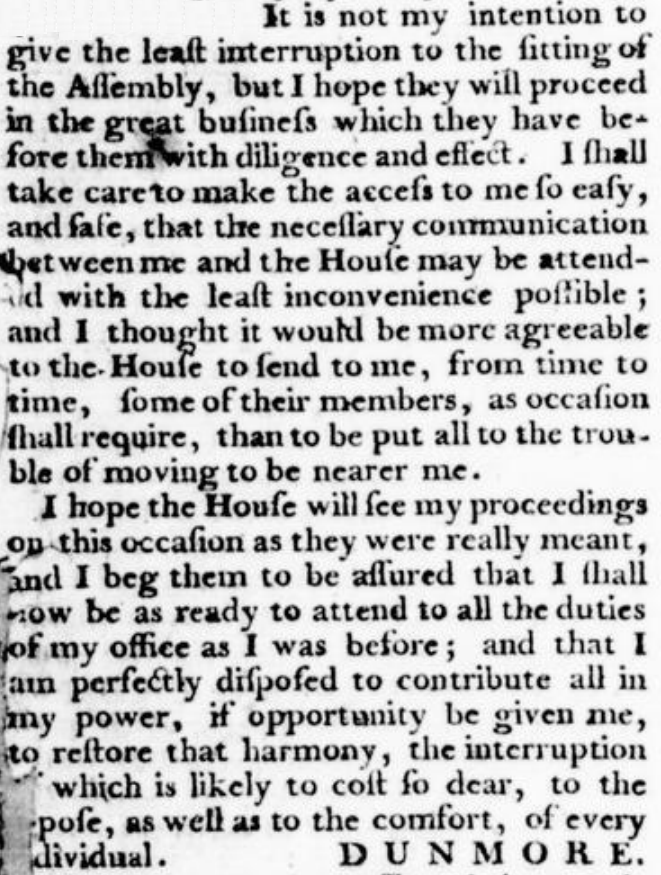
Lord Dunmore claimed he could continue to perform his role as governor from the British warship
Source: Colonial Williamsburg, Supplement to the Virginia Gazette (No. 19, June 9, 1775)
On the political level, however, the Virginia rejection of the Conciliatory Resolution demonstrated that the authority of royal government had evaporated. The Virginians were organizing to manage the colony without a role for British officials, and choosing to follow guidance from the Continental Congress rather than accept dictates from Parliament. The House of Burgesses reply to Lord North included:1
Richard J. Werther, "The Lord North Conciliatory Proposal: A Case of Too Little Too Late," Journal of the American Revolution, October 31, 2023, https://allthingsliberty.com/2023/10/the-lord-north-conciliatory-proposal-a-case-of-too-little-too-late/; "Virginia Resolutions on Lord North's Conciliatory Proposal, 10 June 1775," Founders Online, National Archives, https://founders.archives.gov/documents/Jefferson/01-01-02-0106; "Unaware of the Battle of Bunker Hill, the British elite partied on," Washington Post, June 23, 2025, https://www.washingtonpost.com/opinions/interactive/2025/american-revolution-britain-london-bunker-hill/; "Dispatch from 1775: Exiled to a British ship in the James River, royal governor says 'every part' of Virginia is 'resisting' him," Cardinal News, July 15, 2025, https://cardinalnews.org/2025/07/15/dispatch-from-1775-exiled-to-a-british-ship-in-the-james-river-royal-governor-says-every-part-of-virginia-is-resisting-him/ (last checked July 16, 2025>
A month after fleeing the Governor's Palace, Dunmore dropped efforts to conmmunicate with people in Williamsburg. He moved his fleet on July 17, 1775 from Yorktown to the Elizabeth River. Dunmore was welcomed at Gosport by Andrew Sprowle, who owned the shipyard on the west side of the Elizabeth River in what today is the city of Portsmouth. The governor create a new center for royal authority there, in a place he could control rather than in Williamsburg.
Enslaved people began to escape to the British lines around the shipyard at Gosport. Some stole boats and went directly to British ships. Dunmore soon accumulated 20-30 white loyalists and 100 blacks who had escaped slavery.2
Bernie Kirsch, "A Shipyard in Portsmouth, Virginia to the American Revolution," Old Dominion University, https://freepages.rootsweb.com/~vancgenealogyrecords/genealogy/Misc%20Files/our_naval_shipyard.htm; Andrew Lawler, "Lord Dunmore's Ethiopian Regiment," Journal of the American Revolution, February 11, 2025, https://allthingsliberty.com/2025/02/lord-dunmores-ethiopian-regiment/; Matthew Krogh, "Lord Dunmore's Navy in Hampton Roads, 1775-1776, Part I: The Battle of Hampton," Hampton Roads Naval Museum, October 27, 2016, https://hamptonroadsnavalmuseum.blogspot.com/2016/10/lord-dunmores-navy-in-hampton-roads.html (last checked August 30, 2025)
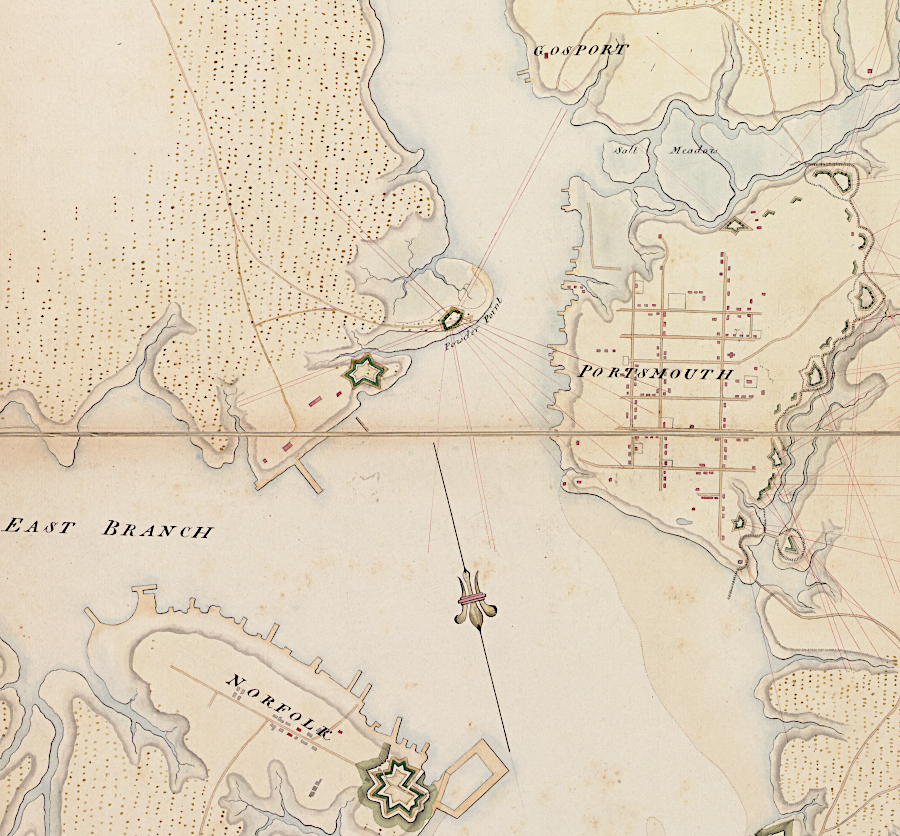
after abandoning Williamsburg, Governor Dunmore eastablished new quarters at the shipyard in Gosport (north is towards bottom of map)
Source: Library of Congress, plan of Portsmouth Harbour in the province of Virginia shewing the works erected by the British forces for its defence, 1781 (by James Stratton, 1782)
In June 1775 at the Second Continental Congress, American leaders took a two-pronged approach to the conflict with London officials. On the military prong, the Continental Congress authorized raising 10 regiments from Virginia, Maryland, and Pennsylvania on June 14 to supplement the Army of Occupation that had trapped the British forces in Boston. June 14 is now considered the birthday of the US Army. George Washington was appointed commander on the new Continental Army on June 15, and quickly left Philadelphia to take charge in Massachusetts.
Virginia raised two regiments in the Shenandoah Valley. They assembled in Mecklenburg (now Shephersdtown, West Virginia) and Winchester, then marched roughly 600 miles to Boston within 25 days. The "Beeline March" demonstrated that Virginia was committed to support the Massachusetts militia who had fought the Battle of Bunker Hill on June 17, 1775.
On the diplomatic prong, Thomas Jefferson wrote the first draft of what ended up being called the "Olive Branch Petition." John Dickinson modified the draft so it ended up as appeal to King George III sent in July, 1775. The Olive Branch Petition asserted that his appointed officials and Parliament were at fault, and that colonists remained loyal personally to the king despite bad behavior of other authorities in London. The representatives of 12 colonies (Georgia was not yet participating in the Second Continental Congress) sent the petition seeking reconciliation even after the Battle of Bunker Hill, where over 1,000 British troops had been killed or wounded in two hours of fighting on June 17, 1775.2
"The Battle of Bunker Hill," National Park Service, https://www.nps.gov/articles/000/the-battle-of-bunker-hill.htm; "Washington's Appointment as Commander in Chief of the Continental Army," National Park Service, https://www.nps.gov/articles/000/washingtoncommission.htm; "How a Relentless, 484-Mile March From Virginia to Massachusetts Fueled the Legend of the Dashing Frontier Rifleman," Smithsonian Magazine, July 15, 2025, https://www.smithsonianmag.com/history/how-a-relentless-484-mile-march-from-virginia-to-massachusetts-fueled-the-legend-of-the-dashing-frontier-rifleman-180986953/; "'Beeline March' to Cambridge: National Guard roots of Army's founding," National Guard, July 15, 2015, https://www.nationalguard.mil/News/Article/841123/beeline-march-to-cambridge-national-guard-roots-of-armys-founding/ (last checked July 17, 2025)
The conservatives in the Continental Congress, unwilling to push for independence, were able to get an Olive Branch petition sent to England. However, they were outvoted on July 31, 1775. The Continental Congress formally rejected Lord North's Conciliatory Resolution, foreclosing a diplomatic solution to the crisis.2
"Resolutions of Congress on Lord North's Conciliatory Proposal," The Avalon Project, Yale Law School, https://avalon.law.yale.edu/18th_century/jeffnort.asp (last checked June 30, 2025)
The Olive Branch Petition sent by the Second Continental Congress was delivered to King George III on September 1, 1775. He too foreclosed a diplomatic solution; the king refused to read the petition. His refusal to negotiate, based on a belief that the majority of Americans were loyal to the crown and that the troublemakers in Massachusetts could be suppressed by force, closed down the last channel for negotiating peaceful re-establishment of royal control over the colonies.2
"Congress adopts Olive Branch Petition," History.com, https://www.history.com/this-day-in-history/july-5/congress-adopts-olive-branch-petition; "Second Petition from Congress to the King, 8 July 1775," Founders Online, National Archives, https://founders.archives.gov/documents/Jefferson/01-01-02-0114; "Petitioning the King and Parliament," American Battlefield Trust, July 24, 2024, https://www.battlefields.org/learn/articles/petitioning-king-and-parliament; "The Olive Branch and the Declaration of Independence," New York Public Library, June 30, 2015, https://m.nypl.org/blog/2015/06/30/olive-branch-petition (last checked July 3, 2025)
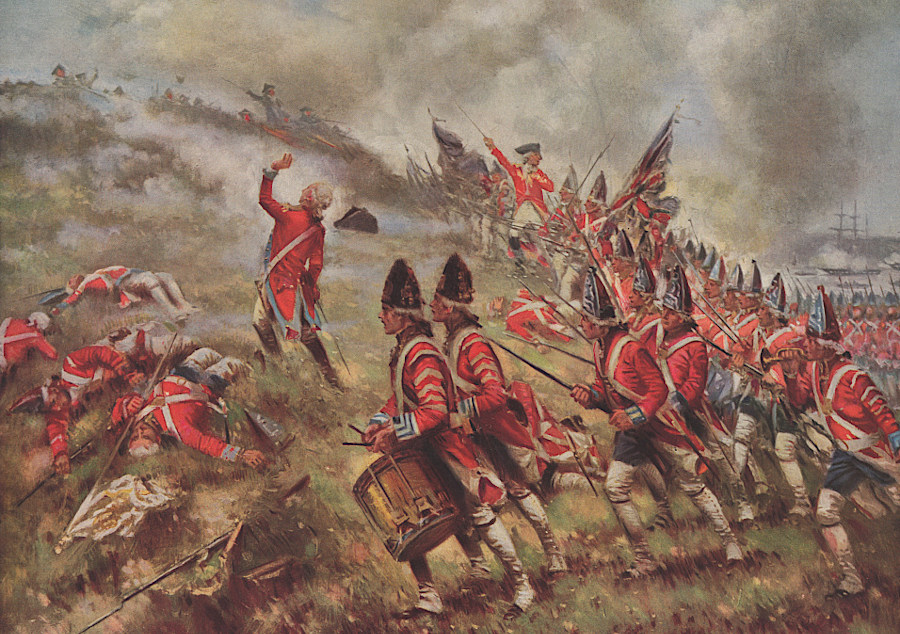
British forces captured Bunker Hill on June 17, 1775, but at the cost of over 1,000 casualties
Source: Library of Congress, Battle of Bunker Hill (by E. Percy Moran, 1909)
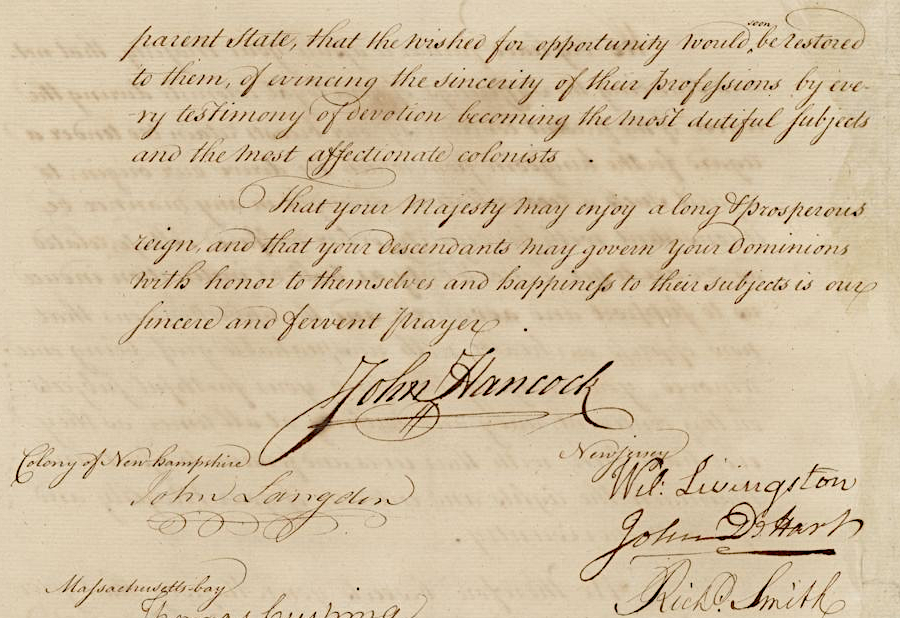
on July 5, 1775, John Hancock prominently signed the Olive Branch petition to George III
Source: New York Public Library, Petition to George III, King of Great Britain, 1775
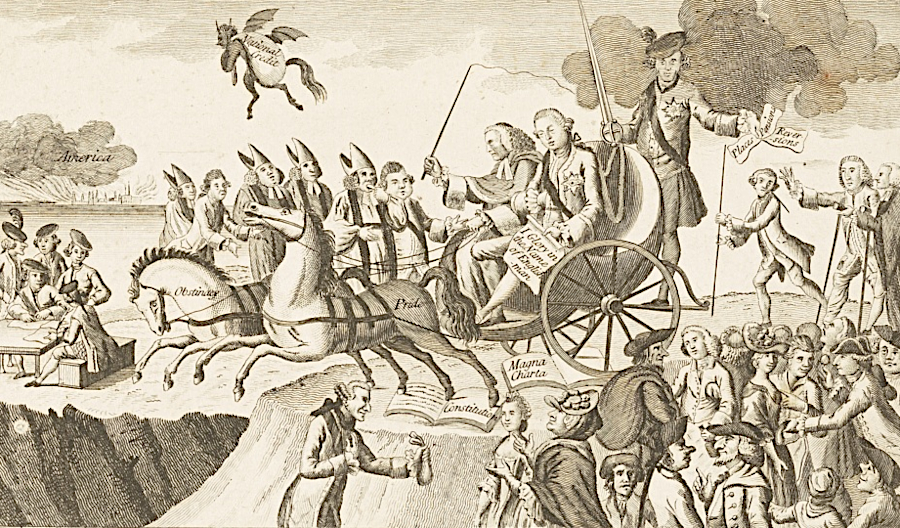
in a cartoon showing horses named Pride and Obstinancy leading him over a cliff, George III was criticized in London for his effort to force a military solution in America
Source: Library of Congress, The political cartoon for the year 1775
The king was a war hawk. He subscribed to the "domino theory" that if the American colonies seceded from the empire, which had just been created at the end of the French and Indian/Seven Years War, then Great Britain would also lose the other colonies stretching around the world - starting with Canada, Ireland, India, and the sugar islands.
In addition, the stability of the monarchy was still questionable. Only 30 years earlier, the grandson of King James II had led an invasion from France to force the Hanover dynasty from the thone and restore the Stuarts. Bonnie Prince Charlie had rallied forces in Scotland and marched to within 125 miles of London before being defeated at Culloden. King George III viewed maintaining the primacy of royal authority as an existential fight for maintaining the monarchy.2
"Jacobite Risings," National Army Museum, https://www.nam.ac.uk/explore/jacobites; "George III's Battle to save an Empire,"
in his speech to Parliament on October 26, 1775, George III made clear that he now sought a military solution to the political problem in North America. Previous efforts to "reclaim than to subdue" Massachusetts were replaced by his announcement that the army and navy would be expanded, and that foreign forces could be obtained.
At the same time, the king created the option for colonies to avoid having ships sailing to and from North American ports seized by the Royal Navy. Comonial leaders just needed to reverse couse and back away from rebellion. Those who agreed to submit to royal rule would be welcomed back into the fold:2 "is Majesty's most gracious speech to both houses of Parliament, on Friday, October 27, 1775," Library of Congress, https://lccn.loc.gov/2020768864; "King George III speaks to Parliament of American rebellion," History, https://www.history.com/this-day-in-history/october-26/king-george-iii-speaks-to-parliament-of-american-rebellion
Governor Dunmore also adopted a hard line, months before learning of the king's speech. Dunmore sought to spark civil war among the colonists, with the hope that the Loyalists would fight the rebels and allow him to reoccupy the Governor's Palace.
General Gage in Boston sent a detachment of the 14th Regiment of Foot from Florida to Virginia, and on July 31, 1775 Dunmore welcomed another 70 soldiers from the British garrison in St. Augustine. A few more soldiers came in October, and by November Dunmore commanded two regiments totaling 150 men. Otherwise he had to recruit from within Virginia to create an army of loyalists. He ended up creating two separate regiments, one for white loyalists and one for blacks loyalists. The Ethiopian Regiment was led by white officers.
The Royal Navy did send some ships to support the governor. They gave Lord Dunmore the ability to launch raids onshore ("chicken stealing expeditions") that created the first armed confrontations in Virginia.2
"The Revolution Takes Shape,"
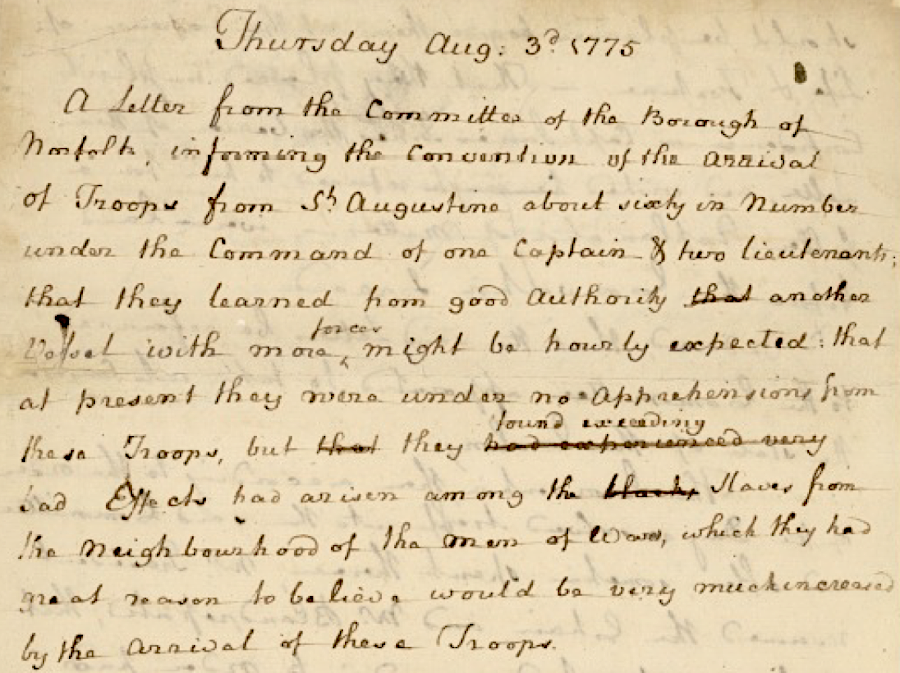
volunteer companies in Williamsburg reported to the Third Virginia Convention that British reinforcements had arrived from Florida to support Governor Dunmore
Source: UnCommonwealth blog, Library of Virginia, Banditti of Brothers: Irregulars and Plunderers During the Revolution (August 6, 2025)
On September 2, 1775 a hurricane pushed the support tender Liberty away from the HM Otter and onto the shoreline of the Back River near Hampton. Virginians plundered the boat, removed the guns, and burned the Liberty. The six British members of the crew were taken captive, but then quickly released.
Two of the three enslaved men on the boat who had escaped from Virginia plantations, known as Tom and Tawley, were sent to work in the lead mines at Austinville. They were later shipped to Antigua to be sold into slavery there. The ship carrying them was intercepted in the Caribbean, and apparently the British prevented that sale.
The third formerly-enslaved man, Joseph Harris, was a skilled river pilot. He managed to find a canoe and row with the captain of the Liberty, Matthew Squire, across the James River to eventually reach Gosport.
British demands for compensation for destruction of the Liberty were met with demands from the Virginians to return the enslaved workers who had fled into the British lines. The Virginians closed down the custom house in Hampton, but the British re-opened it in Norfolk. Step by step, the traditional processes of colonial government were transformed by the reduction of royal authority.
On September 30, 1775, a detachment of marines from British ships landed at Norfolk and seized the town's only printing press. Articles in the the Virginia Gazette or Norfolk Intellingencer had insulted the British, calling them pillagers and plunderers and even suggesting Lord Dunmore was guilty of the sin of beastiality. During the September 2 hurricane, the publisher claimed:
2
Gerald Holland, "The Seizure of the Virginia Gazette, or Norfolk Intelligencer," Journal of the American Revolution, January 20, 2016, https://allthingsliberty.com/2016/01/the-seizure-of-the-virginia-gazette-or-norfolk-intelligencer/ (last checked August 16, 2025)
When the British came ashore and stole the printing press, local residents did not resist. That demonstrated to Governor Dunmore that the efforts of the Third Virginia Convention to put the colony "in a state of defense" were not succeeding.
Dunmore followed up with additional raids deeper into Princess Anne and Norfolk counties. He also used the printing press to produce his own newspaper and to print his proclamations.2
Gerald Holland, "The Seizure of the Virginia Gazette, or Norfolk Intelligencer," Journal of the American Revolution, January 20, 2016, https://allthingsliberty.com/2016/01/the-seizure-of-the-virginia-gazette-or-norfolk-intelligencer/ (last checked August 16, 2025)
It gradually became clear that neither side was willing to compromise and both were willing to fight, just as had occurred in Massachusetts in April at Lexington anbd Concord and in June at Bunker Hill. Open warfare in Virginia finally started after the British blocked ship traffic into Hampton.
Anticipating an attack, the residents of Hampton sank ships to block the channel of the Hampton River. Matthew Squire returned with small, shallow-draft ships from the British fleet on the night of October 26, 1775. Firing broke out between men on the ships and Virginia militia on the shore. It was the first time that the two sides chose to shoot at each other in Virginia.
No one was killed in the hour of firing that night. On October 27, the British cut through the barrier. They salied up to the wharves at Hampton to fire their swivel guns and cannon at buildings, expecting to set fire to the town. Hampton militia hiding within the buildings fired at the men on deck, complicating their ability to load the guns and eventually killing several of the British. One ship came too close to shore and was captured.
The battle, with the first killing by Virginia militia of British sailors, must have generated much talk across Virginia. Word spread among the enslaved that the British had an integrated fighting force and were unwilling to returned escaped slaves to the Virginians. That news spurred some of the enslaved to flee in early November to potential freedom with the British, even though no formal invitation had been issued.2
"Anniversary of the 1775 Battle of Hampton," Mariners Museum, October 26, 2017, https://www.marinersmuseum.org/2017/10/anniversary-1775-battle-hampton/; "The revolution's first battle outside Northeast was in Virginia. It started with a dispute over a runaway slave," Cardinal News, October 14, 2025, https://cardinalnews.org/2025/10/14/the-revolutions-first-battle-outside-northeast-was-in-virginia-it-started-with-a-dispute-over-a-runaway-slave/ (last checked March 14, 2026)
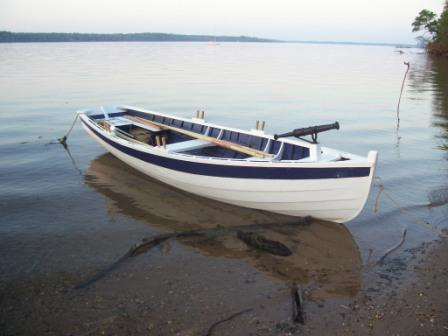
the tender seized by Hampton residents may have resembled this 16' skiff created by the HM Sloop Otter living history reenactors
Source: HM Sloop Otter, Our Boat
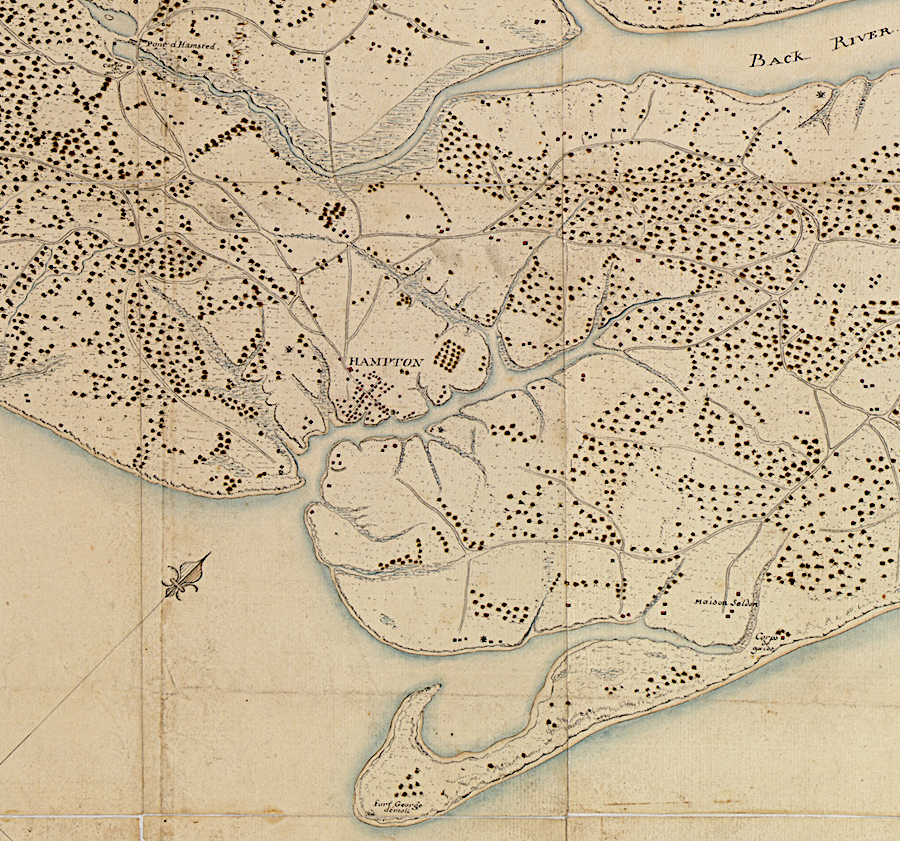
to reach Hampton, Royal Navy ships had to sail up the narrow Hampton River
Source: Library of Congress, Carte des environs d'Hampton
Dunmore published (using the stolen press) his Emancipation Proclamation on November 7, 1775. His men of the 14th Regiment of Foot, plus loyalists, had just defeated a group of North Carolina and Virginia militia.
Dunmore offered freedom to black men who would fight for the British.
In addition to building a fighting force, getting enslaved men to flee to the British would lower the ability of the rebellious Americans to construct fortifications. Reducing the workforce on plantations would reduce food and supplies needed by the Virginia militia. Dunmore wrote on November 30, 1775 to General Howe, who had peplaced General Gage in Boston, that the proclamation:2
"Lord Dunmore to Major General William Howe, November 30, 1775," Naval Documents of the American Revolution, https://navydocs.org/node/14242 (last checked August 26, 2025)
On October 26, the citizens of Hampton repelled a British force on five ships. Men on the ships fired muskets and small cannon, while the colonists on the shore fired rifles. The ships wrre 300 yards offshore, and it was not clear if anyone on the ships was hit.
Ships that had been sunk by the Virginians at the mouth of the Hampton River prevented the British from getting upstream to the town on October 26. They managed to cut a path through the barrier and get the ships closer to Hampton on October 27.
Musket fire from the 2nd Virginia Regiment regulars, local militia, and minutemen from Culpeper County on the shoreline forced the sailors to go belowdecks. One ship drifted too close to shore, and eight people were captured by the Virginians.
The Battle of Hampton was the first time the colonists and British forces opened fire on each other. Several of the 25 British were killed and others wounded. As at Lexington on April 19, it is unclear who fired the first shot at Hampton. According to one eyewitness, Captain Lyne of the local minuteman company fired a rifle on October 26 and killed a British sailor with the first shot of the engagement.2
Michael Cecere, "A Tale of Two Cities: The Destruction of Falmouth and the Defense of Hampton," Journal of the American Revolution, September 9, 2015, https://allthingsliberty.com/2015/09/a-tale-of-two-cities-the-destruction-of-falmouth-and-the-defense-of-hampton/ (last checked November 9, 2025)
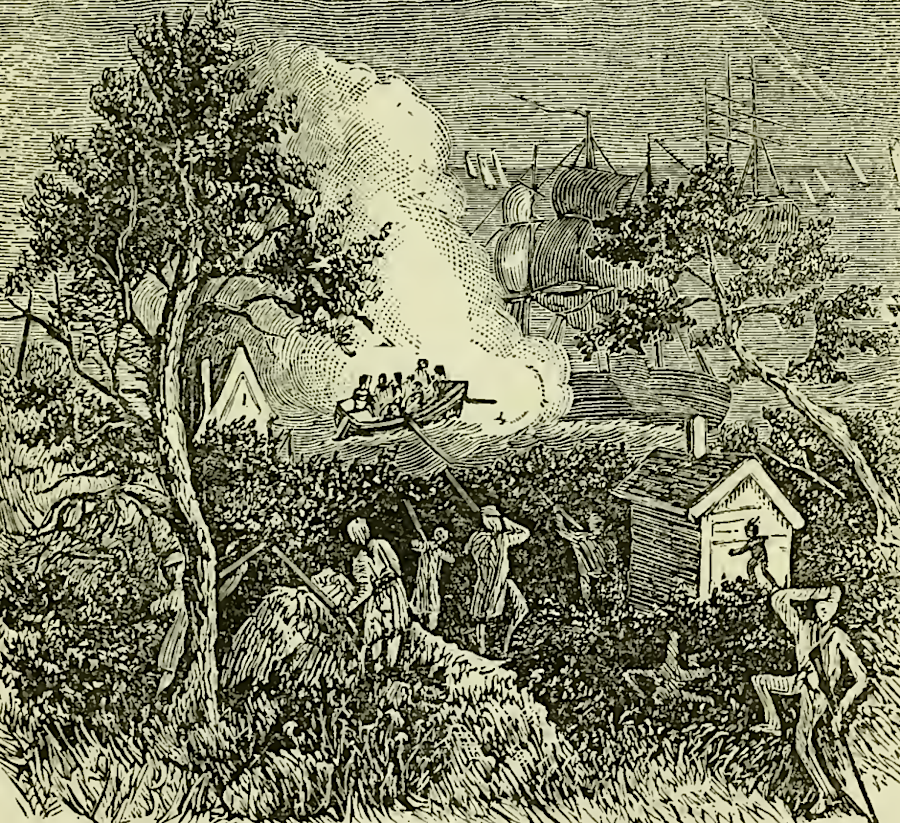
the first deaths from military operations in Virginia occurred when the British attacked Hampton on October 26-27, 1775
Source: Mary Tucker Magill, History of Virginia for the Use of Schools (1873, p.179)
The British could use their warships to travel wherever they wished, so long as they stayed in the river channels. Small vessels launched from those warships could ferry men through shallow water to shore, reaching places faster than the local militia or state regiments could march on poor roads to provide a defense. British vessels constantly sought to intercept any ships bringing gunpowder or other supplies to the militia.
A Virginian wrote in October 1775:2
Benjamin Quarles, "Lord Dunmore as Liberator," The William and Mary Quarterly, Volume 15, Number 4 (October, 1958), p.497, https://doi.org/10.2307/2936904 (last checked November 23, 2025)
Wherever the Virginians could assemble enough armed resistance, the British lacked sufficient forces to land and conduct a raid. After fleeing Williamsburg, Dunmore was unable to seize and hold any territory. The area around the Elizabeth River, dominated by Scottish merchants who depended upon trade with Great Britain, offered his only opportunity to establish a base on land. There he could obtain a steady supply of fresh water, and acquire needed food from the agricultural regions of Princess Anne and Norfolk counties - since he was not going to be supplied from Boston or Great Britain.
Dunmore needed a land army to regain control. He had been reinforced by the 14th Regiment of Foot from St. Augustine, Florida, but recognized that he would not get a significant number of additional soldiers from Massachusetts or from across the Atlantic Ocean. To solve the problem, he prepared an Emancipation Proclamation while on the William on November 7. It declared martial law, and directed:2
"Lord Dunmore's Proclamation, 1775," Gilder Lehrman Institute of American History, https://www.gilderlehrman.org/history-resources/spotlight-primary-source/lord-dunmores-proclamation-1775 (last checked November 23, 2025)
The governor waited a week before publishing his proclamation. During a November 15, 1775 raid, which the governor led personally, British troops defeated Princess Anne County militia assembled at Kemp's Landing. A soldier in that engagement captured the colonel of a militia company who had been his former enslaver. The victory gave Dunmore the opportunity to issue his proclamation publicly on November 16 from the home of a loyalists supporter, John Logan, at Kemp's Landing.2
Patrick H. Hannum, "Recognizing the Skirmish at Kemp's Landing," Journal of the American Revolution, December 17, 2018, https://allthingsliberty.com/2018/12/recognizing-the-skirmish-at-kemps-landing/ (last checked November 23, 2025)
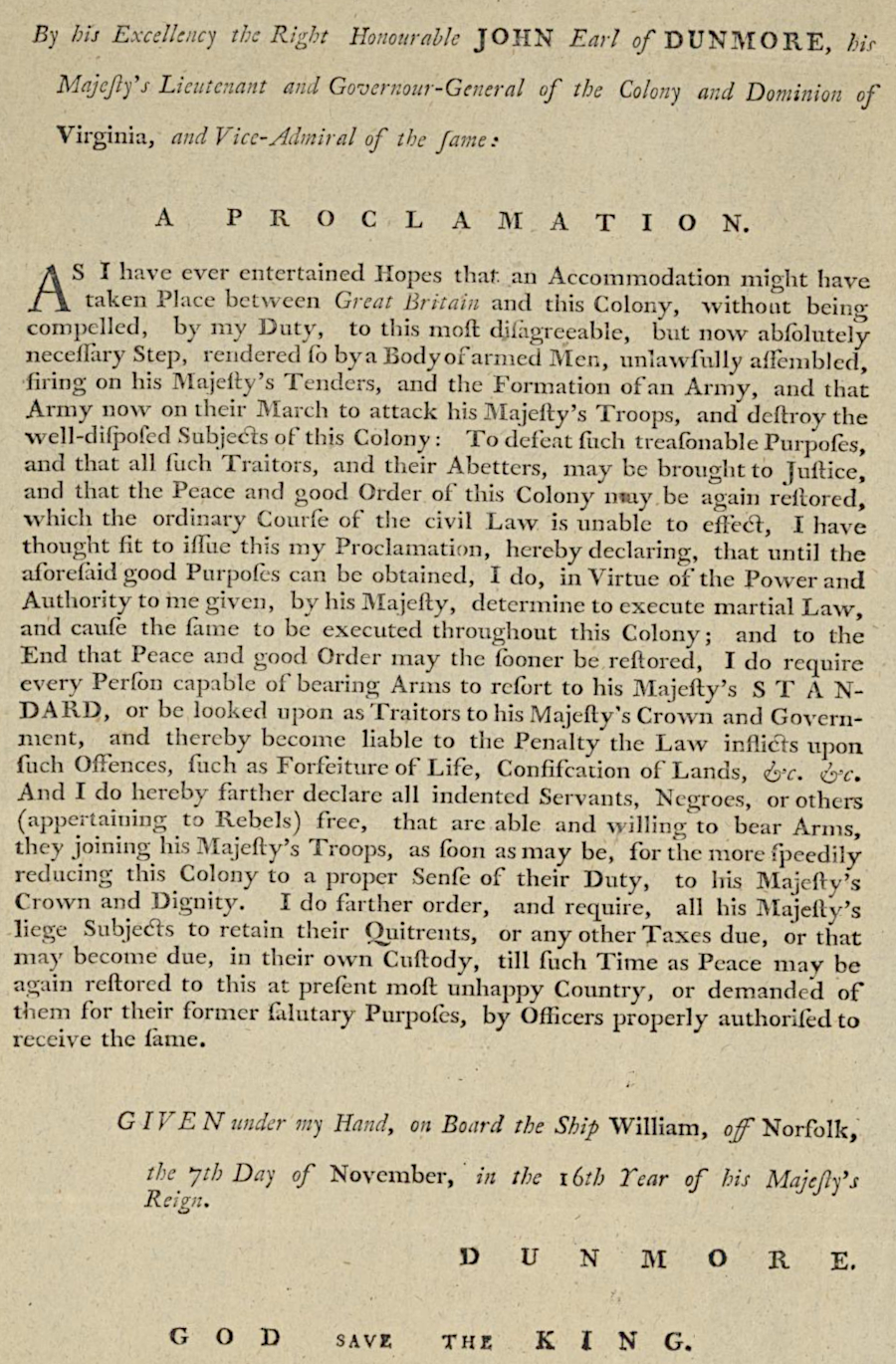
Governor Dunmore gambled that he could raise an army from enslaved workers and regain control of the colony, but his proclamation radicalized many white Virginians to reject royal authority
Source: Library of Congress, By his Excellency the Right Honourable John Earl of Dunmore, his Majesty's Lieutenant and Governor-General of the Colony and Dominion of Virginia, and Vice-admiral of the same. A proclamation
The emancipation-in-exchange-for-fighting offer attracted enough men for the royal governor to form the Ethiopian Regiment with initially 300 formerly enslaved Virginians. Eventually he may have recruited as many as 800-2,000 black men, along with loyalist whites that he organized into the Queens Own Loyal Virginia Regiment. The soldiers in the Ethiopian Regiment had "Liberty to Slaves" embroidered on their shirts, a counter to "Liberty or Death" embroidered on shirts worn by Virginia militia in 1775.
One enslaved man from New Jersey somehow managed to get to Norfolk. Titus Cornelius later returned to New Jersey where, known as Colonel Tye, he led loyalists there who effectively harrassed the American revolutionary forces.
The proclamation forced colonists to choose sides. The penalty for treason was death. The proclamation was intended to make Virginians be loyal to the royal government, rather than risk being executed as rebels.
Even more dramatically, Dunmore freed indentured servants and men who were enslaved by disloyal Virginians, if they were willing to fight for King George III.
Governor Dunmore had threatened to free and arm enslaved men back in April. That was his response when he feared an attack, after seizing the gunpowder from the magazine in Williamsburg. Since fleeing Williamsburg on June 8, he had accepted black men who sought freedom on his British ships.
When soldiers and sailors from British warships raided onshore between June-November 1775 to get water and food, they encouraged enslaved Virginians to flee the plantations. Impoverishing wealthy colonists who refused to acknowledge Dunmore's authority was a side benefit of the raids.
Dunmore's Proclamation officially announced a policy that would transform life in the colony.
Dunmore was motivated by military necessity, not by a desire for social justice. His proclamation was limited to men owned by insurrectionists who were willing to fight. He did not free those enslaved by those willing to "resort to his Majesty's standard," soon to be labelled as loyalists. The proclamation did not free women or children, or those unable to fight.
Source: Library of Virginia, A Spatial History of Lord Dunmore's Proclamation
People under the control of Virginians who chose to stay loyal to the Crown would remain enslaved or indentured. The proclamation offered no opportunity for freedom to the 57 enslaved people and 12 indentured servants that Governor Dunmore owned in 1775.
Dunmore needed a land army to expand his military capacity beyond the handful of men on a few British ships. He may have felt confident in his capacity as a military leader, having led a column of Virginia troops in 1774 to conquer the Shawnee in the Ohio River Valley in Dunmore's War.
He had realized soon after arriving in Virginia that the Spanish or any other foreign enemy invading Virginia could enlist support from those held in slavery, threatening the capacity of the British to defend the colony. He violated his instructions and in 1772 signed an act passed by the House of Burgesses to increase the tarriff on the import of enslaved people, even those brought into Virginia from Maryland or North Carolina. London officials blocked implementation of the extra tax, as they had for all similar efforts previously.
Dunmore needed more men capable of serving as laborers and soldiers, in order to build entrenchments and fortify land bases in Hampton Roads. From there he hoped to march to Williamsburg, regain control of the colonial capital, and re-establish royal control over the colony.
He envisioned that as a successful royal governor, he could suppress the insurrection in 1775-1776. In the end a few traitors would be hung, taxes would be collected, abnd the tobacco would be renewed. Dunmore could again be a wealthy man, remaining leading a cadre of white loyalists willing to serve as compliant members of a colonial government owing allegiance to King George III and Parliament.
More than any other action, Dunmore's decision to put weapons into the hands of black enslaved men across Virginia forced those trying to be neutral to pick a side. The culture and economy of the colony was going to be transformed by either a war with Great Gritain, or by liberation of 40% of the population that had been forced to work for nothing. Either way, no one was left with the option of just living their normal life until the political elites who gathered occasionally in Williamsburg somehow resolved their differences.
Of the 200,000-220,000 enslaved people in Virginia, between 1,000-1.5000 managed to cross into British lines to freedom. Some ended up wearing shirts with "Liberty to Slaves" sewn on the front, mocking the "Liberty or Death" words of Patrick Henry. However:2
James Corbett David, Dunmore's New World: The Extraordinary Life of a Royal Governor in Revolutionary America--with Jacobites, Counterfeiters, Land Schemes, Shipwrecks, Scalping, Indian Politics, Runaway Slaves, and Two Illegal Royal Weddings, UVA Press, 2013, pp.44-45, https://www.google.com/books/edition/Dunmore_s_New_World/V3qz3CccKc0C; Benjamin Quarles, "Lord Dunmore as Liberator," The William and Mary Quarterly, Volume 15, Number 4 (October, 1958), pp.495-497, https://doi.org/10.2307/2936904; "Long before Abraham Lincoln, Virginia's last royal governor issued his own Emancipation Proclamation. Here's what happened next," Cardinal News, November 18, 2025, https://cardinalnews.org/2025/11/18/long-before-abraham-lincoln-virginias-royal-governor-issued-his-own-emancipation-proclamation-heres-what-happened-next/ (last checked November 24, 2025)
Dunmore got an army, but failed to weaken the support for rebellion. His strategy failed in part because there were not enough Loyalists in Virginia, and in part because those who were loyalists were threatened seriously by rebels who lived nearby.
Dunmore used the power of the British Navy in early November to interfere with the effort of the Second Virginia Regiment and Culpeper Minutemen to cross the James River.
The Patriot Committee of Safety had ordered the troops to march to Norfolk and displace Dunmore from his base there. Four companies crossed before a British sloop, the Kingfisher, shelled the ferry landing and ships at Jamestown Landing on November 1. An attempt to land men from the Kingfisher, at Archers Hope was blocked by effective shooting from one Virginia rifleman onshore.
After four more companies managed to get to the southern shore of the James River, Col. Woodford decided to evade the Kingfisher by marching his last three companies upstream. He had to cross the Chickahominy River to reach Sandy Point in Charles City County. The James River was narrower there, and riflemen on each shore could prevent the British from threatening the boats that crossed. Woodford's men then marched through Suffolk to reach Great Bridge.
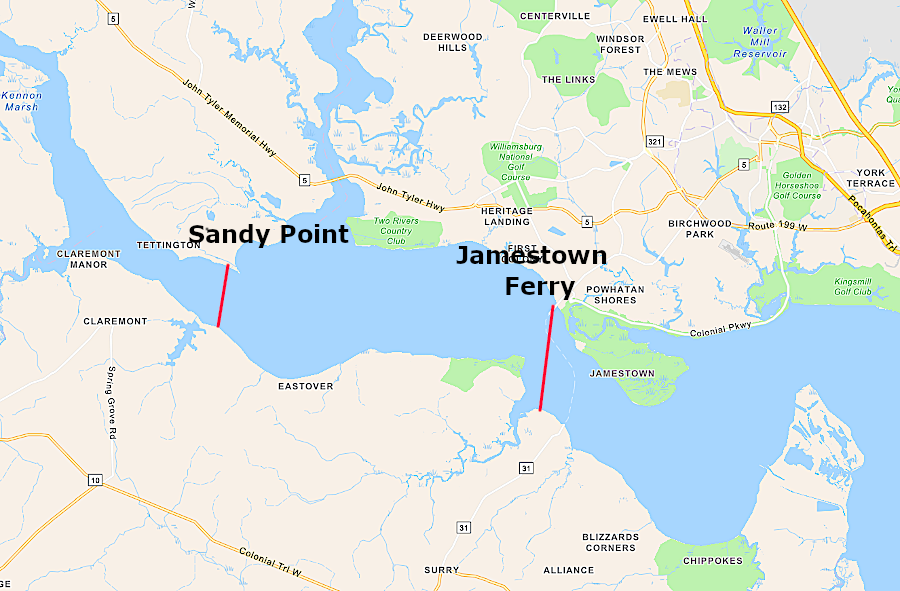
in November 1775, Virginia troops marched upstream to Sandy Point to cross the James River without interference from the British sloop Kingfisher
Source: ESRI, ArcGIS Online
After the success at Kemp's Landing on November 14, Dunmore fortified Great Bridge. Control of that crossing over the Southern Branch of the Elizabeth River would allow the British to block Virginia and North Carolina militia from approaching Norfolk. On December 3, 1775, a mixed group of British Regulars and recently-recruited black soldiers attacked Virginia militia at a ferry crossing nearby and forced them to flee:2
Andrew Lawler, "Lord Dunmore's Ethiopian Regiment," Encyclopedia Virginia, Virginia Humanities, February 17, 2025, https://encyclopediavirginia.org/entries/lord-dunmores-ethiopian-regiment/; Michael Cecere, Great Things Are Expected From the Virginians, Heritage Books, 2008, pp.51-53, https://www.google.com/books/edition/Great_Things_are_Expected_from_the_Virgi/P9DCwAEACAAJ; Michael Cecere, "A Tale of Two Cities: The Destruction of Falmouth and the Defense of Hampton," Journal of the American Revolution, September 9, 2015, https://allthingsliberty.com/2015/09/a-tale-of-two-cities-the-destruction-of-falmouth-and-the-defense-of-hampton/; Patrick H. Hannum, "'It is Incredible How Much They Dread a Rifle': Col. William Woodford’s 1775 James River Crossing," Journal of the American Revolution, September 1, 2025, https://allthingsliberty.com/2025/09/it-is-incredible-how-much-they-dread-a-rifle-col-william-woodfords-1775-james-river-crossing/ (last checked November 20, 2025)
William Woodford's Second Virginia Regiment and Culpeper Minutemen reached Great Bridge. They anticipated reinforcements from North Carolina, and planned to seize Norfolk.
Dunmore received accurate intelligence about the additional forces coming north and inaccurate intelligence about just a small number of Virginia troops already in place south of his fortifications at Great Bridge. On December 9, the British marched across the causeway and attacked the entrenched Virginians.
It was a one-sided battle. The British were packed into a narrow line on the causeway, with limited ability to fire while the Virginians were able to shoot from multiple directions. The attacking British were slaughtered before any reached the end of the causeway. After the defeat, Dunmore's forces quickly withdrew to Norfolk. The rebellious Virginians and North Carolinians finally had access to prepare for an attack on the city.
In mid-December a ship arrived from England with 3,000 muskets for Dunmore's loyalist army. Those weapons came too late; both the white and black regiments were thinned after the raids in Princess Anne and Norfolk counties, by defeat at the Battle of Great Bridge, and especially by disease. Typhus and smallpox killed men in the Queen's Own Loyal Regiment, and particularly the malnourished men in the black Ethiopian Regiment, almost as fast as new recruits arrived.2
Patrick H. Hannum, "Lord Dunmore's Proclamation: Information and Slavery," Journal of the American Revolution, December 30, 2019, https://allthingsliberty.com/2019/12/lord-dunmores-proclamation-information-and-slavery/ (last checked August 26, 2025)
The Fourth Virginia Convention recognized that just the two regiments authorized by the Third Virginia Convention would not be enough to defend the various places within Virginia where the British ships could land forces. The delegates approved expanding the full-time Virginia army to eight regiments. Each of the six new regiments would have 10 companies, with 68 men enlisted for two years.
Recruiting nearly 5,500 new soldiers was less difficult that getting weapons for them. George Mason wrote George Washington on April 2, 1776:2
Michael Cecere, Great Things Are Expected From the Virginians, Heritage Books, 2008, pp.63-65, https://www.google.com/books/edition/Great_Things_are_Expected_from_the_Virgi/P9DCwAEACAAJ; "To George Washington from George Mason, 2 April 1776," Founders Online, National Archives, https://founders.archives.gov/documents/Washington/03-04-02-0017; Patrick H. Hannum, "Virginia's 1775 Regular Company-level Military Force Structure," Journal of the American Revolution, September 15, 2022, https://allthingsliberty.com/2022/09/virginias-1775-regular-company-level-military-force-structure/ (last checked August 27, 2025)
The Fourth Virginia Convention also created a Virginia Navy. The small armed vessels in the Virginia Navy would not be able to clallenge large British warships, but might interfere if the British tried to launch a raid using small boats to take soldiers to shore. As described by Mason:2
"To George Washington from George Mason, 2 April 1776," Founders Online, National Archives, https://founders.archives.gov/documents/Washington/03-04-02-0017 (last checked July 18, 2025)
More companies from Williamsburg and militia from North Carolina arrived after the Battle of Great Bridge, bringing artillery as well as hundreds of additional soldiers. They marched unopposed into Norfolk on December 14, five days after the battle at Great Bridge.
The British forces withdrew to the warships. After losing control of the chokepoint at Great Bridge, they abandoned efforts to defend the city from land attack.
Prior to the battle at Great Bridge the loyalists (probably men in the Ethiopian Regiment) had dug trenches and placed 15 cannon in earthworks stretching up to 3/4th of a mile. However, as described by one historian:2
"Dunmore’s Virginia Campaign 1775 – 1776," Virginia Revolutionary War Trail brochure, https://www.va250.org/wp-content/uploads/2024/03/2023-Dunmore-Map-narrative.pdf; H. J. Eckenrode, The Revolution in Virginia, 1916, pp.78-79, https://www.google.com/books/edition/The_Revolution_in_Virginia/08QBAAAAMAAJ (last checked August 28, 2025)
Even the arrival of 400 marines did not give Dunmore enough capacity to protect the town. He evacuated his forces from Portsmouth, and all British soldiers moved onto ships. Members of the Ethiopian Regiment and many loyalists also got onto ships. A fleet of private ships, some of which had been seized as prizes by the Royal Navy, provided shelter in the Elizabeth River and Hampton Roads. People who were not willing to become part of Dunmore's "Floating Town" of loyalists fled inland, anticipating the destruction of Norfolk.
At the end of 1775, Dunmore chose to destroy warehouses on the waterfront of Norfolk. On January 1, 1776 British marines set fire to 19 buildings in Norfolk and cannon on the British warships then shelled the city.
His attempt to destroy the city was only partially successful. The Virginians chose to complete the burning of Norfolk, torching 800 remaining structures. Destroying Norfolk prevented the British from returning and re-establishing a military base there.2
Andrew Lawler, "The Biggest Coverup of the American Revolution," The Bulwark, July 4, 2025, https://www.thebulwark.com/p/the-biggest-coverup-of-the-american-revolution-declaration-of-independence-jefferson-lord-dunmore-burning-of-norfolk; Matthew Krogh, "Lord Dunmore's Navy in Hampton Roads, 1775-1776, Part II: The Road to Great Bridge," Hampton Roads Naval Museum, January 18, 2017, https://hamptonroadsnavalmuseum.blogspot.com/2017/01/lord-dunmores-navy-in-hampton-roads.html; Matthew Krogh, "Lord Dunmore's Navy in Hampton Roads, 1775-1776, Part III: From Great Bridge to Gwynn's Island," Hampton Roads Naval Museum, March 6, 2017, https://hamptonroadsnavalmuseum.blogspot.com/2017/03/lord-dunmores-navy-in-hampton-roads.html (last checked August 30, 2025)
Source: Library of Virginia, Book Talk With Andrew Lawler | A Perfect Frenzy
The London Chronicle published the story of the destruction of Gosport Shipyard soon after the burning of Norfolk:
London Chronicle, April 16-18, 1776, in Naval Documents of the American Revolution - Volume 4, Naval History and Heritage Command (NHHC), p.38, https://www.history.navy.mil/content/dam/nhhc/research/publications/naval-documents-of-the-american-revolution/NDARVolume4.pdf (last checked August 25, 2025)
The destruction of Norfolk and Gosport by the rebelling Virginians occurred before the news arrived that the invasion of Quebec had failed. The British victory could have led to reconsideration of the insurrection. It was not too late to reach a reconciliation agreement in which the colonists accepted continuation of royal authority, while obtaining greater control over how taxes would be raised in the colonies. At the start of 1776, there was no consensus in the colonies that the goal was independence and creation of 13 new states with no allegiance to King George III.
Virginia started the new year with the use of an independent military force to destroy the homes and businesses of loyalists. The Second Regiment compelled the royal governor to shelter on a British ship, and soldiers fired randomly at the warships floating in the Elizabeth River. Pubication and wide circulation of Thomas Paine's pamphlet Common Sense pushed the colonists from Georgia to Massachusetts towards independence rather than reconciliation.
The town of Portsmouth, north of Gosport on the other side of Crab Creek, was not shelled by the British fleet or destroyed by the Virginia/North Carolina forces on January 1. Local residents continued to live in the town. When the 44-gun HMS Rowbuck arrived in February 1776, Dunmore established a new base onshore north of Portsmouth at Tucker's Point (also known as Tucker's Mill Point and Mill Point). It later became known as Hospital Point, when in 1830 the US Navy opened its first hospital in the Unied States.
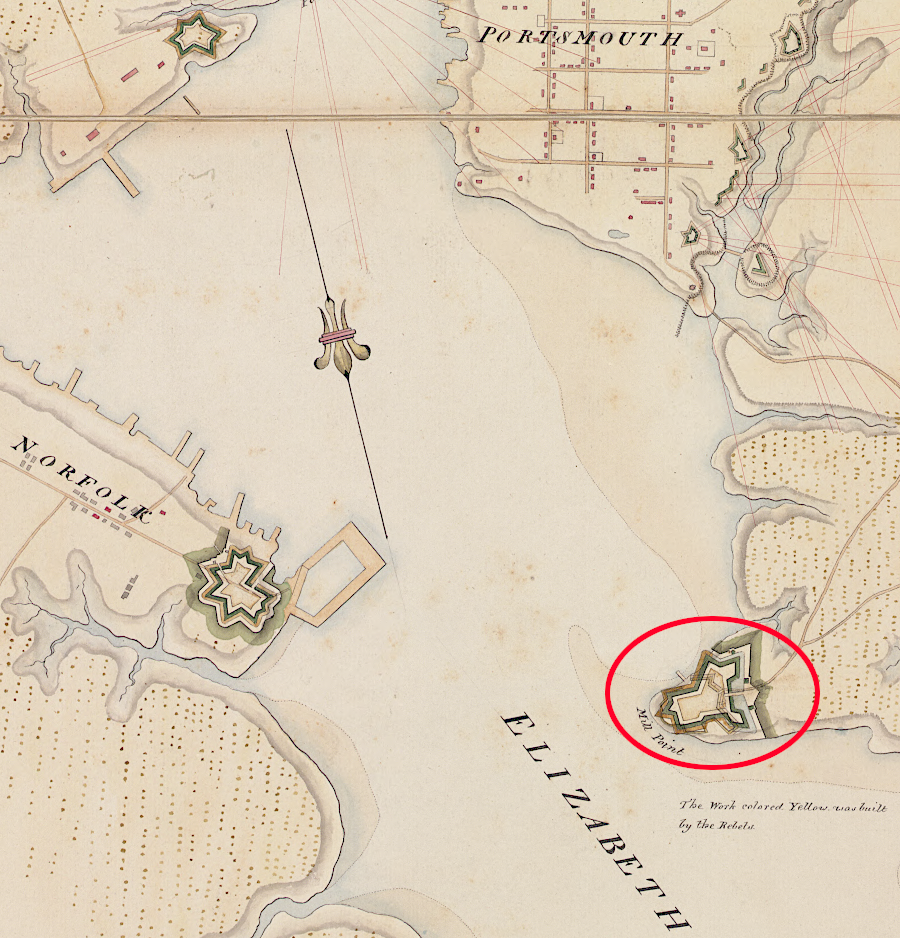
Governor Dunmore based his Ethiopian Regiment at Tucker's Point between February-May, 1776
Source: Library of Congress, plan of Portsmouth Harbour in the province of Virginia shewing the works erected by the British forces for its defence, 1781 (by James Stratton, 1782)
Dunmore explained why he established the camp in a letter Lord Germain, Secretary of State for the Southern Colonies in London:2
"Lord Dunmore to Lord George Germain, March 30, 1776," Naval Documents of the American Revolution - Volume 4, Naval History and Heritage Command (NHHC), https://navydocs.org/node/16437; "Portsmouth Naval Hospital," Historical Marker Database, https://www.hmdb.org/m.asp?m=21042 (last checked August 28, 2025)
Soldiers in the Ethiopian Regiment constructed an eight-foot deep entrenchment to protect four acres on the peninsula from a land attack. Moving black (and white) loyalists and sick sailors ashore improved health conditions and relieved overcrowding on the ships. A land base on the western side of the Elizabeth River also created a launching point for raids into Nansemond County.2
"Episode 077: Dunmore Proclamation and the Southern War," American Revolution Podcast, December 30, 2018, https://blog.amrevpodcast.com/2018/12/episode-077-dunmore-proclamation-and.html; W. Hugh Moomaw, "The British Leave Colonial Virginia," The Virginia Magazine of History and Biography, Volume 66, Number 2 (April, 1958), p.148, https://www.jstor.org/stable/4246423 (last checked August 26, 2025)
The American rebels destroyed Norfolk, the largest town in the colony, rather than fortify it for the same reasoning as the British. The Virginia militia could not defend the city. Norfolk was exposed to ground attack by troops that cpuld be unloaded from a British fleet, and the small boats in the Virginia Navy were no match for the British Navy. The warships could launch cannonballs and shot without threat of any Virginia retaliation besides an occasional shot from a musket on the shoreline.
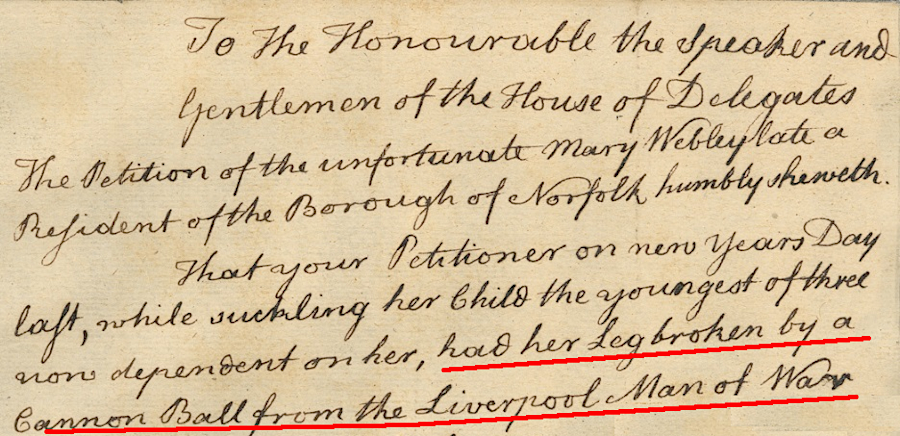
a civilian wounded in the January 1, 1776 bombardment of Norfolk petitioned the General Assembly for aid in October, 1776
Source: Library of Virginia, The UnCommonwealth blog, Two Revolutionary War Petitions (March 9, 2022)
The Fourth Virginia Convention established no position of commanding general to manage the army that it created. The 11-person Committee of Safety decided where to send the eight Virginia regiments.
The Third Regiment and the Fifth Regiment served along the Potomac River. Together with troops in Maryland, they set up observation stations to monitor ship traffic. If British warships sailed up the Potomac River, towns all the way to Alexandria would get advance notice.
Patrick Henry objected to how his First Regiment was directed, after William Woodford was sent to Great Bridge and earned glory in the victory there. Henry thought the commander of the First Regiment should be able to issue orders to the Second Regiment, but his political opponents in the Committee of Safety had no desire for Henry to become a war hero. Henry finally resigned his commission in February 1776 and returned to politics.
In late 1775-early 1776, the Continental Congress was establishing guidance and oversight procedures for civilian control of the Continental Army. George Washington ensured throughout the war that the civilian delegates were recognized as the source of military authority. Under his leadership, the tradition of the American military obeying orders from elected representatives was established. The Continental Congress, not Washington, chose who would be commissioned as generals. Washington was the commander of the army, but could not choose his immediate subordinates.
The Continental Congress did pick someone to be responsible for all the regiments in Virginia, and it also bypassed Patrick Henry. The Continental Congress chose Andrew Lewis rather than Henry to be a brigadier general. George Washington then sent General Charles Lee to Williamsburg in April, 1776 to organize regional defenses. He was there only briefly; the Continental Congress directed Lee to go to Charles Town, South Carolina. The Eighth Virginia Regiment marched there with him, led by Colonel Peter Muhlenberg. Virginia's full-time regiments were not limited to service just within the boundaries of the state.
2
Michael Cecere, Great Things Are Expected From the Virginians, Heritage Books, 2008, pp.64-65, pp.67-68, https://www.google.com/books/edition/Great_Things_are_Expected_from_the_Virgi/P9DCwAEACAAJ (last checked July 14, 2025)
In December 1775, as Lord Dunmore had been organizing his Ethiopian Regiment and fighting with militia in Princess Anne County, Parliament had passed the Prohibitory Act. It prohibited almost all trade with the colonies, freezing the ability of shipowners to continue to do business through ports other than Boston. Any ship caught trading in violation of the blockade would be seized and sold like a pirate ship.
On the other hand, the same bill authorized peace commissioners and granted them the power to issue pardons to rebels in the colonies. Like the Continental Congress, Parliament followed two tracks with both carrots and sticks. Propositions for peaceful reconciliation were approved at the same time as plans for war.
The process of appointing a peace commissioner was not smooth. Admiral Richard Howe forced King George III to make concessions before accepting the dual role of peace commissioner (together with his brother, General William Howe) and as the new commander of the Royal Navy in American waters. Hardliners ensured that the instructions given to the Howe brothers made it unlikely the Americans would accept. The instructions required the acceptance of Parliamentary authority, dissolution of the Continental and provincial congresses that were not called by royal governors, and disbanding the independent companies of militia before negotiations could begin.
John Adams, who opposed reconciliation, learned of the Prohibitory Act first. It delighted him. A total trade blockade of all 13 colonies forced his political opponents to acknowledge that the traditional pattern of royal rule had been broken, and spurred reluctant revolutionaries to choose the path towards independence. Adams wrote about the Prohibitory Act in March 1776:
2
"Prohibitory Act of 1775," Statues and Stories blog, https://www.statutesandstories.com/blog_html/prohibitory-act-of-1775/; "Richard Howe: Admiral of the British Fleet in North America and Peace Commissioner," Journal of the American Revolution, March 7, 2018, https://allthingsliberty.com/2018/03/richard-howe-admiral-of-the-british-fleet-in-north-america-and-peace-commissioner/; Weldon Amzy Brown, "The Howe Peace Commission Of 1776," The North Carolina Historical Review, Volume 13, Number 2 (April 1936), https://www.jstor.org/stable/23514816 (last checked August 11, 2025)
In January 1776, Lord Dunmore sent a letter to the Committee of Safety through Richard Corbin, who remained a loyalist but was also on good terms with the leaders of the rebellion. Dunmore cited the offer by King George III to grant pardons and offered "em>to effect a reconciliation.."
The Committee of Safety responded by telling the governor that only the House of Burgesses could respond to the offer. The Committee of Safety reply proposed that Dunmore empower the senior member of his Council, Thomas Nelson, to convene the legislature. The governor declined, the General Assembly never met, and the effort at reconciliation produced no results.2
Virginia Gazette (Purdie), Colonial Williamsburg, February 16, 1776, p.3, https://research.colonialwilliamsburg.org/DigitalLibrary/va-gazettes/VGSinglePage.cfm?issueIDNo=76.P.11&page=2&res=LO; Virginia Gazette (Purdie), Colonial Williamsburg, March 1, 1776, p.2, March 1, 1776 (last checked August 28, 2025)
For a brief moment in February, 1776, there was a strong British presence in the Chesapeake Bay. A fleet arrived with General Henry Clinton and the troops he was taking to support Governor Josiah Martin regain control in North Carolina.
General Clinton had been granted authority to support Governor Dunmore. Lord George Germain had written to Dunmore and the royal governor of Maryland, Robert Eden:
2
Michael Cecere, Great Things Are Expected From the Virginians, Heritage Books, 2008, p.63, https://www.google.com/books/edition/Great_Things_are_Expected_from_the_Virgi/P9DCwAEACAAJ; Michael Romero, "Virginia's Unconquered Liberty," Naval History, Volume 32, Number 5 (October 2018), https://www.usni.org/magazines/naval-history-magazine/2018/october/virginias-unconquered-liberty (last checked August 11, 2025)
Clinton declined Dunmore's request to stay and engage the Virginia rebels. He directed the fleet to sail to Wilmington because he saw no opportunity to re-establish royal government after the defeat at Great Bridge.
Clinton wrote later about his brief time in the Chesapeake Bay in February, 1776:2
"Narrative of Sir Henry Clinton," February 17 to February 27,1776, in Naval Documents of the American Revolution - Volume 4, Naval History and Heritage Command (NHHC), p.102, https://www.history.navy.mil/content/dam/nhhc/research/publications/naval-documents-of-the-american-revolution/NDARVolume4.pdf (last checked August 25, 2025)
The royal governor in Virginia must have been delighted to see that weather had forced Clinton to stop first in the Chesapeake Bay, then greatly disappointed to lose the opportunity to return to power in Williamsburg. If forced to return London, Lord Dunmore could sit in the House of Lords as a Scottish peer, but Virginia offered him the only opportunity to gain great wealth through acquiring land. Dunmore already had invested substantial personal effort in governing the fractious colony, even leading a military exopedition in 1774 to the Ohio River. There he negotiated the Treaty of Camp Charlotte that forced the Shawnee to recognize the right to colonize lands according to the 1768 Treaty of Fort Stanwix and the 1760 Treaty of Lochabar.
After the British ships reached Wilmington, Clinton discovered the loyalists in North Carolina had been defeated in a battle at Moore's Creek. As in Virginia, the royal governor in North Carolina could not gather a critical mass of colonists to support him. The "restoration of legal government in that part of America" was not a viable option.
In accord with his orders, Clinton chose to sail further south and seize Charles Town, South Carolina. That city was a far bigger prize than any town in Virginia or North Carolina, and he anticipated finding strong support for royal government in that colony. However, the British ships were unable to get past the palmetto log fort on Sullivan's Island on June 28, 1776. When Clinton finally sailed north to New York inorder to join General Howe there, the first British attempt at a "southern strategy" to mobilize loyalists from Georgia to Virginia had failed.
So long as Governor Dunmore remained in the Chesapeake Bay, the nascent Virginia Navy, consisting of converted merchant ships with few cannon, was unable to protect the supply lines for Virginia militia or prevent raids on the plantations onshore. British ships intercepted vessels bringing gunpowder from the Caribbean or Europe to Virginia and captured "rebel" ships that were attempting to export flour or other goods, or could serve as privateers in the Atlantic Ocean.
The British ships in the Chesapeake Bay, led by Captain Andrew Snape Hamond of HMS Roebuck, also suffered from a shortage of supplies in 1776. After the burning of Norfolk, the Royal Navy could no longer deal with merchants to purchase food or naval stores from Princess Anne or Norfolk counties.
On February 26, 1776, Captain Hamond ordered Captain Mathew Squire of the HMS Otter to sail to Baltimore and seize "any vessels you may suspect to be Laden with any kind of Provisions or that have the appearance of being proper for Arming." On the return, after performing the directed service at Balitimore, Captain Squire was to stop along the shoreline to acquire livestock:2
"Captain Andrew Snape Hamond, R.N., to Captain Mathew Squire, H.M.S. Otter" and "Captain Andrew Snape Hamond, R.N., To Vice Admiral Molyneux Shuldha," March 5, 1776 in Naval Documents of the American Revolution - Volume 4, Naval History and Heritage Command (NHHC), pp.92-93, p.182, https://www.history.navy.mil/content/dam/nhhc/research/publications/naval-documents-of-the-american-revolution/NDARVolume4.pdf (last checked August 25, 2025)
On April 3, 1776, the Continental Congress in Philadelphia approved an act of war. It authorized ship captains to use a letter of marque issued by the Congress to seize British ships and their cargoes - though not to imprison sailors. Such seizures were perceived as legitimate when separate nations were at war. By then the colonies had fought at Bunker Hill, organized an army, captured Montreal and Fort Ticonderoga, attacked Quebec, and forced the British Army and Navy to evacuate Boston. However, the colonies had not yet declared themselves to be a separate nation and established the United States of America.2
Source: "In Congress, Wednesday, April 3, 1776: Instructions to the commanders of private ships or vessels of war," Library of Congress, https://lccn.loc.gov/90898007 (last checked April 3, 2026)
The Fifth Virginia Convention decided in May, 1776 that rapprochment with King George III and Parliament was never going to be possible. The convention issued instructions on May 15, 1776 to the Virginia delegates at the Continental Congress to formalize the separation from Great Britain and to declare independence.
The convention then adopted a Declaration of Rights on June 12 and a state constitution on June 29. The state constitution flipped the basis for government legitimacy. The first colony to create an independent state government established one authorized from the bottom up by the people of Virginia, no longer top down by a king and Parliament.2
"Virginia's Fifth Revolutionary Convention’s Resolutions for Independence (May 15, 1776)," Encyclopedia Virginia, Virginia Humanities, July 15, 2025, https://encyclopediavirginia.org/primary-documents/virginias-fifth-revolutionary-conventions-resolutions-for-independence-may-15-1776/; "The Virginia Declaration of Rights," National Archives, https://www.archives.gov/founding-docs/virginia-declaration-of-rights; "The Constitution of Virginia (1776)," Encyclopedia Virginia Virginia Humanities, December 7, 2020, https://encyclopediavirginia.org/primary-documents/the-constitution-of-virginia-1776/ (last checked August 29, 2025)
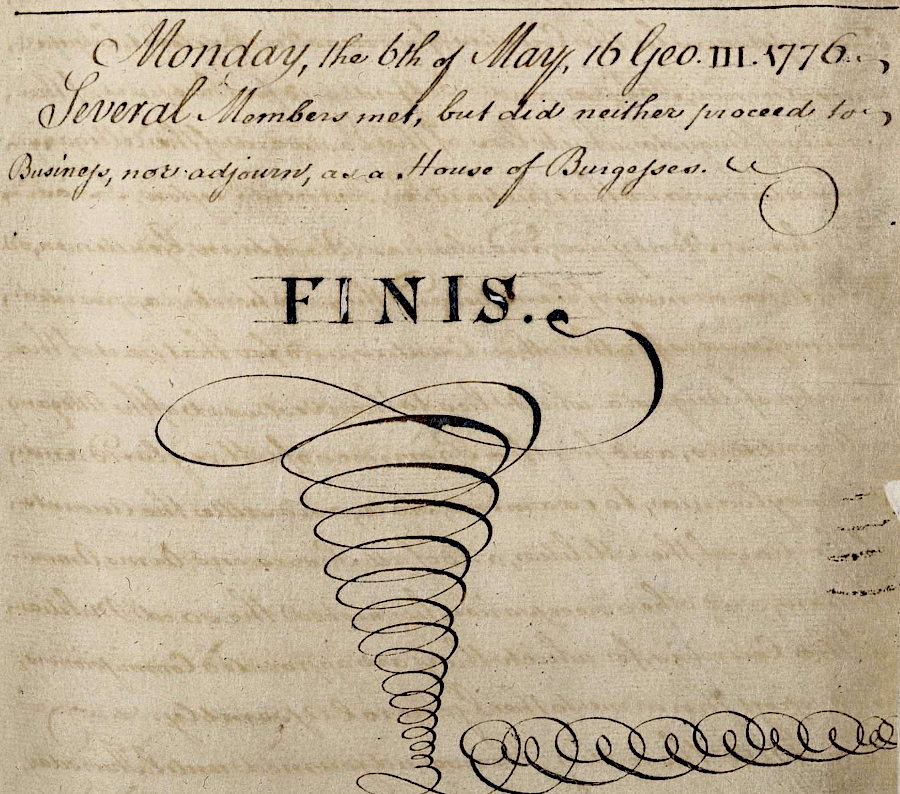
the House of Burgesses stayed in existence for over a year after Lord Dunmore fled Williamsburg
Source: Encyclopedia Virginia, Journals of the House of Burgesses of Virginia, May 6, 1776
The British chose to move from the Elizabeth River after learning that the Virginia militia were placing cannon at the mouth of the Elizabeth River. They were also preparing fireships which could destroy the fleet trapped in the narrow Elizabeth River channel. The loyalists and black runaways at Tucker Point, north of Portsmouth, loaded up onto British warships and nearly 90 private ships at the end of April. Their camp was full of disease; 300 graves had been dug for victims of typhus and smallpox.
The fleet sailed to a new base at Gwynn's Island 35 miles north of Norfolk in May 1776. A member of the Virginia gentry, John Randolph Grymes, supported royal rule and offered the use of his plantation on the island. Dunmore chose Gwynn's Island after being told there were loyalists in the area, there was plenty of fresh water, and a good harbor could shelter the ships.
Having a British base on land at Gwynn's Island, as at Tucker's Point, maintained the claim of continuing royal rule in Virginia. Dunmore calculated that if General Henry Clinton returned from the Carolinas to the Chesapeake Bay, he still had a chance to stay in Virginia.
To regain authority as royal governor, Dunmore needed help from Clinton's fleet or from the British who were stationed at Halifax after evacuating Boston. There were not enough loyalists, black or white, by the time the fleet reached Gwynn's Island tp counter the eight regiments being directed by the Committee of Safety in Williamsburg. Dunmore had just 150-200 Regulars and 450 loyalists in the white Queen's Own Loyal Regiment and the black Ethiopian Regiment who were healthy enough to fight.
Virginia's military leaders were surprised by the shift to Gwynn's Island. General Andrew Lewis, who had been appointed by the Continental Congress to oversee defenses in Virginia and lived west of the Blue Ridge, said:2
John E. Selby, The Revolution in Virginia, 1775-1783, 2007, pp.104-106, https://www.google.com/books/edition/The_Revolution_in_Virginia_1775_1783/WfCBYZs_jIMC; W. Hugh Moomaw, "The British Leave Colonial Virginia," The Virginia Magazine of History and Biography, Volume 66, Number 2 (April, 1958), pp.147-148, https://www.jstor.org/stable/4246423; Paul Burns, "With Lord Dunmore on Tucker's Point - A Runaway Slave's Perspective," Being a History Head and Other Things blog, January 7, 2013, https://beingahistoryheadandotherthings.blogspot.com/2013/01/with-lord-dunmore-on-tuckers-point.html (last checked August 26, 2025)
The local militia in Gloucester County quickly responded after the ships arrived on May 27 and set up camp on the shoreline opposite Gwynn's Island. When the Seventh Virginia Regiment arrived to provide additional firepower, the colonel was not impressed with the milita's capacity. He found them to be very active but very unorganized, commenting sarcastically in one report that upon the arrival of the Seventh Virginia Regiment:2
Michael Cecere, Great Things Are Expected From the Virginians, Heritage Books, 2008, p.76, https://www.google.com/books/edition/Great_Things_are_Expected_from_the_Virgi/P9DCwAEACAAJ (last checked July 14, 2025)
Musket fire from the militia created only a minor harassment to the British ships in the channel between the Gloucester County mainland and the island. The greatest challenge to the British was disease. Dunmore reported:2 "Lord Dunmore to Lord George Germain," September 4, 1776, in Naval Documents of the American Revolution - Volume 6, p.678, https://www.history.navy.mil/content/dam/nhhc/research/publications/naval-documents-of-the-american-revolution/NDARVolume6.pdf
To threaten Dunmore's camp on Gwynn's Island, the Virginians brought artillery to the shoreline. Two 18-pound cannon and a mortar started bombarding the British on July 9, 1776. What Dunmore dismissed as "crickets" were deadly.
The cannon fire from "Cricket Hill" triggered an immediate response; the British quickly sailed away. They left behind many of the men in the Ethiopian Regiment, who were debilitated by disease. When the Virginians finally collected enough boats to cross over to the island the next day, they found just dead black loyalists and others suffering from smallpox.
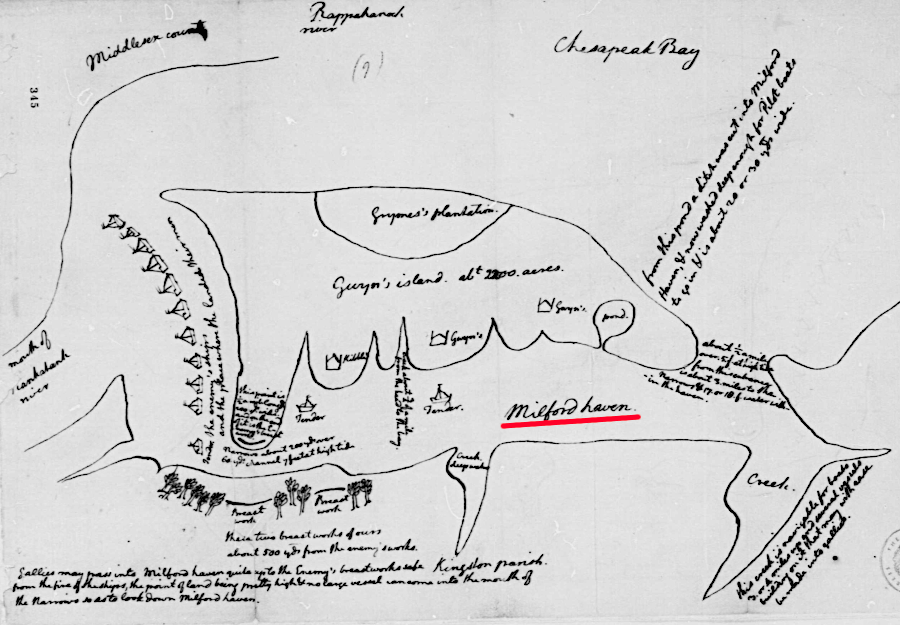
Milford Haven offered a sheltered harbor for Lord Dunmore's fleet - until the cannon on Cricket Hill opened fire
Source: Library of Congress, Thomas Jefferson, June-July 1776, Map of Action at Gwyn's Island, Chesapeake Bay
After being forced off Gwynn's Island, Dunmore sailed to St. George's Island in Maryland at the mouth of the Potomac River. One of his ships went north and raided the Brent plantation in Stafford County, burning the main house while seizing food. The ship returned with a Virginia newspaper that announced Dunmore's role had been officially abolished by the establishment of Virginia's first state constitution. The royal governor wrote to George Germain:2
"Lord Dunmore to Lord George Germain," July 31, 1776 in Naval Documents of the American Revolution - Volume 5, pp.1312-1313, https://www.history.navy.mil/content/dam/nhhc/research/publications/naval-documents-of-the-american-revolution/NDARVolume5.pdf; "Purdie's Virginia Gazette, August 2, 1776," Colonial Williamsburg, p.2, https://research.colonialwilliamsburg.org/DigitalLibrary/va-gazettes/VGSinglePage.cfm?issueIDNo=76.P.54 (last checked August 28, 2025)
Maryland militia initially blocked Dunmore's forces from landing on St. George's Island. When they finally occupied it, Maryland militia slipped onto the island and destroyed the well along with some of the British water casks.
Dunmore finally told all of the private ships to sail away to Great Britain, the West Indies or St. Augustine. Since there were so few qualified sailors on the private ships, the British warships had to provide some men. The HMS Otter was detached to provide protection and guidance for those sailing to St. Augustine.
In 1775-1776, the Royal Navy captains commanding warships in the Chesapeake Bay had little desire to spend time protecting Governor Dunmore and his fleet of private ships filled with loyalists, while other warships were directed to attack Charles Town or New York City. There were too few British warships to create an effective blockade. Many small ships loaded with supplies managed to sail from islands in the Caribbean to Virginia and Maryland ports, frustrating the Royal Navy captains.
The naval leader in the Chesapeake Bay, Captain Andrew Snape Hamond, was frustrated by his assignment to guard a "Floating Town" filled with loyalists rather than to engage in a military campaign such as the attack on Charles Town. He had been unable to obtain additional ships, troops, or weapons as the British prepared to defend and then evacuate Boston.
Hamond vented in a letter sent back to England after Dunmore decided to abandon Virginia:2
"Captain Andrew Snape Hamond, R.N., to Hans Stanley," August 5, 1776 in Naval Documents of the American Revolution - Volume 6, p.66, https://www.history.navy.mil/content/dam/nhhc/research/publications/naval-documents-of-the-american-revolution/NDARVolume6.pdf; "Captain Andrew Snape Hamond, R.N., To Hans Stanley," September 24, 1776, in Naval Documents of the American Revolution - Volume 6, p.973, https://www.history.navy.mil/content/dam/nhhc/research/publications/naval-documents-of-the-american-revolution/NDARVolume6.pdf; W. Hugh Moomaw, "The British Leave Colonial Virginia," The Virginia Magazine of History and Biography, Volume 66, Number 2 (April, 1958), p.156, https://www.jstor.org/stable/4246423 (last checked August 28, 2025)
Virginia and Maryland also managed to create their own naval forces. By the middle of 1776, they posed a military threat to the small boats (tenders) used by the British warships. Dunmore reported on July 31, 1776 that the military situation was degraded and he was no longer able to establish a presence on land:2
"Lord Dunmore to Lord George Germain," July 31, 1776, in Naval Documents of the American Revolution - Volume 5, p.1314, https://www.history.navy.mil/content/dam/nhhc/research/publications/naval-documents-of-the-american-revolution/NDARVolume5.pdf; "Captain Andrew Snape Hamond, R.N., to Captain Mathew Squire, H.M.S. Otter" in Naval Documents of the American Revolution - Volume 5, p.1315, https://www.history.navy.mil/content/dam/nhhc/research/publications/naval-documents-of-the-american-revolution/NDARVolume5.pdf (last checked August 28, 2025)
Lord Dunmore abandoned his effort to re-establish royal rule after learning on August 4 that General Clinton had failed to capture Charles Town and was sailing to New York City, not coming back to the Chesapeake Bay. Dunmore repeated his disappointment in his report to Lord George Germain:2
"Lord Dunmore to Lord George Germain," August 4, 1776, in Naval Documents of the American Revolution - Volume 6, p.51, https://www.history.navy.mil/content/dam/nhhc/research/publications/naval-documents-of-the-american-revolution/NDARVolume6.pdf (last checked August 28, 2025)
By August 1776, Virginia's loyalists had been thoroughly suppressed. The "rebels" had established full political and military control since Governor Dunmore had fled Williamsburg on June 8, 1775. In the intervening 13 months, the colony had declared its independence and adopted a constitution for operating as an independent state. Lord Dunmore's expectation of becoming a wealthy landowner in North America, and his dream of returning to his former role as colonial governor, finally evaporated.
There was no hope of Dunmore's small force, isolated on ships in the Chesapeake Bay, being able to conquer Virginia. Several hundred soldiers and marines on warships would allow the British to conduct raids at will, but not to defeat the larger number of militia that would assemble on land.
Lacking strong loyalist support, Dunmore had recognized the impossibility of restoring his authority through military occupation from the beginning. Two weeks after he fled Williamsburg in June 1775, he wrote to Lord Dartmouth that he was requesting military assistance from General Thomas Gage in Boston. However:2
"Lord Dunmore to Lord Dartmouth," June 25, 1775 in Naval Documents of the American Revolution - Volume 1, Naval History and Heritage Command (NHHC), p.756, (last checked August 31, 2025)
On August 6, 1776, the HMS Fowey and the rest of the British fleet sailed out of the Chesapeake Bay. Some ships went south to St. Augustine, Florida. Governors Eden and Dunmore went north to New York City, and soon returned to England.2
"St. George Island," MDTwoFifty, https://mdtwofifty.maryland.gov/story/st-george-island/;
Michael Cecere, Great Things Are Expected From the Virginians, Heritage Books, 2008, p.78-80,https://www.google.com/books/edition/Great_Things_are_Expected_from_the_Virgi/P9DCwAEACAAJ; William B. Cronin, The Disappearing Islands of the Chesapeake, Johns Hopkins University Press, 2005, p.129, p.145, https://www.google.com/books/edition/The_Disappearing_Islands_of_the_Chesapea/tb54AAAAMAAJ; W. Hugh Moomaw, "The British Leave Colonial Virginia," The Virginia Magazine of History and Biography, Volume 66, Number 2 (April, 1958), p.148, https://www.jstor.org/stable/4246423; "Battle of Cricket Hill," Mathews Memorial Library, https://mathewslibrary.org/history-genealogy/battle-cricket-hill (last checked August 26, 2025)
Lund Washington had feared some warships leaving St. George's Island would sail north and destroy Alexandria. He wrote to George Washington:2
"To George Washington from Lund Washington, 17 January 1776," Founders Online, National Archives,https://founders.archives.gov/documents/Washington/03-03-02-0090 (last checked July 18, 2025)
As George Washington noted much later in the war, the ships of the Royal Navy moved British troops faster than the Virginia militia could respond by marching on the poor roads and via slow ferry crossings. Throughout the Revolutionary War and again in the War of 1812, British ships enabled the army and marines to conduct swift raids along the Virginia shoreline without significant local resistance almost anywhere in Tidewater Virginia:2
Mary Miley Theobald, "The Monstrous Absurdity," Colonial Williamsburg Journal, Summer 2006, https://research.colonialwilliamsburg.org/Foundation/journal/Summer06/plots.cfm; Norman Fuss, "Prelude To Rebellion: Dunmore's Raid On The Williamsburg Magazine," Journal of the American Revolution, April 2, 2015, https://allthingsliberty.com/2015/04/prelude-to-rebellion-dunmores-raid-on-the-williamsburg-magazine-april-21-1775/; "Summary of Dunmore's Proclamation," Colonial Williamsburg, https://www.history.org/history/teaching/tchaadun.cfm; "Lord Dunmore," American Battlefield Trust, https://www.battlefields.org/learn/biographies/lord-dunmore; "Lord Dunmore’s Ethiopian Regiment," Black Past, June 29,2007, https://www.blackpast.org/african-american-history/lord-dunmore-s-ethiopian-regiment/; "Virginia Resolutions on Lord North's Conciliatory Proposal, 10 June 1775," Founders Online, National Archives, https://founders.archives.gov/documents/Jefferson/01-01-02-0106; "Final Meeting of the House of Burgesses (“Finis” Document), May 6, 1776," Shaping the Constitution, Library of Virginia, https://edu.lva.virginia.gov/oc/stc/entries/final-meeting-of-the-house-of-burgesses-(%22finis%22-document)-may-6-1776; "From George Washington to Thomas Jefferson, 8 November 1780," Founders Online, National Archives, https://founders.archives.gov/documents/Washington/03-29-02-0095; "The Gunpowder Incident and the Collapse of Royal Government in Virginia," April 11, 2025, Colonial Williamsburg, https://www.colonialwilliamsburg.org/discover/historic-area/historic-places/magazine/the-gunpowder-incident/; Andrew Lawler, "The Biggest Coverup of the American Revolution," The Bulwark, July 4, 2025, https://www.thebulwark.com/p/the-biggest-coverup-of-the-american-revolution-declaration-of-independence-jefferson-lord-dunmore-burning-of-norfolk (last checked July 8, 2025)
By the time Lord Dunmore was willing to leave Virginia, General Howe had captured New York City. Dunmore went there in a convoy with the major warships and two prize ships loaded with wealth seized in Virginia. About 50 other ships sailed to Bermuda and St. Augustine, where they unloaded 28 prisoners from Virginia. Maryland's royal governor, Robert Eden, sailed with the seven vessels which went directly to England.
Of the 150 remaining loyalists enlisted in Dunmore's two regiments, only 100 were healthy enough to fight. Captain Hamond summarized the reasons for the British fleet's departure in the middle of a hot summer in 1776:2
"Narrative of Captain Andrew Snape Hamond," in Naval Documents of the American Revolution - Volume 6, pp.172-174, https://www.history.navy.mil/content/dam/nhhc/research/publications/naval-documents-of-the-american-revolution/NDARVolume6.pdf; "Governor Patrick Tonyn to Lord George Germain," October 18, 1775, in Naval Documents of the American Revolution - Volume 6, p.1328, https://www.history.navy.mil/content/dam/nhhc/research/publications/naval-documents-of-the-american-revolution/NDARVolume6.pdf (last checked August 29, 2025)
Further north, the Continental Army suffered a series of defeats in 1776. The British abandoned Boston on March 17, 1776, after an 11-month siege. Henry Knox brought cannon seized at Fort Ticonderoga through the snow and installed them at Dorchester Heights, where they could shell the warships and army fortifications. General William Howe arranged for a peaceful evacuation of 11,000 men and loyalists fled in 120 ships, with most going to Halifax in Nova Scotia.2 "The story behind Evacuation Day, the holiday Boston officially recognizes on March 17," WBUR, March 14, 2025, https://www.wbur.org/news/2025/03/14/evacuation-day-history-boston-massachusetts-revolutionary-war-newsletter (last checked December 1, 2025)
There was a brief period between March-July 1776 in which the only British left fighting in the 13 colonies were in Virginia, led by Governor Dunmore. In July, General William Howe and his brother Admiral Richard Howe brought 32,000 Regulars on 400 warships to New York City. They landed first on Staten Island, then captured Long Island. George Washington was outmaneuvered and defeated in several battles, but managed to keep the Continental Army intact as it retreated from the city.2 Bonnie K. Goodman, "OTD in History... August 27, 1776: The Battle of Long Island," Medium, September 6, 2025, https://bonniekgoodman.medium.com/otd-in-history-august-27-1776-the-battle-of-long-island-ce5eeb904336 (last checked December 1, 2025)