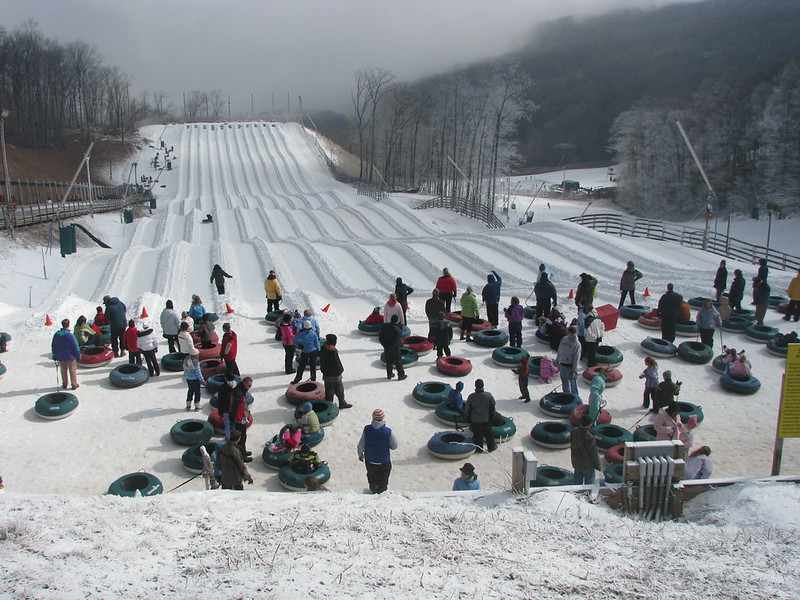
snowsports include skiing and tubing, as at Wintergreen Resort
Source: terren in Virginia, Lining Up the Tubes (February 24, 2008)
snowsports include skiing and tubing, as at Wintergreen Resort
Source: terren in Virginia, Lining Up the Tubes (February 24, 2008)
Virginia has four operating ski resorts - Massanutten, Bryce, Omni Homestead, and Wintergreen. They require snow, topographic relief, and customers.
Only the topography is reliable. All of those sites depend upon making artificial snow, so each requires an adequate supply of water in addition to cold weather. Manufacturing snow is expensive and requires energy to power the machines which spray water. The energy produces greenhouse gas emissions, so ironically the artificial extension of the ski seasons exacerbates the global warming that reduces the availability of natural snow.
Snow is not essential for some forms of skiing. Bryce Mountain Resort offered "grass skiing" in the summer between 1966-2012. It was developed in Europe as a technique for training skiers in the summer. In Europe, competitive races began in 1968. The world championship for grass skiing was held at Bryce in 1977. The Federation Internationale de Ski Sur l'Herbe (FISH) has evolved into FIS, and that official governing body holds grass skiing championships every two years.
Grass skiers described the experience as similar to downhill mountain biking. Grass skiing never became very popular, in part because it required ski resorts to groom the slope carefully to remove rocks and sticks. Skiers had to learn the "carving" technique using the edges of the skis for turning and slowing down on grass. Maximum speed on grass was about 25% slower than on snow, and the wheels on the skis ("an elaborate variation on roller skates") had to be re-oiled after just 1-2 runs.
Bryce was the last place in the United States to operate a lift during the grass skiing season. The resort replaced the grass skiing with a mountain bike operation in 2012, but still advertises the potential for grass skiing there.1
Source: Bryce VA, A Downhill Tradition
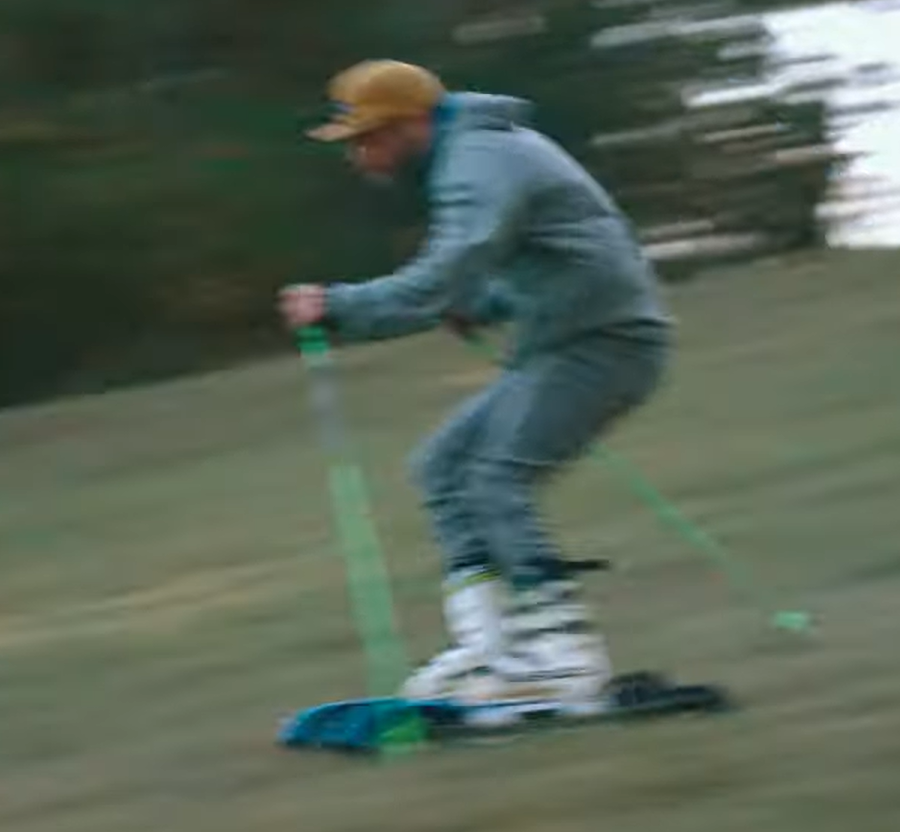
grass skiing is offered in the summer at Bryce Mountain Resort
Source: Bryce VA, A Downhill Tradition
An artificial ski slope is also operational at Liberty University in Lynchburg; Liberty Mountain Snowflex Centre does not require either snow or cold weather. In 1973-74, Ski Land at Pantops Mountain east of Charlottesville used polyester plastic beads to supplement the natural snow.
Like grass and plastic, the icy pellets of artificial snow have a different character than natural snow. Artificial flakes have different textures that natural flakes.
Cross-country skiers in particular need to adjust the base surface of their skies and the waxes they apply. The product emitted from snow-making machines lets downhill skiers go faster and create a higher risk of losing control on the slopes. Cross-country skiers without metal edges on their skies have an even harder time making turns and maintaining control in artificial snow.2
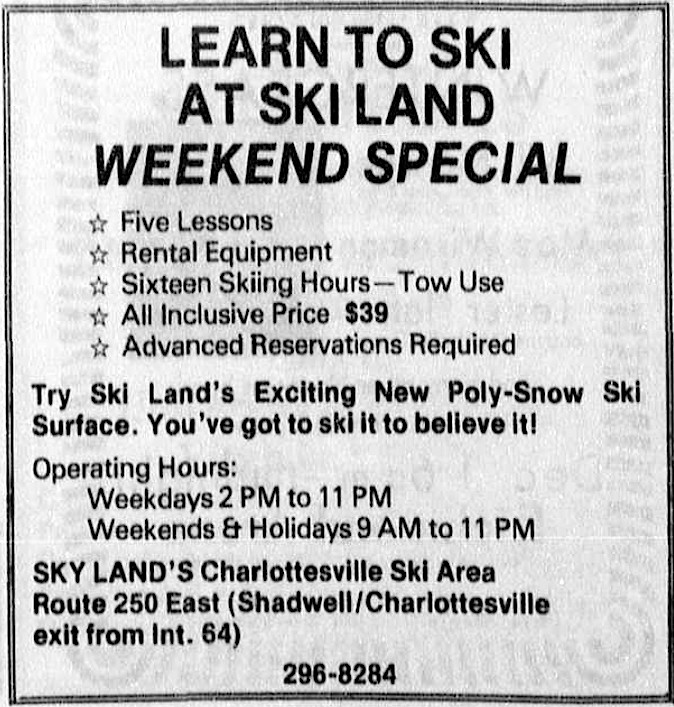
in 1973, Ski Land used plastic particles as well as snow on Pantops Mountain near Charlottesville
Source: University of Richmond, The Collegian (November 29, 1973. p.3)
The demand varies with the economy, especially the cost of gasoline, and demographics. Only about 20% of those who participate one time in a snowsport - skiing, snowboarding, and snow tubing - will try it again. About 3% of the American population engages in snowsports now.
Attracting millennials and younger customers is an existential requirement for the industry. As the population in the United States ages, older people may choose less-active recreational sports. In 2023, the National Ski Areas Association reported than over the last decade, the average age of a participant in snowsports had increased from 30 years old to 35 years old. 3
Competition from Pennsylvania, West Virginia, and even North Carolina ski resorts is another business risk for Virginia ski resort investors and operators. Customers, especially those living in Northern Virginia, may choose to visit other resorts with better snow conditions such as Seven Springs/Whitetail Mountain/Ski Liberty in Pennsylvania or Canaan Valley in West Virginia. The Alpine Ski Team at Virginia Tech practices at Winterplace in West Virginia. Driving to the closest Virginia slopes at Wintergreen would require twice the travel time.4
Resorts in latitudes north of Virginia benefit from colder weather which offers the opportunity to make snow and generate revenue for a longer number of days. West Virginia's Canaan Valley is high enough to capture moisture coming from the west and northwest, including Lake Erie. Ski resorts around Canaan Valley can receive 150 inches of snow per year. Because Canaan Valley is a textbook cold sink, there are many days when snow guns can be used effectively.
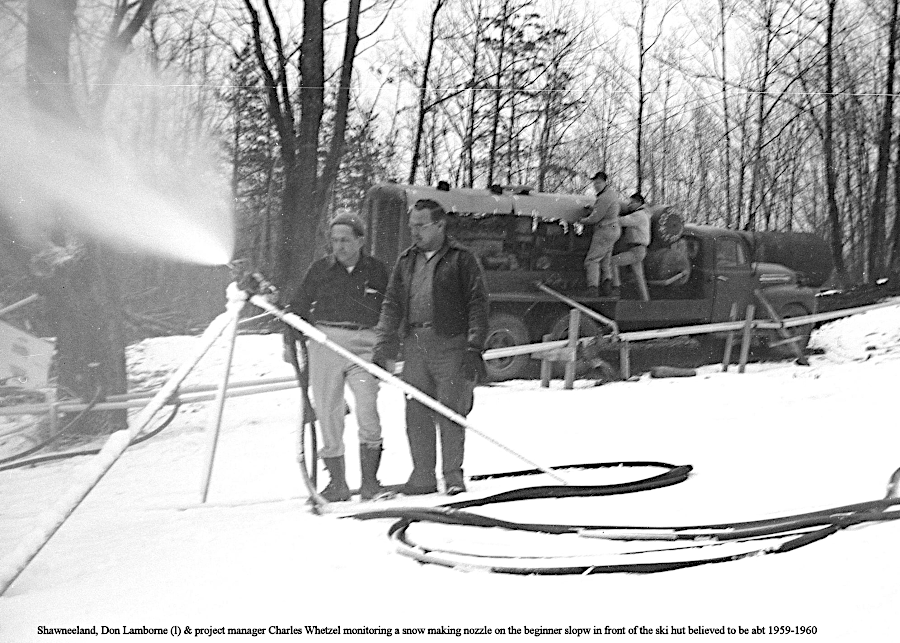
the now-closed Shawneeland ski resort claims to be the first place in Virginia to make artificial snow
Source: Facebook post, Shawneeland Through the Ages
In addition to the four resorts in Virginia with ski lifts, the Cove Campground 12 miles west of Winchester offers snow tubing on the west-facing slope of Great North Mountain. It has a lift with hauls tubing customers back to the top of the slope for another run. The Shawneeland ski area operated on the east-facing mountain slope in the 1960's.
The Ski Cove component of that site also depends upon making artificial snow in the winter, and considers natural snow to be an obstacle. To get 1" of usable snow for tubing requires compacting 10" of natural snow. but that amount of snow blocks the roads and reduces access for customers.
The Cove makes enough snow to cover the slope to a depth of five feet. It can stay in operation during warm spells, but the tubes go slower down the hill. While warm rain melts some of the snow, most of the rain drains through the snow. Typically The Cove is able to break up the ice that forms on top and offer tubing afterwards.
Cold weather is the critical element for the seasonal opening:5
Wintergreen Resort tries to open by the second week in December, making real snow for the 26 runs with water from a 5-million gallon tank. At that resort, 400 snow guns can spray 175,000 gallons to make 1 acre-foot of snow and coat trails three feet deep. At Massanutten Resort, 275 snow guns maintain snow on 21 trails.
Traditional snow guns can manufacture snow at a 28℉ wet-bulb temperature by forcing small droplets of water into below-freezing air. Dry air as well as cold temperatures is required for traditional snow making machinery. If the air is humid, those snow guns can not create snow even when temperatures are as low as 29℉.6
A new approach offers the ability to manufacture snow at much higher temperatures. The Latitude 90 machine (originally labeled Snowflake) creates a barrel of frozen ice, then shaves flakes from it to blow onto the ski run. Machines that make snow cones in the summer use a similar approach and produce shaved ice.
Significantly more electricity is required for making snow with shaved ice, but less water is needed. Ice flakes can be created in above-freezing temperatures and they last longer than artificial snow.
The primary advantage of the new snow-making technology was that it increased the predictability of having snow on the ground for customers. Bursts of warm weather would always affect the acreage suitable for skiing, but the ability to cover key portions of hillsides with snow could be sufficient to maintain the arrival of revenue-producing customers.7
The ability to open the season before Christmas requires a resort operator to evaluate investing $500,000 per ice-making machine vs. $15,000-$30,000 per traditional snow gun. In 2023 a ski resort manager said:8
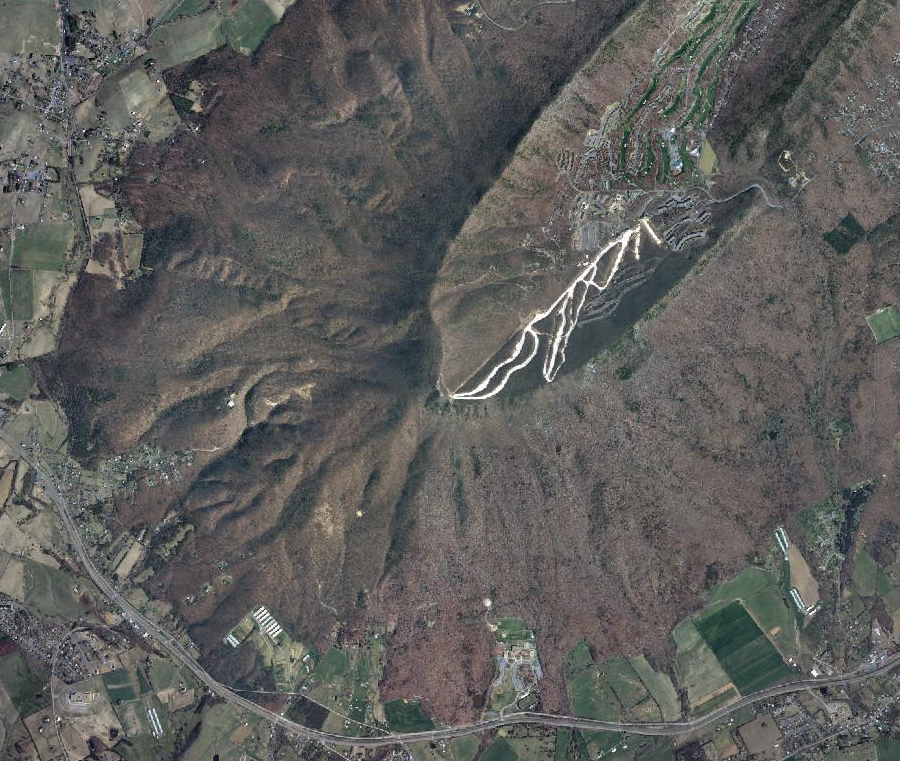
artificial snow outlines the ski slopes at Massanutten Mountain
Source: Virginia Geographic Information Network (VGIN), VBMP 2011 WGS Web Mercator (VGIN)
The most unusual ski resort in Virginia is at Lynchburg. It offers "dry skiing" independent from Virginia's lack of snow and too-warm temperatures in the winter In 2009, Liberty University spent $8 million to cover Candler Mountain with Snowflex.
The artificial turf substitutes for real snow at Liberty Mountain Snowflex Centre. The Neveplast synthetic surface uses concentric conical stems to provide the necessary gripping surface for skis. It is a form of artificial turf with a built-in shockpad. For skiers that fall down, Snowflex claims to provide a softer impact than hard-packed snow.
The Snowflex Centre is a gleaming white hillside offering artificial skiing 12 months of the year. It was designed to provide recreational diversions at a school that bans the use of alcohol. Public use helps fund operations at the site, one of just two artificial skiing/tubing mountains in the United States.9
Existing ski resorts in Europe are adding dry slopes, using a variety of plastic materials to ensure skiers will have a place for fun whether or not snow has fallen on the weekend that skiers have scheduled for an annual trip. Resorts can borrow money with a long-term mortgage and plan to operate as four-season event centers with winter snowsports, even while the warming climate reduces the ability to keep artificial or natural snow on the slopes. By 2024, there were 1,000 dry slopes within 50 countries.
Snow offer a more-forgiving surface for beginning and average skiers to make mistakes. Ski instructors encourage training on dry slopes to enhance high-level skills:10
The business risk of investing in a ski resort in Virginia is high. Climate change is altering the pattern of snowfall and creating warmer winter temperatures. Between 2000-2019, warmer temperatures shortened the ski season by 5.5-7.1 days. By 2050, the season could construct by an additional 14-33 days.
When warm temperatures force a delay in opening a resort until after the December holiday season or force a closure in early March, the economics of operating a ski resort in Virginia are dramatically impacted. According to one climate researcher:11
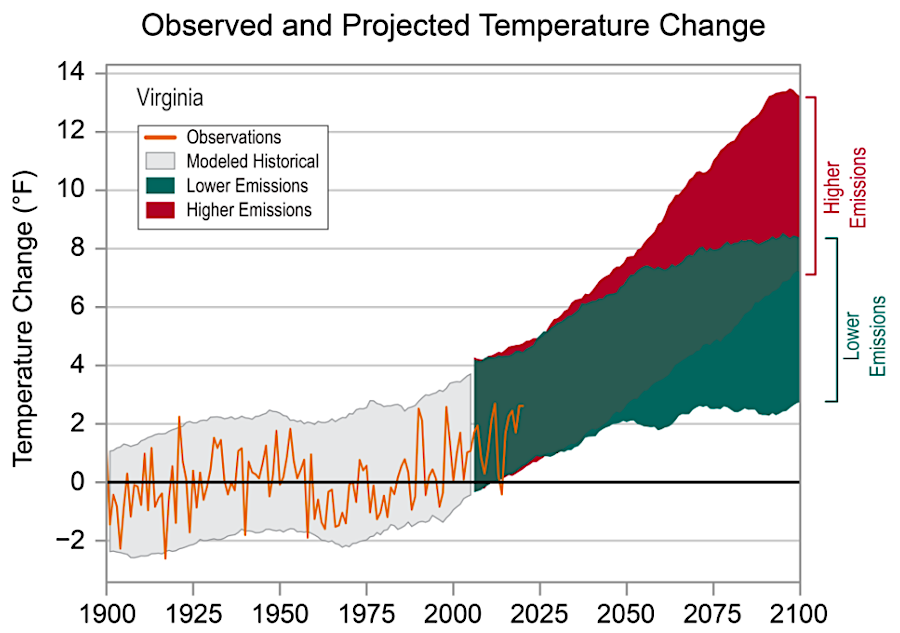
ski resorts face an existential threat as warmer temperatures (compared to the 1901–1960 average) reduce the number of potential skiing days
Source: National Oceanic and Atmospheric Administration (NOAA), State Climate Summaries 2022 - Virginia
Potential investors in Fairfax County have proposed an alternative to dry skiing as a way to cope with climate change. There are no mountains in Fairfax County, and certainly no snow-covered mountains, but there are people with money living there who want to ski often but lack time for travel to distant resorts. The solution: build an indoor skiing arena with its own snow-covered mountain.
The Fairfax County Sports Tourism Task Force announced plans in 2019 to partner with a private corporation, SnowWorld USA, to create a public-private partnership and build the indoor "Fairfax Peak" ski slope on the slopes of the county landfill at Lorton.
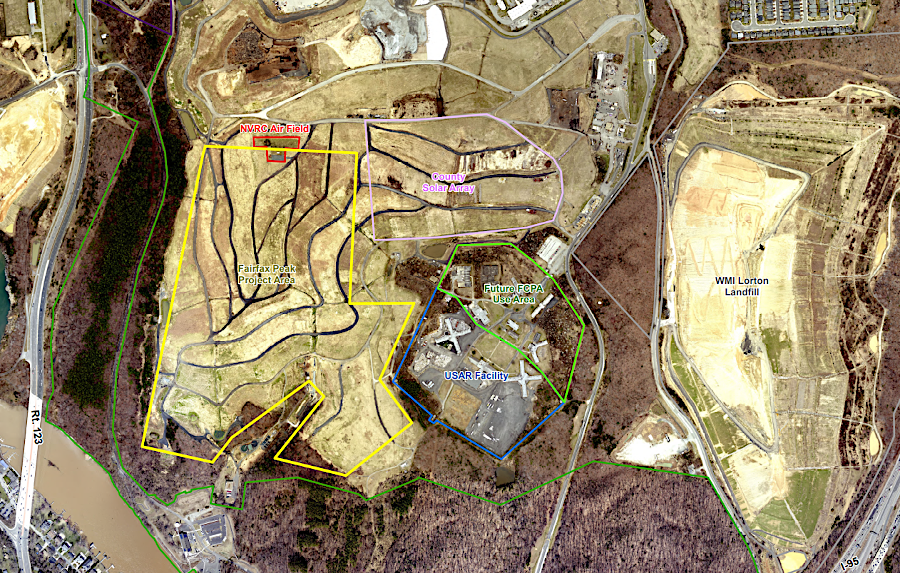
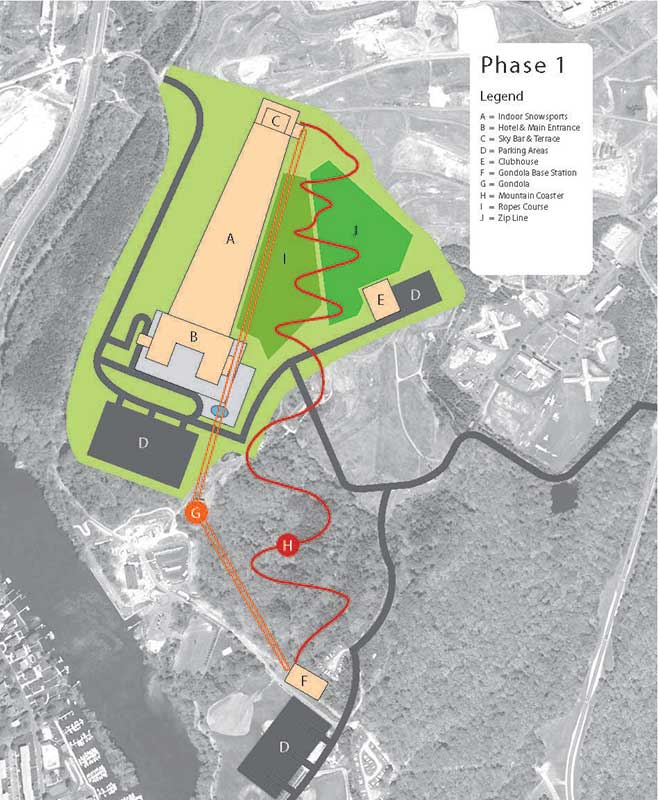
Fairfax Peak is planned for the western edge of the I-95 Lorton Landfill owned by Fairfax County, adjacent to the Urban Search and Rescue (USAR) training site
Source: Fairfax County, Map of Fairfax Peak
The proposal was designed to use the hill created by the pile of municipal solid waste at the I-95 Lorton Landfill, owned by Fairfax County. The site is adjacent to the Lorton Debris Landfill, a construction and demolition debris (CDD) landfill developed by EnviroSolutions before that company was acquired by Waste Management in 2018. The taller construction and demolition debris landfill is planned to become Overlook Ridge Park, a passive recreation site.
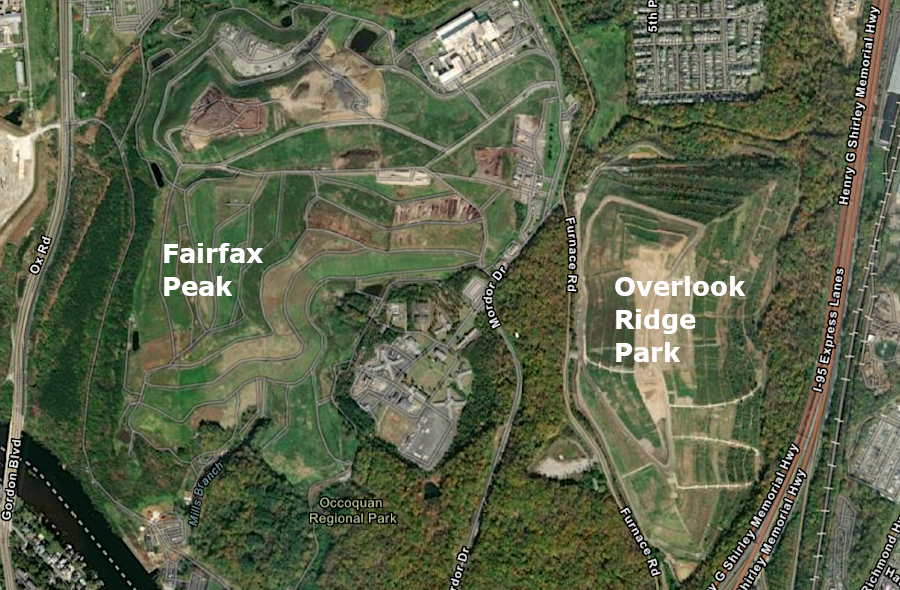
Fairfax Peak was planned west of the taller landfill on which Overlook Ridge Park was planned
Source: ESRI, ArcGIS Online
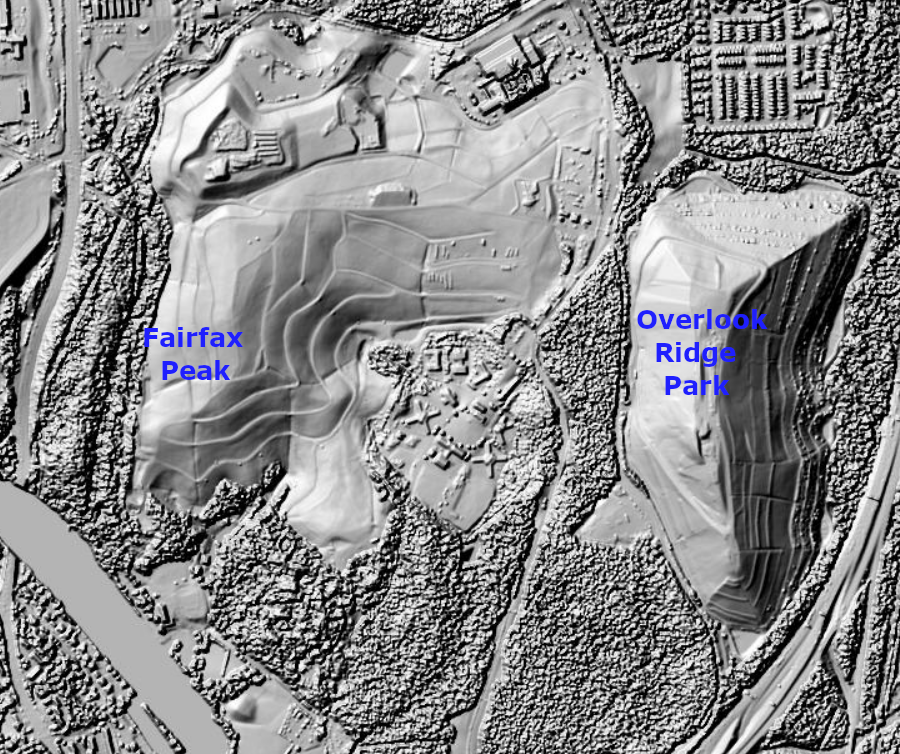
LIDAR reveals the topography of Fairfax Peak and Overlook Ridge Park in Fairfax County
Source: Fairfax County, LiDAR Digital Surface Model -2018
The Fairfax Peak project would have a height of 280 feet, with a 20-degree angle slope. It would resemble the SnowWorld facility at Landgraaf in the Netherlands, and include a hotel, mountain coaster, restaurants and other amenities. The first "indoor, real-snow, year-round ski and snow resort in North America was Big Snow, which opened in 2019 near the Meadowlands in New Jersey (Exit 16 or Exit 18 from the New Jersey Turnpike).11
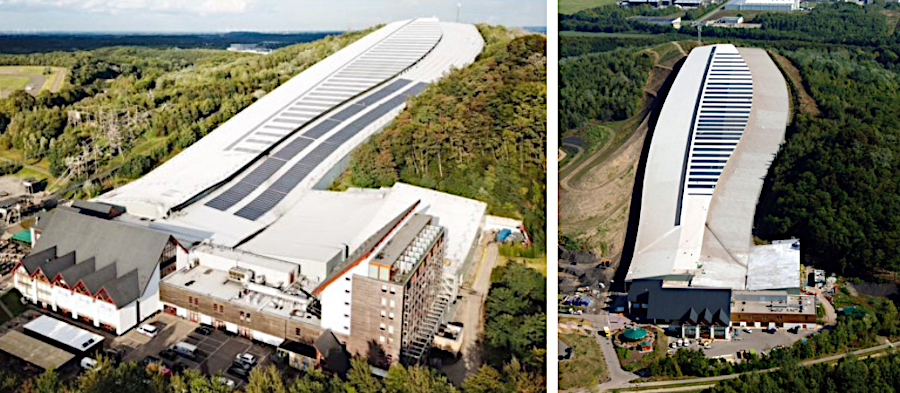
the success of the SnowWorld facility at Landgraaf led to a proposal to build a similar indoor ski ramp and entertainment complex in Fairfax County
Source: Alpine-X LLC, PPEA Proposal - Fairfax Peak, Sports Entertainment and Active Lifestyle Community (p.38)
The justification for the county's involvement was expressed clearly by an elected supervisor:12
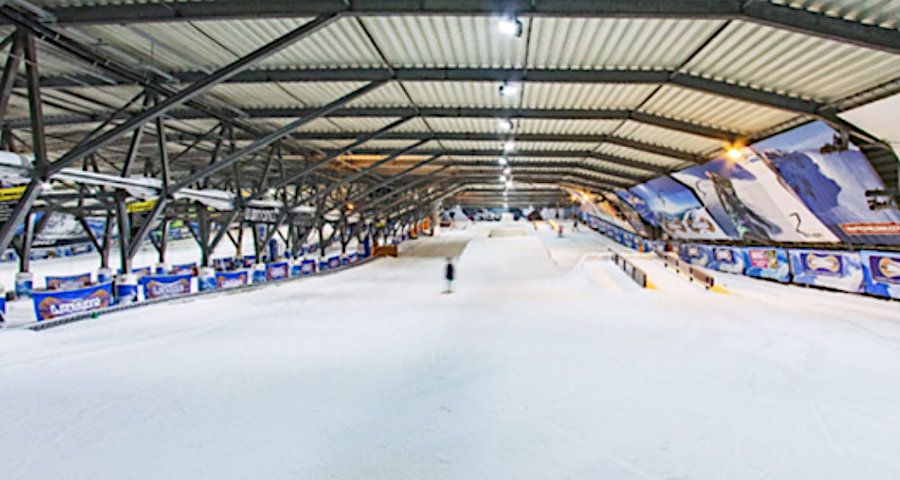
The developers suggested that prices for using the longest indoor ski slope in the United States (1,700-foot in length) would be less expensive than traditional ski resorts:13
proposed ski run in Fairfax County at the I-95 Landfill Complex
Source: Fairfax County, Fairfax Peak: One of the World's Longest Indoor Ski Slopes may be Built on Fairfax County's I-95 Landfill
The COVID-19 pandemic delayed action. In 2021, Fairfax County officials began to annually extend deadlines for SnowWorld and its American partner, Alpine-X, to submit the Fairfax Peak zoning package. By the end of 2024, Alpine-X was searching for new investment partners and SnowWorld was no longer involved. The company let its exclusive rights to the project expire, but the developer was clear that he intended to pursue the project. He said his efforts would end:14
Fairfax Peak was intended to include an entertainment complex, centered on an indoor ski slope
Source: Alpine-X LLC, PPEA Proposal - Fairfax Peak, Sports Entertainment and Active Lifestyle Community (p.41)
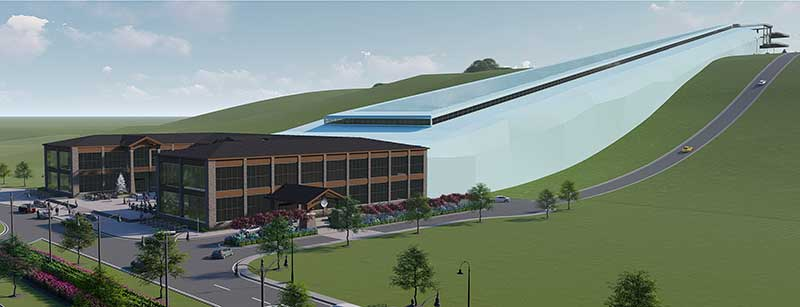
a ski run in Fairfax County was proposed at the I-95 Landfill Complex
Source: Fairfax County, Fairfax Peak: One of the World's Longest Indoor Ski Slopes may be Built on Fairfax County's I-95 Landfill