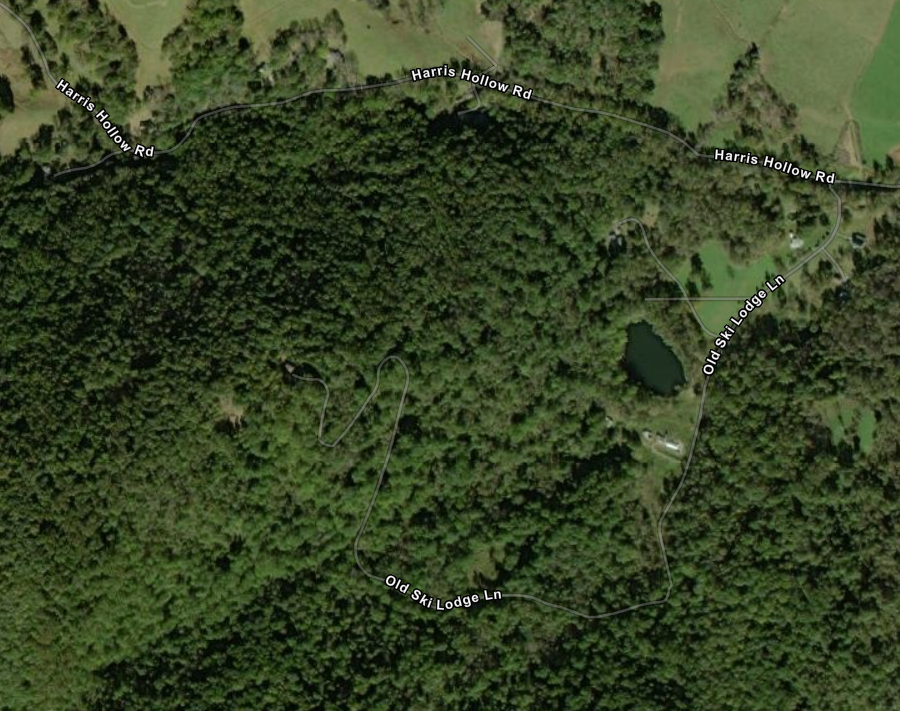
other than a road name, there is little evidence today of the former Rappahannock Ski Area
Source: ESRI, AercGIS Online
other than a road name, there is little evidence today of the former Rappahannock Ski Area
Source: ESRI, AercGIS Online
When baby boomers started to become adults in the 1960's, a series of cold snowy winters in Virginia incentivized developers to open si resorts. Starting in the 1950's, snow blowers could coat slopes with artificially-produced snow when the weather did not cooperate.
Developing a ski resort requires a substantial initial capital investment to acquire suitable land and build the infrastructure, including ski lifts, access roads, and lodges. Annual operational costs for snow-making equipment and staff require a steady cash flow, but weather and economic recessions intermittently reduce the number of paying customers below the required minimum. Resorts that have closed are known as "lost ski areas." Today the slopes are suitable for mountain biking and hiking trails.
The Rappahannock Ski Area near the Town of Washington started in the 1950's and lasted until 1974. It initially was a private club that catered to members of the US Congress and State Department officials. When the facility opened to the public, it was named Skyline Ski Area and later Big Devil.
The ski slopes offered runs with a vertical drop of less than 700 feet. At the start, skiers were pulled uphill on a rope that was powered by an engine on the back of a truck. At one point, there were two rope tows and a T-bar lift for three slopes.
Big Devil closed in 1974. It went bankrupt because the number of customers shrank due to the 1973 gas crisis, while operational costs climbed due to a series of rainstorms in the winter of 1973-74. Bid Devil had to make snow seven times to cover slopes that were exposed by the warm rain to bare earth. When the Rappahannock County Public Schools Ski and Snowboard Club organized in the winter of 2021-2022, it had to travel to the slopes at the Bryce Resort.1
The Shawneeland/Shawnee Land resort west of Winchester started operations in 1958 as part of a real estate development by Don Lamborne. He divided 8,000 acres into 3,000 lots on the east-facing side of Great North Mountain. It was the first ski resort in Northern Virginia to use snow blowers, and it managed to offer 78 skiing days one year even though natural snowfall that winter barely covered the ground.
The ski lodge, known as Tecumseh Lodge, was located alongside Keckley Run. It incorporated at least the fireplace of the 18th century "Jacob Kackley" cabin. Keckley Run was dammed to create Cherokee Lake.
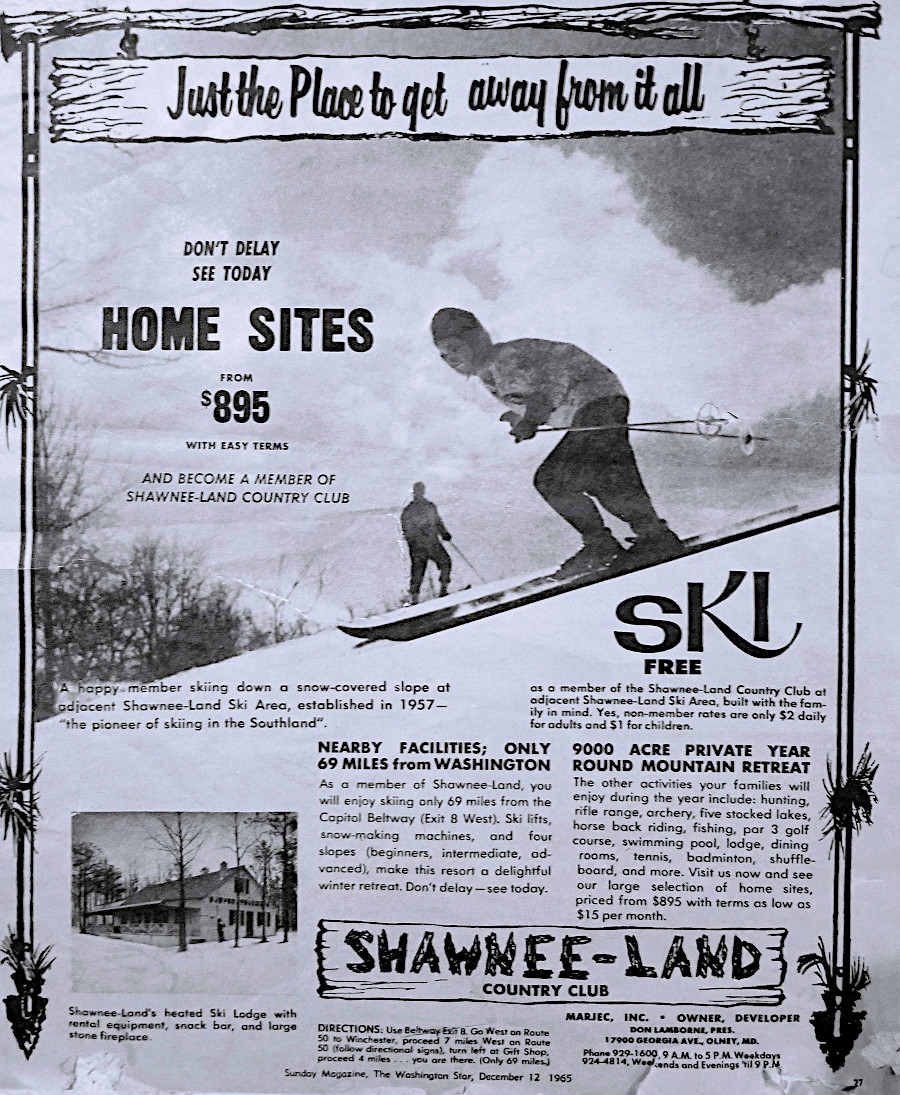
the ski resort which opened in 1958 at Shawneeland was part of a real estate project to sell subdivision lots
Source: Shawneeland Through The Ages, Facebook post (February 8, 2024)
Shawnee Land had a vertical drop of just 400 feet. A former skier recalled that the slopes were gentle, so the downhill experience was not exciting:2
According to recollections from different skiers, a tow rope was powered by a truck at the top of the slope and looped around the wheel rim of another truck at te bottom of the slope:3
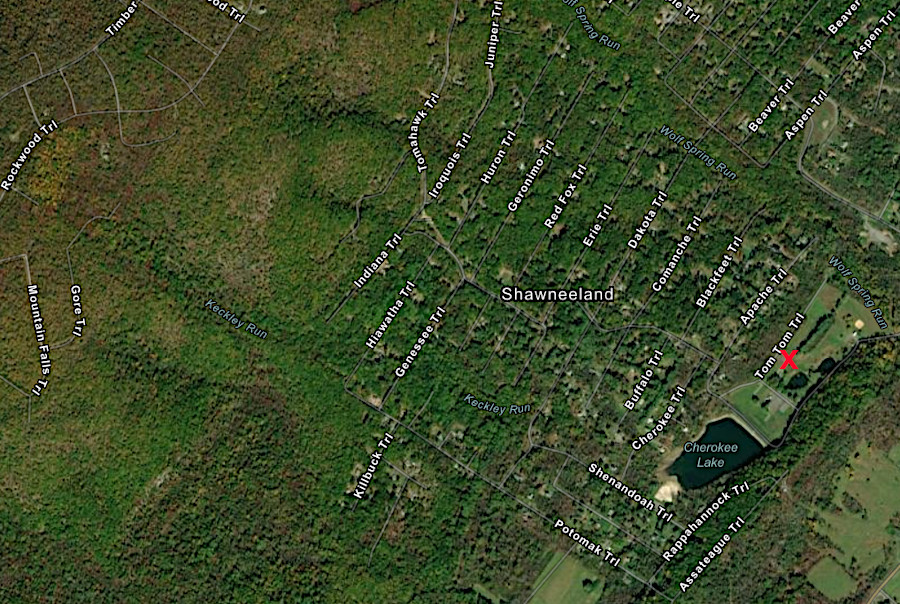
Cherokee Lake was built near the site of Tecumseh Lodge (red X), the ski lodge for Shawneeland
Source: ESRI, ArcGIS Online
In the 1960's two ski slopes were cut into the Blue Ridge of Nelson County south of the gap through which I-64 crosses at Afton. The owner of the Swannanoa golf course developed a slope with a rope tow at the course, then replaced it with a new one with a 300' vertical drop.
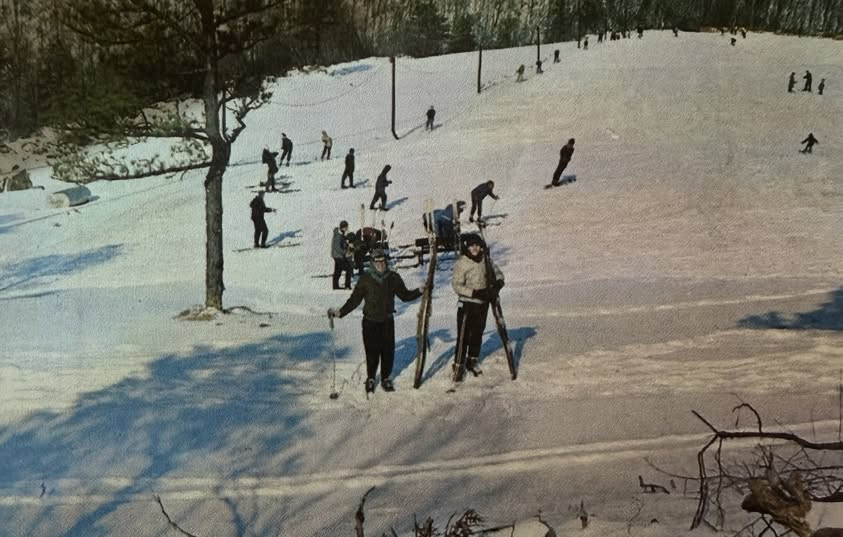
tow rope and Swann Ridge Ski Slope at Afton, operated by Swannanoa Country Club
Source: Waynesboro Heritage Foundation, Facebook post (January 6, 2026)
On the new slope, skiers could return to the top for another run using a double chair lift. It operated until at least 1973, using manufactured snow to supplement what fell naturally. A third slope was carved into the forest but never opened.4
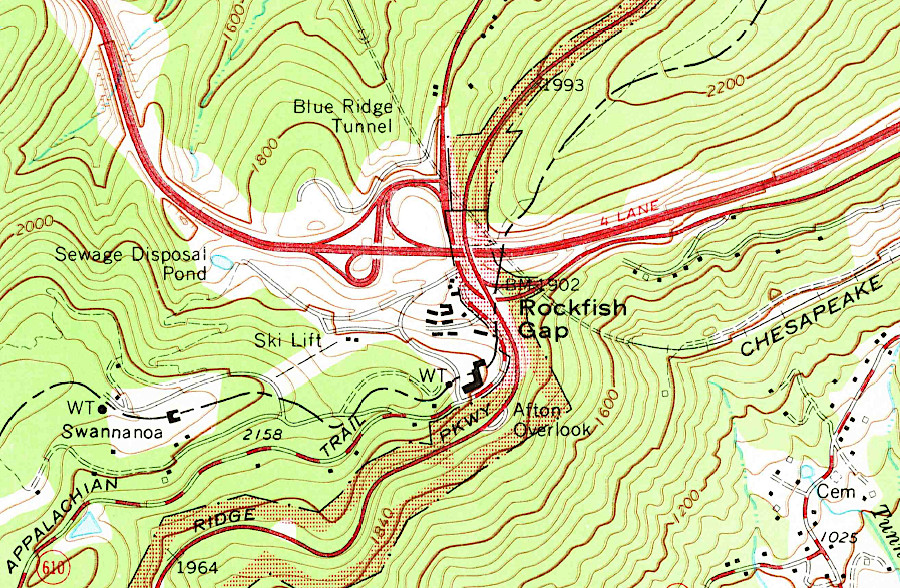
a double chair lift operated on the ski slope at Afton in 1973
Source: US Geological Survey (USGS), Waynesboro East 1:24,000 topographic quadrangle (1973)
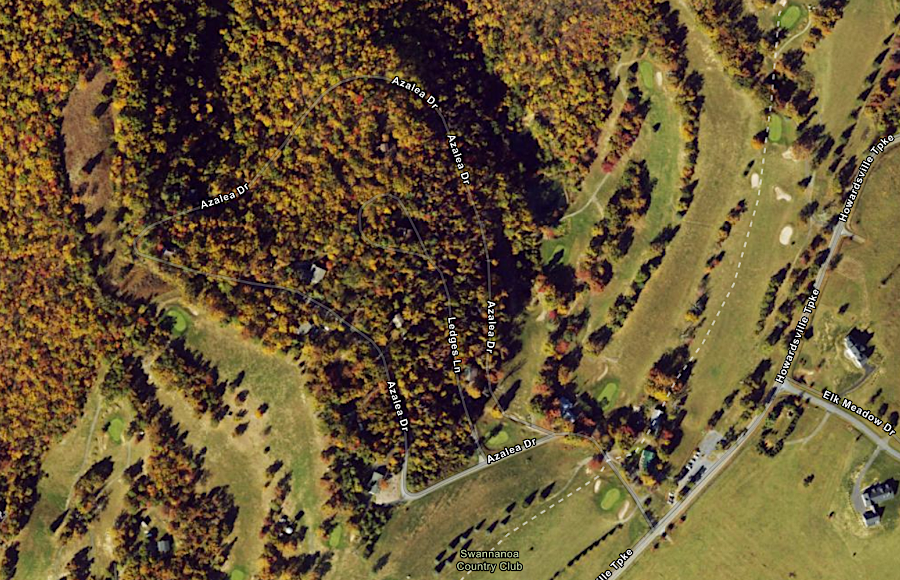
the third slope created at Afton never opened for public use after the 1973 gas crisis
Source: ESRI, ArcGIS Online
The Mountain Run Resort was developed east of the Town of Mount Jackson, on the west-facing slope of Massanutten Mountain near Moreland Gap. The ski component was part of a four-season real estate development planned by the Frank Lloyd Wright Foundation on 600 acres of land surrounded by George Washington National Forest. Taliesin Associated Architects designed the ski lodge condominiums, and ski cabins in 1971.
Trees were removed from four planned slopes but they were never developed. As in all other Virginia ski resorts, snow guns provided artificial snow. The ski operation lasted only two years.5
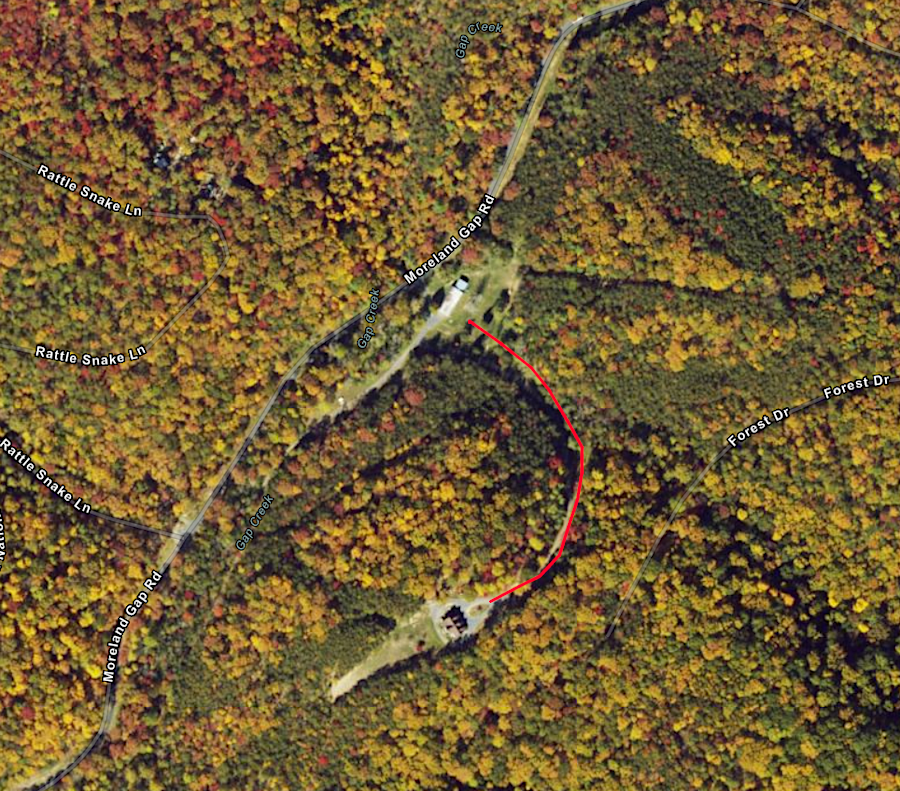
pine trees now reveal the outline of former ski slopes around the 900-foot long double lift chair (red line) at Mountain Run
Source: ESRI, ArcGIS Online
The Cascade Mountain Resort in Fancy Gap was the most-southern ski resort to operate in Virginia. It was part of a project to develop up to 900 mountain lots in Carroll County next to the Blue Ridge Parkway. North Carolina National Bank took charge of the project in 1974 and completed the ski slopes and lodge, motel and restaurant along with roads and water system. The the Liebenschuss lodge burned in 1984 and was replaced by the current Summit Haus.6
Most skiers came from North Carolia. After Winterplace opened in West Virginia in 1983, many customers kept driving on I-77 to take advantage of the additional slopes and amenities there. The competition was too much for the Cascade Mountain Resort ski business and it closed.
After 1985, the Cascade Mountain Property Owners Association purchased the property and assets of the independent ski operation.7
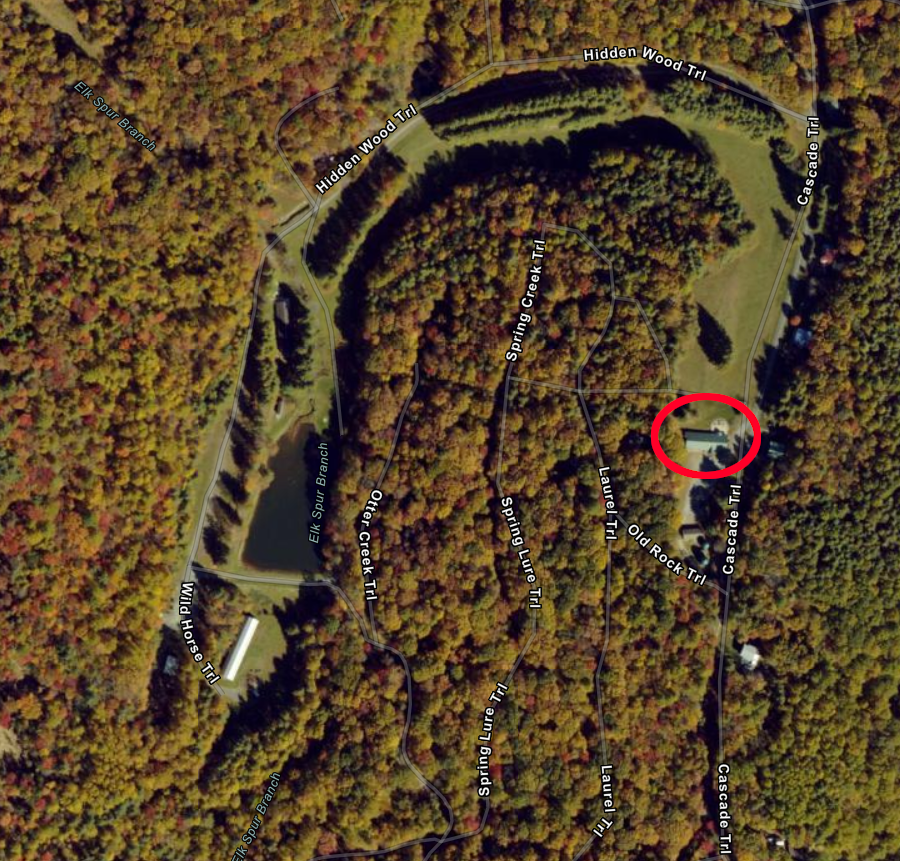
Summit Haus today, at the top of the former ski slopes
Source: ESRI, ArcGIS Online
The closest ski resort ever built for Northern Virginia customers was Ski Cherokee, on High Knob Mountain at Linden in Warren County. The developer, Gene Adkins, chose the name of the resort to honor a great-grandmother who identified herself as a Cherokee.
He purchased 1,100 acres from the heirs of John Marshall in 1988 for $2 million. Adkins spent a total of $6 million to buy the land and to clear two slopes, construct two quad chair chairlifts, buy snowmaking machines and build a lodge. Ski Cherokee was designed to handle 4,000 people per hour. The focus was on attracting intermediate skiers; no "expert" run was built. The customer base in Northern Virginia already had easy access via I-66, and downtown District of Columbia was just 65 miles - an hour's drive - away. The developer hoped to get 25% of the 500,000 people driving by on I-66 to come ski.
His description of the decision process and hoiw he planned to generate enough revenue to pay off the $6 million investment was:8
It was designed to be a family ski area to attract day-trippers from the DC area. Snow was manufactured regularly, since the highest elevation was only 2,200 feet. Customers starting skiing at Ski Cherokee in the winter of 1990-1991. Plans to open in 1989 were derailed by delays in completing the wastewater treatment plant.
A year later Whitetail Resort opened in Pennsylvania, just 30 minutes further away. The developers there invested $40 million to offer superior facilities.
Ski Cherokee lasted only three years. A major shortcoming was the inability to generate and maintain enough snow. The site had previously been an apple orchard. It was suitable for the fruit trees because it was below the cold zone at the top of the mountain and above where cold air was trapped at the bottom.
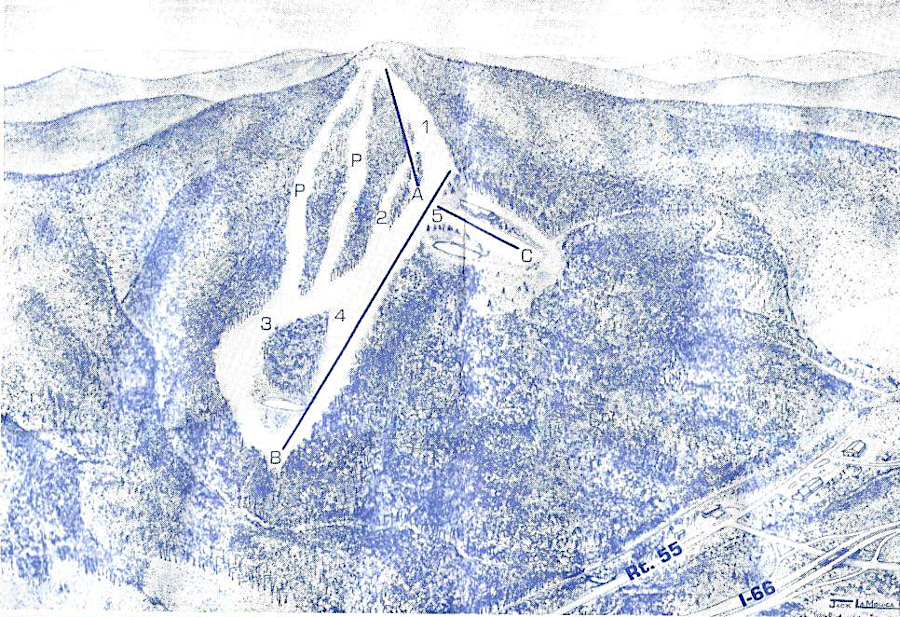
Ski Cherokee lasted only three years
Source: DC Ski, Ski Cherokee
Though the use of chemicals allowed snowmaking at around 34 degrees, Ski Cherokee experienced three warm, rainy winters before closing. Icy conditions and fog on the slopes during the weekends limited the number of customers. Dry summers limited runoff to be collected in the resort's snowmaking ponds, and objections from neighbors delayed drilling wells needed to pump groundwater and fill those ponds.
The terrain was good for low-intensity skiing, but not for thrill seekers. The more-challenging ski runs at Whitetail Resort in Pennsylvania offered a wider range of experiences. By one assessment, Ski Cherokee failed because of High Knob's topography:9
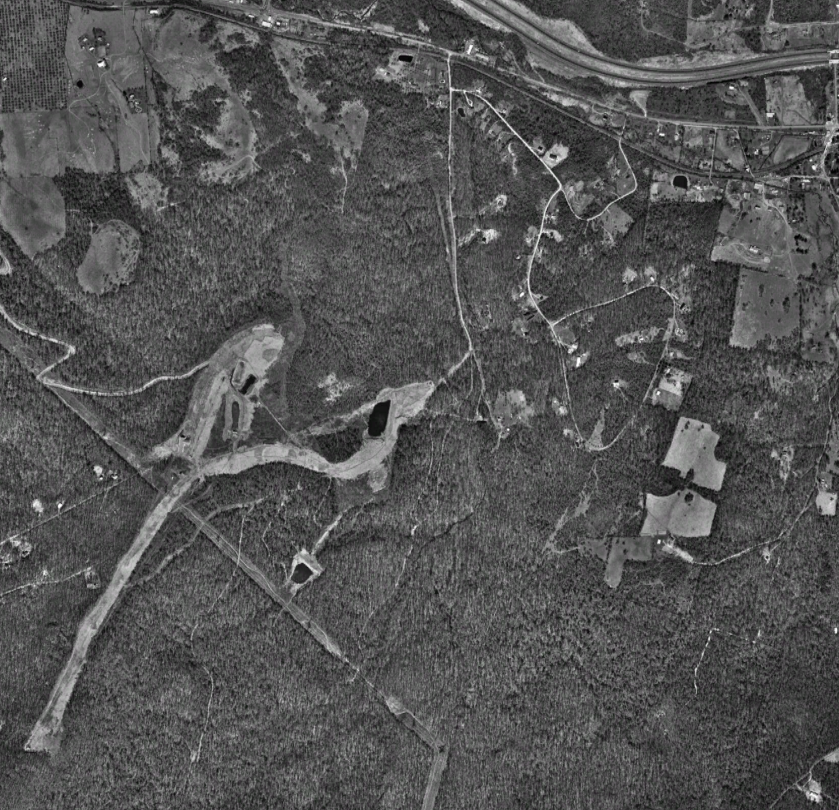
evidence of ponds for manufacturing snow at Ski Cherokee were visible in 1997
Source: GoogleEarth
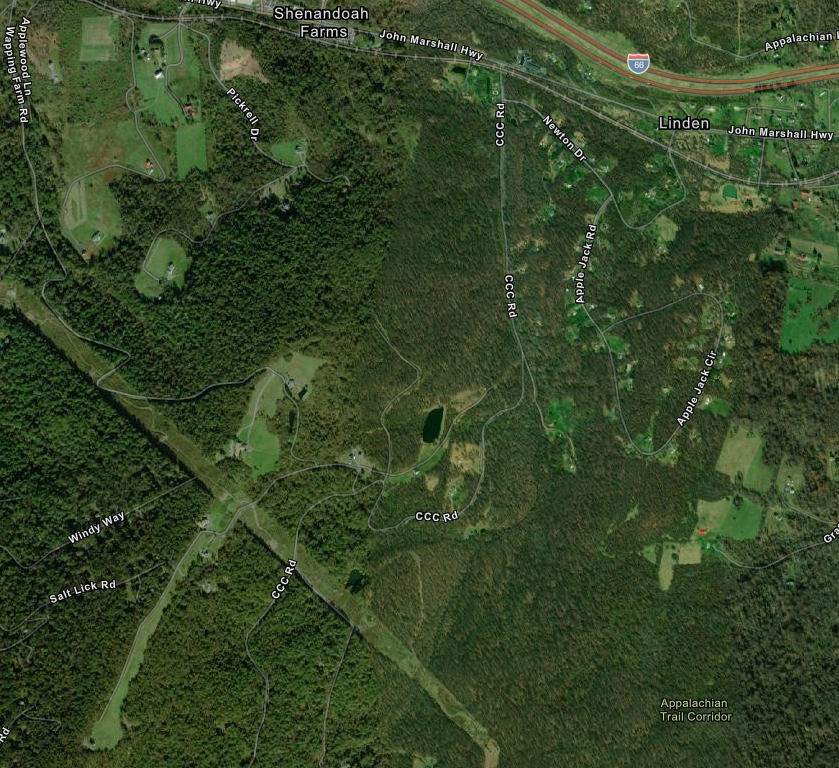
a run cleared for Ski Cherokee is still visible today, west of the CCC Road
Source: ESRI, ArcGIS Online