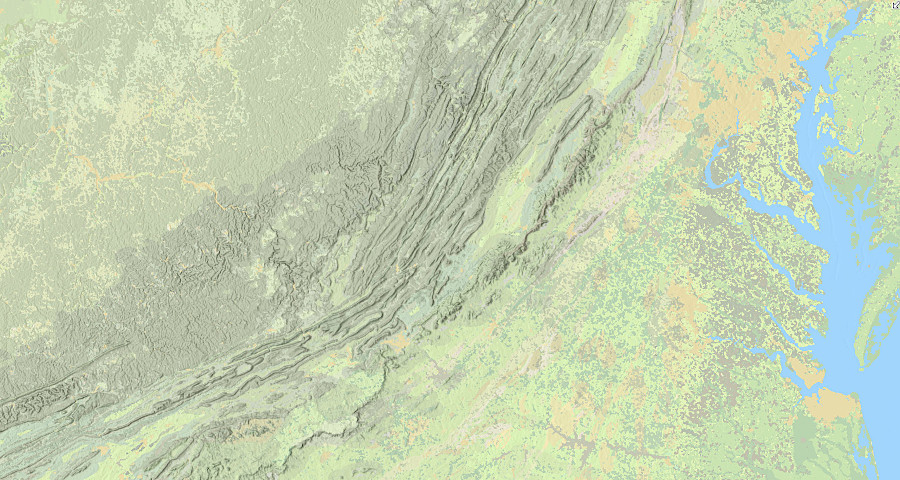
topographic view of Virginia
Source: ESRI, ArcGIS Online
topographic view of Virginia
Source: ESRI, ArcGIS Online
Some of the hydrogen, helium, and lithium now on Earth may have been created in the Big Bang 13.8 billion years ago. All the other atoms were created since then, within stars. Elements heavier than iron were created when those stars exploded as a supernova or when stars collided, with fusion forming the heavier elements.
Within the Milky Way, interstellar gas clouds distributed atoms until gravity caused them to coalesce and trigger formation of new stars and solar systems. Astronomers classify three populations of stars based upon the percentage of heavy elements within them.
The very first stars, formed after the Big Bang led to the creation of matter, are classified as Population III stars. Those oldest first generation Population III stars contained no heavy elements because their source material was almost exclusively hydrogen and helium. Some supermassive Population III stars may have collapsed without exploding in a supernova, forming massive black holes seen today in the center of galaxies.
Population III stars that went through the supernova stage created heavier elements such as carbon, oxygen, calcium and iron and blasted them into space. Gases were dispersed irregularly, but gravity caused the interstellar particles to consolidate and form a new generation of Population II stars. Population II stars started with heavy elements already in their mix. When Population II stars exploded as supernova, they created even more heavy elements.
Population I stars assembled from gas clouds that formed after older, Population II stars died and disseminated elements which had been created through fusion. When spinning clouds collapsed into two centers, a binary star system formed. Other clouds consolidated into systems with even more suns.
The sun in our Solar System is a Population I star. It formed from primarily recycled hydrogen in the solar nebula about 4.6 billion years ago; the fusion process within the sun began after about 50 million years of consolidation. When the sun formed, it ended up with a disk of gas and dust particles surrounding it. About 99% of the disk was composed of gas, but within that disk was enough solid dust ("rocky") particles to create 300 planets the size of Earth.
The sun was born around 16,300 light-years from the galactic core, but is now about 26,100 light-years from the center of the galaxy. Ever since fusion started, the sun has been combining hydrogen atoms to create helium atoms. Today 1.8% of its mass consists of elements heavier than helium.
At the end of the Sun's life cycle five billion years from now, when the hydrogen fuel is exhausted, fusion processes in the sun will create a series of heavier elements. Those elements will have more protons in the nucleus, ranging from lithium (3 protons) to iron (26 protons). The sun lacks the mass to collapse into a supernova, so it will not create even heavier elements before it transforms into a white dwarf.
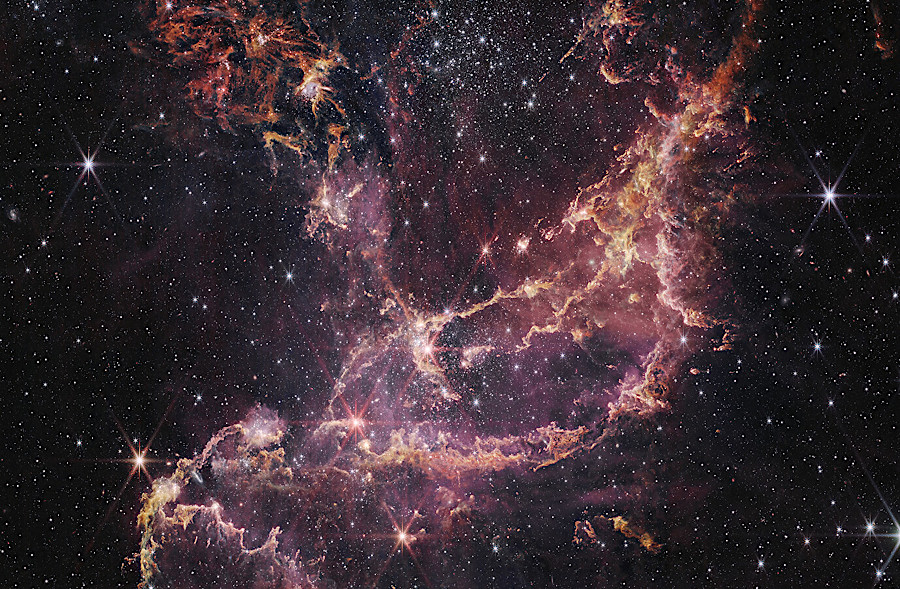
fusion in Population III stars, which started with just hydrogen, helium, and a little lithium, created the first heavier elements
Source: National Aeronautics and Space Administration (NASA), NASA’s Webb Uncovers Star Formation in Cluster’s Dusty Ribbons, NGC 346 (NIRCam)
The elements within the rocks of Virginia may have been through three cycles or more of Population II/II/I star formation, death, dispersion, and coalescing. All matter which is part of Virginia today is destined to go through yet another cycle.
In another five billion years, the sun will run out of hydrogen, become unstable, and morph into a red giant. The core will shrink into a white dwarf. In about seven-eight billion years, the gas cloud enveloping the core will dissipate and create a planetary nebula expanding into space. The elements in that planetary nebula may coalesce later into another sun or planet, repeating the cycle underway since the first stars formed perhaps 100 million years after the Big Bang.
Carl Sagan is famous in part because he stated so clearly how the elements on earth form all living organisms:1
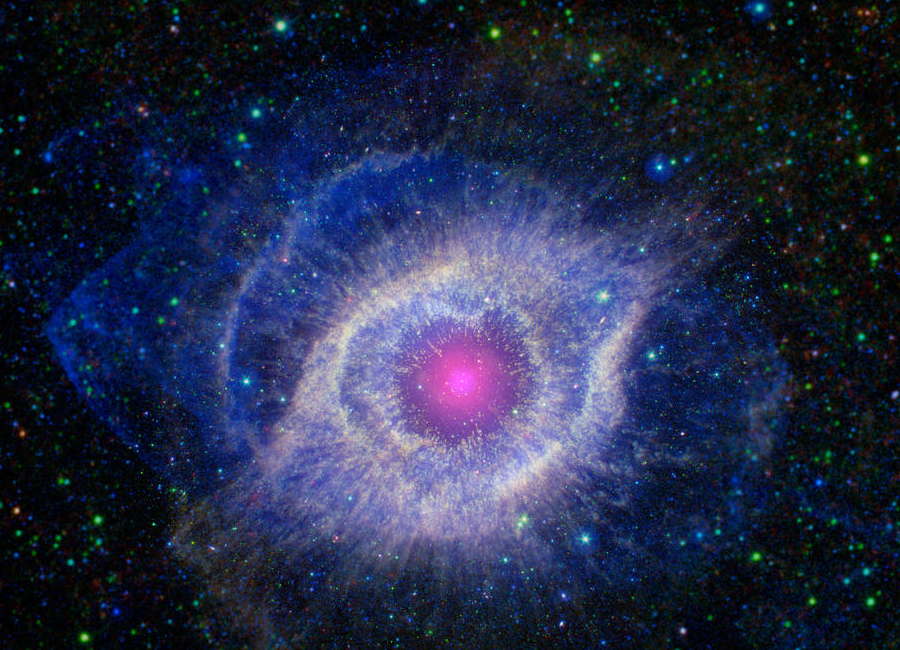
elements heavier than lithium that now form minerals in Virginia were created within Population II and Population I stars and dispersed through space
Source: National Aeronautics and Space Administration (NASA), Helix Nebula - Unraveling at the Seams
All the atoms that form elements, minerals, and rock formations in Virginia were created before the Earth formed almost 4.6 billion years ago. The Earth initially formed from the gas cloud and fragments of already-assembled particles surrounding the sun, as the cloud collapsed and consolidated with very gentle collisions.
The classic interpretation of the formation of the Solar System starts with a cloud of dust particles created in nuclear explosions of other stars. Those dust particles bumped and clung together to form chondrules about the size of sand grains. Gravity and static electricity brought the chondrules together to form pebbles. Pebbles clumped together to form boulders, boulders formed planetesimals, and eventually many of the planetesimals merged to form planets.
According to the Nice model of planetary formation, the large planets did not form where they are currently in orbit. Jupiter's gravity forced planetesimals and a fifth ice planet outward, ejecting them into interstellar space from their initial orbits around the Sun. Following Newton's Third Law of Motion, Jupiter itself migrated inward towards the sun. During Jupiter's "tack" towards the Sun, it absorbed much of the material from what is now the orbit of Mars. Gravitational interaction with Saturn eventually moved Jupiter back away from the Sun and into its current orbit.
The Earth was originally a molten mass, hot due to both the energy of planetesimal collisions and radioactivity. When the crust cooled enough, the first basalt rock crystallized. During the Late Heavy Bombardment 4.5-3.8 billion years ago, large portions of the surface of the Earth remelted due to the energy of fragments from space impacting the planet.
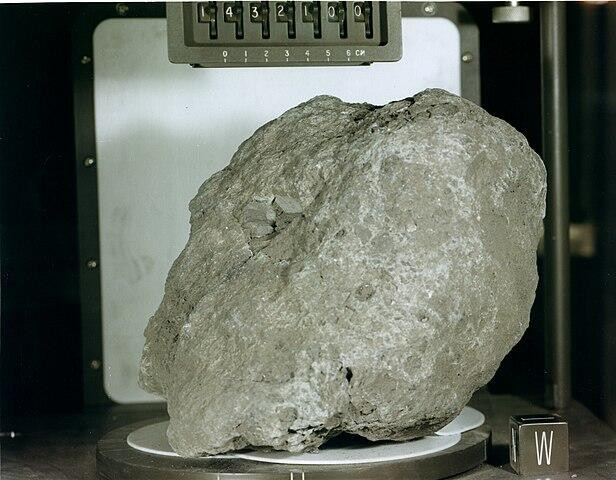
rock blasted off the Earth 4 billion years ago was deposited as a meteorite on the Moon, and later collected by Apollo astronauts
Source: US Geological Survey (USGS), Big_Bertha_Sample.jpg
At the center of the earth, the temperature at the core still exceeds 10,800°F At the boundary between the mantle and the outer core, the temperature is roughly 5,800°F Closer to the earth's surface, the temperature 60 miles deep is 2,400°F. From that point up to the surface, the cool crust and a portion of the molten mantle form a layer known as the lithosphere.
The lithosphere is fragmented into tectonic plates which move at slightly different speeds and directions. Rock at the bottom of the lithosphere is hot enough to move like molten plastic, carrying the hard crust on top like a bug on a leaf floating in a slow river current. The top 20 miles of a tectonic plate, roughly - the depth is deeper beneath continents vs. ocean basins - is composed of solid crust.
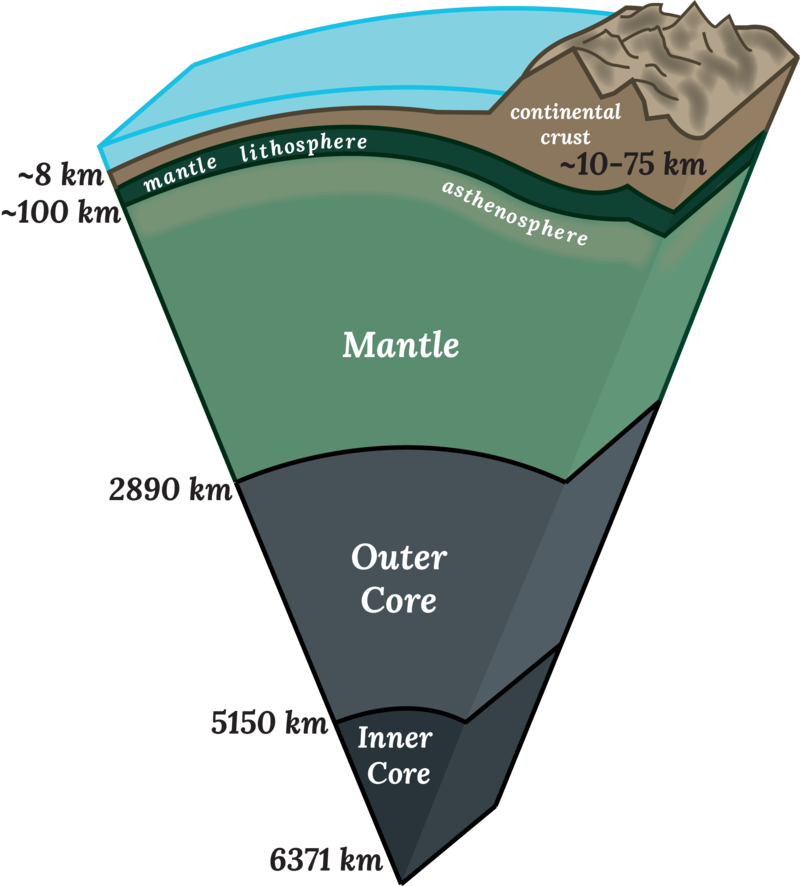
the center of the Earth is 10,000°F hotter than the surface
Source: Wikipedia, Earth radius
After the original assembly of atoms to create the earth, the planet cooled and a solid crust formed on the exterior. A dry, solid, single layer crust may have existed before enough water appeared to create oceans and before tectonic plates began to move.
Timing and mechanism of water arrival remains a subject of debate. Water is thought to be essential for the development of the first life on earth, but the process and timing of the earliest forms of life are also unclear.
Today, there are seven major tectonic plates of hard crust and a dozen or so smaller "chunks." They move around the surface of the globe in slightly different directions and at slightly different speeds.
Tectonic plates can move because below the crust, at depths varying from 5-20 miles, the heat and pressure are sufficient to make the rock move like honey or molten plastic. The "asthenosphere" below the crust is the upper layer of the mantle. Even where the rock in that layer has not melted, it still can flow.
Continuing generation of heat from the steady decay of radioactive elements keeps the mantle hot enough for deeper rock to flow in convective currents up to the asthenosphere. In smaller planetoids, just the heat from radioactive uranium and thorium is sufficient to melt the interior and create a heat flow from the center to the surface.
On Earth, the flow of molten material between the core and the crust generates electromagnetic forces in space around the planet. Those forces deflect the solar wind, the plasma particles constantly streaming from the sun. On Mars and the moon, however, the core of Mars is apparently a cold and solid mass now. That plant may once have had a molten interior and electromagnetic forces around it, but after the interior of Mars "froze" the solar wind stripped away most of the atmosphere and water molecules from the surface of Mars.
Differential pressure within the mantle has been moving and reshaping tectonic plates on the crust for 3.3 billion years; no other planet in our Solar System developed a crust with tectonic plates. The process by which the initial crust cracked into separate tectonic plates, and what powers their motion, is poorly understood.
It is possible that tectonic plate movement may be related to formation of the moon. The moon was created when Earth and a Mars-sized protoplanet called Theia collided 4.5 billion years ago, about 60 million years after the formation of the solar system.
According to the Giant Impact Hypothesis, Theia did not strike the Earth head-on; it hit at a roughly 45° angle. Immediately after the collision, the Earth was covered with molten magma and spun so fast that each day lasted only six hours. The impact tilted Earth to its current 23.5° from the plane of its orbit around the sun. That tilt now wobbles between 22.1° and 24.5°, creating Milankovitch Cycle changes that cause major climate impacts such as ice ages.
Debris blasted into space from the Theia-Earth collision circled the Earth and condensed into the moon, perhaps within 40-100 years. Initially, the moon also was covered by a magma ocean that slowly cooled over up to hundreds of million of years. The new satellite was much closer to the Earth than today, so tides in the early oceans were dramatically high. Today, the moon moves away from the Earth at an inch and a half per year.
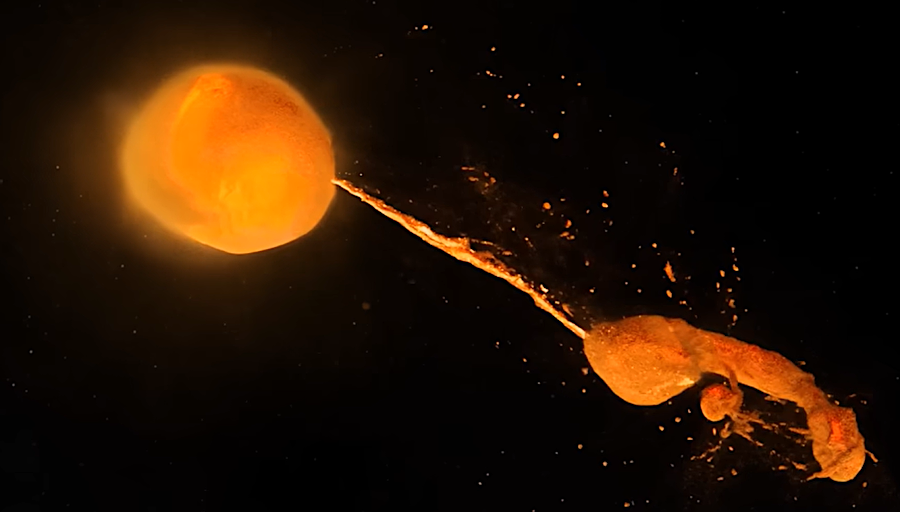
the moon may have formed within hours after Earth and Theia collided
Source: NASA's Ames Research Center, New Supercomputer Simulation Sheds Light on Moon’s Origin
Two "blogs" of thicker rock in the mantle located below West Africa and the Pacific Ocean may be remnants of the mantle of Theia. Creating places with different densities in the Earth's mantle could have affected heat flow from the hot core, spurring convection that cracked the crust into tectonic plates and still moves them.
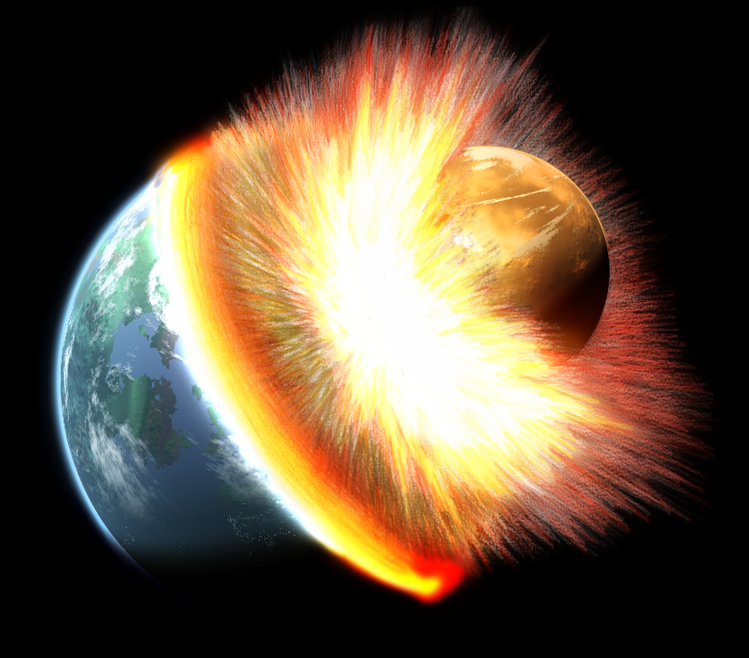
convection flow in the mantle may be related to the collision with Theia 4.5 billion years ago
Source: Representacion posible de la creacion de la Luna (by Rufus Gefangenen)
What may have once been a homogenous crust has differentiated into oceanic crust and continental crust. Oceanic crust resembles the composition of the mantle, with a high percentage of iron and manganese. Continental crust is physically lighter, with a higher percentage of lighter elements such as oxygen, silica, aluminum, phosphorous, and sodium. Those elements combine to form a variety of minerals which weigh less than the minerals in oceanic crust.
A change in how seismic waves move is used to distinguish the crust above the Mohorovičić (Moho) discontinuity from the mantle below. Evidence indicates the crust is consistently and roughly 4 miles thick underneath the oceans. Depth of the crust underneath modern continents varies widely, from 10-50 miles thick.
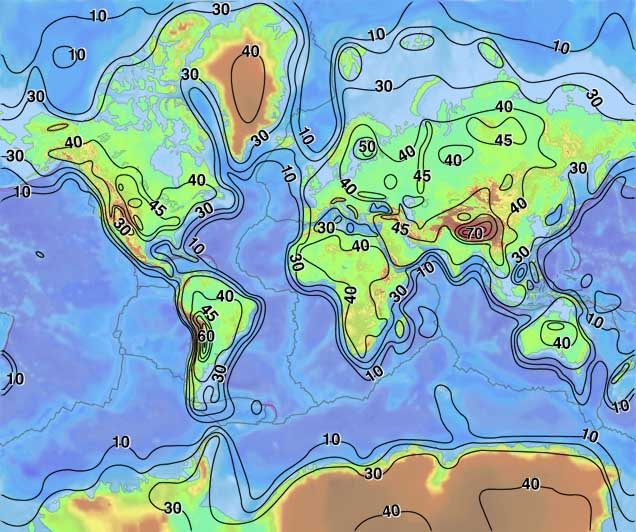
the depth to the Mohorovičić (Moho) discontinuity (in kilometers) is greater at the Blue Ridge than at the Outer Continental Shelf
Source: US Geological Survey (USGS), USGS ShakeAlert (April 26, 2019 tweet)
Most of the oceanic and continental crust that originally formed on the surface of the earth has cooled and been carried (subducted) back into the mantle over the last 4.5 billion years.
Oceanic crust in particular has been recycled regularly. It is rare to find any oceanic crust older than 200 million years, though the bottom of the Heroditus Basin in the eastern Mediterranean Sea may date back to 340 million years ago.
Continental crust, because it is lighter, resists being subducted and remelted at depth. Nonetheless, most continental crust has been subducted, melted, and re-emerged on the surface, transformed since subduction began as long as 4 billion years ago. About 35 fragments ("cratons") of the continental crust formed in the Archean eon, and now at least 2.5 billion years old, were never subducted. The Slave craton in northern Canada is oldest craton, at 4 billion years, though other cratons contain zircon grains as old as 4.4 billion years.
Zircons from the Jack Hills in Australia contain oxygen isotopes that suggest fresh water was present on the continents 4.0 billion years ago.
The rock formations in the 35 cratons have been metamorphosed by heat and pressure, but those chunks of continental crust have not melted at the edge of the mantle and been recycled into new crust. Those cratons appear to be welded to a buoyant piece of the mantle which allows them to avoid subduction in geodynamic cycles.
Today continental crust covers 41% of the Earth's surface; the rest is heavy, basalt-rich oceanic crust. Roughly 60%–70% of the current volume of light continental crust had formed by three billion years ago. However, all but 10% of that ancient crust has been recycled by subduction. Except for radioactive elements which have decayed into new forms over the last 4.6 billion years, the original elements in ancient continental crust are still present. Those elements have been re-organized into younger minerals within younger crustal bedrock.
New pieces of continental crust continue to emerge from the mantle over time. Subduction, followed by chemical/physical differentiation of minerals as magma crystallizes, converts some basalt-rich oceanic crust into new fragments of continental crust. The new fragments are relatively rich in silica and lighter elements than the original subducted oceanic basalt, gradually increasing the percentage of the Earth's surface so it is now 41% continental crust.
Younger chunks of continental crust have attached themselves to the cratons to form large continents. About 10% of ancient crust still survives as stable cratons, while subduction is consuming the edges of continents.2
Source: University of Texas at Dallas, Plate Tectonics Basics 1
The edges get pushed back into the mantle and emerge again as new fragments of continental crust. The recycling process is slow. The North American Plate has been drifting over the remains of the Farallon Plate since they collided 20 million years ago. The Farallon Plate was pushed underneath the North American Plate. The Farallon Plate slab of crust is now underneath the Mississippi River Valley as it continues to dive into the mantle. The bottom of the North American Plate there is melting and thinning, with "drips" of crust stretching down as much as 400 miles deep.3
The other fragments of crust that today includes Virginia has evolved dramatically over the last 2 billion years. Volcanoes have spewed lava onto the surface, oceans have deposited sediments, continental collisions have added clumps of land, and sediments have eroded from uplands to form new land at the edge of the waters (or underneath the water). About 600 million years ago, the core of North America (the "craton") was much smaller than today's continental plate.
Though the North American plate has grown in size, Virginia also gotten smaller at times. Continental collisions pushed rocks over each other and folded up Virginia like an accordion, pushing the Blue Ridge west and compressing the Shenandoah Valley. Throughout the entire time, erosion has carved into the land and ocean currents have carried sediments away.
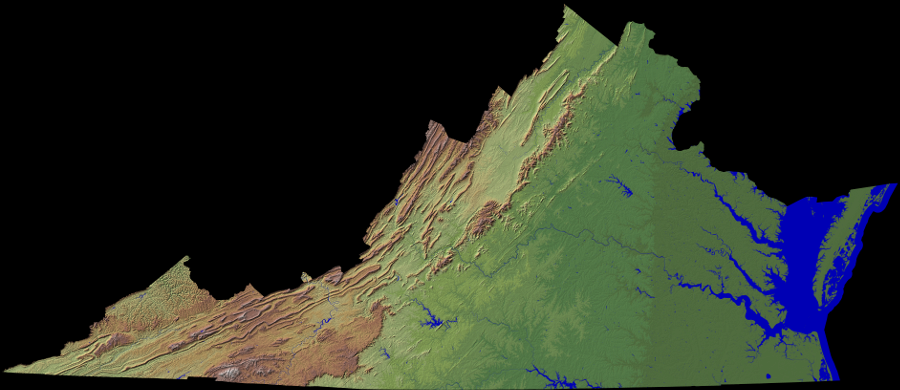
Virginia's current topography reflects over a billion years of geologic evolution
Source: USGS Earth Resources Observation and Science (EROS) Center, National Elevation Dataset - Shaded Relief Map of Virginia
That's the basic process, and it affected the entire eastern coast of North America from Maine to Florida. When all the cereal clumps were together, the North American plate (the Cheerios), plus the Taconic, Avalon, and other island arcs plus Gondwana (the Rice Krispies) formed the supercontinent Pangea. (Earlier, chunks had consolidated to form the supercontinents of Columbia/Nuna and then Rodina.)
Source: Tectonics and Earth Systems Group, 1.8 Billion Years of Plate Tectonics (going backwards in time)
The limestones in the Shenandoah Valley and the igneous rocks in the core of the Blue Ridge are part of the original clump of Cheerios. Much of the eastern third of Virginia was added later, when clumps of Rice Krispies smushed into the Cheerios. That part of Virginia east of Great Falls on the Potomac River to Danville on the North Carolina border is "Rice Krispies" bedrock, formed from slices of crust left behind after collisions of island arcs and North Africa with the old continental core (the Cheerios).
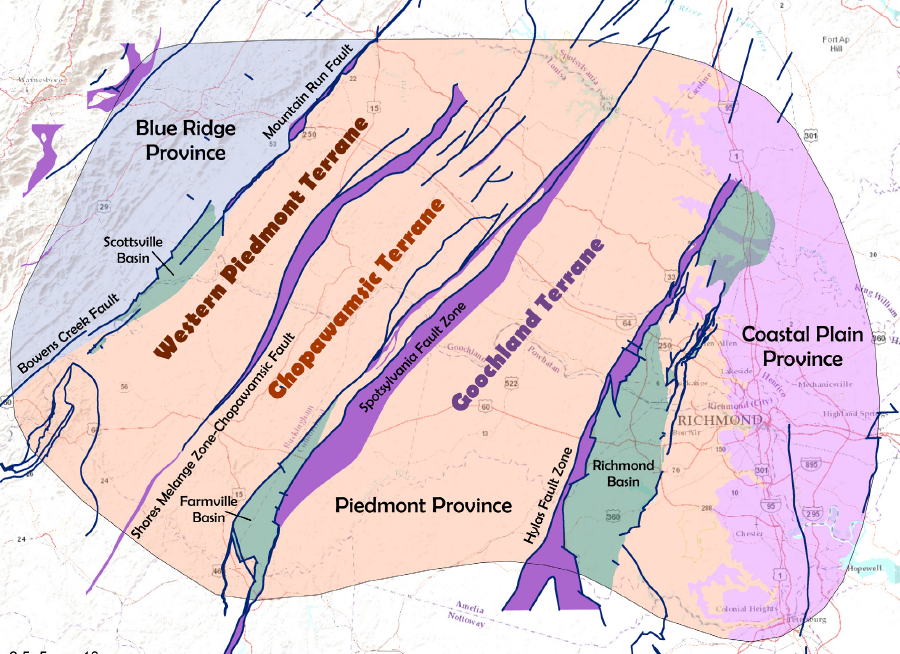
the bedrock of Virginia was assembled over the last billion years by accretion of major terranes
Source: Virginia Department of Energy, Mapping Seismic Hazards in Virginia and Seismic History of Virginia (Figure 6)
The crystalline bedrock underneath the more-recent limestone in Florida was once part of Africa. That bedrock was a component of the African plate (one of the clumps of Rice Krispies) before it smashed into the North American plate (the Cheerios) in the Alleghenian Orogeny which formed the supercontinent of Pangea. When Pangea split up and the Atlantic Ocean formed, the Florida chunk of that African plate broke off and was left behind.4
The original chunk of Cheerios is about one billion years old. It expanded gradually on the edge, as limestone deposits accumulated in the adjacent ocean, for another 600 million years. Much of central and eastern Virginia, like the Florida bedrock, has been attached to North America for only the last 300 million years.

Great North Mountain (Shenandoah County)
(Whew, did you look at all three? Long description, lots of words... and it's only a short, not-exactly-perfect abbreviated version. Considering that you covered 1.8 billion years in a few minutes, that's a pretty good compression ratio.) Now check out:
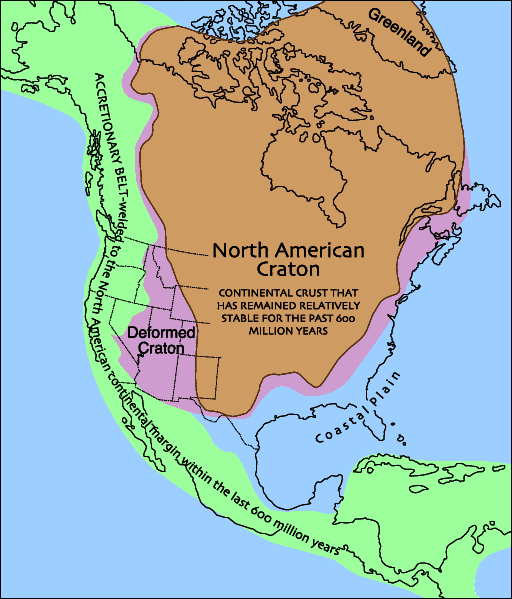
much of Virginia has been added to the core "craton" of North America over the last 600 million years, as limestone reefs grew on the continent's edge and through collisions with other tectonic plates
Source: US Geological Survey (USGS), The North American continent
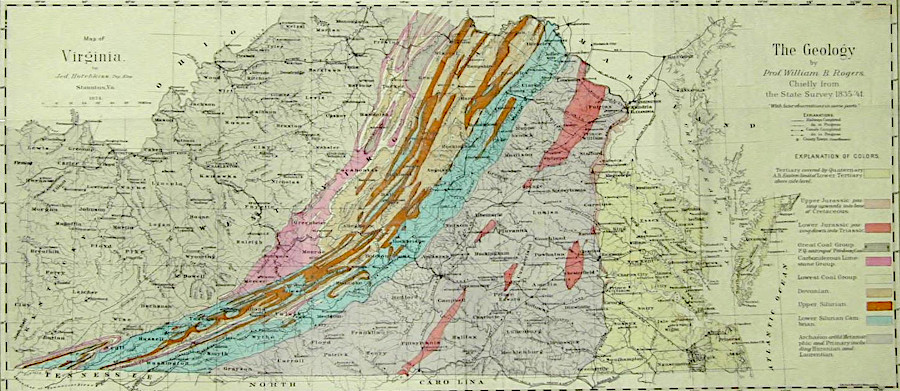
the boundaries of different geological provinces were recognized by Virginia's state geologist, William Rogers, before the Civil War
Source: Huntington Library, Map of Virginia (by Jedediah Hotchkiss, 1875)
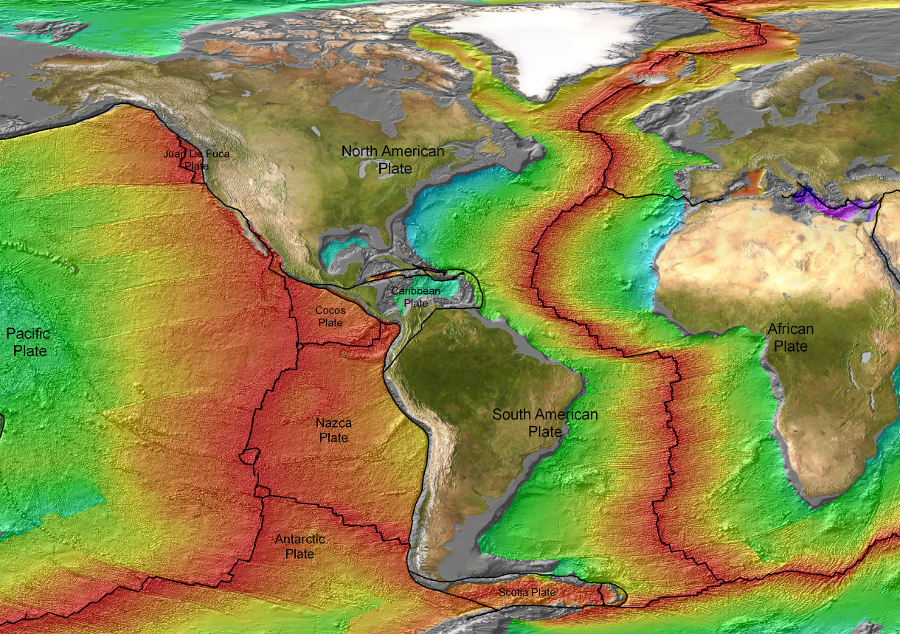
Virginia is located near the middle of the North American tectonic plate, which stretches from the Mid-Atlantic Ridge to California
Source: National Oceanic and Atmospheric Administration (NOAA), Age of the Sea Floor with Shaded Vegetation and 20my contour
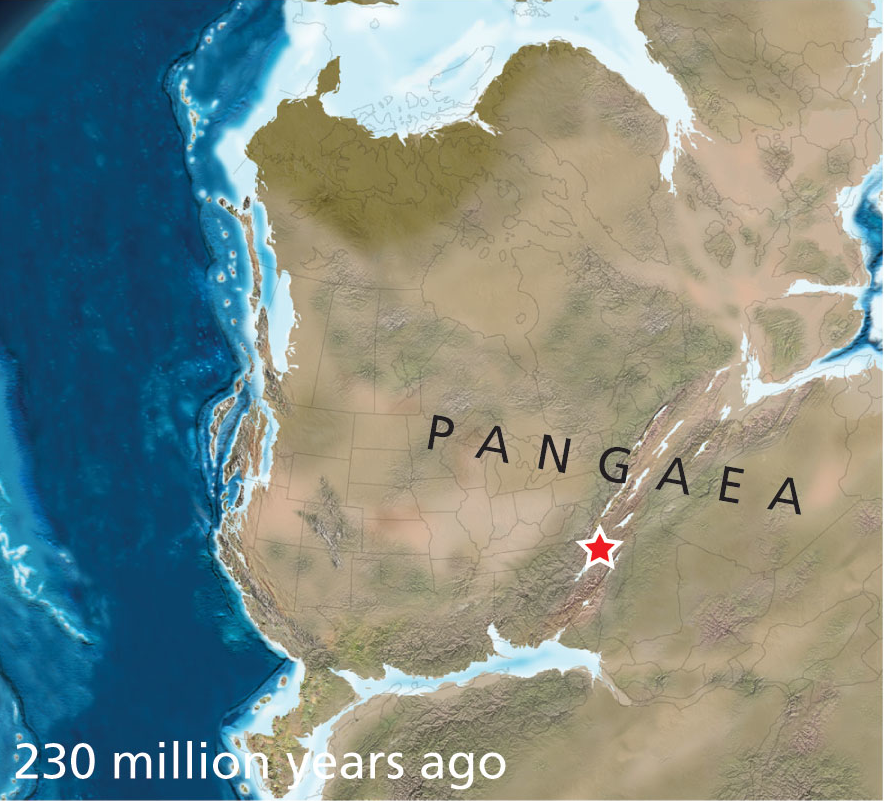
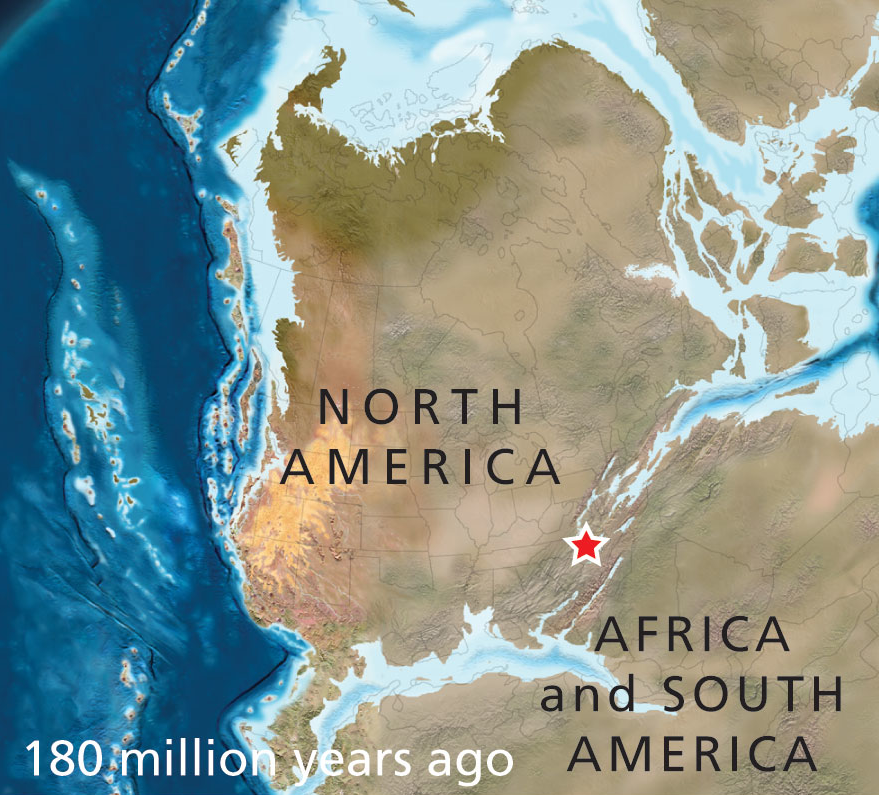
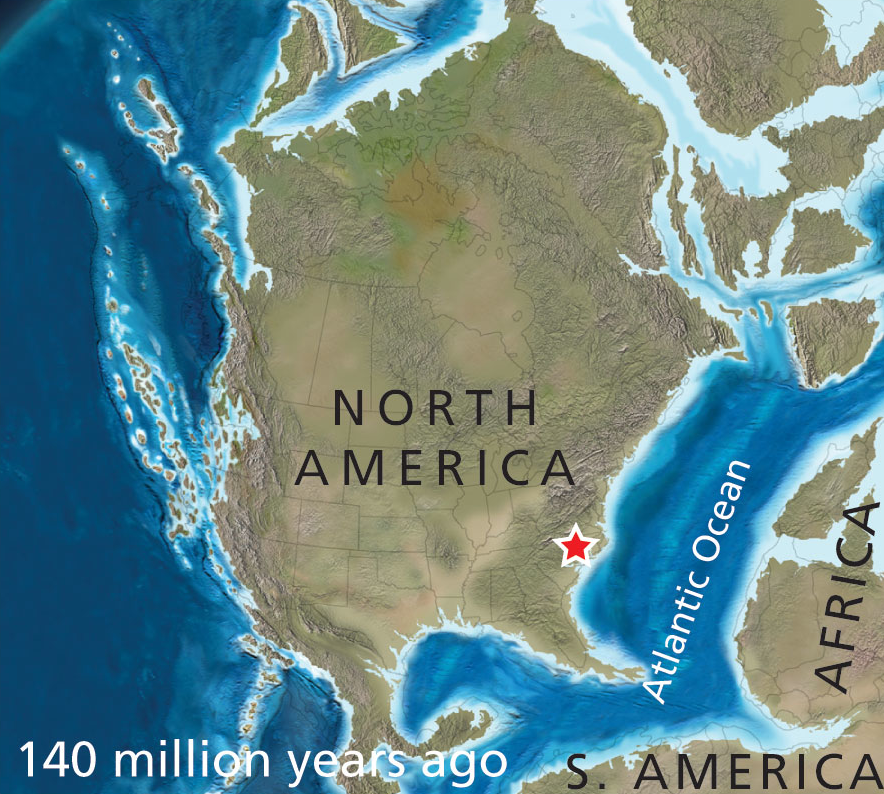
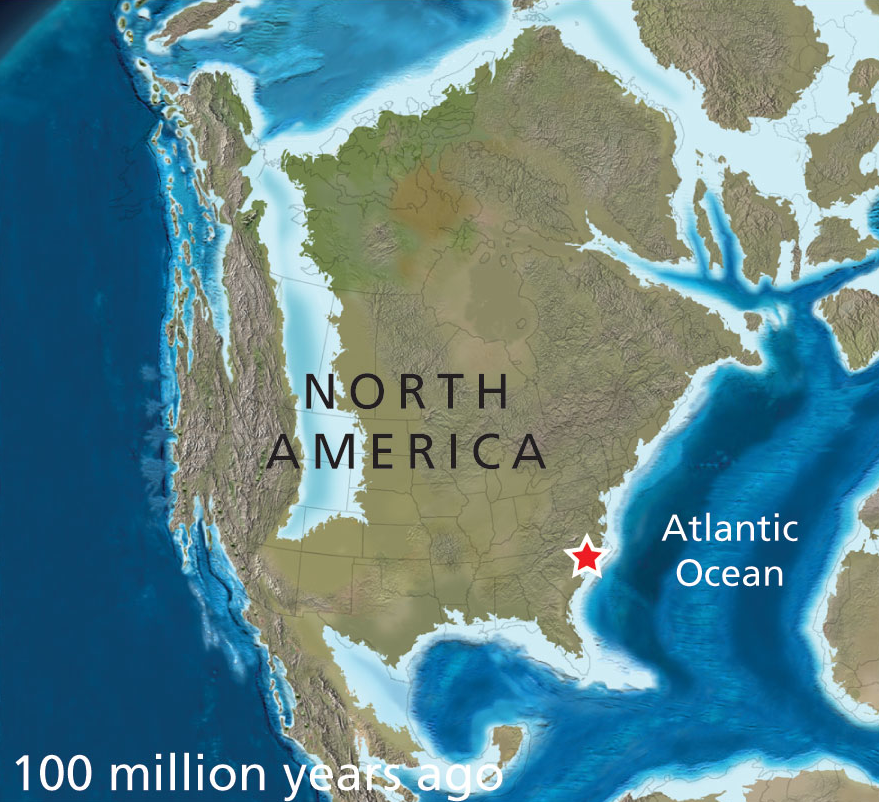
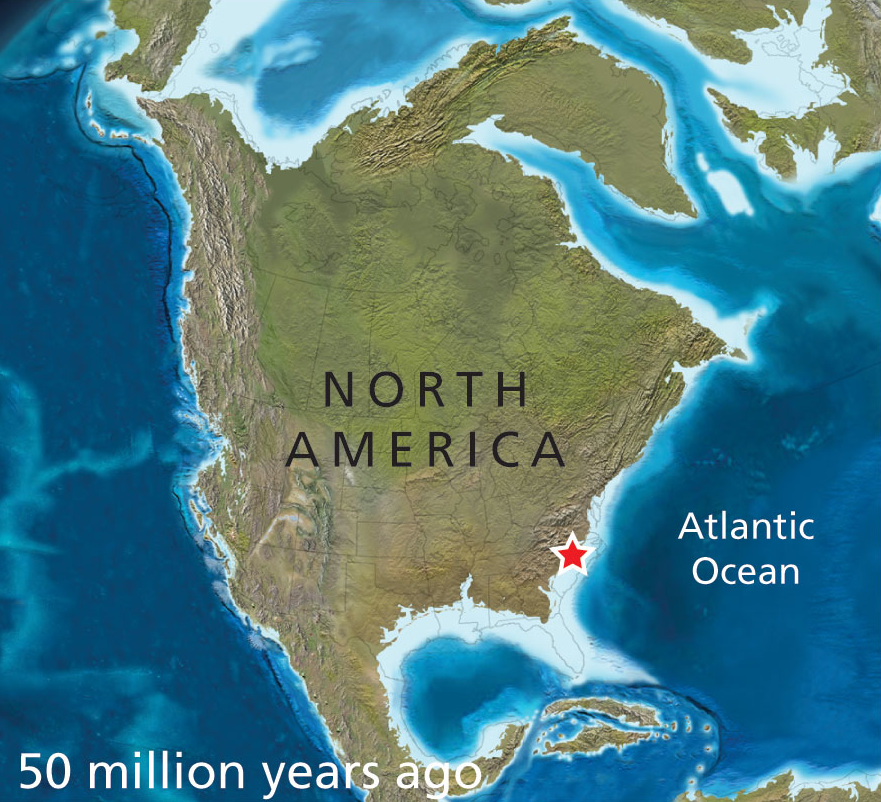
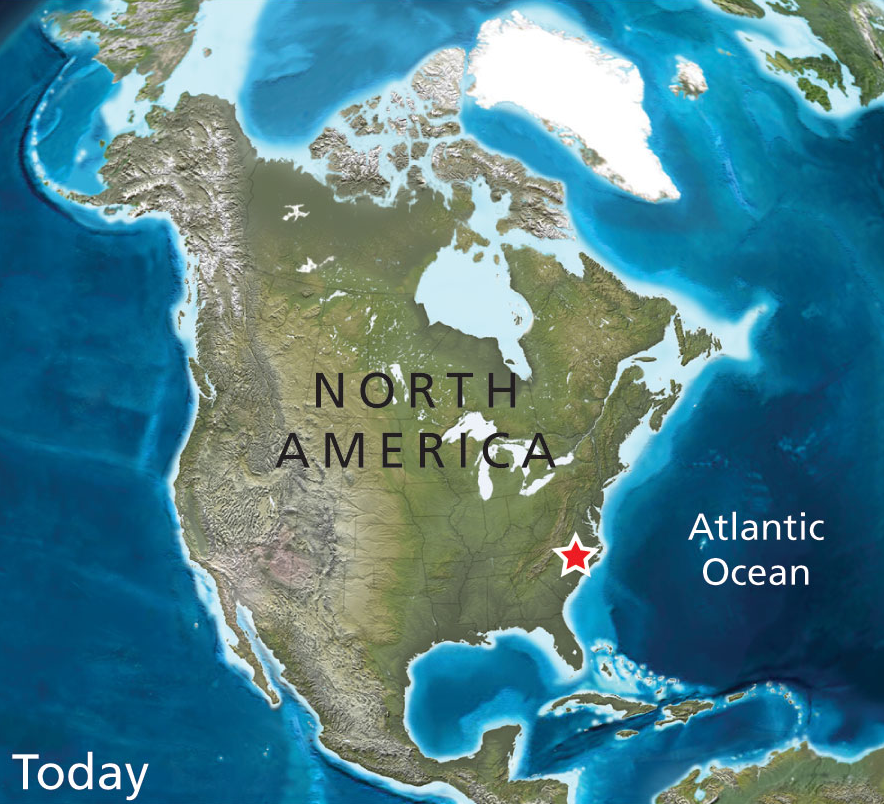
as tectonic plates moved over the last 230 million years, what is now Virginia went from the middle of Pangea to the middle of the North American Plate
Source: National Park Service, Appalachian Paleogeography: Paleozoic Era Paleogeography
