Lord Dunmore's War in 1774 gave Virginia a new level of control over the Shawnee living in the Ohio River Valley.
Shawnee towns along the Ohio River housed members of the Delaware tribe who had been forced off their traditional lands in eastern Pennsylvania. The blatant unfairness of the Walking Purchase in 1737 caused many Delaware to abandon the hopes of negotiating with the Quakers and coexisting with the settlers in Pennsylvania. The Delaware built Shannopin's Town at the Forks of the Ohio.
The two Algonquian-speaking tribes were joined by Mingoes, predominantly Iroquois-speaking members of the Seneca who migrated westward and were resistant to control of the Haudenosaunee (Iroquois) Council based at Onondaga.1
The Haudenosaunee claimed they owned the Ohio River Valley, and asserted in negotiations with the British that they spoke for the residents there. The Haudenosaunee appointed Shikellamy, living in Shamokin, to represent their interests along the Susquehanna River in Pennsylvania. Tanaghrisson, also known as Half-King, and his associate Scarroyady oversaw the Mingoes and others living along the Ohio River. Tanaghrisson settled in Logstown, located 18 miles downstream from the Forks of the Ohio.
Tanaghrisson joined George Washington in 1753 when he traveled to Fort LeBoeuf to deliver Governor's Dinwiddie warning against trespassing on British-claimed lands in the Ohio River Vally. The Half-King was also with Washington in 1754 when he brought troops to force the French away from the Forks of the Ohio. It was Tanaghrisson who sank a tomahawk into the skull of a wounded Joseph Coulon de Jumonville, killing the French ensign and sparking the French and Indian War.2
Since the Iroquois claimed they owned the land occupied by the Shawnee and refugees of various tribes who had moved away from colonial settlement, colonial officials requested that they ensure peace in the Ohio River Valley. However, the Iroquois were unable to control the western tribes.
After France was expelled from North America at the end of the French and Indian War, the British Governor General in North America Jeffrey Amherst sought to minimize costs of occupying the western lands. He had little understanding of Native American cultures, and in the name of economy ended the fundamental tradition of gift-giving to maintain relationships with the tribes. Pontiac's Rebellion was the result.
By June 1763, all British forts in the west had been overrun except forts Niagara, Detroit, and Pitt. The war ended in 1765 after the Native Americans were unable to obtain weapons and gunpowder from the French, and British officials modified their approach to dealing with Native American groups.
3
In 1774, Lord Dunmore was the royal governor and responsible for the military defense of the colony of Virginia. The Shawnee and Delaware had lost patience with British efforts to restrain unauthorized settlement. Their raids on those settlements at the western edge of the colony gave Dunmore the opportunity to unite the fractious colonists in a military response.
British officials had provided no soldiers ("Redcoats") for Dunmore to defend the colony. By 1774 military expenses in North America were being minimized after the British won the French and Indian War (Seven Years War). The French had been expelled from North America in 1763 and were no longer a military threat, and the immense debt incurred to pay for that war had to be repaid.
Attempts to economize backfired. After the English reduced subsidies for Native American tribes who were no longer needed to fight the French in an attempt, a pan-tribal war erupted in the western backcountry in 1763. Pontiac's Rebellion united tribes between the Ohio and Mississippi Rivers. They no longer had the option of enlisting the French to use diplomacy and trade to maintain a balance of power in the backcountry, so going to war was the next best alternative. The only other option was to abandon their homelands and move west.
King George III responded to the uprising attributed to Pontiac by issuing the Proclamation of 1763 in hopes of slowing westward expansion to a rate which the Native Americans would accept. The proclamation defined the western edge of authorized colonial settlement as the watershed divide between the Atlantic Ocean and the Mississippi River. All lands in the watersheds of the Ohio, Cumberland, and Tennessee rivers were reserved for the Native Americans until the British could negotiate land sales in later negotiations.
The proclamation was a temporary measure - at least as viewed by land speculators in Virginia and Pennsylvania - to ensure peace. The text issued by King George included a key qualifier (highlighted below):4
Our Privy Council, declare it to be our Royal Will and Pleasure, that no Governor or Commander in Chief in any of Our Colonies of Quebec, East Florida, or West Florida, do presume, upon any Pretence whatever, to grant Warrants of Survey, or pass any Patents for Lands beyond the Bounds of their respective Governments, as described in their Commissions; as also, that no Governor or Commander in Chief in any of Our other Colonies or Plantations in America, do presume, for the present, and until Our further Pleasure be known, to grant Warrants of Survey, or pass Patents for any Lands beyond the Heads or Sources of any of the Rivers which fall into the Atlantick Ocean from the West and North West, or upon any Lands whatever, which, not having been ceded to, or purchased by Us as aforesaid, are preserved to the said Indians, or any of them.
The 1763 paper blockade against colonial settlement helped Sir William Johnson, the Superintendent of Indian Affairs for the Northern Department, convince the tribes that settlement would be controlled. Johnson negotiated an end to Pontiac's Rebellion at the 1766 Treaty of Fort Ontario.
The 1768 Treaty of Fort Stanwix was the major negotiation to alter the edge of the reserved lands, modifying the boundary established in 1763. The Haudenosaunee (Six Nations of the Iroquois) ceded claims to all territory south of the Ohio River, as far west as the mouth of the Tennessee River.
In the eyes of the British and the Iroquois, the 1768 Treaty of Fort Stanwix legitimized the farms of most colonists who in 1763 already lived west of the boundary line or had chosen to ignore it in the last five years. In the eyes of the land speculators in the Ohio, Loyal Land, and Greenbrier companies, the treaty affirmed the legitimacy of their efforts to survey and sell western lands.
The Shawnee, Lenape/Delaware, and Mingo who lived along the Ohio River did not agree. They used the lands south of the river as hunting grounds, and received no compensation in return for the supposed right of colonists to displace them.
The representatives of those tribes had not been not allowed to speak during the negotiations at Fort Stanwix in 1768. The English and the Iroquois had claimed they were dependent tribes and the Iroquois, by right of conquest, could determine their fate. Though the Mingo were Iroquois originally, they had moved west beyond the traditional territory of the Seneca and no longer felt obliged to take direction from the Six Nations. The Delaware in eastern Pennsylvania and the Susquehanna River valley had acknowledged Iroquois supremacy, but those who moved west across the Allegheny Front felt they had escaped that control.5
The myth of George Washington includes the claim that he could not tell a lie. In reality, he was quite capable of prevarication. In a 1767 letter to George Crawford, his surveyor scouting lands along the Ohio and Kanawha rivers, he suggested filing land claims in separate actions to bypass the acreage limits that might be imposed by officials at the land office in Carlisle, Pennsylvania.
He also made clear that he was racing to survey and patent the good land even though the Proclamation of 1763 prohibited settlement:6
The other matter just now hinted at and which I proposd in my last is to join you in attempting to secure some of the most valuable Lands in the Kings part which I think may be accomplished after a while notwithst(an)ding the Proclamation that restrains it at present & prohibits the Settling of them at all for I can never look upon that Proclamation in any other light (but this I say between ourselves) than as a temporary expedien(t) to quiet the Minds of the Indians & must fall of course in a few years esp(e)cially when those Indians are consenting to our Occupying the Lands. any Person therefore who neglects the present oppertunity of hunting ou(t) good Lands & in some measure Marking & distinguishing them for their own (in order to keep others from settling them) will never regain it.
In Williamsburg, Governor Dunmore received reports of "outrages" along the western edge of the colony. Warriors from the Shawnee, Delaware, and Miami settlements (many of them mixed together) were killing unauthorized settlers. Settlers who had developed a hatred towards Native Americans did not discriminate in their retaliation, or when initiating conflicts.
On April 30, 1774, Jacob and Daniel Greathouse led other settlers in the unprovoked murder of the family of a Mingo leader named Logan. Logan blamed Michael Cresap for the Yellow Creek Massacre, but practiced collective justice in his retribution. He led war parties against multiple settlements with no direct connection to the Greathouse brothers or Cresap.
Dunmore saw the opportunity, but in 1774 most British troops in North America were stationed in New York and in Boston in respond to the destruction of tea in the December 16, 1773 Boston Tea Party. Fort Pitt had been abandoned, in an effort to reduce costs. British warships were stationed in the Chesapeake Bay, but Lord Dunmore had no Redcoats at his disposal for military action.
Dunmore could not get the House of Burgesses to authorize funding for recruiting soldiers; he had dismissed the burgesses at the start of June 1774 after they had expressed support for the port of Boston and opposition to the Coercive Acts passed by Parliament.
The royal governor used his authority to call out the militia in order to organize an attack on the Shawnee and others living downstream from Pittsburgh. He made clear that the soldiers would get, in addition to regular pay for militia service that exceeded five days, an opportunity to plunder the Shawnee.
Dunmore's goal was to force the Native Americans through military power to move westward and permit colonists to settle the lands along the Ohio River. Through conquest, Dunmore could strengthen Virginia's claims to western lands being contested by both the French and by the Pennsylvanians. Personally, Dunmore probably anticipated that he would gain wealth through his own land speculation in the Ohio River region.
His ally Dr. John Connolly at Fort Pitt actively sought to start a war with the Shawnee. By May 1774, Shawnee families whose relatives had been murdered by Cresap, Greathouse and others had killed enough settlers to satisfy their desire for retribution. Connolly chose to ignore Native American efforts to maintain peace and wrote to Governor Dunmore misrepresenting the situation. His objective was to spur an invasion by a Virginia army that would force the Shawnee, Delaware and Mingo to accept colonization and creation of new farms along the Ohio River.
Dunmore's military strategy involved sending three columns westward. Angus McDonald led 400 Frederick County militia from Fort Fincastle (now Wheeling, West Virginia) towards Wapatomica, a major Shawnee town on the Muskingum River. They burned Wakatomika and five other towns on August 3, 1774, and then returned to Fort Fincastle. The residents of the burned towns moved west, abandoning the territory.7
Andrew Lewis organized a column of 1,500 soldiers and marched westward along the Kanawha River in September. Lewis had recruited soldiers mostly from west of the Blue Ridge, including Augusta County, but he obtained veterans of the French and Indian War from Culpeper County as well.
Governor Dunmore led the third column. He returned to Fort Pitt, which he had visited in 1773, and obtained funds there from traders, needed to recruit soldiers and buy supplies. The second column marched westward from the Forks of the Ohio starting on September 23, 1774. They traveled 80 miles through the wilderness, during which Governor Dunmore gained popularity by walking and carrying a knapsack rather than riding on a horse in comfort.
Dunmore and Lewis had planned to meet at the Shawnee towns on the Scioto River. Raiding the towns would provide an opportunity for the soldiers to capture horses and obtain other plunder, while forcing the Native Americans to move westward for at least the winter of 1774-1775.
The Shawnee recognized the threat and decided to attack Andrew Lewis' column before it could unite with Dunmore's troops. Lewis reached Point Pleasant two weeks after Dunmore left Fort Pitt. Cornstalk argued against attacking there, but was overruled by other Native American leaders leading 700 Mingo, Delaware, Shawnee, Wyandot, Ottawa, and Miami warriors.
A surprise assault on the militia camp at Point Pleasant ended up being unsuccessful, because some of Lewis' men who were out hunting gave the alarm. After serious fighting, the Native Americans withdrew across the Ohio River. The Virginia militia had won the Battle of Point Pleasant without Dunmore's troops:8
...at the climactic battle - at Point Pleasant, in modern-day West Virginia - Dunmore was miles away. The frontier leader Andrew Lewis, from modern-day Roanoke County, led the victorious troops that day. It might have been Lord Dunmore's War, but it was Andrew Lewis' victory.
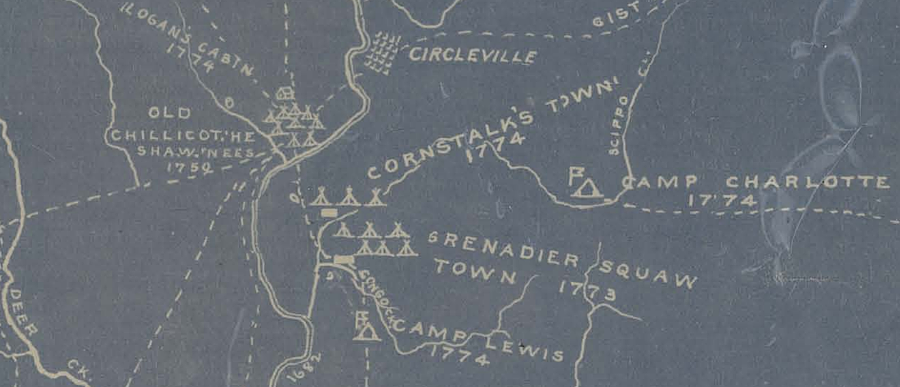
Dunmore kept marching westward and reached the edge of the Scioto River towns unmolested. He initially refused a proposal from Cornstalk to stop moving towards the main Shawnee town at Chillicothe, and his column came very close to the town before Dunmore agreed to negotiate. The governor named his last campsite Camp Charlotte, after his wife or perhaps Queen Charlotte in London.
Cornstalk chose to negotiate rather than try to engage in a suicidal fight against Dunmore's column because British officials had disrupted their efforts to recruit more Native American allies. The Superintendent for Indian Affairs for the Northern Department, William Johnson, ensured the Iroquois, Wyandot, Huron, and Ottawa nations would not support the Shawnee. The Superintendent for Indian Affairs for the Southern Department, John Stuart, did the same with the Cherokee, Choctaw, Chickasaw, and Creek nations.
The Virginians were able to win Dunmore's War because they fought just the Shawnee and their close allies, rather than a united front of Native Americans. Virginia settlements that were exposed while the militia marched towards Chilicothe were not attacked.
The initial Treaty of Camp Charlotte was concluded with Cornstalk on October 20, 1774. The Shawnee gave away their claim to Kentucky, their hunting territory south of the Ohio River stretching westward to Mississippi River. That was a loss of 40,000 square miles, roughly the size of the modern state of Virginia.
Dunmore agreed to block settlement north of Ohio River, which was already British policy based on the Proclamation of 1763. He also prevented the men in Lewis' column from plundering Chillicothe, a major reward they had expected for choosing to leave their farms in the fall and march west to fight.
The Treaty of Camp Charlotte was an interim decision. Both sides agreed to meet again in 1775 and negotiate a final conclusion to the war. As part of the deal, Governor Dunmore took four Shawnee back to Williamsburg as hostages to ensure good behavior until a final meeting. One hostage was the son of Chief Cornstalk.
Dunmore rode back to Williamsburg, while Lewis led 3,000 men to Fort Gower on Ohio River. That was largest army organized in Virginia's history, to date. At Fort Gower the soldiers received news of the Continental Congress meeting in Philadelphia. The soldiers adopted the Fort Gower Resolves, the first public call for taking up arms if necessary against royal authority. The soldiers linked their access to western lands not with Dunmore's royal power but instead with colonial military power. They valued liberty and Virginia authority, separate from British rule.
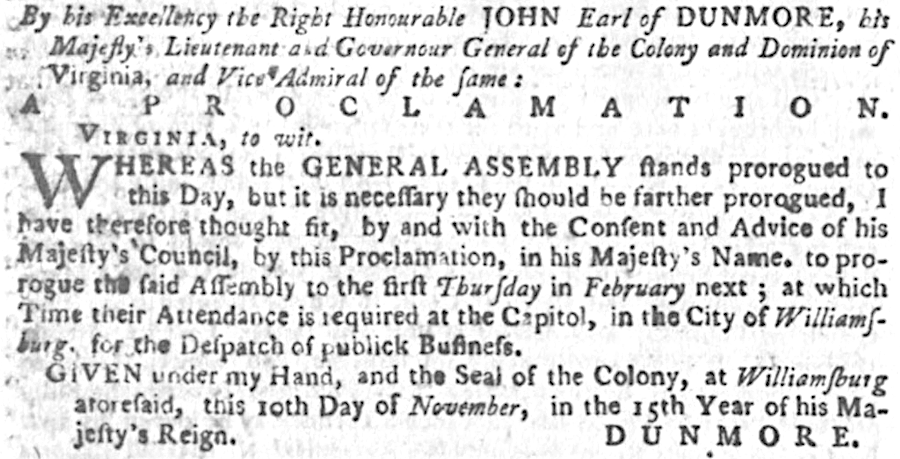
Governor Dunmore delayed the planned meeting of the General Assembly in November 1774 because he was returning from the Ohio River valley
Source: Virginia Chronicle, Virginia Gazette (November 17, 1774, p.2)
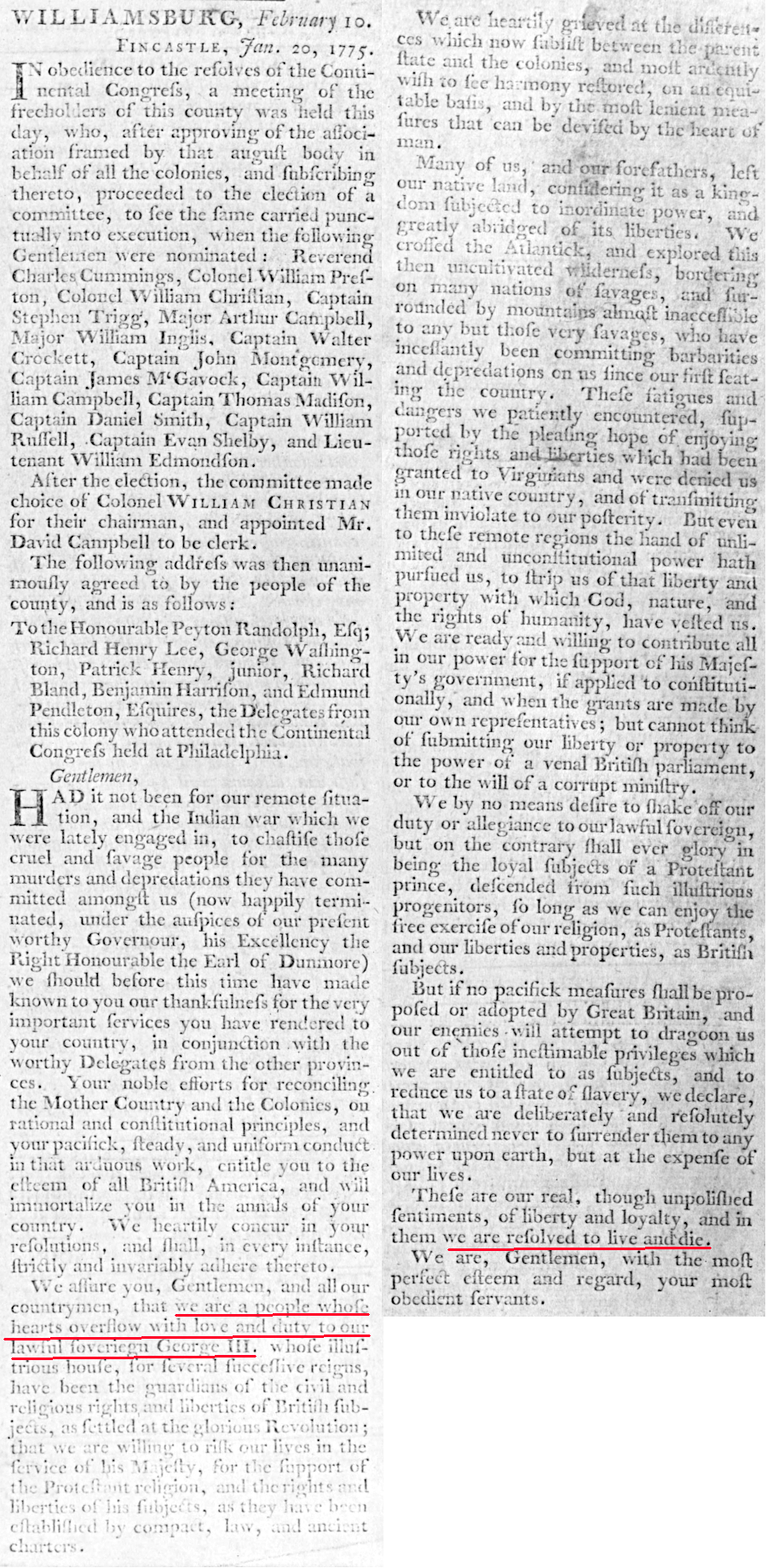
The leaders in Fincastle County adopted a bold statement on January 20, 1775, after soldiers had returned from Fort Gower, while meeting probably at McGavock's Tavern in Fort Chiswell. The Fincastle Resolutions were directed at Virginia's seven delegates in the Continental Congress. Men who had just been fighting on the Ohio River made clear that they were unwilling to accept the policies coming from London, but they were willing to fight and die if necessary in Virginia for their liberties.
leaders in Fincastle County said they were loyal to King George III, but were still "resolved to live and die" for their liberties
Source: Virginia Chronicle, Virginia Gazette (February 10, 1775, p.3))
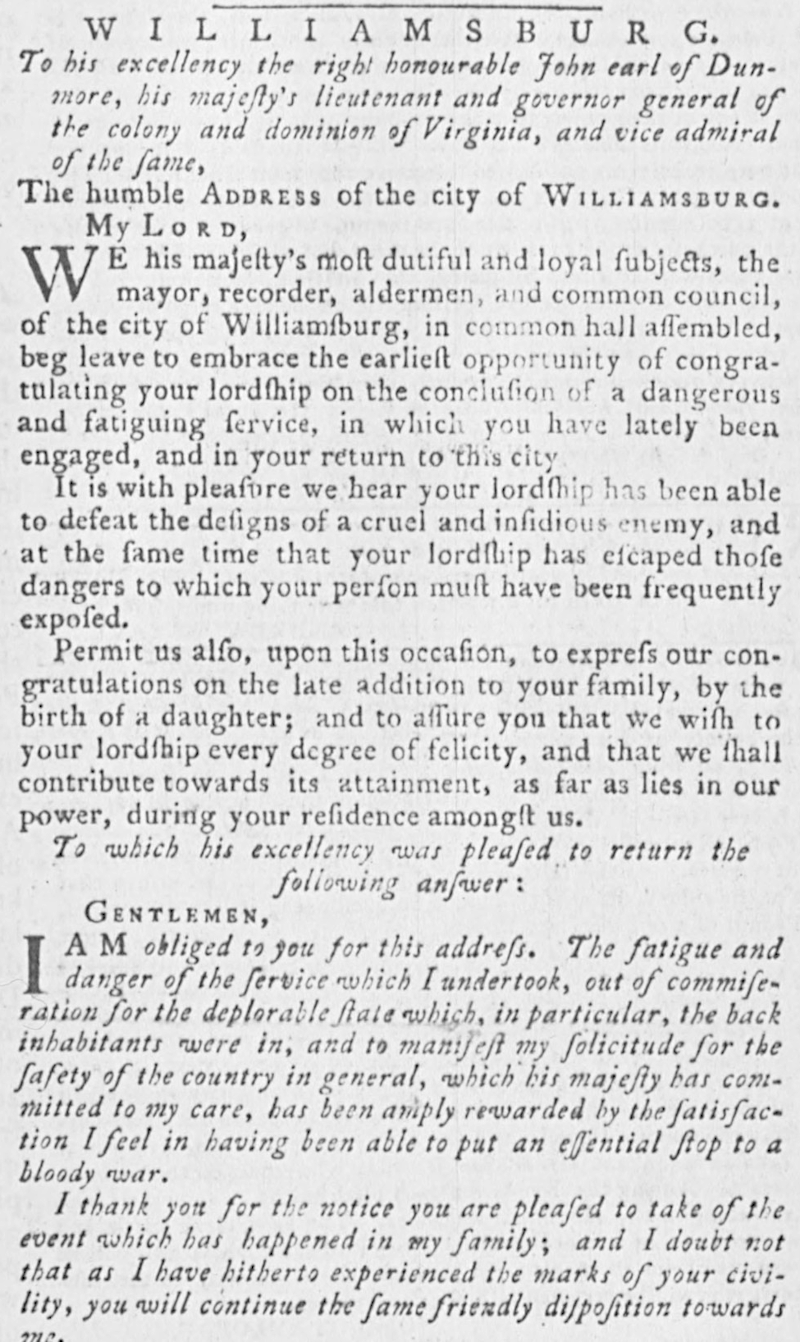
Governor Dunmore reached Williamsburg December 4, 1774. He learned that his wife Charlotte had just given birth to a baby girl a day earlier. They named their new daughter Virginia.
The four Shawnee hostages arrived in Williamsburg two weeks after the governor. They were housed at Governor's Palace and treated as guests rather than prisoners.
Lord Dartmouth in London objected to Dunmore's western expedition. He judged it to be inconsistent with efforts to make peace with tribes living west of 1763 Proclamation Line and to minimize military costs. Dunmore replied that British policy would never "restrain the Americans."
Williamsburg residents welcomed the royal governor upon his return and celebrated his victory, but he received only a very short political honeymoon. During his absence, the planned meeting of the House of Burgess was postponed and royal government was supplanted by the Virginia Convention.
County courts had stopped operating, independent militia had organized and began gathering arms, and a ban on British imports was being enforced by Committees of Safety in all counties. Supporters of Parliament and King George III were being labeled as loyalists who could not be trusted, and whose civil rights should be constrained.
Governor Dunmore chose to stay silent in public after returning from the Ohio country. He tried to walk a tightrope to avoid conflict with the burgesses and Governor's Council who were resisting royal authority. He did not pick a fight with the Virginia gentry, in part because he had no British troops or control over county militia to force compliance with any of his orders. He was able to use his authority to release Cornstalk's son early from his role as a hostage. He returned to the Shawnee-controlled territory west of the Ohio River.
Governor Dunmore also was planning to live in Virginia and establish his family wealth based on land grants in the colony. Since arriving in 1771 he had accumulated several plantations, working them with indentured servants and over 50 enslaved workers. Lord Dunmore was an earl, but he had more of an economic future in Virginia than in Scotland or England.
He was eventually forced to confront the Virginia leaders and assert royal authority. On the night of June 8-9, 1775, Governor Dunmore took his family from the Governor's Palace and fled to a British warship anchored off Yorktown. After that, the last three Shawnee hostages fled back home.9
Completing the Treaty of Camp Charlotte negotiations in 1775, at which the hostages were to be returned, was challenging. Dr. John Connolly had been designated as the governor's representatives to meet with the Shawnee delegation at Pittsburgh. However, Connolly had been embroiled in the conflict between Pennsylvania and Virginia over the western boundary of Pennsylvania. He had organized a Virginia militia for the District of West Augusta at Pittsburgh and arrested judges of the Westmoreland County court, in order to block Pennsylvania from collecting taxes or issuing land titles.
When members of tribes in the Ohio River Valley arrived at Pittsburgh in June 1775, Westmoreland County officials had arrested Connolly. The Virginians were finally able to have him released. Connolly concluded a deal finalizing the Treaty of Camp Charlotte between July 3-6 and the colonial hostages held by the Native Americans were released. The Shawnee were not at the table, but the other tribal representatives were satisfied.10
After concluding the negotiations with the Delaware and Mingo, Connolly traveled back to Virginia. He sought Lord Dunmore's support for recruiting a Native American army to attack the western edge of Virginia and undo the Treaty of Camp Charlotte. While in Fredericksburg, he attracted suspicion but managed to elude followers and get to Gosport on August 8. There he and Governor Dunmore developed a plan to enlist Native Americans, French, and any others that Connolly could "engage by pecuniary rewards or otherwise" in Pittsburgh.11
Connolly's army would cross the Appalachians and attack down the Potomac River Valley. Loyalists in that attacking force would get a bounty of 300 acres - perhaps from lands that would be seized from Virginia traitors, once their rebellion was suppressed. Connolly and Dunmore prepared a letter to Koquethagechton (Chief White Eyes), leader of the Delawares, promising to block whites from expanding westward.
Connolly sailed to Boston to request that General Gage launch a diversionary attack in Massachusetts to facilitate an invasion of Virginia from the west. When they met on September 11, Gage supported opening a western front in part because it would divert rebel troops headed up the Hudson River/Lake Champlain to capture Montreal and Quebec.
The Connolly Plot failed when he was captured while trying to travel through the Potomac River Valley to Pittsburgh. He was seized by militia sent to Philadelphia and imprisoned until being paroled in 1780. Connolly was finally exchanged and managed to join Cornwallis in Yorktown. He passed through the British lines and was recaptured before the British army surrendered and ended up a prisoner of war until 1782.
Dunmore spent the first half of 1776 trapped on a warship. It was one of nearly 100 ships in his "floating town" on the Elizabeth River, after Norfolk was burned to the ground at the start of 1776. When the Virginia militia threatened to send fireships into the fleet, the royal governor sailed to Gwynn's Island. Andrew Lewis, the leader at the Battle of Point Pleasant, organized the militia response there.
Lewis's cannon began firing from a slight rise known as Cricket Hill on July 9. A cannonball which struck Dunmore's ship sent splinters into his leg. There was no wind, but the tide and rowboats finally moved Dunmore's ship out of range. The British quickly fled the island. They left behind many of the enslaved men who had joined the Ethiopian Regiment, but were ill from smallpox.
The British ships sailed around the Chesapeake Bay until it became clear Dunmore would not receive reinforcements. The fleet finally split up in August 1776. Some ships, including one with Dunmore's family, sailed to England. Other ships went to St. Augustine (Florida), New York City and Halifax (Nova Scotia).
Dunmore's warfighting in Virginia ended when his ship sailed out of the Chesapeake Bay and went to New York.12
Governor Dunmore was warmly welcomed in Williamsburg upon his return in December 1774 from Camp Charlotte near Chillicothe, Ohio
Source: Virginia Chronicle, Virginia Gazette (December 8, 1774, p.3)