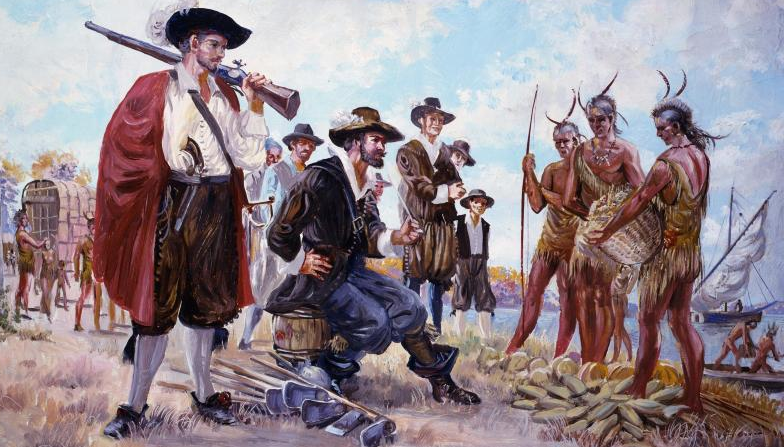
leadership at Jamestown was often ineffective, but John Smith (sitting on barrel) is credited with savvy negotiations with Powhatan and leaders of other tribes to obtain essential food
Source: National Park Service, John Smith Trading With the Indians
John Smith was an adventurer who arrived Virginia in April, 1607. At the time, he was 27 years old, the son of farmers who had chosen to seek a life of international adventure over the routine of farm life. He had run away from his apprenticeship and served as a soldier in an Austrian army. In Transylvania, he earned his right to a coat of arms after beheading three Turkish soldiers in one-on-one contests.
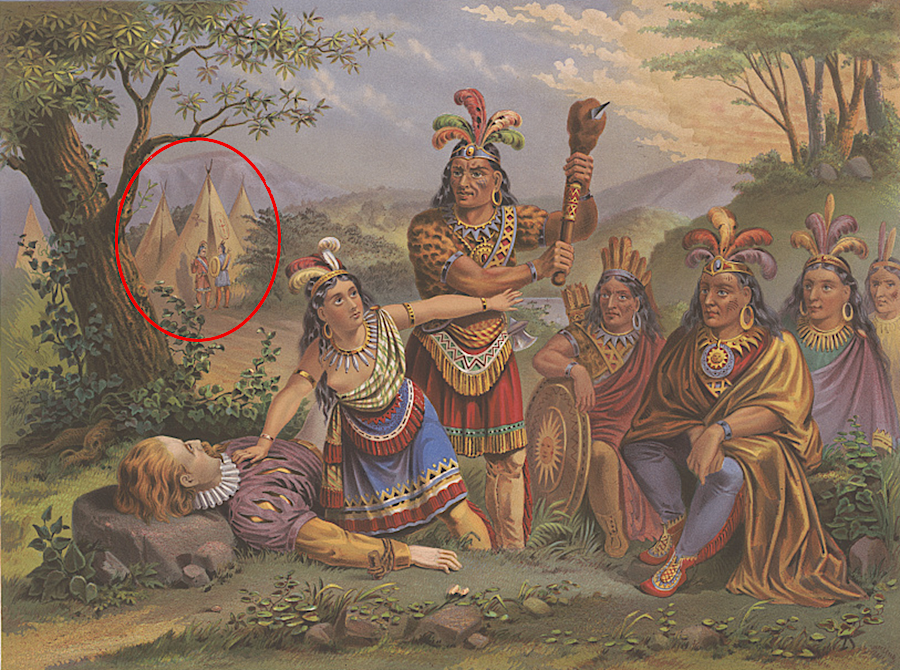
Smith spent 30 months in Virginia and returned to England (after an accident/assassination attempt) in October, 1609. In those two-and-a-half years, Smith was both a thorn in the sides of the Jamestown officials and the prime leader of the colony. Other leaders in the colony sought to execute Smith twice, once on the journey before the Susan Constant, Godspeed, and Discovery had arrived at the Chesapeake Bay. If you believe a story written by John Smith years after the incident, Powhatan was prepared to execute Smith until Pocahontas saved his life.
John Smith's claim of a rescue has been portrayed in many historically-incorrect ways, including Great Plains tipis from west of the Mississippi River
Source: Library of Congress, Pocahontas saving the life of Capt. John Smith (New England Chromo. Lith. Co, 1870)
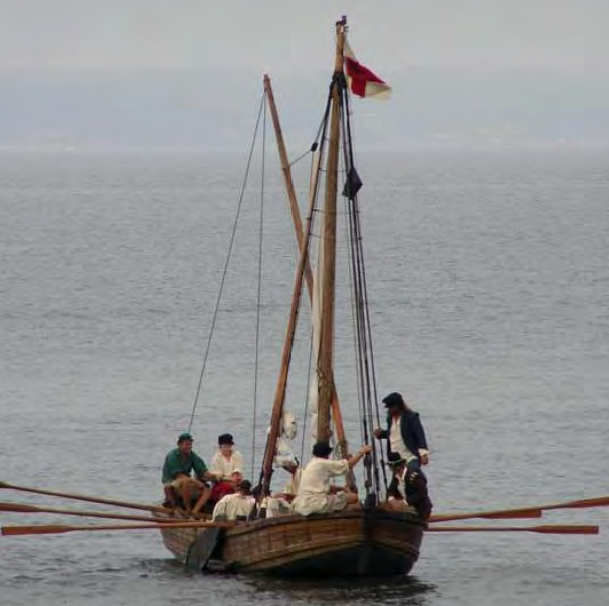
John Smith may have hoped to become rich by "venturing his person" to the New World, but his true love seems to have been exploration (perhaps stimulated by conversations with Richard Hakluyt). John Smith explored the James River and its tributaries, as did others in the colonial settlement. What makes him unique is a pair of journeys in 1608 in a 30-foot open boat (known as a "shallop") that could be sailed as well as rowed.
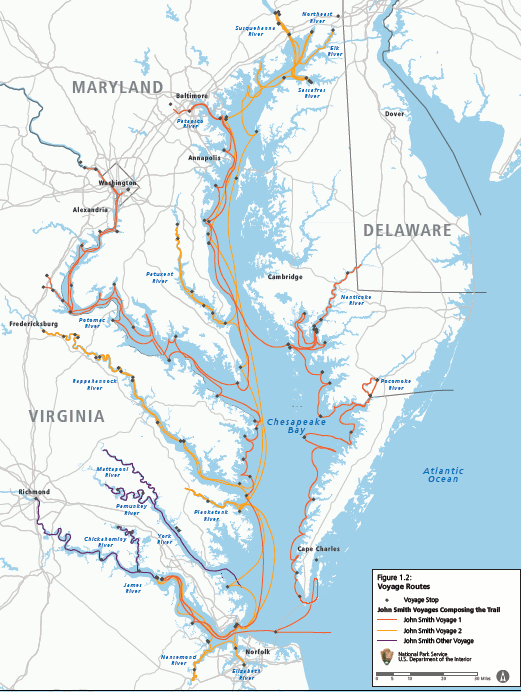
Smith led expeditions that mapped the shape of the Chesapeake Bay, and determined that the Susquehanna/Potomac/Rappahannock/James rivers did not provide the long-sought Northwest Passage to the Pacific Ocean. He appears to have stopped 150 times on the two trips, traveling with 14 men on the June 2-July 21 trip and with 12 men on the July 24-September 7 trip.1
He sent a map back to England in 1608. Spies working for the Spanish ambassador Don Pedro Zuniga Marquise de Villa Flores obtained a copy; fortunately for later geographers and historians, a version of Smith's original map survived in the Spanish government archives.
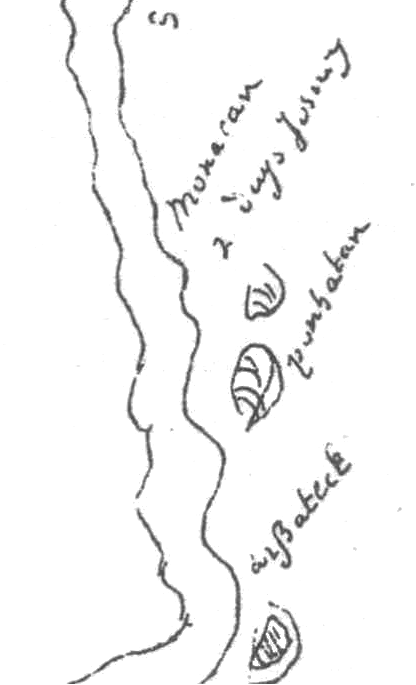
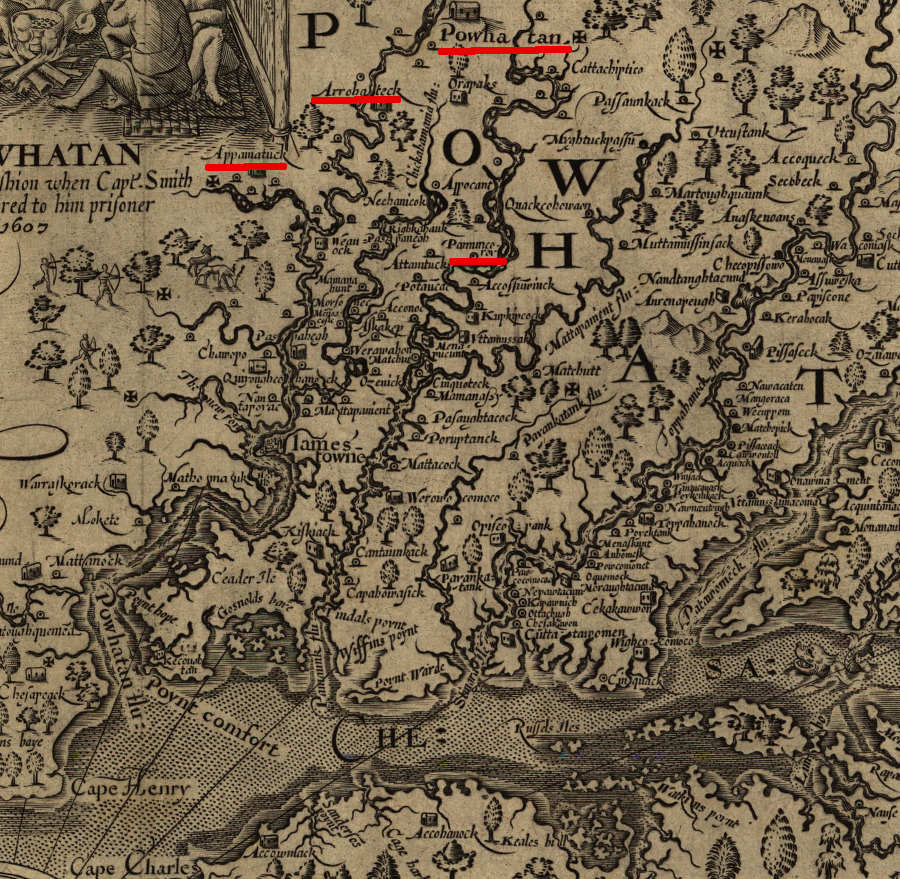
location of Parahunt's town of Powhatan (site of modern-day Richmond) on Zuniga version of John Smith's map (with "Monacan two days journey" identified to the west)
Source: she-philosopher.com, The "Zuniga Chart" of Virginia, 1608
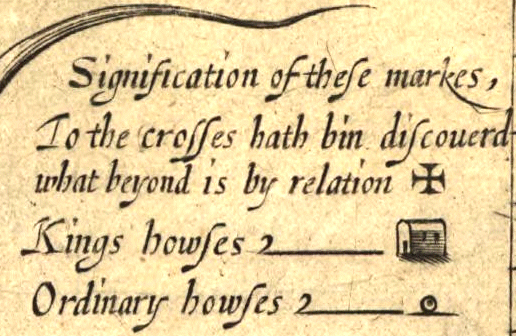
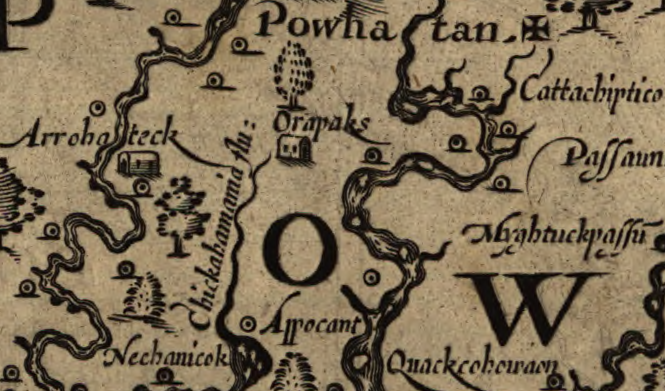
On his map of Virginia, Smith used a Maltese cross to identify the extent to which he had personal knowledge of the territory, marking the location where he saw the houses ("howfes") of chiefs ("kings") and ordinary people. Smith used a specific symbol to show the locations of the key towns with "werowances," or chiefs with the power to assemble warriors.
Based on Smith's map, we know that Parahunt (a brother of Powhatan) occupied the town of Powhatan at the falls of the James River. That site, the birthplace of Powhatan, is now Tree Hill farm.
John Smith's map did not show towns for two of the original six tribes over which Powhatan inherited control - Youghtannund and Mattaponi
Source: Library of Congress, Virginia (by John Smith, 1624)
Developers have planned to build a new urban community there, with 2,770 residences and over 1 million square feet of commercial space. They planned to preserve a location where archeology indicates the town was once located.2
location of Parahunt's town at the falls of the James River ("Powhatan flu[vial]")
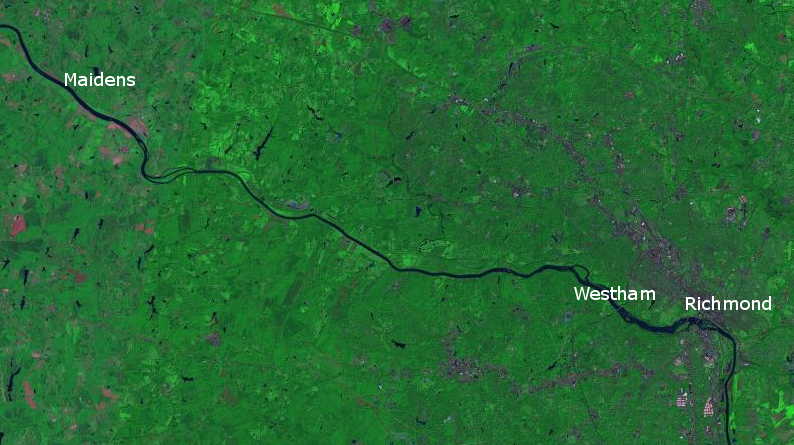
A close examination of Smith's map suggests that he traveled beyond the falls of the James to at least modern-day Westham, and perhaps as far as modern-day Maidens in Goochland County.
John Smith explored beyond the Fall Line in person
Map Source: US Geological Survey (USGS), The National Map
He explored the Chickahominy River to its headwaters and the Pamunkey River up to the Fall Line. Smith may have walked around the location of the modern-day amusement park at Kings Dominion near Ashland.
While in Virginia between 1607-1609, Smith established relations with numerous Tidewater tribes and even a few tribes based in the Piedmont. He was an effective diplomat with both the Algonquians who owed allegiance to Powhatan, and with tribes who spoke Siouan dialects and were enemies of the 30+ tribes controlled by Powhatan. Smith negotiated the exchange with those tribes of prestige goods/tools/weapons for food. In Jamestown, he provided enough discipline (as well as food) to keep many of the colonists alive.
Smith was an assertive leader, at a time when that approach was required. When the English started to build Jamestown, there were 104 colonists. By September 10, 1607, 46 had died and they were down to 58 living colonists. When Smith returned at the start of 1608 from his captivity, after being "adopted" by Powhatan, only 38 men were still alive.3
The Second Supply and then some of the ships from the Third Supply brought new men, but many lacked the skills and manual labor experience needed in a place so far from London. John Smith provided the disciplined leadership to keep the colony as a viable venture.
However, Smith's reputation among the London Company officials in England suffered from complaints about his behavior. Smith was not a "good news" manager. He sent complaints back to the investors about the quality and quantity of resources shipped to the colony. He lived under tough conditions, and he wrote in blunt rather than diplomatic language.
Worse, ships that returned from Jamestown to London brought back no gold. The investors were inclined to blame their employees in Virginia, rather than believe Virginia lacked treasure equivalent to what the Spanish had discovered in Central and Southern America.
Many of the new colonists shipped to Virginia in the First, Second, and Third Supply expeditions resisted Smith's requirements that anyone who wanted to eat would have to work, which involved hard physical labor. In September 1609, Smith was wounded while returning from a failed effort to improve the settlement at what is now Richmond. A random spark or a fellow Englishman set fire to the bag of gunpowder that hung from Smith's waist while he slept in the boat.
The incident could have been an accident while the fellow colonist was striking a spark to light some tobacco, or it could have been a purposeful attack. Smith jumped overboard and extinguished his burning clothing, and suffered serious burns to his skin.
The wounded Smith recovered slowly in Jamestown, and was unable to serve effectively on the council. He sailed back to England in October, 1609, and was never able to return to Virginia. His later writings reflect his personal ego, and his frustrations with fellow colonial leaders and the London Company directors, as well as his knowledge of the colony and the geography of Virginia.
In 1614, after realizing he could not get the London Company to send him back to Virginia as governor, he explored "Northern Virginia" - far north of the Virginia colony, up where the Plymouth company had tried to establish the Sagadahoc colony at the mouth of the Kennebec River. Along the coast off Nova Scotia, Smith's expedition caught fish while he mapped the shoreline. He named the region "New England" and honored the younger son of King James by naming "The River Charles" at what later became Boston.
Smith made his investors wealthy from that trip to New England, but his focus was on discovering new lands and new people. A later expedition to New England ended disastrously when he was captured by pirates. While trapped as a prisoner, he started to write A Description of New England. When Smith escaped from the pirate ship, he chose to bring the manuscript with him - a clue about his commitment to publishing his geographical discoveries.
John Smith took two journeys by water to map the Chesapeake Bay
Source: National Park Service - Captain John Smith Chesapeake National Historic Trail,
Draft Comprehensive Management Plan and Environmental Assessment (September 2010) - Summary and Chapter 1
The Travels of Captaine John Smith in Two Volumes: The Generall Historie of Virginia, New England & The Summer Isles [published 1624]; Together with The True Travels, Adventures and Observations [published 1630], and A Sea Grammar [published 1627] - Volume I and Volume II
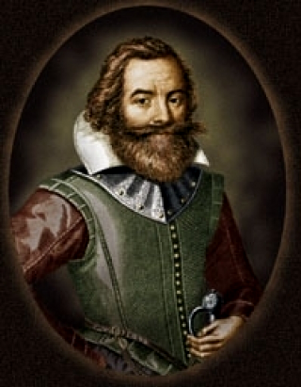
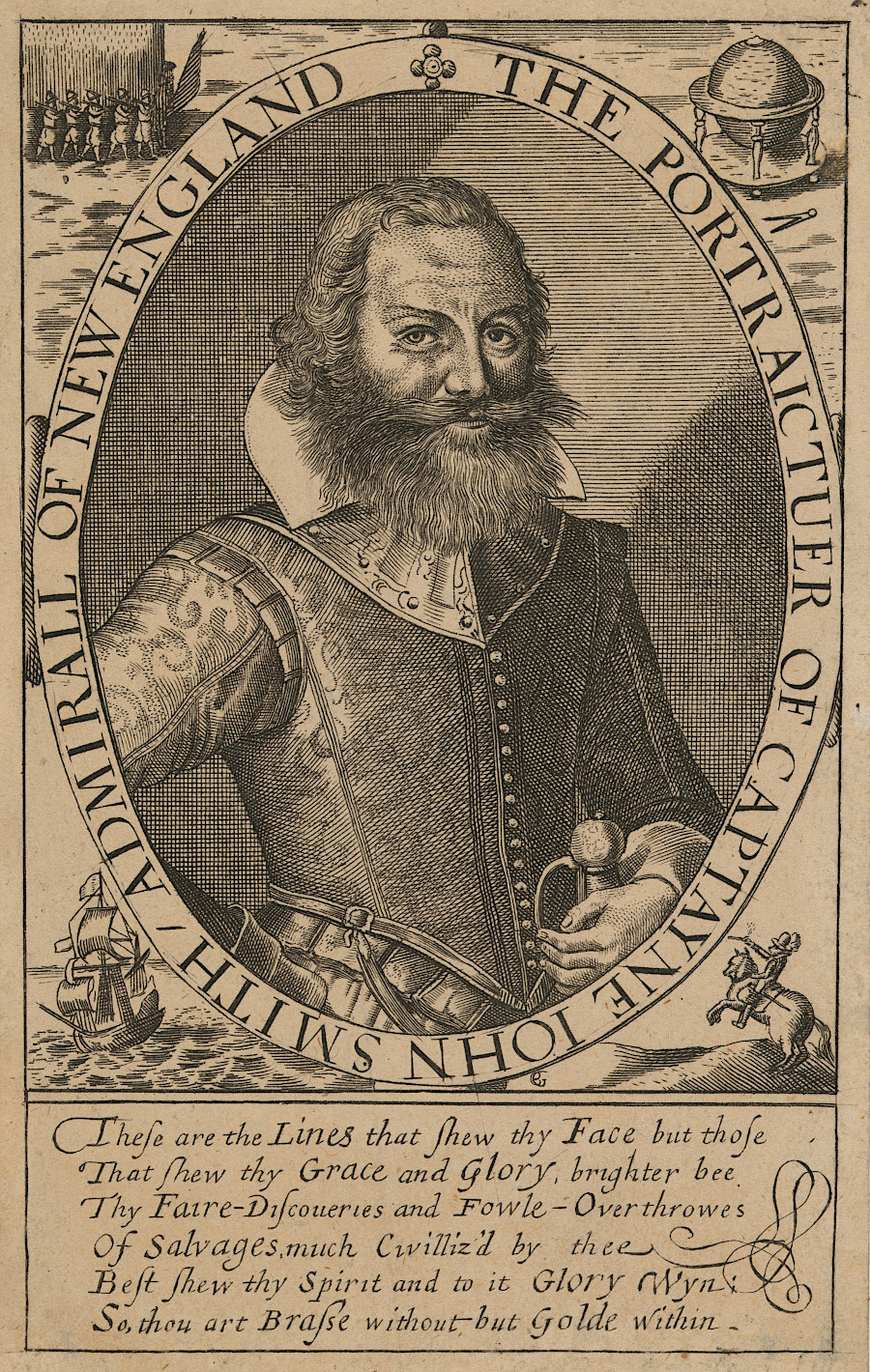
John Smith was in Virginia between 1607-1609
Source: Smithsonian Institution, National Portrait Gallery, John Smith
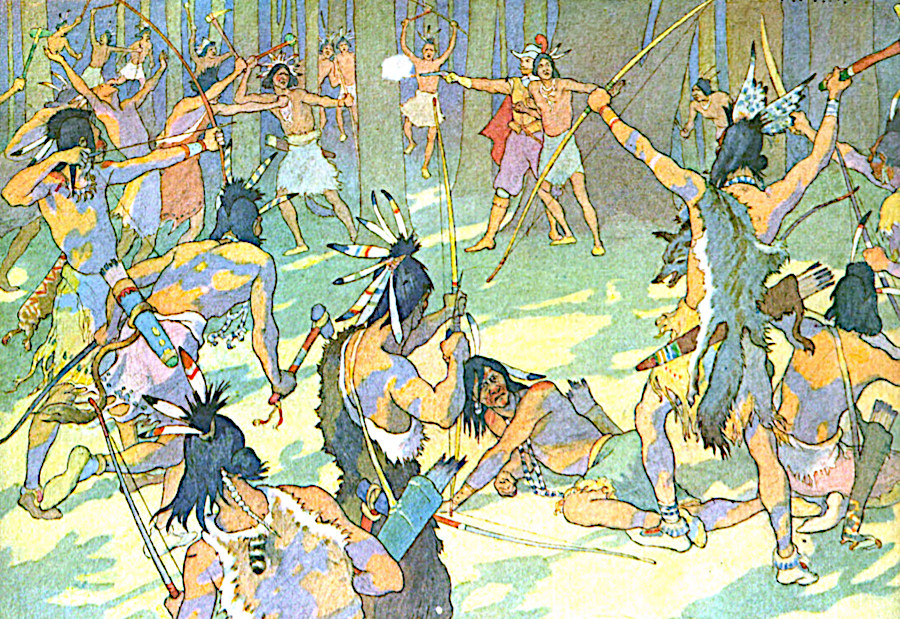
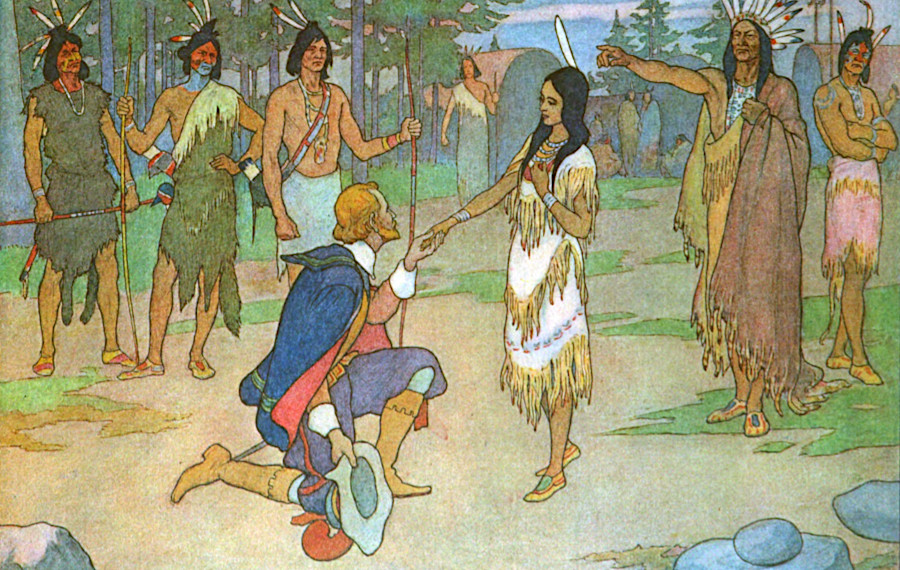
in these drawings of Smith being captured and released after intervention by Pocahontas, the Native Americans are costumed like Plains Indians
Source: Elmer Boyd Smith, The Story of Pocahontas and Captain John Smith (1906)

![location of Parahunt's town at the falls of the James River - Powhatan flu[vial]](graphics/smithmap1.gif)